<home # start here # guides # builds # services # shop # about # categories>
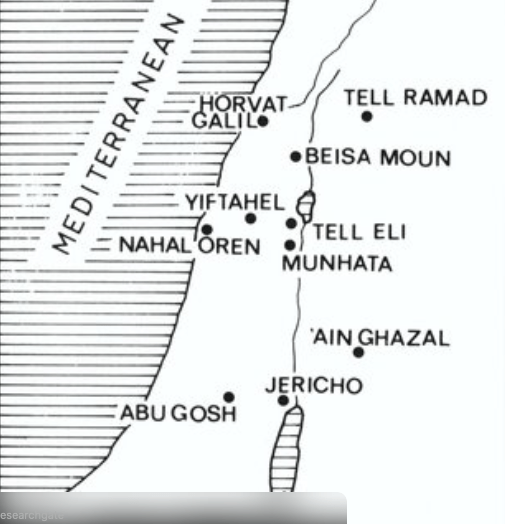
Yiftahel was excavated in the 1980s–1990s and has given archaeologists a very clear picture of the PPNA to PPNB transition, roughly 10,000–8,500 years ago.
Setting Located on a low hill in the Lower Galilee, between the Jezreel Valley and the Nazareth hills
A well-watered, fertile zone in the early Holocene, was attractive for both farming and hunting.
The site sits in an ecotone where Mediterranean woodland met open valleys, offering diverse resources.
Chronology: Occupied from the PPNA (ca. 9500–9000 BCE) through more commonly excavated Early–Middle PPNB (ca. 8500–8000 BCE).
One of the few sites in Israel where both round (PPNA-style) and later rectilinear (PPNB-style) houses were found in sequence, showing the architectural shift over time.

Architecture
PPNA phase: Round or oval pit-dwellings, partly dug into the ground, with stone foundations and brush/mud superstructures.
PPNB phase: Rectilinear, multi-room stone-built houses, with plastered or tamped-earth floors.
The transition shows the move from more temporary, circular shelters to more permanent, rectilinear household compounds.
The economy included early use of wild cereals and pulses (e.g., wild emmer wheat, lentils) and exploitation of oak–pistachio woodland. Later evidence for the domestication of goats and sheep (herding begins in the PPNB).
Flint sickle blades, grinding stones, and storage features show commitment to plant cultivation. And, hunting of gazelle, deer, and smaller game continued alongside herding.
They became a material culture
With flint tools, abundant arrowheads, sickle blades, and naviform cores, typical of the PPNB. And, beads and ornaments made of stone and shell.
Like many Neolithic sites, burials were found beneath house floors.

Yiftaḥel is one of the best-documented sites for the PPNA–PPNB transition in the Galilee. It shows how small pit-house hamlets evolved into permanent farming villages with rectangular architecture. The site provides strong evidence for the early stages of animal domestication in northern Israel. And, it links the Galilee into the broader Neolithic “core zone” that included the Jordan Valley and southern Levant. It is a key site for understanding how Levantine communities transitioned.
Bibliography: Wikipedia contributors. Yiftahel. Wikipedia. https://en.wikipedia.org/wiki/Yiftahel
Slon, Viviane & Sarig, Rachel & Hershkovitz, Israel & Khalaily, Hamoudi & Milevski, Ianir. (2014). The Plastered Skulls from the Pre-Pottery Neolithic B Site of Yiftahel (Israel) – A Computed Tomography-Based Analysis. PloS one. 9. e89242. 10.1371/journal.pone.0089242.
Milevski, I. Recent Excavations at the Neolithic Site of Yiftahel(Khalet Khalladyiah), Lower Galilee.
R. Malinowski and Y. Garfinkel. 1990, Prehistory of Concrete. Concrete International 13/3: 62–68.
Y. Garfinkel. 1987. Yiftahel: A Neolithic Village from the Seventh Millennium B.C. in Lower Galilee, Israel. Journal of Field Archaeology 14: 199–212.
Y. Garfinkel. 1987. Bead Manufacture at the Pre-Pottery Neolithic B Site of Yiftahel. Mitekufat Haeven – Journal of the Israel Prehistoric Society 20: 79–90.
Y. Garfinkel. 1987. Burnt Lime Products and Social Implications in the Pre-Pottery Neolithic B Villages of the Near East. Paléorient 13/1: 68–75.
Y. Garfinkel, I. Carmi and J.C. Vogel. 1987. Dating of Horsebean and Lentil Seeds from the Pre-Pottery Neolithic B Village of Yiftahel. Israel Exploration Journal 37: 40–42.
Y. Garfinkel. and L.K. Horwitz. 1988. The Pre-Pottery Neolithic B Bone Industry of Yiftahel. Paléorient 14/1: 73–86
Leave a Reply