<home # start here # guides # builds # services # shop # about # categories>
Among the most remarkable discoveries of the Neolithic world are the life-sized human statues found at Ain Ghazal. Created between approximately 7200 and 6500 BCE, these plaster figures are among the earliest known large-scale representations of the human form in history.
For hundreds of thousands of years, humans created tools, shelters, and symbolic objects. Yet at some point during the Neolithic period, people began producing large human images that appear to represent ancestors, spirits, social identities, or perhaps humanity itself.
The statues of Ain Ghazal raise an important question: what psychological change encouraged people to represent themselves on such a scale? Were these figures religious objects, memorials, social symbols, or evidence of a deeper transformation in human self-awareness?
While definitive answers remain elusive, the statues provide a rare window into the emergence of complex symbolic thought during one of humanity’s most important transitions.
The Settlement of Ain Ghazal
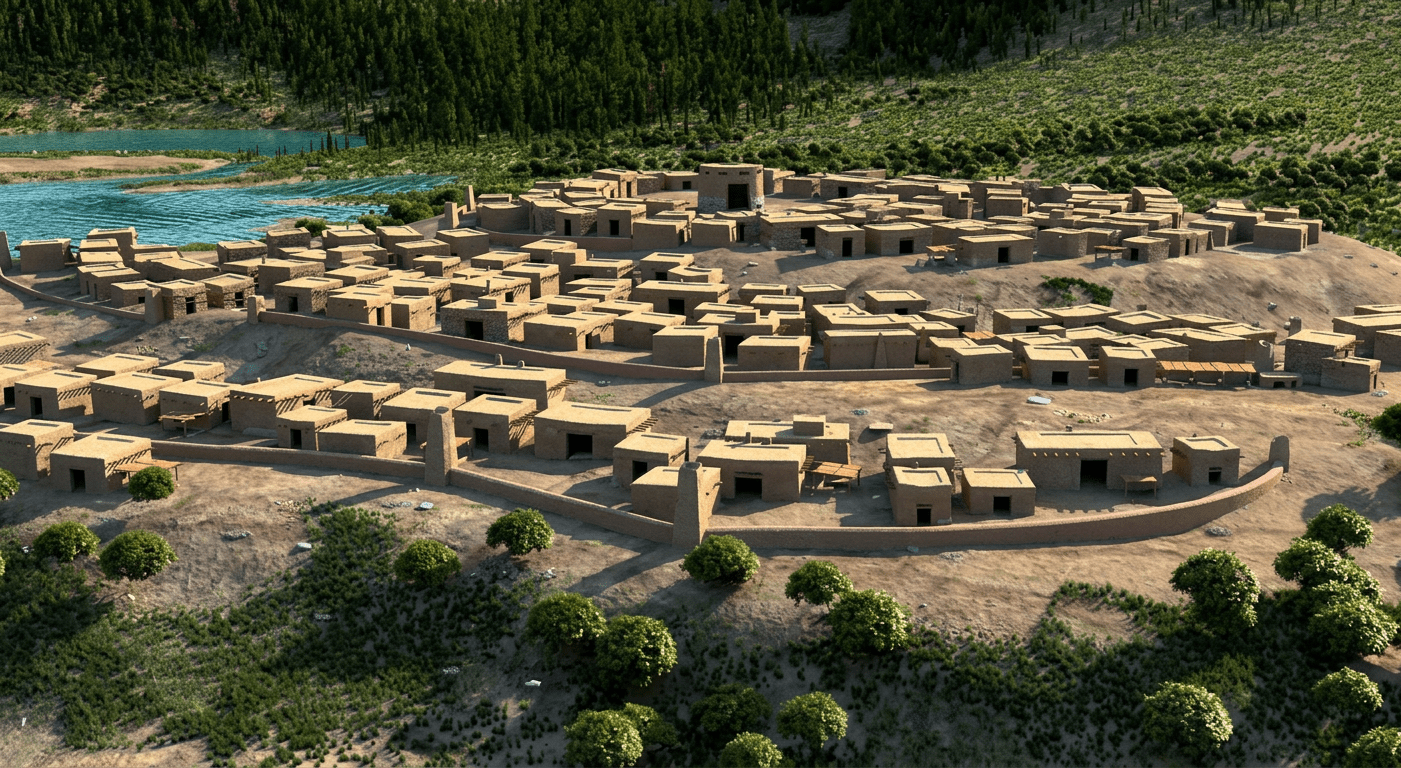
Ain Ghazal (“Spring of the Gazelles”) is located near modern-day Amman. Occupied from roughly 7200 to 5000 BCE, the site became one of the largest Neolithic settlements in the Near East. At its height, Ain Ghazal contained hundreds of buildings, permanent residential neighborhoods, agricultural production, animal management, specialized craft activities and ritual practices. The settlement emerged during a period when humans were adapting to increasingly complex village life. As populations expanded, new questions emerged: Who belongs to the community?
How are people connected across generations?
What defines social identity? And,
How should collective memory be preserved?
The famous statues may represent attempts to answer such questions.

The Discovery of the Statues
In 1983, archaeologists uncovered a cache of remarkable plaster figures buried beneath the settlement. Additional statues were discovered in later excavations. The collection includes full-body human figures, busts, male and female representations, adults and possible children, and figures with striking facial features. Many statues possess large eyes outlined with bitumen, carefully modelled faces, simplified bodies, distinctive heads and minimal attention to individual clothing. The figures were not casually discarded. Instead, they were deliberately buried in pits after use, suggesting ritual significance.
Humanity Looking at Itself
One of the most intriguing aspects of the Ain Ghazal statues is their scale. Earlier symbolic art often focused on animals, hunting scenes, small figurines and portable ritual objects. The Ain Ghazal statues differ dramatically. They are nearly life-sized. For perhaps the first time, humans created images approaching the dimensions of real people. This development may indicate a profound psychological shift. Rather than merely depicting the world around them, people increasingly turned their attention toward themselves. Questions of identity, ancestry, social belonging, and human existence may have become central concerns.
The Rise of Collective Identity
Large villages create social challenges. Small hunter-gatherer bands usually consist of people who know one another personally. Large settlements are different. As populations increase social networks expand, family groups multiply, conflicts become more likely and shared identities become more important. Some archaeologists suggest the statues helped reinforce collective identity. The figures may have represented ancestors, founding families, clan identities, mythological beings and community guardians. In this interpretation, the statues served as visual reminders that individuals belonged to something larger than themselves.
Ancestors and Social Memory
A leading interpretation links the statues to ancestor veneration. Throughout the Neolithic Near East, communities displayed strong interest in the dead. Evidence includes burials beneath houses, skull preservation, ritual treatment of human remains and commemorative practices. The statues may have functioned as symbolic ancestors whose presence connected living villagers with earlier generations. Such practices would have strengthened family continuity, community stability, social cooperation and shared history. As villages grew larger, maintaining collective memory became increasingly important. The statues may have provided a physical embodiment of that memory.

A New Awareness of the Individual
Another possibility is that the figures reflect an emerging awareness of individual human identity. Although the statues are not realistic portraits, they emphasize distinctly human characteristics. The large eyes are especially striking. Some researchers suggest they symbolize watchfulness, spiritual perception, supernatural knowledge and human consciousness itself. Whether intended as individuals or archetypes, the figures place human beings at the center of symbolic expression. This represents a significant departure from many earlier artistic traditions.
Architecture and Symbolism
The statues did not exist in isolation. They were created within one of the largest settlements of the Neolithic world. Architecture likely played an important role in their meaning. Permanent houses created long-term family spaces, generational continuity, stable neighborhoods and shared community experiences. As architecture became more permanent, concepts of identity may also have become more permanent. People no longer moved constantly across landscapes. Instead, they remained connected to specific houses, places, and communities. The emergence of large human representations may reflect this growing attachment to settled life.

Psychological Shifts in the Neolithic
The statues of Ain Ghazal may represent several overlapping psychological developments (greater future thinking, expanded social networks, collective memory, symbolic complexity and self-reflection)
Greater Future Thinking. Agriculture requires planning months and years ahead. Long-term planning encourages abstract thinking and social organization.
Expanded Social Networks. Larger populations require new ways of understanding relationships between strangers. Collective Memory. Permanent villages create histories that extend across generations.
Symbolic Complexity. Communities increasingly relied upon symbols to communicate shared values and beliefs.
Self-Reflection. Humans may have become increasingly interested in representing themselves, their ancestors, and their place in society.
Together, these developments contributed to a new psychological landscape unlike that of earlier mobile populations.

Why the Statues Were Buried
One of the greatest mysteries surrounding the Ain Ghazal statues is their deliberate burial. The figures were carefully placed in pits rather than abandoned as refuse. This suggests they may have had limited ceremonial lives. Possible explanations include completion of rituals, replacement by newer figures, ceremonial retirement, seasonal religious practices and changes in social traditions. The burial itself appears to have been meaningful. Just as people were buried, the statues may also have undergone symbolic “deaths.”

Lessons from Ain Ghazal
The statues remind us that the Neolithic Revolution involved far more than farming. Humans were not simply domesticating plants and animals. They were also transforming how they understood community, identity, memory, ancestry, the human condition. The figures reveal a society exploring new ways of thinking about itself. In many respects, they represent the beginnings of questions that continue today: Who are we?
Where do we come from?
What connects us to others? And,
How should we remember the past?
The life-sized plaster figures of Ain Ghazal stand among the earliest large-scale human representations ever created. Produced within one of the Near East’s largest Neolithic settlements, they reveal a society grappling with identity, memory, ancestry, and social belonging.
Whether viewed as ancestors, ritual beings, community symbols, or expressions of emerging self-awareness, the statues mark an important psychological turning point. They suggest that as villages grew larger and more permanent, humans increasingly turned their symbolic attention toward themselves.
The significance of Ain Ghazal lies not only in its architecture or agriculture, but in its evidence that Neolithic communities were developing new ways to understand what it meant to be human. The statues stand as enduring reminders of a moment when humanity began representing itself at a scale never seen before.

References: Köhler-Rollefson, I. (1988). Ain Ghazal: A major Neolithic settlement in central Jordan. Paléorient, 14(1), 99–112.
Rollefson, G. O. (1983). Ritual and ceremony at Neolithic Ain Ghazal (Jordan). Paléorient, 9(2), 29–38.
Rollefson, G. O. (2000). The Ain Ghazal statues. In I. Kuijt (Ed.), Life in Neolithic farming communities: Social organization, identity, and differentiation (pp. 103–134). Kluwer Academic/Plenum Publishers.
Rollefson, G. O., & Simmons, A. H. (1985). The 1983 season at Ain Ghazal: Preliminary report. Bulletin of the American Schools of Oriental Research, 259, 13–30.
Rollefson, G. O., & Simmons, A. H. (1987). The Neolithic village of Ain Ghazal, Jordan: Preliminary report on the 1985 season. Bulletin of the American Schools of Oriental Research, 268, 45–67.
Simmons, A. H., & Najjar, M. (Eds.). (2006). Ain Ghazal archaeological project: Final reports, volume 1. Council for British Research in the Levant.
Kuijt, I. (Ed.). (2000). Life in Neolithic farming communities: Social organization, identity, and differentiation. Kluwer Academic/Plenum Publishers.
Verhoeven, M. (2002). Ritual and ideology in the Pre-Pottery Neolithic B of the Levant and southeast Anatolia. Cambridge Archaeological Journal, 12(2), 233–258.
Leave a Reply