<home # start here # guides # builds # services # shop # about # categories>

For much of the twentieth century, archaeologists assumed that pottery, permanent villages, and social complexity emerged only after agriculture. According to this traditional model, humans first domesticated plants and animals, then settled into villages, developed storage technologies, and eventually created more sophisticated societies.
The prehistoric Jōmon culture of Japan challenges this assumption.
Between approximately 14,000 and 3,00 BCE, Jōmon communities developed some of the world’s earliest pottery, constructed long-lived settlements, managed landscapes, and created rich artistic traditions—all while relying primarily on hunting, fishing, gathering, and limited forms of plant management rather than large-scale agriculture.
The Jōmon case raises an important question for archaeologists and architectural historians: Is agriculture truly necessary for sedentary living and technological innovation, or can complex societies emerge through alternative pathways?
The evidence suggests that the Jōmon people demonstrate a different route toward social development—one based on abundant natural resources, seasonal planning, and sophisticated environmental knowledge.
Who Were the Jōmon?
The term “Jōmon” means “cord-marked,” referring to the distinctive impressions pressed into pottery vessels using twisted cords. The Jōmon period spans thousands of years, making it one of the longest archaeological cultural traditions in the world.
Archaeologists typically divide it into several phases: Incipient Jōmon (c. 14,000–8,000 BCE);
Initial Jōmon (c. 8,000–5,000 BCE);
Early Jōmon (c. 5,000–3,500 BCE);
Middle Jōmon (c. 3,500–2,500 BCE); and,
Later and Final Jōmon phases.
Throughout these periods, communities occupied much of the Japanese archipelago, adapting to changing climates and environments.
Early Pottery Before Agriculture
One of the most significant aspects of Jōmon culture is its pottery. Some Jōmon ceramics date to around 14,000 BCE, making them among the oldest known pottery traditions in the world. This is remarkable because: Agriculture had not yet developed in Japan. Villages remained dependent on wild resources. And, Domesticated crops played a limited role. Traditional archaeological theories once linked pottery directly to farming. The Jōmon evidence may demonstrate that this connection is not universal.
Pottery can emerge wherever people benefit from cooking foods, processing nuts, boiling fish, storing resources and preparing plant materials. In other words, pottery appears to be associated less with agriculture itself and more with the need to process and store food efficiently.

Permanent Villages Without Farming
Perhaps even more surprising is the existence of long-term settlements. Many Jōmon communities occupied the same locations for centuries. Archaeological evidence reveals: pit houses, storage facilities, refuse middens, cemeteries, ritual spaces and community gathering areas. Sites such as Sannai-Maruyama demonstrate substantial settlement planning and long-term occupation. These villages challenge the assumption that mobile hunting groups must constantly relocate. Instead, many Jōmon communities remained in place for extended periods.
Why Could Hunter-Gatherers Settle Permanently?
The answer lies largely in environmental abundance. Unlike many regions where resources fluctuate dramatically, prehistoric Japan offered exceptionally rich ecosystems. Communities had access to: salmon runs, shellfish beds, nuts such as acorns and chestnuts, wild plants, deer, boar and coastal fisheries. These resources often returned predictably each year. As a result, people could remain in favorable locations without needing intensive agriculture. Some archaeologists describe this pattern as “resource-rich sedentism.” People settled because nature already provided reliable food supplies.
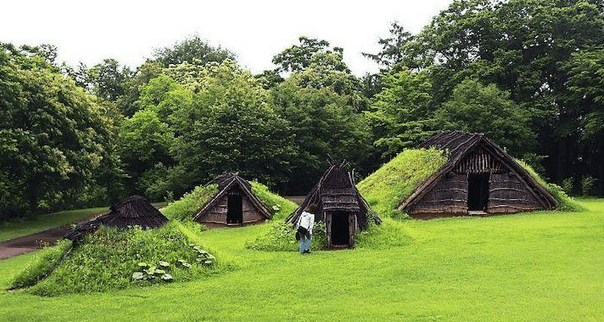
Architecture of Jōmon Villages
Jōmon architecture reveals considerable planning and organization. The most common structures were pit dwellings. These typically featured semi-subterranean floors, wooden frameworks, thatched roofs, central hearths and circular or oval floor plans. Many villages arranged houses around central open spaces. Some larger settlements contained storage pits, raised structures, ritual buildings and specialized activity areas. The architectural evidence suggests stable communities with shared traditions and social organization.
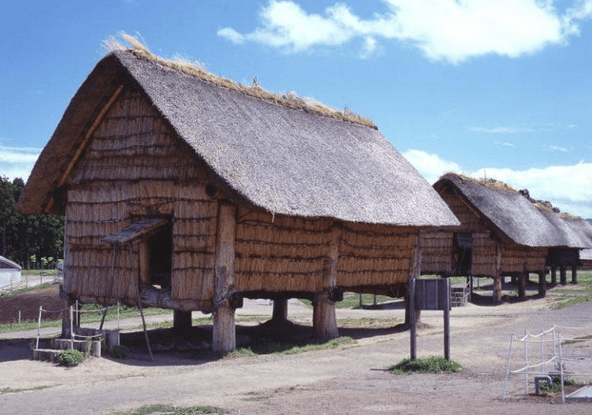
Storage and Future Planning
Permanent settlement requires more than shelter. It also requires planning for future needs. Jōmon communities invested heavily in food storage. Particularly important were nuts such as acorns, chestnuts and walnuts. These foods could be collected seasonally, processed, stored for long periods, and shared within communities. Storage reduces uncertainty and helps support larger populations. This strategy resembles one of the benefits often associated with agriculture, yet it was achieved largely through wild resources.

Social Complexity Without Farming
One of the most important lessons from Jōmon archaeology is that social complexity does not necessarily require agriculture. Evidence suggests long-distance exchange networks, specialized crafts, elaborate pottery production, ritual practices, organized settlements and community identity. Materials such as obsidian, jade, and shells travelled considerable distances across the Japanese islands. These exchange systems indicate social connections extending well beyond individual villages.
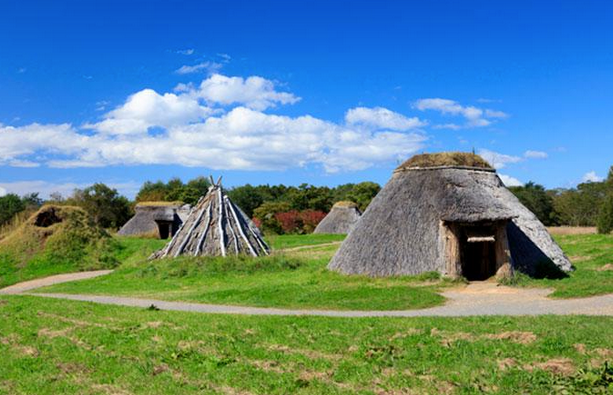
Ritual and Symbolic Life
Jōmon culture also produced a rich symbolic tradition. Artifacts include: clay figurines known as dogū, decorative pottery. stone arrangements, ritual deposits and ceremonial spaces. Some figurines display exaggerated human features and may have been associated with fertility, healing, protection, or spiritual beliefs. The artistic sophistication of these objects demonstrates that symbolic complexity flourished alongside hunting and gathering economies.

Did the Jōmon Practice Agriculture?
The answer depends on how agriculture is defined. For much of the Jōmon period, there is little evidence for intensive farming comparable to later agricultural societies. However, some evidence suggests management of useful plants. Possible practices include encouraging growth of desirable species, managing nut-producing trees, small-scale cultivation and landscape modification. Many scholars describe this as environmental management rather than full agriculture. The distinction highlights an important reality: subsistence systems often exist along a continuum rather than fitting into simple categories.
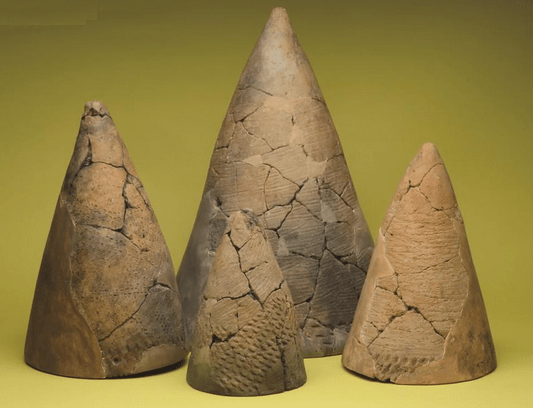
Rethinking the Agricultural Revolution
The Jōmon example forces archaeologists to reconsider traditional narratives. The older model suggested: Agriculture → Permanent Villages → Pottery → Social Complexity. The Jōmon sequence appears closer to: Abundant Resources → Pottery → Settlement → Storage → Social Complexity. This alternative pathway demonstrates that human societies can achieve similar outcomes through different strategies. Agriculture is one route to complexity, but it is not the only route.

Lessons for Neolithic Architecture
For students of architecture and settlement planning, the Jōmon case is particularly valuable. It shows that permanent architecture can emerge when communities possess reliable food sources, invest in storage systems, develop long-term social ties and create strong attachments to place.
Buildings are not simply responses to farming. They are responses to stability, cooperation, and shared expectations about the future. Jōmon villages illustrate how architecture can flourish even in societies that remain heavily dependent on wild resources.
The Jōmon culture of prehistoric Japan stands as one of the strongest challenges to the idea that agriculture is necessary for sedentary living, pottery production, or social complexity. Between approximately 14,000 and 3,000 BCE, Jōmon communities created pottery, built permanent settlements, maintained exchange networks, and developed rich symbolic traditions while relying largely on hunting, fishing, gathering, and environmental management.
Rather than representing a primitive stage before farming, the Jōmon demonstrate an alternative pathway to complexity. Their settlements reveal that abundant resources, long-term planning, storage technologies, and social cooperation can support stable communities without intensive agriculture.
For archaeologists, architects, and historians alike, the Jōmon world offers an important reminder: human societies have never followed a single blueprint for development. The road to permanent settlement and cultural sophistication has always been more diverse than simple agricultural models suggest.

References: Crawford, G. W. (2011). Advances in understanding early agriculture in Japan. Current Anthropology, 52(S4), S331–S345.
Habu, J. (2004). Ancient Jomon of Japan. Cambridge University Press.
Habu, J. (2010). Seafaring, food procurement, and sedentism in the Jomon period. Journal of Island and Coastal Archaeology, 5(1), 54–68.
Imamura, K. (1996). Prehistoric Japan: New perspectives on insular East Asia. University of Hawai’i Press.
Kobayashi, T. (2004). Jomon reflections: Forager life and culture in the prehistoric Japanese archipelago. Oxbow Books.
Pearson, R. (2006). Jomon hot spot: Increasing sedentism in prehistoric Japan and its relationship to social complexity. World Archaeology, 38(2), 239–258.
Sannai-Maruyama Site Research Center. (2010). Sannai-Maruyama: A large Jomon settlement in northern Japan. Aomori Prefectural Government.
Yasuda, Y. (2002). Origins of pottery and agriculture in East Asia. In Y. Yasuda (Ed.), The origins of pottery and agriculture (pp. 119–142). Lustre Press.
Barnes, G. L. (2015). Archaeology of East Asia: The rise of civilization in China, Korea and Japan (2nd ed.). Oxbow Books.
Leave a Reply