<home # start here # guides # builds # services # shop # about # categories>

A few kilometers northeast of Stonehenge lies one of the largest known Neolithic settlements in northwestern Europe: Durrington Walls. For decades, archaeologists viewed the site primarily as a massive earthwork enclosure. However, extensive excavations during the late twentieth and early twenty-first centuries revealed something far more significant—a large settlement occupied during the period when Stonehenge’s great stone circles were being erected.
The discoveries transformed understanding of the Stonehenge landscape. Archaeologists uncovered houses, roads, ceremonial structures, and enormous quantities of animal bones, particularly pigs, suggesting repeated episodes of large-scale feasting (Parker Pearson et al., 2006; Parker Pearson, 2012).
These findings have inspired an important question: was Durrington Walls simply a settlement, or was it a center where communal feasting helped create political unity among widely dispersed communities? If Stonehenge represents monumental cooperation in stone, Durrington Walls may represent the social system that made such cooperation possible.
Discovery and Excavation
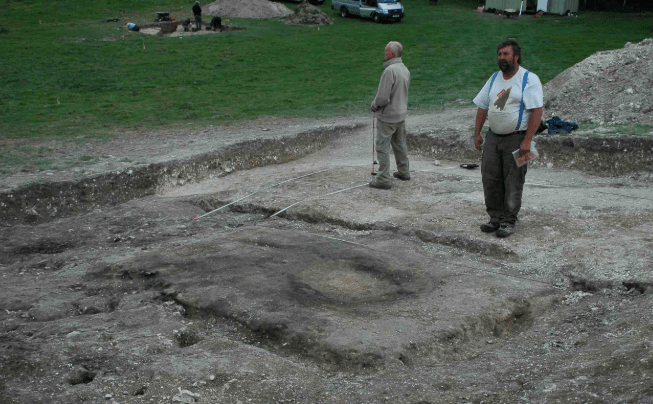
The earthworks of Durrington Walls had been known for centuries, but its importance became clearer through modern archaeological investigations. Major excavations were undertaken by researchers including Mike Parker Pearson and colleagues as part of the Stonehenge Riverside Project beginning in 2003. Their work uncovered extensive evidence of settlement beneath and around the henge enclosure (Parker Pearson et al., 2006). Among the most significant discoveries were remains of neolithic houses, large middens containing food waste, processional avenuesm, ceremonial features, massive deposits of animal bones and evidence linking occupation to the construction era of Stonehenge. The scale of the findings surprised archaeologists. Rather than a small village, Durrington Walls appeared to have functioned as a major gathering place for people arriving from across Britain (Parker Pearson, 2012).

The Largest Known Neolithic Settlement in Britain
At its height around 2500 BCE, Durrington Walls enclosed an area of approximately 17 hectares. The site contained hundreds of potential structures, temporary and permanent dwellings, ceremonial spaces, storage areas and gathering places. Some researchers estimate that thousands of people may have assembled there during important seasonal events (Parker Pearson et al., 2007). This population far exceeded that of typical Neolithic villages. Such numbers suggest that Durrington Walls was not merely a local settlement but a regional center drawing participants from many different communities.

The Pig Bone Evidence
One of the most remarkable discoveries at Durrington Walls involved animal remains. Excavators recovered enormous quantities of animal bones, particularly pigs. Analysis revealed thousands of pig bones, large numbers of cattle remains, evidence of butchering, cooking marks, rapid consumption and disposal in large communal middens. Zooarchaeological studies showed that many pigs were slaughtered at roughly nine months of age, suggesting deliberate planning for seasonal feasting events (Albarella & Serjeantson, 2002; Parker Pearson et al., 2007). Parenthetically, researchers were struck by the scale of the deposits, which far exceeded ordinary domestic consumption and instead pointed toward periodic mass gatherings involving significant food preparation and communal dining (Parker Pearson et al., 2007).
Feasting on a Monumental Scale
The evidence indicates that Durrington Walls hosted some of the largest known feasting events in prehistoric Britain. The gatherings likely involved roasted pork, beef, shared meals, ceremonial activities and seasonal celebrations. Chemical analysis of animal remains suggests that some livestock were brought from considerable distances across Britain (Madgwick et al., 2019). This finding is particularly important. It means people were not merely attending local festivals. They were traveling substantial distances and bringing animals with them. Such efforts imply that participation carried significant social importance.

The Stonehenge Connection
One reason Durrington Walls attracts so much attention is its close relationship to Stonehenge. Archaeological dating indicates that the settlement flourished during the period when major construction was occurring at Stonehenge (Parker Pearson et al., 2006). Researchers have proposed that Durrington Walls housed builders and participants. Stonehenge served ceremonial functions. The two sites formed parts of a single ritual landscape.
Parenthetically, excavations revealed a processional avenue connecting Durrington Walls to the nearby River Avon, while Stonehenge possessed a similar avenue, suggesting coordinated movement through the broader ceremonial system (Parker Pearson et al., 2007). In this interpretation, Durrington Walls represented the domain of the living, while Stonehenge was associated with ancestors and ritual remembrance. Although aspects of this model remain debated, the connection between the two sites is widely accepted.
Why Feasting Matters
Modern readers sometimes underestimate the importance of communal meals. In many societies, feasting serves functions far beyond nutrition. Large communal feasts can strengthen alliances, resolve tensions, reinforce identity, display generosity, demonstrate leadership and create obligations. Anthropologists have documented these functions in societies around the world. Food is one of humanity’s most powerful social tools. At Durrington Walls, communal feasting may have helped transform numerous local groups into participants in a larger cultural network.

Did Feasting Create Political Unity?
This question lies at the center of current interpretations. The construction of Stonehenge required cooperation, labor organization, resource sharing and long-distance communication. These activities are difficult to sustain without mechanisms for building trust and collective identity. Feasts may have provided exactly such mechanisms. Gatherings at Durrington Walls would have allowed participants to meet distant communities, exchange information, arrange marriages, conduct trade, resolve disputes and reinforce common traditions. In this sense, feasting may have functioned as a form of politics. Not politics in the modern governmental sense, but politics as the creation and maintenance of large social networks.
The Archaeological System
Durrington Walls was not an isolated site. It formed part of a broader ceremonial landscape that included Stonehenge, the River Avon, processional avenues, burial mounds, timber monuments and gathering spaces. Archaeologists increasingly describe these features as an integrated ritual and social system (Parker Pearson, 2012).
Parenthetically, excavations demonstrated that movement between monuments appears to have been carefully organized through avenues, rivers, and ceremonial pathways, indicating a highly structured landscape rather than isolated monuments (Parker Pearson et al., 2006; Parker Pearson, 2012).
The architecture itself may have guided participants through experiences that reinforced shared beliefs and identities.
Power Without Kings?
One of the most interesting aspects of Durrington Walls is the absence of obvious rulers. Unlike later societies, there is little evidence for palaces, thrones, royal tombs and centralized governments. Yet the scale of organization was immense. This suggests that power may have operated differently. Authority may have emerged through ritual leadership, social influence, organizational skill, control of ceremonies and ability to mobilize labor. Durrington Walls demonstrates that large-scale cooperation does not necessarily require kings or states. Communities can organize monumental projects through shared traditions and collective participation.

Lessons for Neolithic Architecture
Durrington Walls provides several important insights into prehistoric architecture and society (architecture creates gatherings, food builds communities, large projects require social systems, rituals & politics overlap and landscapes mater)
Architecture Creates Gatherings. Monuments are not merely structures; they organize human interaction.
Food Builds Communities. Feasting can strengthen social networks and cooperation.
Large Projects Require Social Systems. Stonehenge could not have been built without mechanisms for coordinating people.
Ritual and Politics Overlap. Ceremonial gatherings often perform political functions.
Landscapes Matter. Architecture works best when understood as part of larger systems of movement, gathering, and meaning.
Durrington Walls provides some of the strongest archaeological evidence for large-scale communal feasting in prehistoric Europe. Excavations uncovered vast quantities of pig bones, settlement remains, ceremonial features, and clear links to the construction era of Stonehenge. The evidence suggests that people traveled long distances to gather, feast, and participate in shared rituals. These events likely served purposes extending far beyond food consumption. Feasting helped create relationships, reinforce identities, and build cooperation among communities scattered across Britain.
Whether viewed as a settlement, ceremonial center, or gathering place, Durrington Walls reveals the social foundations of monumental construction. If Stonehenge represents the physical achievement of collective labor, Durrington Walls may represent the social engine that made that achievement possible. The site reminds us that some of humanity’s greatest architectural accomplishments begin not with stone, but with people coming together around a shared table.

References: Albarella, U., & Serjeantson, D. (2002). A passion for pork: Meat consumption at the British Late Neolithic site of Durrington Walls. In P. Miracle & N. Milner (Eds.), Consuming passions and patterns of consumption (pp. 33–49). McDonald Institute for Archaeological Research.
Madgwick, R., Lamb, A. L., Sloane, H., Nederbragt, A. J., Albarella, U., Parker Pearson, M., & Evans, J. (2019). Multi-isotope analysis reveals extensive movement and management of pigs in Late Neolithic Britain. Science Advances, 5(10), eaau6078.
Parker Pearson, M. (2012). Stonehenge: Exploring the greatest Stone Age mystery. Simon & Schuster.
Parker Pearson, M., Pollard, J., Richards, C., Thomas, J., Tilley, C., Welham, K., Chamberlain, A., Chenery, C., Evans, J., Knüsel, C., Linford, N., Martin, L., Montgomery, J., Payne, A., Pitts, M., Richards, M., & Wysocki, M. (2007). The Stonehenge Riverside Project: Excavations at the east entrance of Durrington Walls. Antiquity, 81(313), 617–639.
Parker Pearson, M., Pollard, J., Richards, C., Thomas, J., Tilley, C., & Welham, K. (2006). Materializing Stonehenge: The Stonehenge Riverside Project and new discoveries. Journal of Material Culture, 11(1–2), 227–261.
Pollard, J., & Ruggles, C. (2001). Stonehenge and associated monuments. English Heritage.
Richards, C. (1990). The Stonehenge enclosure and associated monuments. English Heritage Archaeological Report.
Wainwright, G., & Longworth, I. H. (1971). Durrington Walls: Excavations 1966–1968. Society of Antiquaries of London.
Leave a Reply