<home # start here # guides # builds # services # shop # about # categories>

Humanity’s first villages were not simply primitive versions of later cities. They were prototypes for human life. Experiments in how people might organize belief, housing, security, trade, and resources. Some models endured and spread widely. Others disappeared, leaving behind clues about paths not taken. Five famous Neolithic and Chalcolithic sites illustrate these different experiments: Göbekli Tepe, Çatalhöyük, Jericho, Varna, Jarmo, and many failed.

Ritual: Göbekli Tepe
Dating to roughly 9600–8200 BCE, Göbekli Tepe contains massive circular enclosures built from carved limestone pillars decorated with animals and abstract symbols (Schmidt, 2010). What makes the site remarkable is that it appears to predate fully developed farming communities. Large groups of people cooperated to quarry, transport, and erect monumental stones long before cities or states existed. Its prototype was shared belief as a tool for large-scale cooperation. The site suggests that ritual may have helped create society, rather than simply emerging after society became complex.
Density: Çatalhöyük
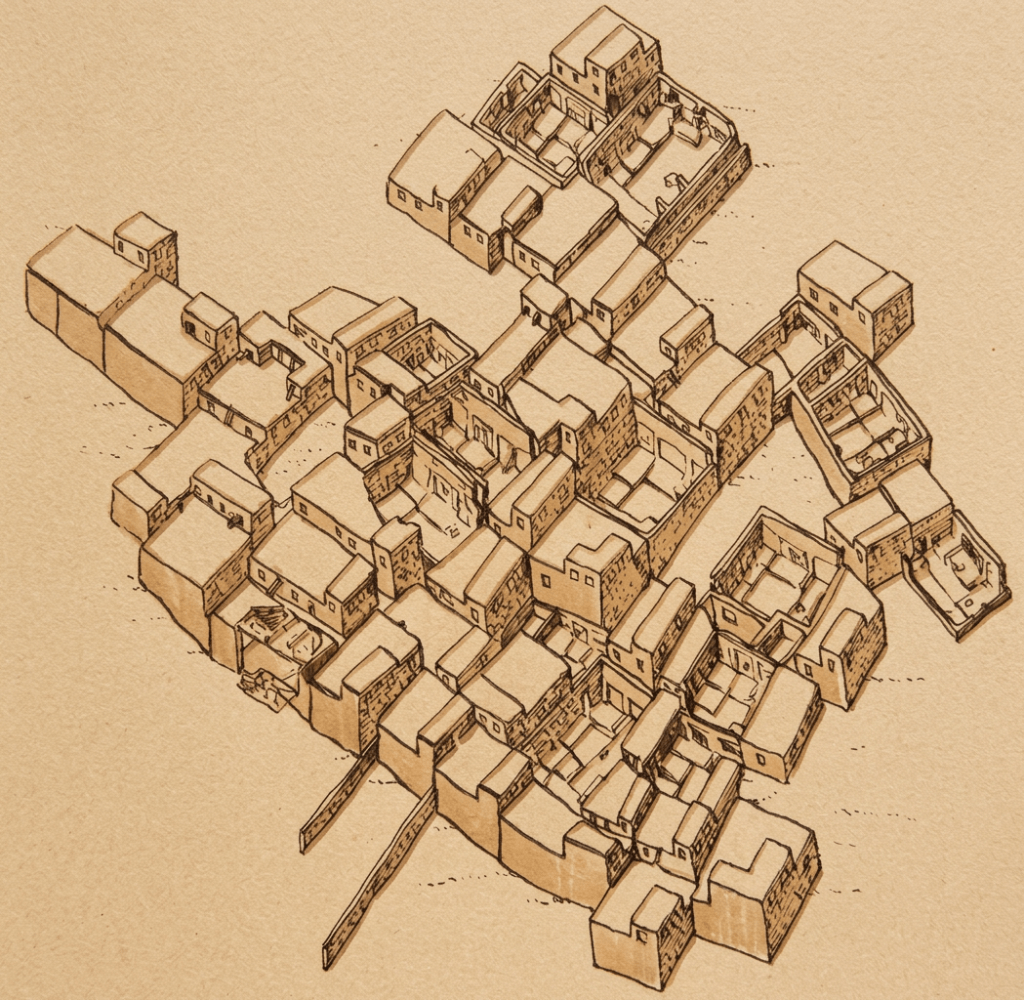
Occupied between approximately 7100 and 5950 BCE, Çatalhöyük housed thousands of people in tightly packed mudbrick homes, entered through the roof (Hodder, 2018). There were no obvious streets, palaces, or centralized government buildings. Instead, households formed a dense urban-like fabric. Prototype: High-density living without clear state institutions. Çatalhöyük demonstrates that large populations can coexist through shared norms and household-based organization rather than visible centralized authority.

Defense and Control: Jericho
Jericho, one of the world’s earliest permanent settlements, is famous for its massive stone tower and surrounding wall, built around 8000 BCE (Kenyon, 1981). Archaeologists debate whether the wall served defensive, flood-control, ceremonial, or multiple functions. Its prototype was collective labor organized around protection and territorial control. Regardless of its exact purpose, the construction required coordinated effort and suggests growing concern with managing people, space, and resources.

Trade and Inequality: Varna
The Varna Necropolis in Bulgaria, dated to about 4500 BCE, It contains some of the earliest known gold objects in the world. Burials vary dramatically in wealth, with certain individuals interred with enormous quantities of gold, copper, and prestige goods (Renfrew, 1986). It prototyped long-distance trade linked to social inequality. The site reveals a society in which wealth was no longer distributed evenly. Exchange networks created opportunities for accumulation, status, and hierarchy.
Sustainability: Jarmo
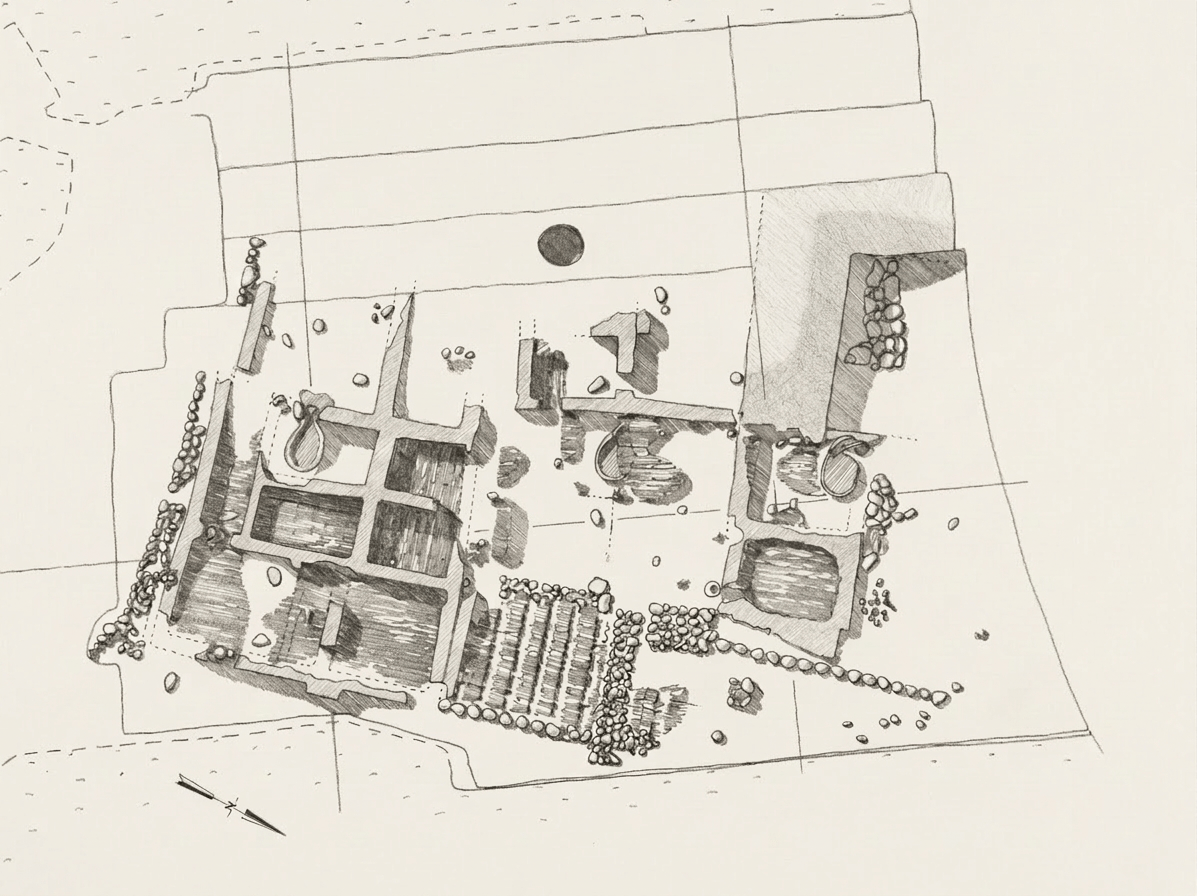
Located in northern Iraq, Jarmo flourished around 7000 BCE and is often cited as one of the earliest farming villages (Braidwood, 1960). Its inhabitants cultivated crops, kept animals, and built relatively modest mudbrick houses.
Prototype: Small-scale agricultural sustainability. Unlike more densely populated settlements, Jarmo appears to have maintained a closer balance between population size and local resources, illustrating a potentially more resilient model of village life.
And, Many Failed
These famous sites are only some of the main survivors. Archaeologists have identified countless settlements that were abandoned, relocated, reduced in size, or transformed. Early farming communities faced drought, floods and climate change; soil depletion; resource shortages; disease; social conflict, and populations pressure. Sites such as Göbekli Tepe, Çatalhöyük, Jericho, Varna, Jarmo demonstrate that even large and sophisticated communities could contract or fragment when environmental and social stresses intensified (Rollefson, 2001).
What These Prototypes Reveal: Sites such as Göbekli Tepe, Çatalhöyük, Jericho, Varna and Jarmo vs The Main Experiment
Göbekli Tepe // Ritual and collective identity;
Çatalhöyük // Dense communal living;
Jericho // Defense and territorial organization;
Varna // Trade, wealth, and inequality; and,
Jarmo // Small-scale agricultural sustainability

The Bigger Lesson
The Neolithic world was not moving along a single path toward civilization. Instead, people were testing different ways of being human. Some communities emphasized ritual. Others emphasized density, defense, trade, hierarchy, or sustainability. Many experiments ended, while a few left lasting legacies that influenced later cities and states.
The surviving archaeological record therefore represents not a straight line of progress, but a laboratory of social possibilities. The first villages were prototypes, and humanity spent thousands of years discovering which combinations of belief, cooperation, security, and resource management could endure.
References: Braidwood, R. J. (1960). The Agricultural Revolution. Scientific American, 203(3), 130–148.
Hodder, I. (2018). Where Are We Heading? The Evolution of Humans and Things. Yale University Press.
Kenyon, K. M. (1981). Excavations at Jericho. British School of Archaeology in Jerusalem.
Renfrew, C. (1986). Varna and the Emergence of Wealth in Prehistoric Europe. In A. Appadurai (Ed.), The Social Life of Things. Cambridge University Press.
Rollefson, G. O. (2001). The Neolithic period. In B. MacDonald, R. Adams, & P. Bienkowski (Eds.), The Archaeology of Jordan (pp. 67–105). Sheffield Academic Press.
Schmidt, K. (2010). Göbekli Tepe—The Stone Age sanctuaries. New results of ongoing excavations. Documenta Praehistorica, 37, 239–256.
Leave a Reply