home # store # services # articles # game # app #contact >
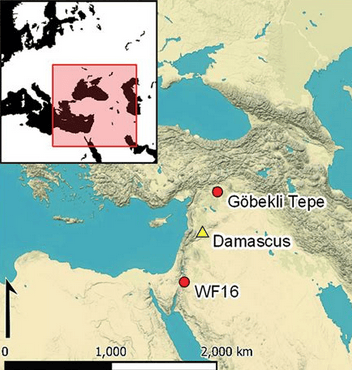
Its location is in the Faynan desert region, in a semi-arid landscape at the edge of the Jordan Rift Valley
WF16 was one of the earliest large sedentary communities in the southern Levant.
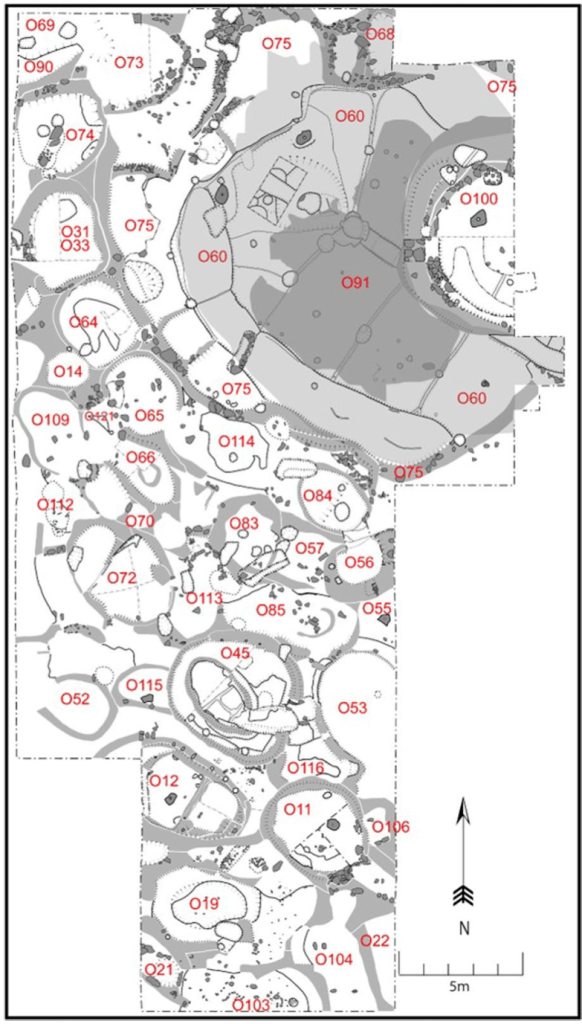
The site covered about 2 hectares and had hundreds of structures, suggesting a substantial, long-term population
Dwellings were generally round, or oval houses. Built with stone foundations and mud-plaster walls. And, were sometimes sunk partly into the ground.

Archaeologists uncovered large communal or special buildings
Alongside domestic ones too. Suggesting social or ritual functions.
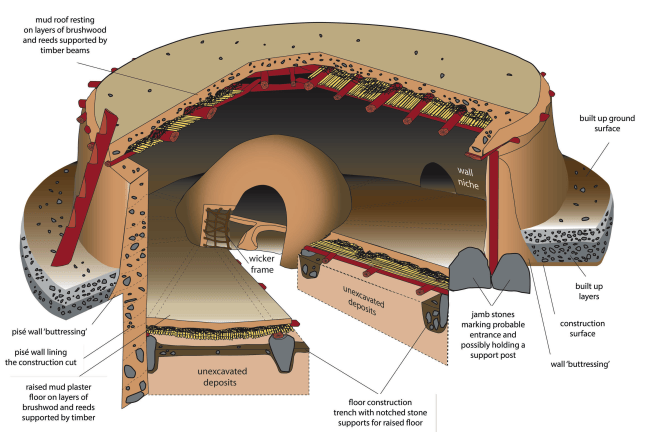
Some structures showed evidence of lime plaster floors and decorated features
Showing they had symbolic or ritual activity beyond just domestic living.
Did you know? Making plaster involved turning stone into powder or quicklime with fire. It then had to be turned back into paste. And, then stone again. Archaeologists say the cycle of destruction and rebirth was highly symbolic. Echoing life, death, and regeneration. It may have been seen as a medium of transformation, much like human life itself.
Figurines and symbolic objects were also found. They tye WF16 into the broader symbolic world during the neolithic time period
Hunting was still important too
Gazelle, ibex, aurochs, and wild equids remains were found.
Inhabitants practiced an incipient form of cultivation
Wild cereals (barley, wheat) and legumes were found. They were gathered and possibly tended.
Wild plants including fruits, nuts and grasses were used
This mix shows the transition from foraging to farming. People were experimenting with cultivation but had not fully domesticated plants or animals yet.
Burials were found within and around houses, sometimes with grave goods, reflecting emerging ancestor veneration.
The presence of communal architecture and symbolic artifacts suggests shared ritual and social cohesion mechanisms. Within a relatively large settlement
Scholars see WF16 as part of the social revolution of the PPNA, where people began building permanent communities before the full agricultural “neolithic package” developed.
WF16 is one of the southernmost PPNA “mega-sites,” showing that the neolithic way of life extended beyond the Jordan Valley heartland. It provides evidence for how early sedentary life adapted to marginal arid zones, not just fertile river valleys.
During the neolithic era, Wadi Faynan 16 was a large PPNA village. Early farmers and foragers lived in stone-and-mud houses, experimented with crop cultivation, hunted wild game, and built communal spaces that reflected an increasingly complex social and ritual life. It stands as one of the earliest examples of large, sedentary communities in the southern Levant.

Bibliography: Mithen, S., Finlayson, B., Maričević, D., Smith, S., Jenkins, E., Najjar, M., Wicks, K., Allcock, S., Elliott, S., & Flohr, P. (2018). WF16: The Excavation of an Early Neolithic Settlement in Wadi Faynan, Southern Jordan: Stratigraphy, Chronology, Architecture and Burials. Council for British Research in the Levant (CBRL). http://www.jstor.org/stab
Leave a Reply