<home # start here # guides # builds # services # shop # about # categories>

Preserving early evidence for cultivated/domesticated cereals (notably einkorn at Jilat‑7), introduction of caprine herding in the steppe; long distance obsidian exchange & predominantly circular/oval house plans. Wadi el-Jilat was an important neolithic place in modern day Jordan.
Wadi el‑Jilat lies in the eastern Jordanian steppe (Azraq drainage). The wadi’s incised ravine and pools retain water seasonally, making it an attractive locus for repeated occupation despite the generally arid setting
Jilat‑7 produced the earliest reported domesticated einkorn dates (9500–9200 BP), placing the site among key localities for early cereal domestication in this area of the southern Levant.
Faunal and isotopic studies show a shift to caprine herding (sheep/goat) in later Neolithic/ELN phases at Jilat loci (notably 13/25), consistent with the emergence of pastoralism in the steppe.
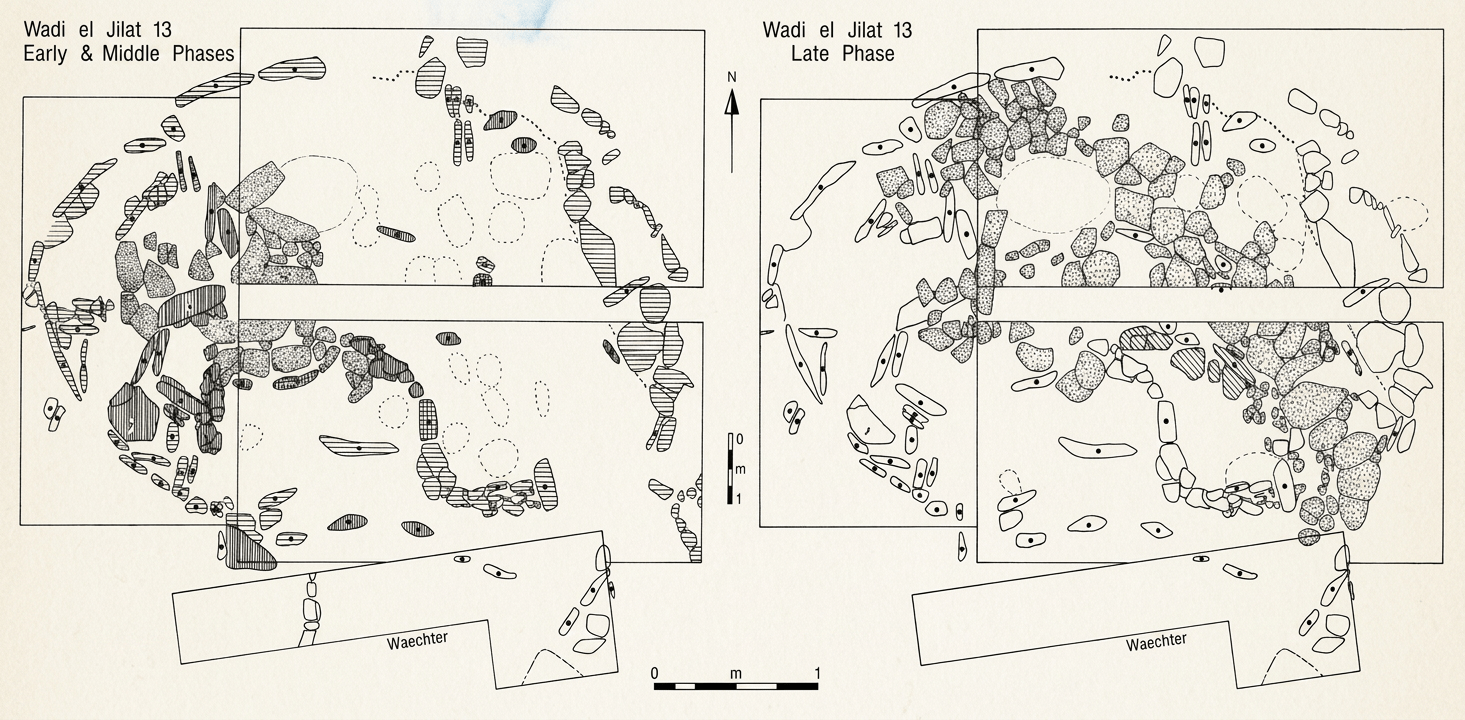
Excavations reveal oval and circular semi‑subterranean structures (hearths, work slabs, storage features) and clusters of dwellings interpreted as seasonal aggregation sites or small villages
Plans show repeated rebuilding and multi‑phase occupation rather than large monumental ritual buildings. Some late Neolithic clusters include larger compound arrangements probably used for organization.
Regional faunal lists emphasize gazelle, hare and later caprines; explicit evidence for large felids (leopard) at Wadi el‑Jilat is not prominent
Carnivores do occur regionally. Vegetation in the immediate wadi is steppe/riparian. Oak and olive woodlands were genreally characteristic of nearby uplands rather than the basin itself.
Andrew N. Garrard and collaborators led Azraq Basin / Wadi el‑Jilat surveys and excavations
There are stable‑isotope and pastoralism syntheses done by Miller, Baird, Martin, Garrard et al.. Including nomadic pastoralism and faunal isotopes.
Wadi el‑Jilat is a multi‑site complex in the Azraq/Azraq‑Badia region of eastern Jordan. It was an important PPNB area with later Neolithic occupations. Check it out with some more neolithic architecture today!
References: NERC Open Research Archive The origins of nomadic pastoralism in the eastern Jordanian steppe: a combined stable isotope and chipped stone assessment https://nora.nerc.ac.uk/id/eprint/526099/1/Miller%20et%20al%20Levant%20Pre-Proof.pdf
Academia.edu (PDF) Garrard, A. N., Baird, D., Colledge, S., Martin, L., & Wright, K. I. 1994. Prehistoric environment and settlement in the Azraq Basin: an interim report on the 1987 and 1988 excavation seasons. Levant, 26 (1): 73-109. https://www.academia.edu/5851906Garrard_A_N_Baird_D_Colledge_S_Martin_L_and_Wright_K_I_1994_Prehistoric_environment_and_settlement_in_the_Azraq_Basin_an_interim_report_on_the_1987_and_1988_excavation_seasons_Levant_26_1_73_109
JSTOR NEW DIMENSIONS TO THE EPIPALAEOLITHIC OF THE WADI EL-JILAT IN CENTRAL JORDAN https://www.jstor.org/stable/41492472
Leave a Reply