< home # store # services # articles # game # app #contact >

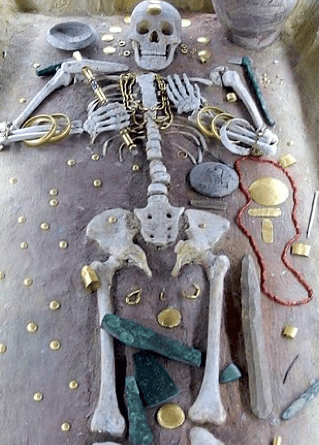

Dating from the late neolithic. Varna necropolis/cemetery or (Варненски некропол), has the oldest radiocarbon dated gold treasures, & jewelry in the world
Bulgaria is considered very internationally significant site for pre-history
It’s not only the 6000 year old large gold treasures but many other treasures from the area.
In October 1972, excavator operator Raycho Marinov accidentally discovered one of the greatest archaeological finds from the past 60 years
He contacted the local museum. What they found contained some of the most sophisticated examples of gold and copper metallurgy; pottery; high quality flint, and obsidian blades; beads; and, shells from the neolithic era. It was the Varna culture.
2006 radiocarbon testing date graves to 4569 and 4340 BCE (1)(2)
Chronology
Many of the sites graves did not contain a skeleton, but had great gifts. Metallic: gold, copper; Non metallic minerals: rocks, pottery, pigments; and bifacts. Tools; and more.
The empty graves actually had the richest gold artifacts
294 graves were found (3), with 3000 gold artifacts. At a weight of approximately six kilograms.
A scepter, or supreme symbol of religious authority was found in three graves
And, these three graves had more than half the total gold weight, than in the entire cemetery. (3)
Grave 43 contained more gold than has been found in the entire rest of the world for that epoch
It was initially identified as the grave of a prince, but is now thought to be that of the smith. (4)
3 graves contained masks of unbaked clay
They probably had trade relations with distant lands
Through the lower Volga and Cyclades. People would have begun exporting metal goods; and, salt from Provadiya rock salt mine-Solnitsata.
Culture had sophisticated religious beliefs about the afterlife and had developed hierarchal status differences
According to Marija Gimbutas, it could be the oldest known burial site evidence of elite male(s)
Many believe the end of 5th millennium was time transition to male dominance occurred in Europe.
It is the oldest cemetery where humans were buried with gold. The total gold at Varna Necropolis exceeds the amount found on earth, from the 1000 year period 7000-6000 years ago.
For its time, Jewelry was special too
Because Chalcedony, a hard gem found in Afghanistan was found, and ground through to create beads.
Three main types of beads are described:
type 1 elongated barrel shaped;
type 2 elongate and trapezeohedral facet: Related beads of type 2 have constant number of 32 facets (16and 16 on both sides of the elongation of the bead);
type 3 short cylindrical (5)(6); and,
There also found agates (crystals).
0.14 and 0.4g weight units were commonly found; as well, a 2 carats chalcolithic unit
On mineral and gold beads
You can see the worlds oldest and largest gold treasure too
It has on television, and toured the USA (7)(8)(9)(10); and, at Museums worldwide (11)(12)(13).

Today many of Varna Necropolises artifacts can be seen at the Varna Archaeological Museum and at the National Historical Museum in Sofia. Providing insight into the treasures of our not so distant prehistoric past.
Cite: 1) Krauß, Raiko; Schmid, Clemens; Kirschenheuter, David; Abele, Jonas; Slavchev, Vladimir; Weninger, Bernhard (2018). “Chronology and development of the Chalcolithic necropolis of Varna I” (https://doi.org/10.4312%2Fdp.44.17). Documenta Praehistorica. 44: 282.doi:10.4312/dp.44.17 (https://doi.org/10.4312%2Fdp.44.17).
2) New perspectives on the Varna cemetery (Bulgaria) (http://www.articlearchives.com/reports-revi
ews-sections/chronologies/545649-1.html) Archived (https://web.archive.org/web/20120512003
512/http://www.articlearchives.com/reports-reviews-sections/chronologies/545649-1.html)
2012-05-12 at the Wayback Machine, By: Higham, Tom; Chapman, John; Slavchev, Vladimir; Gaydarska, Bisserka; Honch, Noah; Yordanov, Yordan; Dimitrova, Branimira; 1 September 2007
3) Slavchev, Vladimir (2010). “The Varna Eneolithic Cemetery in the Context of the Late Copper Age in the East Balkans”. In Anthony, David; Chi, Jennifer (eds.). The Lost World of Old Europe: The Danube Valley, 5000-3500 BC (https://www.google.co.uk/books/edition/The_Lost_World_of_Old_Europe/gFEARIQ6zYoC?hl=en&gbpv=0). New York University, Institute for the Study o the Ancient World. pp. 192–211. ISBN 9780691143880.
4) Miljana Radivojević; Benjamin W. Roberts (2021): ‘Balkan metallurgy in a Eurasian context’ in Miljana Radivojević; Benjamin W. Roberts; Miroslav Marić; Julka Kuzmanović Cvetković; Thilo Rehren The Rise of Metallurgy in Eurasia. Evolution, Organisation and Consumption of Early Metal in the Balkans, Archaeopress Archaeology, p. 613
5) Kostov, R. I. 2007. Archaeomineralogy of Neolithic and Chalcolithic Artifacts from Bulgaria and their Significance to Gemmology. Sofia, Publishing House “St. Ivan Rilski”, 126 p., I–VIII (in Bulgarian with an English summary).
6) Kostov, R. I., O. Pelevina. 2008. Complex faceted and other carnelian beads from the Varna Chalcolithic necropolis: gemmological analysis. – In: Proceedings of the International Conference “Geology and Archaeomineralogy”. Sofia, 29–30 October 2008. Sofia, Publishing House “St. Ivan Rilski”, 67–72.
7) Eisenberg, Jerome M. (January 1998). “The Wealth of the Thracians: A Spectacular Exhibitions of Thracian Treasures Travelling America” (http://minervamagazine.co.uk/archive_pdfs/1998_Vol_9_01.pdf) (PDF). Minerva. Vol. 9, no. 1. p. 9. Retrieved 6 July 2018.
8) The Lost World of Old Europe: The Danube Valley, 5000–3500 BC. Retrieved on 2009-10-31 (http://www.nyu.edu/isaw/exhibitions.htm)
The Lost World of Old Europe: The Danube Valley, 5000–3500 BC (Publication). Retrieved on2009-10-31 (http://press.princeton.edu/titles/9052.html)
9) A Lost European Culture, Pulled From Obscurity. Retrieved on 2009-12-03 (https://www.nytimes.com/2009/12/01/science/01arch.html?ref=science)
10) “The Varna Treasures; Archaeological Museum, Varna” (http://libmma.contentdm.oclc.org/cdm/pageflip/collection/p15324coll10/id/199423/type/compoundobject/show/199379/cpdtype/document/pftype/image#page/8/mode/2up). Thracian Treasures from Bulgaria: Checklist of The Special Exhibition, June 11 – September 4, 1977, coordinated by Dietrich von Bothmer, items 20–74. New York: Metropolitan Museum of Art. 1977. Retrieved 6 July 2018 – via Digital Collections of the Metropolitan Museum of Art.
11) Venedikov, Ivan (1977). “The Archaeological Wealth of Ancient Thrace”. The Metropolitan Museum of Art Bulletin. 35 (1): 7–71. doi:10.2307/3258668 (https://doi.org/10.2307%2F325866
12). JSTOR 3258668 (https://www.jstor.org/stable/3258668). via- Met Publications (https://www.metmuseum.org/art/metpublications/The_Thracians_The_Metropolitan_Museum_of_Art_Bulletin_v_35_no_1_Summer_1977?Tag=&title=&author=Venedikov&pt={05598FA1-8F02-4579-A088-9F7BC7165316}&tc=0&dept=0&fmt=0#)
13) Thracian Treasures from Bulgaria; 12 May – 1 July, 1979, Nagoya City Museum; items 20–74.
Tokyo: The Chunichi Shimbun, The Tokyo Shimbun. 1979.
Bibliography: Varna Archaeological Museum website (http://www.archaeo.museumvarna.com/en/) (in
Bulgarian and English).
Specialized Varna Necropolis website (http://www.varnanecropolis.maxportal.eu/) (in Bulgarian)
Varna Necropolis Cultural Tourism (http://www.goldensands.bg/cultural/treasure-varna.asp)
Anthony, D. W., J. Y. Chi (Eds.) 2010. The Lost World of Old Europe: The Danube Valley, 5000–3500 BC. Princeton, U.P.
Chapman, J. 1991. The creation of social arenas in Varna. – In: P. Garwood (Ed.). Sacred and Profane. Oxford University Committee for Archaeology, Monograph 32, 152–171.
Avramova, M. 2000. Myth, ritual and gold of a “civilization that did not take place”. – In: Varna Necropolis. Varna, Agató, 15–24.
Gimbutas, M. 1977. Varna: a sensationally rich cemetery at the Karanovo civilization: about 4500 B.C. – Expedition, Summer, 39–47.
Chapman, J. 1990. Social inequality on Bulgarian tells and the Varna problem. – In: R. Samson (ed.). The Social Archaeology of Houses, Edinburgh, Edinburgh University Press, 49–98.
Leave a Reply