<home # start here # guides # builds # services # shop # about # categories>
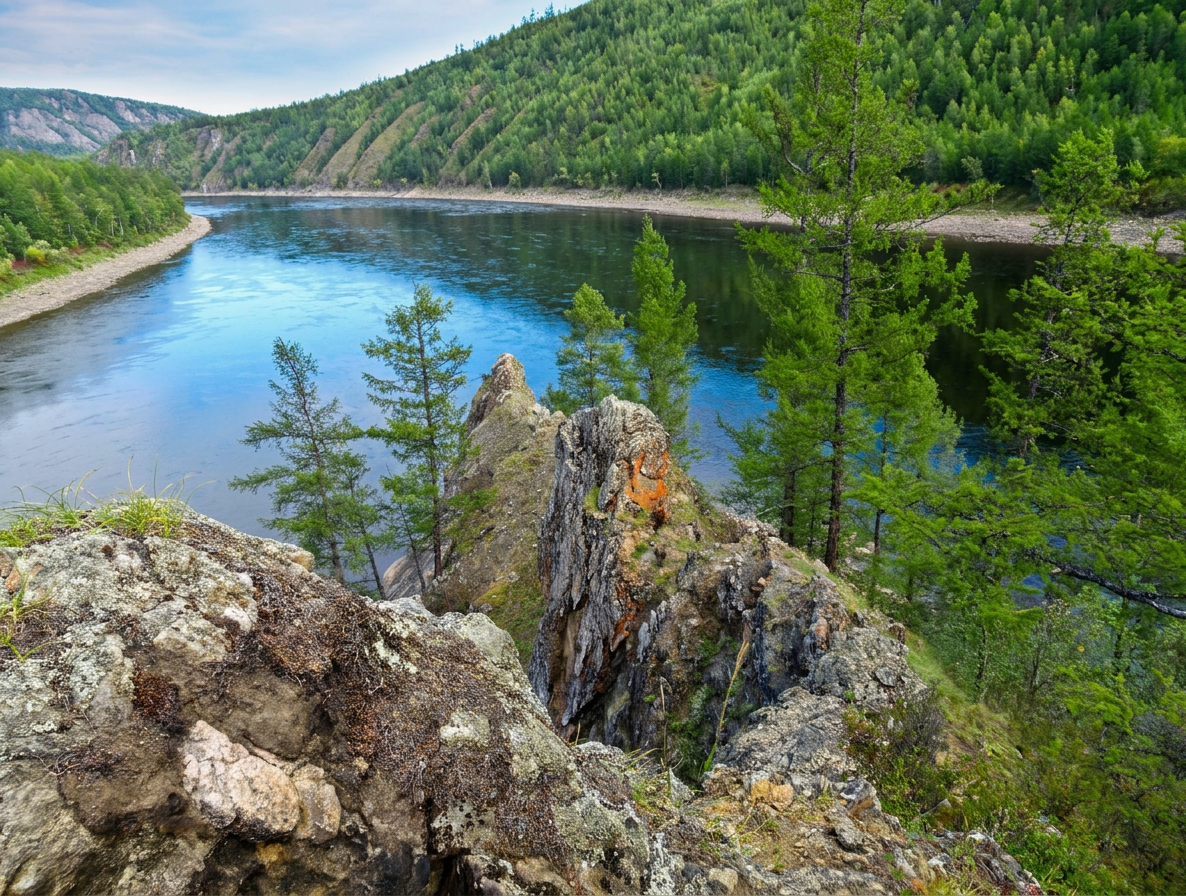
Long before wheat fields spread across Eurasia, before bronze tools, before cities and before permanent mudbrick villages, people living beside a river in eastern Siberia were already making pottery. Their vessels were thin. They were decorated. They were carefully manufactured. And, some were made more than 12,000 years ago.
This is the remarkable archaeological story of Ust’-Karenga, a cluster of prehistoric sites in northern Transbaikalia, along the Vitim River in eastern Siberia. It is one of the most important places for understanding the origins of the Neolithic. Not because its people invented farming, but because they demonstrate that pottery and a hunter-gatherer way of life could develop together.
The earliest pottery at Ust’-Karenga XII has been dated to roughly 12,200–10,700 radiocarbon years BP. With calibrated estimates placing the earliest component around the end of the Late Pleistocene and beginning of the Early Holocene. Independent optically stimulated luminescence dating has subsequently supported the antiquity of the ceramic sequence. [1][3]
This makes Ust’-Karenga one of the great early ceramic traditions of northern Eurasia.

Where is It?
Ust’-Karenga sites lie in Russia, Transbaikal and eastern Siberia. In what is now the Zabaykalsky Krai region. The archaeological cluster is located at approximately 54°28′ N, and 116°31′ E. At the confluence of the Karenga River and Vitim River. The elevation of the river at the confluence is approximately 600 metres above sea level. [1] Genuinely northern Eurasia. The site belongs to the great interior of Siberia and Transbaikalia.

The most important geographical feature is the: Vitim River
A major tributary of the Lena River. Archaeological geography can be simplified Ust’-Karenga to Vitim River to Lena River to Arctic Ocean. An entirely different river world from the Volga, Dnieper or Amu Darya. The people of Ust’-Karenga lived within the enormous drainage system that ultimately carried water northward to the Arctic.

The Karenga River
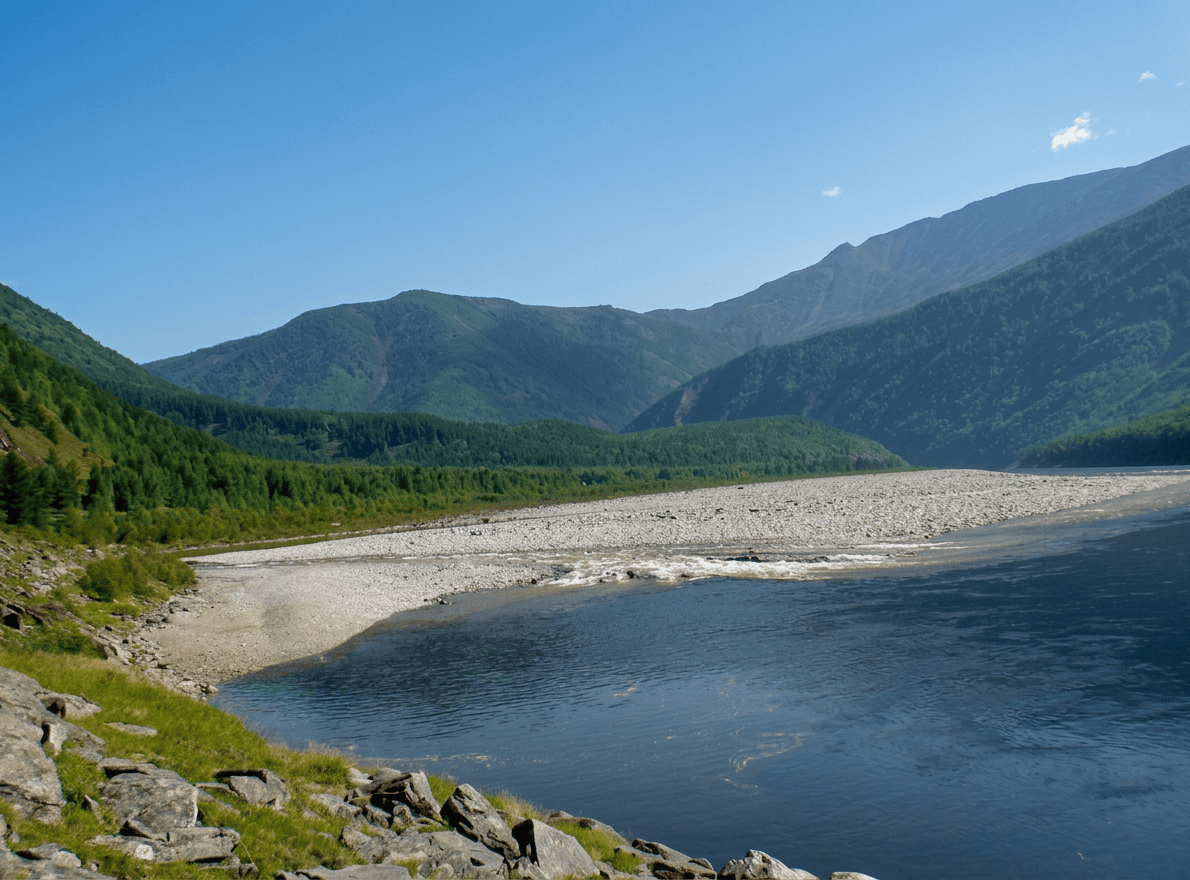
The settlement cluster lies at the mouth of the Karenga River. Where it joins the Vitim. This is important because the archaeological sites are not simply “near a river.” They occupy a river confluence. A confluence is an exceptionally attractive prehistoric location because it combines fish, water, animals, transport, stone, plant resources and different ecological zones. It is a natural prehistoric crossroads.
The surrounding mountains
Ust’-Karenga is surrounded by uplands rather than occupying an enormous open plain. The Vitim cuts through the Vitim Plateau, a low mountainous/upland landscape. The surrounding plateau generally rises to approximately: 800–1,200 metres. With some nearby high points reaching 1,200–1,700 metres. [1] This is therefore a very different landscape from the flat Aral basin. The Ust’-Karenga people lived in a river valley surrounded by taiga-covered uplands and mountains.
What did the landscape look like?
Today the region is characterized by boreal vegetation and extremely continental conditions. The archaeological literature describes dense conifer forest, Dahurian larch, pine, birch and riverine vegetation. The climate is severe. Modern mean January temperatures in the region are approximately: –30 to –33°C. while July can reach approximately: +20°C. Annual precipitation is roughly 350–400 mm. [1]
Imagine building a house here. The architecture suddenly makes much more sense.
No mudbrick cities. Ust’-Karenga was not remotely like Jericho, Çatalhöyük, Mehrgarh or Jeitun
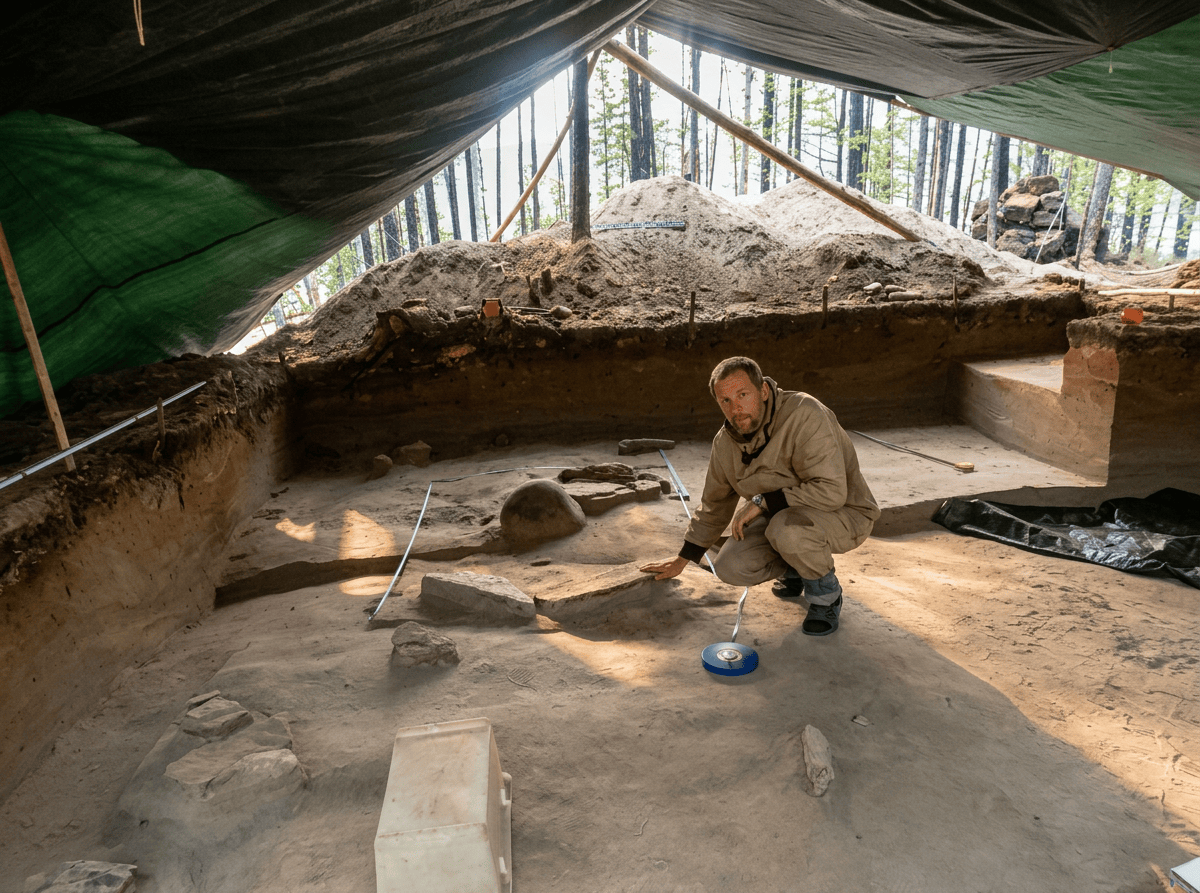
There is no evidence for a mudbrick village. There are no stone houses. There are no massive walls. There is no monumental architecture. Instead, the archaeological evidence points toward lightweight surface shelters. These are generally interpreted as light dwellings or tents, associated with concentrations of hearths, charcoal, pottery and stone artifacts. [4][5]

Houses? An important qualifications for an architectural reconstruction
We do not have a beautifully preserved Ust’-Karenga house with walls still standing. Instead, archaeologists find clusters of artifacts and charcoal. At Ust’-Karenga, these occur in roughly 3–5 metre sub-circular concentrations. They contain pottery fragments, stone tools, charcoal, hearth remains and manufacturing debris. These concentrations have been interpreted as the remains of light surface dwellings or tents. [4]
A safe bet is: small circular or sub-circular timber-and-organic shelters.
Timber frame?
Probably. The archaeological pattern is consistent with lightweight structures using organic materials. But we need to distinguish between archaeological evidence, and reconstruction. Wooden poles and branches decay. Therefore we generally do not have the complete frame. The most defensible reconstruction is wooden poles branches, bark/reed/vegetable coverings and animal skins or other organic materials. This is much closer to a Siberian tent or light frame hut than a mudbrick house.
There is no compelling evidence that the earliest Ust’-Karenga dwellings were deep subterranean houses, wattle and daub, mudbrick, hybrid or other.
Hearths are among the clearest architectural features
Ust’-Karenga XII’s cultural layer contains several well-preserved hearths with concentrations of artifacts around them. Some hearth-associated activity areas extend to approximately 6 metres across. [1] The distribution of pottery and lithics around these fires helps archaeologists reconstruct the activity areas. The hearth was therefore the centre of domestic life.
What happened around the hearth? Probably almost everything
A Siberian hunter-gatherer household needed fire for warmth, cooking, drying clothing, drying meat, working wood, working bone, making adhesives, maintaining tools and pottery production. The hearth was effectively the engine of the house.
No giant communal hall comparable with Dzhanbas-4 has been identified
The Ust’-Karenga settlement system appears much more compatible with small mobile households or family groups.
The settlement was not a village in the Near Eastern sense
The site probably did not contain: dozens of permanent houses, streets, storage buildings and public buildings. Instead, the settlement was probably a collection of small occupation units repeatedly established beside the river. Some locations may have been used more intensively than others.
The wider Ust’-Karenga complex contains more than thirty archaeological sites, demonstrating repeated use of the Vitim/Karenga landscape. [2]
A river settlement system. Perhaps the best way to visualize it
Rather than: “the village of Ust’-Karenga” think: “the Ust’-Karenga river landscape.” People could move between: fishing places, hunting locations, camps, tool-making areas and seasonal resource locations. One archaeological site may represent only one part of a much larger settlement system.
What did they eat?
The strongest archaeological interpretation is hunting, fishing and gathering. There is no evidence that Ust’-Karenga was an agricultural village. The people lived in a landscape extraordinarily rich in wild resources. Likely foods included fish, wild mammals, birds, berries, roots, nuts/seeds where available and other gathered plants. Unfortunately, direct plant remains from the earliest cultural layers are very poorly preserved. Researchers therefore have to reconstruct diet from the environment and associated archaeology rather than relying upon a large archaeobotanical assemblage. [1][6]
Wheat? Barley? Agriculture was not established in this region until much later
Kuzmin and Vetrov specifically emphasized that agriculture was unknown in these northern Siberian regions until considerably later, around the Bronze Age. [1]
Domesticated animals?
There is no good evidence for an established herd of sheep, goats, cattle, pigs and/or horses.
The early Ust’-Karenga economy was a hunter-gatherer economy. That is particularly important because it demonstrates again that pottery does not equal farming.
What animals were hunted?
The surrounding environment could support: elk, deer, roe deer, wild boar in suitable areas, smaller mammals, waterfowl and fish. The exact animal spectrum changed as climate and vegetation changed. Large mammals were particularly valuable because a single successful hunt could provide meat, fat, hide, sinew, bone and antler. One animal could therefore supply much of the household.
Fishing
Fishing was likely important because the settlement sat directly beside the Vitim/Karenga river system. However, the evidence is less spectacular than at some other early fishing sites. There are no famous enormous fish traps or preserved boats. Instead, the river itself provides the environmental context, while the archaeological assemblage includes points and other tools compatible with hunting/fishing activities. The wider East Siberian early-Neolithic record shows that riverine occupations commonly combined hunting and fishing. [6]
Did they build boats? An excellent question
No Ust’-Karenga boat has been preserved. Wooden boats would be extremely unlikely to survive in the archaeological context. Nevertheless, the Vitim was a major river. Watercraft would have been a useful technology. Possible craft could have included dugout canoes, log boats, bark boats and simple rafts. But these should be regarded as possible rather than demonstrated Ust’-Karenga technologies. It’s possible watercraft was used on the Vitim River; though direct archaeological evidence has not survived.
Flint
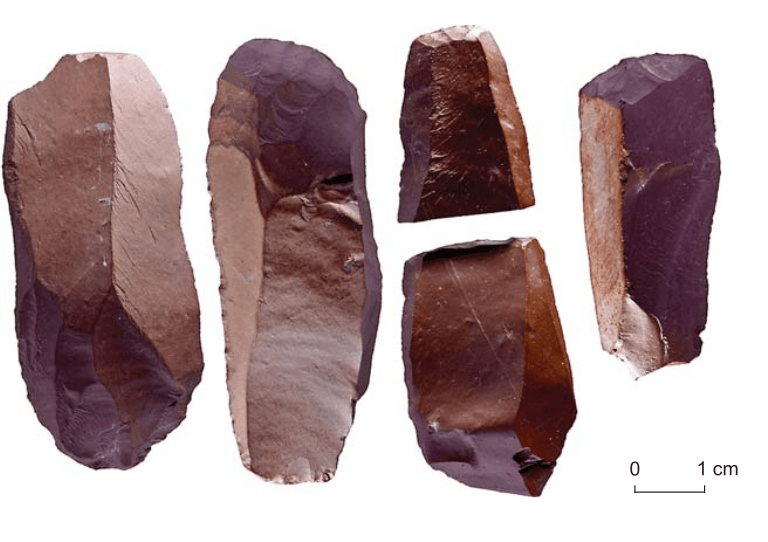
Yes. Flint was one of the most important raw materials. Researchers recovered thousands of stone artifacts from Layer 7. These include: wedge-shaped cores, prismatic cores, sub-prismatic cores, microblades, burins, scrapers, knives, chisels, points and bifaces. [1] This is a sophisticated stone technology.
Local flint
One of the most interesting details is that much of the flint appears to have been obtained from river gravels. Pebbles were collected from the Vitim and Karenga channels. [1] A wonderful example of prehistoric resource engineering. The river supplied water, food, transport and tool stone.
Microblades
Ust’-Karenga is especially interesting because its Neolithic pottery occurs together with a stone industry that still looks strongly Upper-Palaeolithic. This includes wedge-shaped microblade cores. That combination is extraordinary. The people were technologically “Neolithic” in one sense: pottery but technologically conservative in another: Palaeolithic-style hunting and cutting technology. [1][7]
There is evidence for movement of unusual stone materials across the wider Vitim region
This becomes very interesting with: pumice and nephrite.
Pumice from the Udokan region
A pumice artifact at Ust’-Karenga XVI has been traced to the Udokan volcanic field. This is significant because it demonstrates that stone materials could travel substantial distances through the Vitim network. [8] Pumice is not particularly useful for making sharp knives. Its presence is therefore especially interesting. It may have been: selected for a particular property, carried as a valued object and used for grinding or other tasks. Either way, it demonstrates movement of material beyond the immediate campsite.
Nephrite: a much bigger story
Even more exciting is: nephrite. Chemical studies indicate that Vitim-type nephrite was used for objects at Ust’-Karenga XII. Some nephrite material appears to have travelled as much as approximately 1,000 km within prehistoric exchange/mobility networks. [8] That is an astonishing distance. This is not evidence of a Bronze Age-style merchant caravan. It is evidence that people, objects and raw materials were moving across enormous distances in prehistoric Siberia.
Mountains as resource zones
Ust’-Karenga was not isolated in a little river valley. The surrounding mountains and uplands supplied stone, mineral resources, wildlife and timber. The Vitim itself acted as a transportation corridor. Thus: mountains, raw materials; river, movement; floodplain, settlement; forest, timber/fuel; and river, food. An integrated resource system.
The real connection is Eurasian—but not necessarily direct. Ust’-Karenga is part of a much larger story of hunter-gatherer pottery
Comparable early ceramic traditions appear in the Amur basin, the Russian Far East, Japan, China and Siberia. The important point is that pottery could emerge in independent hunter-gatherer contexts. That is one of the great lessons of East Asian archaeology.
The most interesting “valuable” materials are instead: nephrite, unusual stone, pumice and high-quality flint. stone was wealth.
Ust’-Karenga is not famous for a large corpus of anthropomorphic figurines
Its archaeological identity is overwhelmingly associated with: pottery, microblades, burins, scrapers, bifaces, hunting equipment and hearths.
The most interesting “valuable” materials are instead: nephrite, unusual stone, pumice and high-quality flint. stone was wealth.
This is different from some European and Near Eastern Neolithic cultures where figurines became prominent.
Ochre and burials
There is not a famous Ust’-Karenga burial cemetery comparable to some later Siberian or European Neolithic sites. The archaeological importance of the cluster lies much more strongly in: habitation, technology, pottery and riverine subsistence than in mortuary architecture.
Weapons
There are projectile points and other hunting-related implements. The stone industry contains: points, bifaces, microblade inserts, knives and burins. These could be incorporated into hunting weapons. A microblade could become part of a composite projectile or cutting tool. This is one of the strengths of Siberian technology: small stone inserts could make larger organic weapons more effective.

The pottery. Archaeological superstar
The earliest pottery occurs in: Layer 7 of Ust’-Karenga XII. The vessels are thin, plant-fibre tempered, generally pointed/rounded-bottomed, decorated with comb impressions, sometimes featuring zigzag, herringbone and cogged/stamped designs. [1][2] Approximately twenty vessels have been reconstructed from hundreds of fragments in the classic study. [2]
The pointed bottom
This is a particularly Siberian-looking technology. Some vessels have pointed or sharply rounded bases. Why? We cannot know with certainty. But a pointed-bottom vessel can sit conveniently: in soft sediment, among stones, in a fire-support arrangement and in a shallow depression. It also works well with mobile hunter-gatherer equipment.
A flat-bottomed vessel assumes a place to put the vessel. A pointed-bottom vessel can be embedded in the ground or supported by stones. That is a small design choice with a large architectural implication.
Why make pottery if you’re mobile?
It pottery provides capabilities that skins and wooden containers do not. It can boil food, render fat, cook meat, cook fish, process oils and potentially process plant foods. It makes wild foods easier to process.
Pottery may have been a response to abundance
This is an important possibility. If rivers and seasonal resources supplied large quantities of fish, meat and fat. Then cooking technology becomes increasingly valuable. A ceramic pot allows prolonged boiling and rendering. In other words: Pottery can be an adaptation to a rich hunter-gatherer economy.
Climate and the Younger Dryas
The earliest Ust’-Karenga pottery appears near the transition between the: Late Pleistocene, and Early Holocene. This was a period of enormous climate instability. The Younger Dryas, approximately 12,900–11,700 years ago, brought a major return to colder and drier conditions in many parts of the Northern Hemisphere. Regional Transbaikal records indicate substantial climatic fluctuations around this period. [9] The Ust’-Karenga sequence is therefore particularly valuable because it sits close to one of the great climatic turning points in human prehistory.
But was the climate exactly like today’s?
No. The landscape changed considerably. Pollen and palaeoenvironmental research indicates changing combinations of grass steppe, pine, larch, birch and open woodland. One reconstruction for the period of the earliest Ust’-Karenga pottery suggests a cold grass-steppe environment alternating with pine-larch forest and dwarf birch. [10] So we should not simply imagine modern dense Siberian taiga. The landscape was more open and dynamic.
Then the Holocene arrived
As the climate warmed ice retreated, vegetation changed, forests expanded, river environments changed, animal distributions changed and human settlement patterns changed with them. The Ust’-Karenga tradition continued for a surprisingly long time.
It was not abandoned all at once
The broader Ust’-Karenga culture extends far beyond the earliest pottery layer. Research indicates occupation of the region from approximately 14,200 cal BC through much of the Holocene, with the Ust’-Karenga cultural sequence extending to approximately 5500 cal BC. [4]
The settlement system changed repeatedly.
Ust’-Yumurchen
Eventually the archaeological tradition changed. Around the transition approximately 5000/4600 BP. A new cultural complex called: Ust’-Yumurchen appeared. Its origins have been associated with populations moving into the area from southern Transbaikalia. [11] The pottery and stone technologies changed. This is better described as: cultural transformation, rather than simple abandonment.
The modern archaeological history begins with Soviet investigations of the Vitim basin
The Ust’-Karenga cluster was discovered in the 1970s during systematic archaeological survey. Important researchers include M. P. Aksenov, V. M. Vetrov and later, Yaroslav V. Kuzmin, along with researchers E. M. Ineshin, and others, working throughout the Vitim basin. The archaeological investigations were associated particularly with research institutions in Irkutsk and the wider Siberian archaeological community. [1][12]
Modern ceramic science
More recent work has gone beyond simply describing the pottery. Researchers have studied clay sources, mineral inclusions, manufacturing methods, forming techniques, organic inclusions, firing and vessel variability. Peter Hommel and colleagues have demonstrated that the Upper Vitim pottery tradition is technologically more complicated than the older description of “plant-fibre tempered pottery” suggested. [4][13] Some vessels contain substantial mineral inclusions, including crushed rock/granitic material.
Clay was local
Another architectural-material lesson. Clay deposits occur naturally in the Vitim/Karenga floodplain. Researchers have identified fine silty clay deposits close to the archaeological sites. These clays contain clay minerals, silt, sand and organic material. [13]
So pottery production could be integrated into the local river landscape.
Repairs tell a story
Some Ust’-Karenga pottery vessels show evidence of repair. This is fascinating. Pottery was valuable enough to fix. A cracked pot was not necessarily thrown away. A good pot was worth repairing.
The house and the pot
The architecture and pottery tell the same story. House, lightweight, portable, repairable, locally sourced.
Pot. lightweight for ceramic technology, repairable, locally sourced, portable—but fragile.
Both belong to a society that valued mobility without technological simplicity.
The great contradiction: Ust’-Karenga looks “primitive” only if we measure it against cities
But consider what these people could do. They could construct shelters, control fire, hunt large animals, manufacture composite tools, produce microblades, make pottery, decorate pottery, select clay, repair vessels, travel along major rivers, acquire distant stone, process food by boiling AND, maintain a sophisticated seasonal settlement system. That is not technological simplicity. It is technological specialization without agriculture.
Ust’-Karenga and the “Neolithic Revolution”
The phrase “Neolithic Revolution” works well in some parts of the world. It works poorly here. The Levant gives us: sedentism, cultivation, domestication and farming villages. Ust’-Karenga gives us something different riverine hunter-gathering, pottery and continued mobility. Both can be called Neolithic. That tells us something important. There was never one Neolithic. There were many.
A Siberian architecture of survival
The Ust’-Karenga architectural system was River, Forest, Fire, Lightweight Shelter, Pottery and Microblade Technology. Rather than as a conventional “house.” The building was one part of a much larger system.
Construction system
The probable construction sequence might have been: select river terrace, cut poles, construct small frame, cover with bark, hide, brush or other organic material, establish hearth, arrange tools and pottery around fire, repair as necessary and move when seasonal resources changed. This is a very different architectural philosophy from dig foundation, make bricks, build walls and stay permanently.
The river was the highway
The Vitim was not just a source of fish. It was also a natural transportation corridor. Water travel could connect camps, hunting grounds, raw-material sources, tributaries and seasonal territories. Even without surviving boats, the geography makes the river an obvious communication route.
The river was also a quarry
Flint came from river gravels. Clay occurred in the floodplain. Water supplied food. Timber grew nearby. This is almost a perfect example of a closed local resource loop. The settlement did not need to import its fundamental building and subsistence materials.
Nephrite and pumice evidence tells us something very different
The Ust’-Karenga people participated in networks extending across the Vitim and broader Baikal region. At Ust’-Karenga XVI, two ritual pits dated to approximately 7–6 thousand radiocarbon years BP contained argillite artifacts whose raw material has chemical similarities to artifacts from Kovrizhka I, roughly 700 km away along the river system. [8] Researchers interpret these patterns as evidence for episodic contacts rather than one enormous continuously dispersed population. This is exactly the kind of prehistoric communication network that modern maps often fail to show.
Ritual pits
This is one of the more surprising discoveries in the later Ust’-Karenga sequence. Two ritual pits at Ust’-Karenga XVI contained clusters of argillite artifacts, including cores, blades, inserts and end-scrapers. [8] This suggests that the later Ust’-Karenga tradition did have structured ritual behaviour. But it is important not to transfer those 7–6 ka ritual pits directly onto the earliest 12,000-year-old Ust’-Karenga XII occupation. They belong to different stages of the long cultural sequence.
Ritual activity appears to have been conducted through pits, objects, hearths and special deposits rather than monumental architecture
This is another useful lesson: Ritual does not require a temple.
No spectacular Gold finds like later Eurasian assemblages
The Ust’-Karenga story is much more interesting for another reason: people valued unusual stone. Nephrite and other exotic materials could travel huge distances. In a society without metallurgy, a beautiful or unusual stone could perform some of the social role that metal later performed.
No palace, no mine, no metal empire
Ust’-Karenga therefore gives us an almost completely different definition of wealth. Wealth could mean: good hunting territory, good fishing territory, excellent flint, nephrite, warm clothing, reliable fire, good pottery and knowledge of the river. The most important resources were not buried underground. They were embedded in the landscape.
Three things make the site especially important. (pottery, no agriculture and paleo aside neolithic)
- Extremely early pottery. It is among the earliest ceramic traditions in Siberia. [1]
- Pottery without agriculture. The people remained hunter-gatherers.
- Palaeolithic technology alongside Neolithic ceramics. Microblade and bifacial technologies survived alongside pottery. Together these demonstrate that technological change does not occur as one package.
The most important lesson for architecture
Ust’-Karenga demonstrates. A building does not need to be permanent to be sophisticated. A light shelter requires knowledge of: structural geometry, wind, snow, insulation, fire, moisture, materials and repair. In a –30°C winter environment, a poorly designed shelter is not merely inconvenient. It is dangerous.
The architecture was light probably because it was mobile
If your food supply depends upon migrating animals, seasonal fish, berries and changing vegetation. Then permanent architecture can become a liability. A light structure has advantages less labour, less material, faster construction, easier repair and greater mobility.
But the pottery was heavy. Here is the wonderful contradiction again
They were mobile enough to favour lightweight shelters. Yet they carried ceramic vessels. Because some technologies are worth carrying. A pot can transform cooking. A microblade can transform hunting. A light shelter can transform mobility. The Ust’-Karenga system optimized the combination.
Ust’-Karenga compared with Kelteminar
Kelteminar: Aral/Amu Darya, warmer. Wetlands and reeds. Large communal structures. Fishing, hunting and pottery.
Ust’-Karenga: Vitim/Lena basin. Extreme continental climate, taiga/steppe. Timber, small lightweight shelters. Hunting, fishing and pottery.
Both use pottery. Both are hunter-gatherer societies. But their architecture is radically different. That is because architecture follows ecology.
Ust’-Karenga compared with Sakhtysh
Sakhtysh: central European Russia. Forest. Substantial timber architecture. later Neolithic chronology. Agriculture eventually important.
Ust’-Karenga: Transbaikal. River + taiga. Lightweight shelters, very early pottery and no farming. The word “Neolithic” therefore hides enormous diversity.
The site as a communication machine
The river connected communities. The pottery encoded learned techniques. The stone industry encoded manufacturing sequences. The house encoded construction knowledge. The landscape encoded seasonal knowledge. Children could learn all of this simply by watching. The system was effectively a prehistoric information network.
A building without walls Ust’-Karenga: The Neolithic Before the House
Because the archaeological evidence suggests that people were already doing many “Neolithic” things pottery, repeated settlement, specialized craft, structured hearths and long-distance movement of materials. But they had not yet committed themselves to heavy permanent architecture.
The result is a fascinating middle ground home without masonry, pottery without farming and Neolithic without agriculture.
Ust’-Karenga should not be presented as a failed village waiting to become agricultural. It was successful on its own terms
Its people exploited one of the great ecological corridors of northern Asia. They built light shelters. They controlled fire. They manufactured sophisticated stone tools. They made pottery thousands of years before local agriculture. They travelled. They exchanged materials. They adapted to dramatic climatic changes. And, they left us a remarkable archaeological message: Human technological progress does not move in a straight line. Sometimes the next great invention is not a bigger house. Sometimes it is simply a better pot.
References: [1] Kuzmin, Y. V., & Vetrov, V. M. (2007). The earliest Neolithic complex in Siberia: The Ust-Karenga 12 site and its significance for the Neolithisation process in Eurasia. Documenta Praehistorica, 34, 9–20. DOI: 10.4312/dp.34.2. Essential starting reference for Ust’-Karenga XII
[2] Kuzmin, Y. V. (2002). Review of the earliest centres of pottery origin in the Russian Far East and Siberia. This work discusses the Ust’-Karenga cultural complex, its more than 30 sites, reconstructed vessels and distinctive pointed-base, comb-decorated pottery.
[3] Hommel, P., Schwenninger, J.-L., Ineshin, E. M., & Vetrov, V. M. (2017). Testing times: An evaluation of the radiocarbon chronology for early ceramic vessel production at Ust’-Karenga. Reports of the Laboratory of Ancient Technologies, 13(1), 31–46. The OSL evidence independently supports the antiquity of the ceramic sequence and addresses criticisms of the original radiocarbon chronology.
[4] Hommel, P. (2019). The emergence of ceramics among hunter-gatherers in Northern Eurasia: The Neolithic ceramics of the Upper Vitim Basin, Northern Transbaikal, Siberia. PhD thesis, University of York. Particularly valuable for architecture, pottery technology, clay sources, settlement organization and the Ust’-Karenga/Ust’-Yumurchen sequence.
[5] Hommel, P., Day, J., Jordan, P., Müller, J., & Vetrov, V. M. Studies of Upper Vitim pottery and settlement.
[6] Kuzmin, Y. V. Studies of early pottery in Siberia and the Russian Far East. The archaeological record indicates that the early ceramic complexes were principally associated with hunter-gatherer economies, with hunting and fishing playing major roles.
[7] Iizuka, F. (2019). Studies of pottery origins in East and Northeast Asia. Ust’-Karenga is important because pottery occurs alongside technologies derived from earlier Upper Palaeolithic traditions, demonstrating that ceramic adoption did not require agricultural production.
[8] Tetenkin, A. V., Demonterova, E. I., Pashkova, G. V., & Kaneva, E. V. (2018). “Argillite artifacts and final Pleistocene to Middle Holocene cultural links across the Vitim River basin (Baikal Region).” Archaeology, Ethnology and Anthropology of Eurasia, 46(2), 16–24.
[9] Tsydenova, N., et al. Research on environmental conditions and early ceramics in Transbaikalia. Regional evidence indicates significant climatic fluctuations around the Late Pleistocene–Holocene transition, including cooling associated with the Younger Dryas.
[10] Palaeoenvironmental reconstructions of the Ust’-Karenga region indicate cold grass-steppe conditions alternating with pine-larch forest and dwarf birch during the early ceramic period. This is important when reconstructing the landscape rather than simply projecting modern Siberian taiga backward in time.
[11] Research on the later Ust’-Yumurchen transition places a major cultural change around approximately 5000/4600 BP, associated with changes in pottery and lithic technologies and movements from southern Transbaikalia.
[12] Aksenov, M. P., & Vetrov, V. M. The Ust’-Karenga archaeological cluster was identified during systematic surveys of the Vitim basin in the 1970s by researchers associated with Irkutsk State University. Subsequent work by Vetrov and colleagues established the archaeological sequence.
[13] Hommel, P., et al. Research into clay selection in the Upper Vitim Basin demonstrates that floodplain clays were readily accessible around Ust’-Karenga and were exploited for pottery production; the study also emphasizes the technological diversity of the ceramic assemblage.
Leave a Reply