<home # start here # guides # builds # services # shop # about # categories>
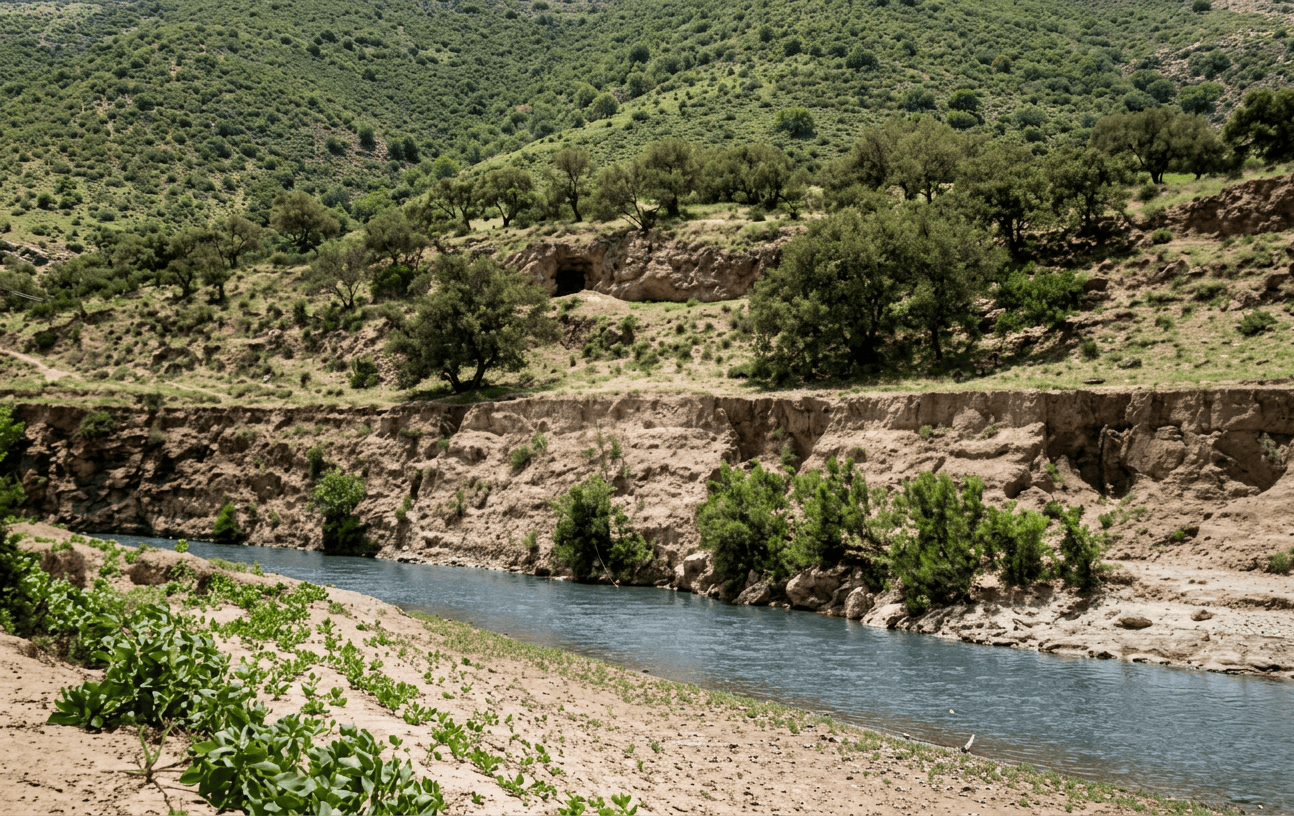
“Maghreb zone escargotières” is not the name of one archaeological settlement. Escargotière (“snailery”) is an archaeological term for a prehistoric shell-and-ash midden, especially common across Morocco, Algeria, Tunisia and Libya.
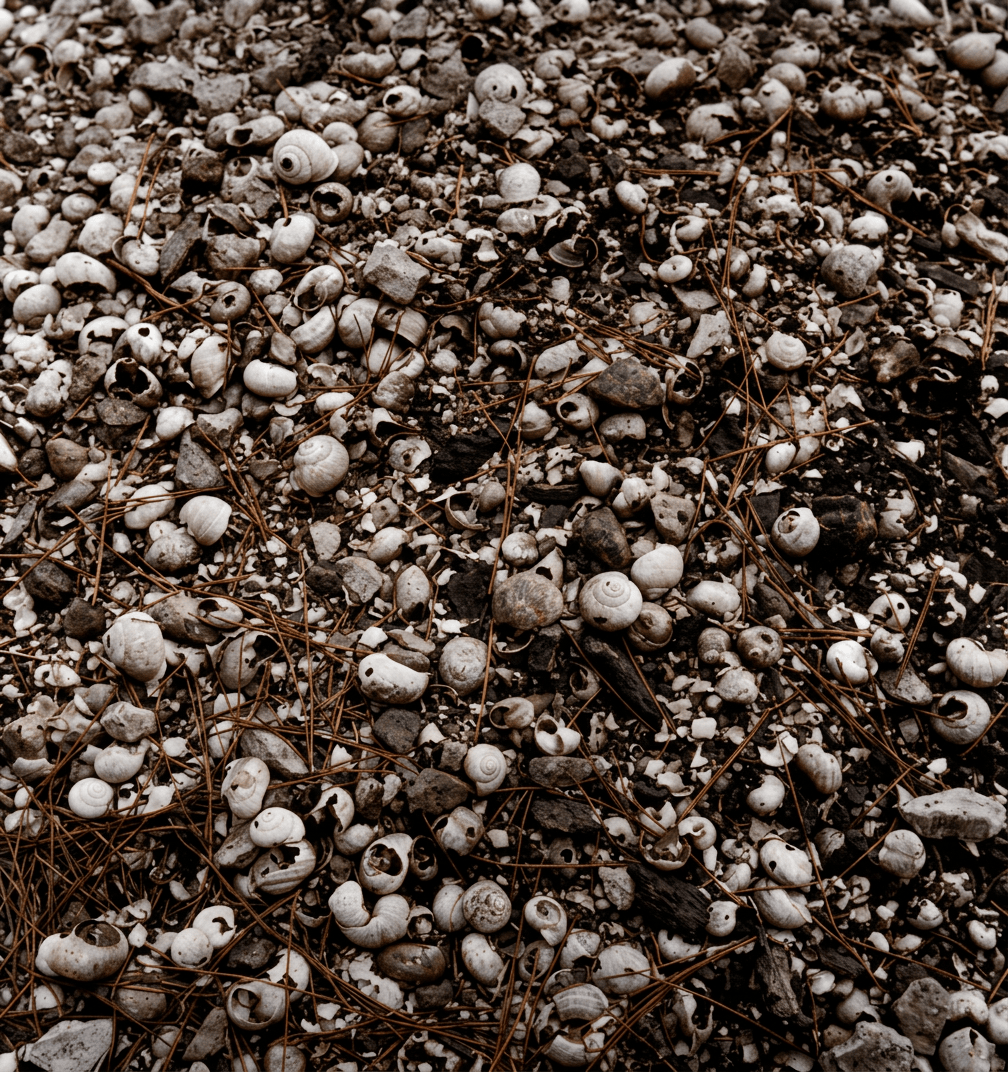
An excellent example, the Escargotière (“snailery”)lies in the Atlantic Atlas of Morocco, about 10 km southeast of Essaouira, in the valley of the Oued Ksob. The site is only about 100 m above sea level and sits on the side of a small rocky terrace or talus, immediately beside a rock shelter. The archaeological deposit overlooks the Oued Ksob by about 7 m. [1]
This is therefore a very different landscape from inland Moroccan sites such as Oued Beht
Tissouirine was close to the Atlantic Ocean; immediately beside the Oued Ksob; close to a natural rock shelter; surrounded by low rocky hills and the Atlantic Atlas; and, connected by the river valley to the mountains farther inland. The Oued Ksob ultimately flows west into the Atlantic Ocean at Essaouira. The river system rises much farther inland in the western High Atlas; its watershed extends from near sea level to roughly 1,700 m elevation. [2]

The escargotière itself was therefore positioned at an unusually useful ecological crossroads: ocean, river, freshwater, rocky shelter, terrestrial snails, flint and vegetation
That helps explain why people repeatedly used the location.
Tissouirine is roughly 10 km southeast of Essaouira, while the Oued Ksob reaches the Atlantic only a few kilometres downstream
Archaeological work in the Ksob valley describes the river mouth as less than about 5 km from the Tassouirine archaeological zone. [3] This means people could exploit two very different food environments: Land, terrestrial snails, plants, small mammals, wild sheep/mouflon, other terrestrial animals; and,
River: freshwater, river gravels, flint, probably other aquatic resources; and
Ocean: mussels and other marine shellfish, coastal plants and animals and marine materials
At Tissouirine, marine mussel shells occur alongside enormous quantities of terrestrial snail shells. The mussels were apparently collected from the Atlantic and carried inland to the settlement. [1] This is one of the most interesting things about the site: the archaeological deposit records movement between the ocean and the river valley.
Was there a lake?
There is no evidence for a large permanent lake immediately beside Tissouirine. The important water feature was the Oued Ksob and its floodplain/terraces. The archaeological study also indicates that the river channel was formerly higher than it is today, meaning that water was probably easier to obtain from the immediate landscape during the period of occupation. [1] The Ksob ultimately drains directly to the Atlantic. So the landscape can be simplified as high Atlas, Oued Ksob, Tissouirine, Essaouira and Atlantic Ocean.
Mountains
Tissouirine was not in a high mountain environment, but it was part of the Atlantic Atlas mountain system. The Ksob watershed reaches into the western High Atlas, and the river’s headwaters and tributaries drain mountainous terrain. The upper watershed rises dramatically inland. [2]
At Tissouirine itself, however, the landscape was much gentler low rocky plateaux, river terraces, hills, shrubs, grassland and coastal vegetation. So I would describe it as a coastal-mountain transition zone, rather than a mountain settlement.
Was it inside a cave?
Not exactly. Tissouirine was an open-air escargotière located on the slope of a rock shelter. The nearby shelter provided some natural protection, while the midden accumulated outside/on the slope. The archaeological team describes the site as a plein-air site associated with a rock shelter, approximately 7 m above the Oued Ksob. [1]
Nearby Tassouirine also contains several small rock shelters. One of them, Tassouirine II, is only about 1 m deep and has an extremely low ceiling. [3] So this wasn’t a giant cave settlement like Taforalt. Instead the rock shelter was the roof; the midden became the floor, rubbish dump, cooking area and archaeological record.
Was this an extreme environment?
Not by North African standards. The region is semi-arid to arid Mediterranean, influenced strongly by the Atlantic. Modern Tissouirine lies within an arid Mediterranean vegetation zone, with open grassland and scattered argan trees. The archaeological pollen record suggests a landscape containing grasses, shrubs and trees rather than true desert. [1] It was therefore considerably more hospitable than the Sahara. The attraction was probably its combination of: relatively mild coastal temperatures; access to water; river terraces; edible snails; marine shellfish; terrestrial animals; wild plants; readily available flint; and natural rock shelter.
When was it occupied?
The best-known Tissouirine escargotière produced radiocarbon dates of approximately: 6,892 ± 166 BP at the bottom; and 5,003 ± 141 BP near the top. [1]
Archaeological material has been interpreted as Early Neolithic/Rharbian. This is important because it is not primarily a 12,000-year-old Paleolithic site. There were much earlier prehistoric occupations in the wider Essaouira region, including caves and rockshelters, but the securely dated Tissouirine escargotière itself begins around 7,000 years ago.
What exactly is an escargotière? The name comes from French escargot, “snail”
An escargotière is essentially an enormous accumulation of: snail shells; ash; charcoal; burnt stone; animal bones; stone tools; food debris; sediment; sometimes pottery; and sometimes human burials. Across the Maghreb, these deposits can become astonishingly large. They are sometimes called rammadiyet in Arabic archaeological terminology, from ramad, “ash.” [4] The important point is that these are not simply natural snail colonies. Concentrations of shells, burning, charcoal, tools and food remains demonstrate repeated human activity.
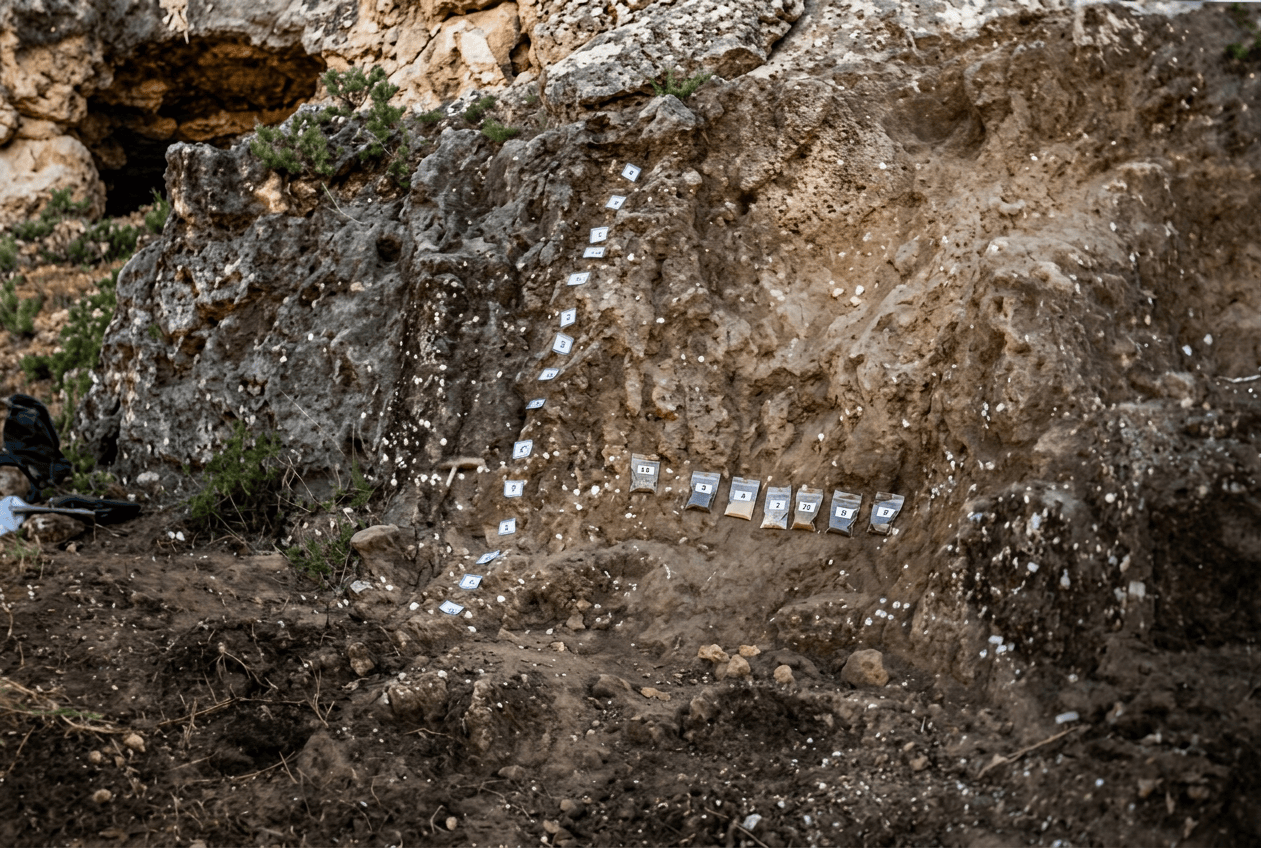
Architecture: Tissouirine is fascinating precisely because there is very little conventional architecture preserved
There is no securely identified: rectangular mudbrick house; stone house; subterranean house; timber-framed village; monumental building; temple; palace; and large communal hall. Instead, the architecture was largely environmental. People used: rock shelter, river terrace, fire, open working space and midden. The archaeological deposit itself became part of the settlement.
The escargotière was approximately 4 m long and 2.5 m high in the surviving exposed section, although the original deposit was probably considerably larger because remnants occur nearby. [1]
Absence of preserved architecture does not mean absence of architecture. It could also mean that the architecture was probably mostly made from materials that disappeared. The environmental study specifically notes the use of wood for maintaining fires and charcoal within the deposit. [1] Charcoal survives much better than untreated wood.
Hearths and fire
Fire is one of the strongest parts of the Tissouirine evidence. The escargotière contains: charcoal; ash; burnt snail shells; burnt stones; burned organic material; and cooking debris. The deposit is literally a fire-modified food landscape. [1] The abundance of burned shell is particularly revealing. People weren’t simply collecting snails. They were: collecting, processing, heating/cooking, eating, discarding, burning/trampling and rebuilding the living surface. Over centuries, this created the enormous ash-and-shell deposit.
The natural rock shelter provided protection from rain and wind, while fire supplied: heat; cooking; light; protection; charcoal; ash; and possibly insect/smoke control
For this environment, simplicity was probably an advantage.
Cooking technology: The most spectacular evidence is actually the food itself
Many snail shells were burned. That strongly suggests heating/cooking. The site also contains: pottery fragments; burnt stones; charcoal; animal bones; and marine shells. Pottery appears to have become part of the Neolithic cooking/serving technology, although the surviving assemblage is relatively modest. [1][3] There is no evidence for sophisticated ovens comparable to later Near Eastern installations.
Storage? At Tissouirine, the food economy appears to have depended heavily on immediate and seasonal gathering, particularly snails
Small-scale storage using: pottery; baskets; leather; woven containers; and dried foods would have been possible, but these materials are poorly preserved.
What did they eat? The principal terrestrial snail was: Otala lactea
Other terrestrial molluscs including Cepea and Rumina. [1] The dominance of Otala lactea is particularly useful environmentally: it indicates an open, grassy Mediterranean environment. So the snails are simultaneously: food evidence, environmental evidence and settlement evidence. They tell us what people ate and something about the landscape in which they lived.
Marine food. Tissouirine also contained marine mussel shells
These are important because they demonstrate movement from the settlement to the coast. The archaeological study identifies Mytilidae in the lower portion of the escargotière and interprets them as marine food brought inland. [1] The wider Essaouira research emphasizes the importance of the nearby river mouth as a source of marine foods. [3] So the diet wasn’t simply “snails.” It was a mixture of land, river and ocean.
Animals
The animal assemblage at Tissouirine is unfortunately rather limited. Identified remains include: Barbary sheep / aoudad (Ammotragus lervia), Shaw’s jird (Meriones shawi) and other poorly identified mammal remains. [1] The aoudad is particularly interesting because it is associated with rocky, open environments. There is not enough evidence at this particular site to claim a livestock economy involving: sheep; goats; cattle; pigs; and horses.
Wheat/barley? Not securely demonstrated at Tissouirine
Finds make the site look more like a foraging-oriented Neolithic community than a fully developed farming village. Fascinating because agriculture existed elsewhere in Morocco during the Neolithic. For example, the nearby Eastern Rif site of Ifri Oudadane preserves domestic cereals and pulses by roughly 7,500 years ago. [5] Tissouirine demonstrates: “Neolithic” did not necessarily mean “farmers everywhere.” Different communities adopted different combinations of technologies and foods.
Argan trees and wild plants
The pollen record is especially interesting. The landscape included: argan (Argania spinosa); grasses; legumes; Ephedra; possible juniper; tamarisk; and numerous herbaceous plants. [1]
The mid-Holocene distribution of argan was different from today. Independent palaeoecological modelling indicates that around 6,000 years ago, argan woodlands extended farther north than their modern distribution in some parts of Morocco. [6] That makes Tissouirine a useful site for studying the history of the famous Moroccan argan landscape.
Stone tools. Yes.
Tissouirine produced a small lithic industry including: cores; flakes; blades; bladelets; burins; perforators; and other retouched pieces. [1] The raw material is particularly interesting. Much of the flint appears to have been locally available, occurring as small nodules and river gravels. The Oued Ksob was therefore not merely a water source. It was also a toolstone source. The wider Tassouirine survey identified concentrations of worked flint around the river and a local source area. [3]
No evidence for Obsidian, jade, gold or elaborate copper metallurgy
Important raw materials were much more ordinary: flint, stone, shell, wood, clay and plant fibre. A good example of architecture and technology based on materials that people could obtain from their immediate landscape.
The strongest trade evidence is for short-distance resource movement: Flint from the Oued Ksob; marine shell from the Atlantic; and terrestrial snails from the surrounding landscape.
Pottery, Yes
Small quantities of pottery were found, generally described as undecorated sherds. [1][3] This is important because it places the occupation firmly within a Neolithic technological world, even though agriculture was not strongly represented at the site. Pottery would have provided a useful new technology for: boiling; cooking; carrying water; storing food; and processing shellfish and plant foods.
Figurines, weapons and game pieces
There is no major figurine assemblage known from Tissouirine. There are also no famous: gaming pieces;
or, ceremonial weapons. The lithic tools could certainly have been used for hunting, cutting, scraping and working organic materials, but there is no spectacular weapon cache.
Burials and ochre
Unlike some of the enormous North African escargotières, Tissouirine has not produced a famous cemetery comparable to Taforalt.
Other Maghreb escargotières sometimes contain human burials and ochre, and the phenomenon as a whole cannot be understood simply as rubbish dumping. [4]
Textiles and basketry
There is no substantial preserved textile assemblage. This does not mean that people didn’t make textiles, mats, baskets or cordage.
What was the settlement actually like?
Rather than imagining a village of permanent houses, a better reconstruction is: Tissouirine settlement system. Rock shelter; protected living/working area; hearths and fires; snail cooking and food processing; stone-tool manufacture; discarded shells, ash, charcoal, bones; growing escargotière; river terrace and pathways toward the Ksob; and coastal route to marine resources. The midden itself became a kind of artificial archaeological hill.
Was it agricultural or nomadic?
It could be described as foraging oriented Neolithic or semi-sedentary settlement rather than fully agricultural village. There is no strong evidence from Tissouirine for intensive cereal farming. The site appears to have depended heavily on: wild snails; marine shellfish; wild plants; hunted animals; local stone; and river resources. That does not necessarily mean highly mobile nomads. The enormous accumulation of food waste indicates repeated, substantial occupation. That is one of the great lessons of escargotières. People could become relatively sedentary before becoming dependent on farming.
What about 8,000 and 10,000 years ago? This requires some chronological care
Tissouirine itself does not have a securely dated occupation this old. But the broader Essaouira region contains much older Stone Age occupations.
8,000 years ago. This is approximately 800 years before the beginning of the dated Tissouirine sequence. Other eastern Moroccan sites were already undergoing major changes associated with the Neolithic transition.
6,000 years ago. This is right in the important Tissouirine period. The archaeological pollen record indicates a warm, relatively dry/open landscape, with increasing woody vegetation in some phases but continuing evidence of heat and dryness. [1]
Independent Moroccan palaeoecological research also indicates major mid-Holocene changes in vegetation, including the expansion and subsequent contraction of argan woodland. [6]
Was there a major climate change?
Yes, but we should not reduce it to one dramatic “climate event.” North Africa experienced a major transition during the early and middle Holocene. After the African Humid Period, conditions generally became increasingly dry. For Morocco, researchers use multiple environmental indicators: Pollen. Tells us about vegetation and therefore moisture/temperature.
Charcoal. Records fire and the plants people were burning.
Snail shells. Can tell us about vegetation and local moisture, while their abundance also records human food collection.
River sediments. Show changes in flooding, erosion and river activity.
Radiocarbon. Provides the chronology for those environmental changes.
Archaeological remains. Show how humans responded.
At Tissouirine, pollen indicates an open, relatively dry landscape, followed by changes in woody vegetation during the occupation. [1]
The 6,000-year climate story
Around 6,000 years ago, North Africa was already moving away from the wetter conditions of the African Humid Period. Palaeoecological modelling indicates that argan had a considerably broader northern distribution around this time than it does today. Subsequent increasing aridity from roughly 6,000–4,000 years ago helped reorganize North African vegetation. [6] That is particularly interesting for Tissouirine because its occupation overlaps this transition.
Why was Tissouirine abandoned? A safe intrepretation
It was a gradual decline rather than a proven catastrophic abandonment. The upper part of the escargotière contains increasing amounts of stones and slope-derived material, while human activity decreases. The researchers interpreted occupation as ending around 5,000 BP. [1] The regional environment was becoming increasingly dry. Occupation declined while the local environment was dry and changing, but the precise reason for abandonment remains uncertain. People could have changed their settlement locations, food strategies, social networks or agricultural practices.
An escargotière is architecture made out of behaviour
At first there was simply a river, rock shelter and edible snails. Then people arrived. They collected food. They made fires. They cooked. They manufactured tools. They discarded shells. They burned wood. They brought stones. They ate. They returned. And, returned again. Over generations, those repeated actions transformed the landscape into a human-made mound of ash, stone, shell and memory. That is architecture in a broader sense. It isn’t a house. It isn’t a temple. It isn’t a city. It is a settlement system encoded in the ground.
Tissouirine compared with Oued Beht
Tissouirine escargotière Oued Beht
~7,000–5,000 years ago ~5,800–4,800 years ago
Atlantic coast Inland Zemmour Plateau
Oued Ksob Oued Beht
Natural rock shelter Open-air settlement
Snails extremely important Cereals extremely important
Hunting/foraging Agriculture/agropastoralism
Little permanent architecture Storage pits + daub structures
No strong cereal evidence Wheat + barley + peas
No major domestic-animal economy demonstrated Sheep/goat + cattle/pig
Food waste builds settlement Food production builds settlement
Architecture of gathering Architecture of farming
The comparison illustrates something fundamental about the Neolithic: There wasn’t one “Neolithic lifestyle.” Different communities solved the problems of food, shelter, water, climate and security in very different ways.

References: [1] Chennaoui, K., Nahid, A., Argant, J., Noçairi, M., Malek, F. & Sahbi, H. (2005). Étude intégrée d’un enregistrement morphosédimentaire anthropique holocène : l’escargotière de Tissouirine (Atlas atlantique, Maroc). Revue de Paléobiologie, 24(2), 541–550. This is the principal detailed multidisciplinary study of Tissouirine.
[2] Studies of the Oued Ksob watershed and its geomorphology describe its connection to the western High Atlas, its Atlantic outlet and its large elevation range.
[3] Boumhaoud, I. et al. (2019). Les origines préhistoriques d’Essaouira: données archéologiques du secteur de l’Oued Ksob. The study documents the Tassouirine shelters, lithics, pottery, marine and terrestrial shells, and the proximity of the Oued Ksob mouth.
[4] Saafi, I., Aouadi, N., Merzoug, S. & Belhouchet, L. (2023). The status of minority species and young individuals of the terrestrial malacofauna in Capsian and Neolithic populations in eastern Maghreb. Paléo, Hors-série, 306–314. Provides a useful regional overview of Capsian and Neolithic rammadiyet/escargotières.
[5] Morales, J. et al. (2013). Research on domesticated plants at Ifri Oudadane, showing that cereals and pulses had entered the Moroccan Neolithic economy by roughly 7,500 years ago.
[6] Alba-Sánchez, F. et al. (2015). Long-term climate forcings to assess vulnerability in North Africa dry argan woodlands. Applied Vegetation Science. The study incorporates the Tissouirine pollen record and discusses the northward expansion of argan around the mid-Holocene and subsequent increasing aridity.
[7] For comparison with the broader Maghreb phenomenon, research on Taforalt and other Iberomaurusian sites shows that escargotières can begin much earlier, during the Late Pleistocene/Epipalaeolithic, and therefore “escargotière” should not automatically be equated with “Neolithic.”
Leave a Reply