<home # start here # guides # builds # services # shop # about # categories>
Tepe Abdul Hosein is one of the most interesting, and still comparatively underappreciated, early Neolithic sites of the Iranian Zagros. It is especially valuable for understanding the transition from temporary occupation to permanent mudbrick settlement, the beginnings of agriculture in the high mountains, early goat management, and the development of a material culture that included figurines, clay tokens, sickle blades, obsidian and worked bone.
The site preserves a remarkable sequence: pits and hearths, prepared floors, mud-and-pisé construction, rectangular mudbrick houses, farming and herding, abandonment and much later reoccupation.
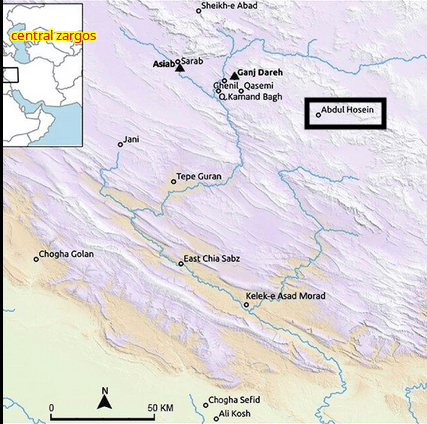
The site is in Lorestan (Luristan), western Iran, in the Central Zagros, at about 1,860 m above sea level. It is roughly 24 km east of Nurabad and about 75–100 km southeast/east-southeast of Ganj Dareh, depending on the route and coordinate used
Where exactly was Tepe Abdul Hosein?
Tepe Abdul Hosein lies in the Khava/Khawa mountain valley or plain of Luristan, in the Central Zagros. A commonly reported approximate position is around 34°N, 48°E, although published coordinate datasets differ somewhat and some modern databases explicitly warn that the location is uncertain. It is in Western Iran, Lorestan, Central Zagros, Khava/Khawa highland valley or Tepe Abdul Hosein. Its not a Tigris-river settlement.
The highland landscape that ultimately drains westward toward the Tigris system. The site itself occupied a small mountain-valley environment rather than the broad alluvial plain beside a major river. It is in the same broad Zagros watershed/environment as Ganj Dareh.
The regional drainage system certainly still exists, but it is better not to describe Abdul Hosein as being directly beside a major perennial river. A good label is high Zagros valley — Tigris drainage basin
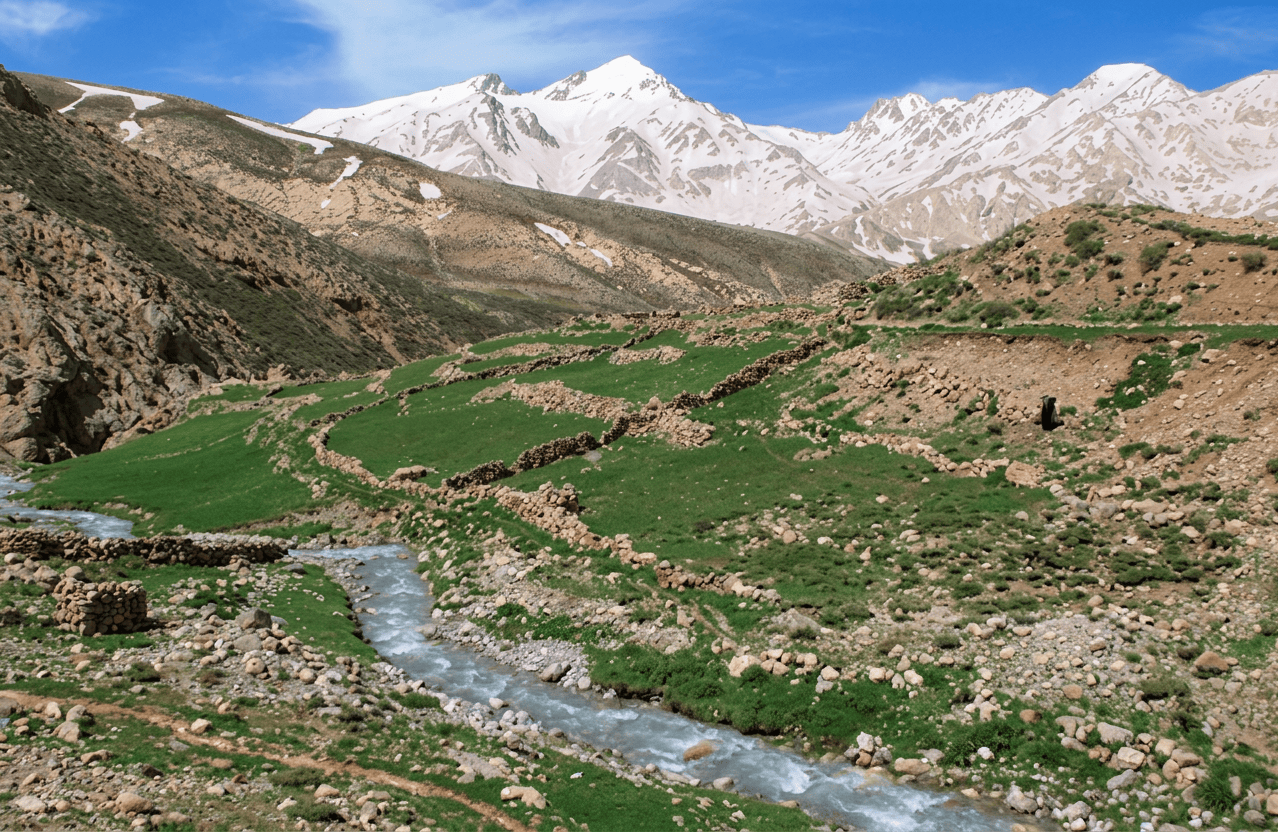
It was in the Zargos mountains
This is not a foothill site looking toward the Zagros. Abdul Hosein is a high-elevation Central Zagros settlement, approximately 1,830–1,860 m above sea level in the published archaeological literature.
It means that the inhabitants were dealing with: cold winters; substantial seasonal temperature variation; mountain pastures; woodland/steppe vegetation; relatively limited arable land; seasonal water availability; and difficult transport across mountain passes. It is therefore an excellent comparison with lower-elevation sites such as Ali Kosh and with the somewhat lower Ganj Dareh.
The closest useful modern reference is Nurabad, approximately 24 km west
Tepe Abdul Hosein is a relatively small mound, approximately 50 m across and about 6 m high in the archaeological descriptions
Excavation was limited, so we should be careful not to reconstruct the entire village from the excavated area.
Judith Pullar directed the major excavation in 1978, with the project specifically designed to investigate: early agriculture; animal husbandry; architecture; and environmental conditions.
The excavated sequence revealed something particularly valuable: the architecture changes through time.
The earliest settlement: before houses
The lowest occupation consisted primarily of pits; fire installations; ash; occupation surfaces; and cooking/storage installations. There was no substantial architecture in the earliest excavated levels. The earliest Abdul Hosein community was not immediately constructing a conventional village of large mudbrick houses. Instead, the archaeological sequence looks something like: natural ground, pits + fires, occupation surfaces, prepared/plastered floors, mud/pisé construction and substantial mudbrick buildings. This is one of the clearest architectural transitions at an early Zagros site.
It was very clearly pre pottery neolithic
The earliest major occupation is Aceramic / Pre-Pottery Neolithic. The stone-tool assemblage and archaeological context place it among the Early Neolithic communities of the Central Zagros. This means something very important: They were using clay architecture before they were routinely making pottery.
Then pottery appeared
The later occupation contains pottery, but it is sparse. The ceramic phase is much later than the principal Aceramic occupation and has been associated with pottery traditions of the fifth millennium BCE in the original synthesis.
Abdul Hosein simply as a “Pottery Neolithic site”
A better classification is: Early Aceramic Neolithic settlement with a later ceramic reoccupation.
An important correction to older chronologies
Older publications sometimes gave Abdul Hosein dates around 9,500 BP, while some interpretations placed the Aceramic occupation in the seventh millennium BC.
More recent direct dating of human remains provides much firmer dates: approximately 8205–7755 cal BC. While older excavated charcoal dates and the original chronology were broader and less secure.
People farmed wheat
This is one of the interesting features of Abdul Hosein. Plant remains include: emmer wheat (Triticum dicoccum), two-row hulled barley, lentils, pistachio and almond. The original archaeobotanical interpretation argued that agriculture may already have arrived at Abdul Hosein in a relatively developed form rather than being invented there from scratch.
Two-row hulled barley (Hordeum distichon) is one of the principal cereal remains
Compared with emmer, barley appears relatively prominent in the assemblage. That is interesting for a high-altitude Zagros settlement because barley is well suited to relatively marginal agricultural environments.
Emmer (Triticum dicoccum) was identified
There is a particularly interesting contrast between Abdul Hosein and some other early Zagros settlements: einkorn is absent or not significant, while emmer and barley dominate.
It could reflect: environmental adaptation; crop choice; trade; cultivation strategy; and, sampling.
It should not automatically be interpreted as a local domestication event.
Lentils and other legumes
Lentils: yes, but in small quantities.
There are also wild weeds and other small-seeded plants associated with the agricultural environment.
Carbonized pistachio (Pistacia) shells occur in the earliest levels
They were numerous enough to suggest that pistachio gathering was important to the economy. This does not mean people had pistachio orchards. The more common interpretation is: wild pistachio gathering from the surrounding Zagros landscape.
Almond remains were also identified
The combination: pistachio + almond + cereals. Is particularly characteristic of the Early Holocene Central Zagros woodland/steppe economy.
No strong evidence for figs
Unlike some Levantine Neolithic sites, fig is not a significant archaeobotanical component of Abdul Hosein.
Other trees
Charcoal analysis identified: pistachio, almond, tamarisk and willow. Willow and other woody plants could have provided construction materials and timber as well as fuel.
Remarkably, oak was not identified in the charcoal assemblage.That is environmentally significant because oak woodland is so important in the modern Zagros.
What did the landscape look like?
The palaeoenvironmental reconstruction suggests a parkland or savanna-like landscape, with: pistachio; almond; grasses; small shrubs; herbaceous plants; and willow/tamarisk in appropriate wetter settings.
George Willcox’s charcoal analysis found relatively narrow growth rings, interpreted as evidence of aridity in the environment from which the wood was collected. So we should not picture Abdul Hosein as an extraordinarily lush mountain forest. It was more likely a semi-arid woodland-steppe mosaic.
Has the climate changed?
The settlement dates to the Early Holocene, when the climate was generally warmer and wetter than the preceding terminal Pleistocene. But the local evidence warns against assuming that the Zagros was simply “green.” The Abdul Hosein charcoal record indicates a relatively dry environment, with open woodland/parkland rather than dense oak forest.
Over the following thousands of years: vegetation communities shifted; oak woodland expanded in parts of the Zagros; human land use increased; grazing became more important; fire increasingly altered vegetation; and, agricultural landscapes replaced portions of natural woodland. So the modern landscape cannot simply be projected backward into the Neolithic.
Sheep and goats
Goats were extremely important. Abdul Hosein belongs to the Central Zagros group of sites that provide some of the earliest evidence for goat management. Modern archaeogenomic research has examined goats from both Ganj Dareh and Tepe Abdul Hosein, demonstrating that these sites preserve very early stages of the transition from wild bezoar goats to managed/domestic populations.
The animal economy appears to have shifted through time toward: wild hunting to increasing management of caprines to a pastoral/agropastoral economy.
Sheep
Sheep were also present in the wider early Zagros economy, and worked bones from Abdul Hosein include sheep/goat material. But they sheep were less diagnostically important
Dogs
Dog: not securely documented as a major Abdul Hosein component. The published Abdul Hosein evidence emphasizes caprines, wild game and worked animal bone, rather than a distinctive dog population.
Hunting continued
Agriculture did not replace hunting. Worked bone indicates use of animals including: goat; sheep; deer; boar; wolf/leopard. This is another good example of why “Neolithic = farmers” is misleading. Abdul Hosein was an agro-pastoral/foraging system.

The architecture develops gradually
Early phase: pits; fireplaces; cooking installations; storage installations; occupation surfaces.
Middle phase: prepared floors; mud/pisé construction; and repeated resurfacing.
Later Aceramic phase: substantial rectangular mudbrick buildings; plastered floors; hearths/ovens; and, repeated maintenance.
One floor was reportedly replastered as many as seven times, sometimes with red ochre. That is wonderful evidence for the practical life of a Neolithic building: a floor was not disposable. It was maintained, repaired and renewed.

What were the buildings made from?
The principal technologies included: mudbrick, pisé/earth, mud plaster, hard-packed floors and wood/timber. The charcoal evidence for willow and other trees suggests that wood was available for construction as well as fuel. This gives us a classic Central Zagros construction system: earth walls + timber + plaster + repeated maintenance.
Eventually they had permanent houses?
The architecture strongly suggests a transition from temporary/seasonal occupation to increasingly permanent settlement. That interpretation is supported by the combination of: increasing architectural investment; repeated floor maintenance; cereal cultivation; storage/cooking facilities; and animal management. Therefore a particularly good site for “hut to house to village” architectural sequence.
No securely identified monumental communal building
There is no known Abdul Hosein equivalent of: Göbekli Tepe’s enclosures; Çayönü’s communal building; or Jerf el Ahmar’s communal structures. The excavated architecture is much more consistent with domestic and productive buildings. However, some burials and unusual objects suggest that symbolic activity took place within the settlement.
So: Communal building: not securely identified;
Ritual activity: probable; and,
Monumental ritual architecture: no evidence.
Burials
This is one of the most fascinating parts of the site. The 1978 excavation identified nine burials, seven of which were attributed to the Neolithic occupation; two belonged to much later Islamic reuse. Several Neolithic burials contained multiple individuals. Some appear to have been associated with collapsed/burning architecture. One group was interpreted by the excavator as a possible family group caught beneath burning debris, although later researchers correctly emphasize that the contextual and biological evidence is not sufficient to prove the exact relationship.
Some of the Abdul Hosein individuals show evidence of intentional cranial deformation
This is remarkable. The practice indicates that the community was manipulating the appearance of the human body from childhood. It also provides a cultural connection to broader Early Neolithic traditions of bodily modification. The skeletal material has been studied by researchers including: Lorentz; Akira Tagaya; Yuko Miyauchi; CNRS researchers; and, the Iran National Museum team.
The site produced clay animal figurines, with rarer human examples
This is significant because the figurines occur in an otherwise Pre-Pottery Neolithic context. So: pottery was not necessary for sophisticated clay technology. People were already manipulating clay to produce: figurines; tokens;
architectural surfaces; plaster; and mudbrick.
Clay tokens
Two clay tokens were recovered from burials at Abdul Hosein. Their precise function is unknown. They may relate to: counting; categorization; exchange; storage; and ritual activity. They should not be described as writing.
The chipped-stone assemblage is characteristic of the Central Zagros Early Neolithic
It includes: blades; bladelets; backed blades; backed points; scrapers; borers; sickle blades; cores; and flakes. A recent study examined 317 stone tools from the National Museum of Iran collection. It found that most of the raw material was local/regional chert, with production taking place at the site.
The majority of the analysed lithics were made from chert/radiolarian chert, with smaller quantities of black and grey flint
The tool-production technology was therefore substantially locally based. A good example of: local stone for everyday tools + imported obsidian for selected tools.
Obsidian appears in the later Aceramic phases, but not in the earliest occupation
The recent lithic study notes that the obsidian is consistent with eastern Anatolian sources, and earlier researchers identified the material as associated with the Nemrut Dağ region. It means that even a small highland community at ~1,860 m was participating in a network extending across the Zagros and toward Anatolia.
The site also produced: shell beads; stone beads; bone ornaments; and tortoise-shell fragments
These are valuable indicators of social identity and exchange.
There is no evidence for a specialized military system
But hunting and projectile technology are represented by chipped-stone points and related tools. The assemblage includes backed points, blades and other cutting implements. There are also sickle blades, which are arguably more important to the site’s story than weapons.
Woodworking very likely
The architecture used timber. Charcoal analysis identified willow and other wood resources, and the wood was used for both fuel and construction. There are also worked bone/antler tools that would have supported woodworking and other craft activities. But: no complete wooden door has survived.
Was the building thermally efficient?
We don’t have modern thermal measurements for Abdul Hosein. But the architectural system would have provided several inherently useful properties
Thick earthen walls: thermal mass, small openings: reduced heat exchange, plastered surfaces: reduced air movement/dust, timber roof: relatively lightweight structure and high-altitude location: strong need for thermal buffering.
Therefore it is reasonable to discuss Abdul Hosein as an early thermal-mass architecture, but not to claim a quantified U-value or modern energy performance without modelling.
How many occupations were there?
This needs some care because different publications divide the sequence differently. The safest interpretation is: Occupation 1 — Early Aceramic Neolithic. Pits; fires; food processing; little/no substantial architecture.
Occupation 2 — Later Aceramic Neolithic. increasingly substantial floors; mud/pisé; mudbrick buildings; farming; herding; figurines; tokens and obsidian.
Hiatus: A substantial abandonment occurred.
Occupation 3 — much later ceramic occupation. A later settlement/reoccupation belongs broadly to the 5th millennium BC, but it was disturbed and is much less important to the Early Neolithic story.
It was abandoned
And this is one of the most important characteristics of Abdul Hosein. The Early Neolithic settlement was eventually abandoned, and archaeological evidence indicates a substantial gap lasting thousands of years before later occupation. The reason for the abandonment is not securely known. Possible factors include: climate; seasonal mobility; agricultural limitations at high altitude; social relocation; changing exchange networks; and local environmental change. It should not be labelled a “climate collapse” without stronger evidence.
Research history is genuinely international
Iranian, British, American, French, Japanese, European researchers and others.
Three individuals from Abdul Hosein were included in the major Early Neolithic genomic study. Two directly dated individuals fall around: 8205–7756 cal BC, and 8204–7755 cal BC. The genomic results place the early Iranian Zagros population within a distinctive eastern Fertile Crescent Early Neolithic genetic cluster. This is important for understanding the spread of farming: The Zagros was not simply receiving a finished Neolithic package from the Levant. It developed a distinctive eastern Fertile Crescent Neolithic trajectory.
The site had seven major Neolithic Architecture significance ratings:
1.High-altitude Neolithic: At ~1,860 m, this is a remarkably high settlement for such an early date.
2. Pre-Pottery architecture: Substantial mudbrick construction existed before pottery became established.
3. Agriculture: Barley and emmer were cultivated or at least intensively managed.
4. Goat management: It participates in the earliest Central Zagros transition toward goat domestication.
5. Wild-tree economy: Pistachio and almond remained important.
6. Exchange: Eastern Anatolian obsidian reached the site. And,
7. Architectural maintenance: Repeated replastering demonstrates long-term investment in earthen buildings.
Abdul Hosein in your Central Zagros sequence
Here’s an example: Asiab, Ganj Dareh, Tepe Abdul Hosein, Tepe Sarab and Tepe Guran, With Chogha Golan farther southwest as a major parallel for plant domestication.
The big story: a mountain village experimenting with almost everything
Tepe Abdul Hosein is especially interesting because it does not fit a simplistic “farmers arrive and build houses” model. Instead, the sequence looks more like: wild pistachio + almond gathering, seasonal occupation, barley + emmer cultivation, goat management, increasingly permanent occupation, mud/pisé architecture, substantial mudbrick houses, figurines + tokens + ornaments, obsidian exchange, repeated building maintenance, eventual abandonment and thousands of years later: reoccupation. That is a very good example of the gradual, experimental character of the Neolithic.
References: Pullar, J. (1990). Tepe Abdul Hosein: A Neolithic Site in Western Iran: Excavations 1978. BAR International Series 563. Oxford: British Archaeological Reports.
Hubbard, R. N. L. (1990). Plant remains from Tepe Abdul Hosein, in Pullar’s excavation report. The study identified barley, emmer, lentils, pistachio and almond.
Willcox, G. (1990). “Charcoal Remains from Tepe Abdul Hosein,” in Pullar, Tepe Abdul Hosein, pp. 223–227.
Broushaki, F. et al. (2016). “Early Neolithic genomes from the eastern Fertile Crescent.” Science, 353(6298), 499–503.
Daly, K. G. et al. (2021). Research on early goat management and domestication in the Zagros, including Ganj Dareh and Tepe Abdul Hosein.
Chehri, M. E., & Sedighi, S. F. (2022). “Techno-Typological Study of Tepe Abdul Hosein Stone Tools based on the National Museum Collection.” Lithic Technology, 48.
Tagaya, A., & Miyauchi, Y. (2013). Preliminary study of the Neolithic human skeletal remains from Tepe Abdul Hosein. Journal of Iranian Archaeology, 4.
Weeks, L. R. (2013). “The Development and Expansion of a Neolithic Way of Life,” in The Oxford Handbook of Ancient Iran.
Matthews, W. et al. Research on Early Holocene palaeoenvironments of the Central Zagros, particularly the interpretation of Abdul Hosein as a relatively open pistachio–almond woodland/parkland environment.
Encyclopaedia Iranica, “Neolithic Age in Iran.” Useful overview of Abdul Hosein’s location, chronology and relationship to the wider Iranian Neolithic.
Leave a Reply