<home # start here # guides # builds # services # shop # about # categories>
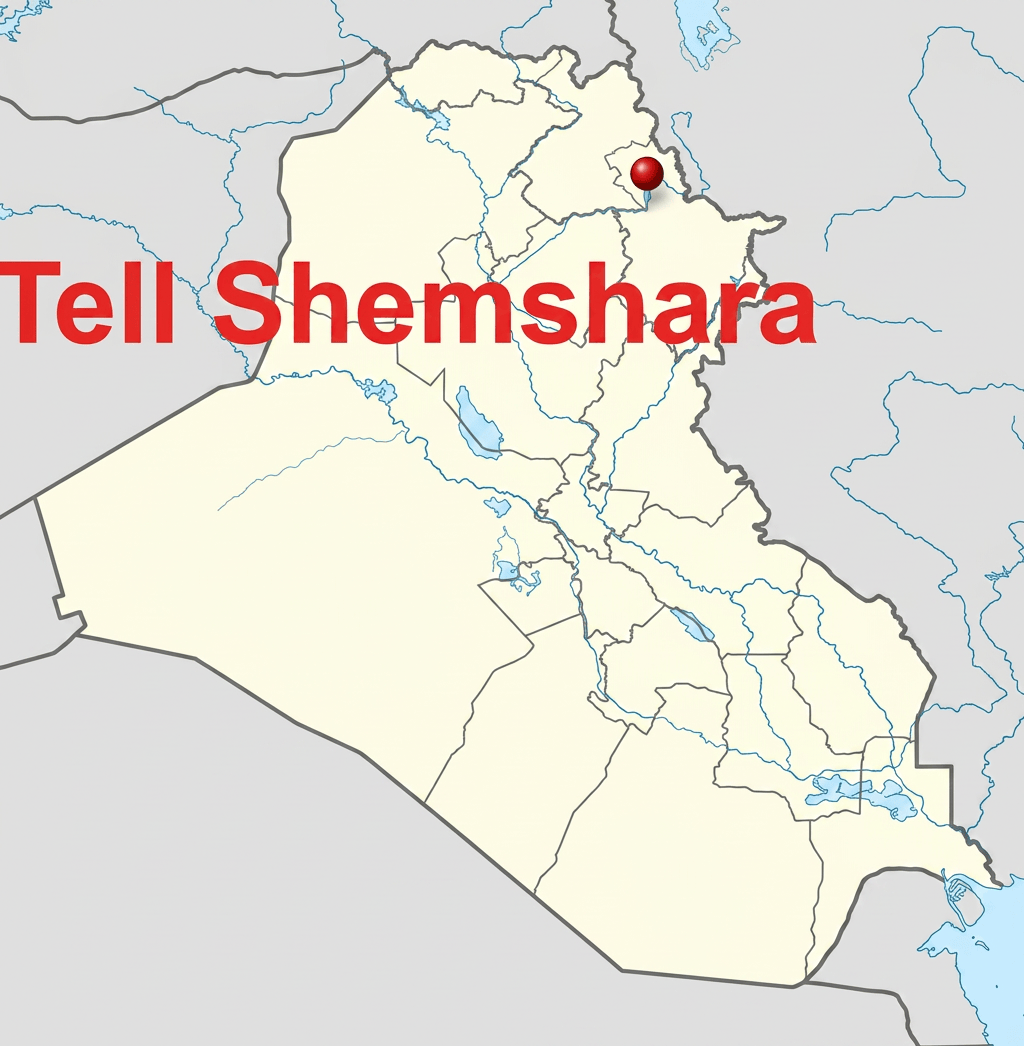
Tell Shimshara is in Iraqi Kurdistan, in present-day Sulaymaniyah Governorate, on the northeastern edge of the Rania Plain. Its coordinates are approximately 36°12′03″ N, 44°56′18″ E, at about 500–515 m above sea level. It stood on a raised conglomerate outcrop on the right bank of the Lesser Zab River, very close to where the river passes through the Sungasur Gorge.
The Tigris river is not immediately beside the site, but the Lesser Zab is a major tributary of the Tigris. It is immediately adjacent along with the Zargos. The site sits at a strategic mountain-pass/foothill location. Rania Plain is immediately south/west of the site. Iran accessible through the mountain routes to the northeast.
The Lesser Zab ultimately runs southwest toward the Tigris; the Tigris is about 170 km downstream/west-southwest from the site according to the CZAP (central zagros archaeology project) reconstruction
It could be classified: Eastern Fertile Crescent → Central Zagros → Rania Plain → Lesser Zab corridor → Zagros/Iranian gateway.

Shimshara occupied an extraordinary ecological position
Within a relatively short distance were: riverine forest, fertile plain, steppe and Zagros hills and mountains. The CZAP researchers emphasize that inhabitants could exploit several ecological zones within approximately 4–5 km, essentially a walking-distance resource catchment. The archaeological fauna and plants demonstrate this unusually diverse environment. It helps explain why the inhabitants could combine: farming; herding; pig exploitation; fishing; hunting; gathering nuts and fruits; and collecting wild plants. It was not simply an agricultural village. It was a multi-ecosystem settlement.
A really important discovery: Shimshara is older than its pottery
For decades, Tell Shimshara was principally known as a Hassuna-period Pottery Neolithic site. The 1950s Danish excavations uncovered 16 archaeological levels. Levels 16–9 were initially assigned to the Hassuna period, approximately 6500–6000 BC. But there was a problem. The lowest levels—particularly 16–14—contained little or no pottery. New CZAP work in 2012–2013, combined with radiocarbon dating, showed that the settlement was substantially older. A charred nutshell from basal deposits produced a date around: 7320–7180 BC (1σ; approximately 7445–7080 BC at 2σ). The newer research therefore places Neolithic occupation at Shimshara across approximately: 7300–6000 BC. Although the exact continuity of occupation through the entire span remains uncertain because the stratigraphic areas and dates are not all directly connected.
Was it Pre-Pottery Neolithic B?
In a broad chronological sense, it overlaps the PPNB. But I would not simply label the entire site “PPNB.” The western Fertile Crescent has a well-developed PPNA → Early PPNB → Middle PPNB → Late PPNB cultural terminology. The eastern Fertile Crescent, including Iraqi Kurdistan, has a somewhat different archaeological sequence. At Shimshara: Earlier levels Aceramic / Pre-Pottery Neolithic, Later levels Pottery Neolithic / Hassuna. The excavators identify Levels 16–14 as Aceramic Neolithic, with pottery becoming substantially more common in Levels 13–9.
The earlier occupation is broadly contemporary with the later PPNB chronology of the Levant. One recent synthesis explicitly describes Shimshara’s Early Neolithic as part of the eastern Fertile Crescent sequence corresponding broadly to the PPNB period.
Period: Early Neolithic → Pottery Neolithic
Aceramic phase: YES
PPNB-equivalent chronology: YES
Classic Levantine PPNB culture: NO / not appropriate as a blanket label.

What was the earliest settlement like?
The earliest known settlement was constructed on a natural raised terrace/outcrop overlooking the plain and river. The 1950s excavators found: mudbrick architecture; stone foundations; pebble floors; clay-lined installations; occupation surfaces;hearth/oven features; and food-processing debris. The earliest excavated architecture included rectilinear mudbrick buildings, often with stone foundations. The more recent excavations found additional mudbrick architecture and well-preserved activity surfaces in the previously unexplored lower levels.
The architecture is considerably less spectacular than the large buildings at some other Neolithic sites—but that itself is significant
There are: rectilinear structures; mudbrick walls; stone foundations; compact activity areas; pebble surfaces; clay-lined basins: ovens/hearths; and external working areas. The settlement appears to have been organized around household and production activities, rather than around a giant specialized ceremonial building. The earliest architectural remains in Levels 16–14 were badly damaged by later occupation and erosion, so we do not have a complete village plan.
Was there a ritual or communal building?
No securely identified monumental ritual building has been found. This is an important negative result. There is no Shimshara equivalent of: Göbekli Tepe’s monumental enclosures; Çayönü’s communal “skull building”; a large temple; or a clearly specialized public ceremonial hall. Instead, symbolic activity seems to have been integrated into domestic and community life.
The site has: unusual stone vessels; marble bracelets; bone ornaments; figurative material in the wider archaeological sequence; elaborate lithic technology; special deposits; and human burial evidence. But the site is more classified as: domestic settlement with symbolic/ritual practices—not a known ritual centre.
Were there figurines?
This is an interesting case. Figurines are not a major feature of the newly excavated Shimshara assemblage. The CZAP material-culture study specifically notes that clay tokens and figurines found at Bestansur have not yet been found at Shimshara. There are, however, figurine traditions associated with earlier/later Zagros sites and older publications have sometimes discussed figurative material in relation to Shimshara.
Figurines: not securely represented in the Early Neolithic CZAP assemblage.
Game pieces or tokens?
Again, caution is warranted. There is no securely identified board-game assemblage from Shimshara. The clay token/figurine repertoire is much more strongly represented at Bestansur. So: Game pieces: no secure evidence; Clay tokens: no secure Early Neolithic assemblage identified; and, Accounting system: no evidence. This is a useful contrast with later Mesopotamian developments.
The stone vessels and bracelets are much more important
Some of Shimshara’s most distinctive objects are marble bracelets and stone bowls. The 2012–2013 excavations recovered: finely worked marble bracelet fragments;; an incised stone bowl fragment; and, other stone objects. These are not merely utilitarian objects. They demonstrate: specialized stone working + selection of raw material + skilled finishing + personal adornment. The CZAP research emphasizes that Shimshara’s marble and bone ornaments were locally sourced, while its obsidian demonstrates much wider connections.
The plant evidence is exceptionally interesting
Archaeobotanical research was undertaken by: Jade Whitlam, Charlotte Diffey, Amy Bogaard and Michael Charles. As part of the Central Zagros Archaeological Project. The plant assemblage is relatively poorly preserved compared with some sites, but it nevertheless contains an important mixture of cultivated and wild resources.
Wheat: the archaeobotanical evidence includes emmer wheat (Triticum dicoccum)
There are also indeterminate wheat grains. The preservation is not good enough to establish the complete range of wheat varieties with confidence, so it would be misleading to give Shimshara the same detailed wheat list as some better-preserved sites.
Barley: primarily wild barley
Plant remains include: wild barley (Hordeum cf. spontaneum). It occurs in approximately 11.8% of the analysed samples, with 22 grains identified. This is important because it indicates that the community was exploiting the local wild cereal resource, whether through deliberate gathering or as part of cultivated fields. The evidence is not strong enough to claim fully domesticated barley at Shimshara.
Lentils
Lentils are one of the strongest plant signals from the site. Large-seeded pulses occur in 100% of the analysed samples, and lentil is among the identifiable taxa.
The inhabitants were therefore combining: cereal + pulse agriculture. Which is a very important component of early farming systems.
The archaeobotanical assemblage includes: bitter vetch (Vicia ervilia)
This is another pulse/wild-food resource that occurs in the early farming systems of the Zagros. Thus the plant economy was considerably more diverse than simply “wheat farming.”
Two flax seeds were identified
Flax is particularly interesting because it can be used for: oil; fibre; and possibly textile production. The number of specimens is too small to reconstruct a major flax industry, however.
Pistachio
Yes—and quite strongly. Pistachio is one of the most important gathered foods identified at Shimshara. Pistacia nutshell occurred in approximately 76.5% of the archaeobotanical samples. This is excellent evidence for exploitation of the natural vegetation of the Zagros. It does not mean they cultivated pistachio orchards. Rather: wild pistachio nuts were gathered from the surrounding landscape.
Almond
This is one place where the newer research is particularly useful. Amygdalus (almond) nutshell occurred in approximately 17.6% of samples. The fragments were too poor to determine the precise species, but almond exploitation is nevertheless documented.
A single fig (Ficus sp.) drupelet was recovered
That is enough to demonstrate that fig was present in the food/resource assemblage, but absolutely not enough to demonstrate fig cultivation.
Plant Evidence Cultivation?
Pistachio Strong No proof;
Almond Moderate No proof; and
Fig Single specimen No proof.

The assemblage also includes: wild grasses; Poa; Lolium; club-rush/bulrush (Bolboschoenus glaucus); and other wild/weed plants
Phytolith studies also found substantial evidence for reed and grass vegetation, including material associated with fuel and other activities. This is particularly useful architecturally. Reeds and grasses could potentially have contributed to: roofing; mats; baskets; cordage; fuel; and temporary structures. Direct identification of a particular roof construction system should nevertheless be avoided unless the archaeological context proves it.
Trees and woodland
The surrounding landscape was considerably more wooded than today’s landscape in some respects. Pollen evidence from the wider Zagros suggests: oak woodland; shrub vegetation; grasses; and, riverine vegetation. Interestingly, oak pollen remained relatively low during the Shimshara occupation in the Lake Zeribar record, while grasses were abundant. Later modern pollen spectra contain much more oak. This means we should not imagine the area as an uninterrupted dense oak forest. It was a mosaic: river woodland + open grassland + steppe + hills + patches of oak woodland.
Sheep and goats were part of the Neolithic economy
But there is an important twist. At Shimshara, pigs are unusually abundant. The CZAP faunal research found evidence for: pigs; sheep; goats; birds; fish; and other mammals. It means that Shimshara’s economy cannot be reduced to the classic: sheep + goat + wheat model. It was much more ecologically diverse.
Pig farming?
Pigs were extremely important. The 2021 study by Donna de Groene, Robin Bendrey and Roger Matthews specifically examined pig remains from the Pre-Pottery Neolithic sites of Bestansur and Shimshara. The evidence indicates a complex relationship between humans and wild boar rather than a simple, fully developed pig-farming system. That is an important distinction. The abundance of pigs is probably partly explained by the site’s exceptional proximity to riverine woodland, which is excellent wild-boar habitat.
Fishing
Fish remains have been recovered. That makes perfect ecological sense given the settlement’s position directly beside the Lesser Zab. Shimshara therefore had access to: field, pasture, forest, river and mountain. Within an exceptionally compact landscape.
Birds and wild animals
The assemblage also includes wild fowl and other mammals. This demonstrates that the inhabitants had not abandoned hunting and gathering. The economic system was more accurately: cultivation + herding + hunting + fishing + gathering. Rather than “agriculture replacing hunting.”
Obsidian: one of Shimshara’s most spectacular features
This is perhaps the most dramatic technological aspect of the site. Obsidian made up an extraordinarily high proportion of the chipped-stone assemblage in the early levels—roughly 80–97% in some datasets. That is extraordinary. And the obsidian did not come from the immediate Rania Plain. Geochemical work connects it to sources in eastern Turkey, including Bingöl/Nemrut-area sources. Some sources are more than 300 km away from Shimshara. Strong evidence for: long-distance exchange networks operating around 7200 BC.
Local/regional stone was also used
Flint/chert represents a much smaller proportion of the lithic assemblage than obsidian. One striking characteristic of Shimshara is therefore: local stone + imported volcanic glass, rather than a purely imported toolkit. The community had access to local raw materials but strongly preferred obsidian for many cutting tools.
A remarkable long-distance network
Shimshara’s position is now beginning to look extremely strategic. Imagine the network: Anatolian volcanoes, obsidian, Zagros mountain routes, Shimshara, Lesser Zab and Mesopotamian plain. At the same time: Rania Plain agriculture, Zagros forests, river resources and Iranian routes converged at the settlement. This is why CZAP describes Shimshara as a community embedded in far-reaching regional networks.
Did they manufacture the obsidian locally?
There is evidence consistent with working obsidian on site. The lithic assemblage includes blades and production debris, indicating that this was not simply a place where finished obsidian objects were occasionally traded in. The technological analysis also identifies distinctive tool-working traditions that connect Shimshara with Anatolian and Zagros technological networks.
Imported obsidian: YES
Obsidian working: YES/probable
Long-distance trade: YES
Source: eastern Anatolia/Bingöl-Nemrut region
A very unusual tool: the long dagger
An especially remarkable object from the Hassuna-period assemblage is a large obsidian dagger, more than 35 cm long. It was broken into four pieces in an ancient fire. That is an exceptional object. It suggests that at least some obsidian was not merely used for disposable cutting flakes. Large, carefully made blades could have had: specialized functions; prestige value; symbolic value; and social significance. We should not assume which without contextual evidence. But it is certainly one of Shimshara’s “unique objects.”
Weapons: The stone toolkit
Included: blades; cutting tools; projectile-related technologies; sickle-related implements; and cores and debitage.
The long obsidian dagger is the most spectacular potential weapon. But the site should not be characterized primarily as a fortified or militarized settlement. Its major technological signatures are: obsidian + food-processing tools + agricultural technology + stone vessels + ornaments.
Doors and woodworking
There is architectural evidence for doorways and internal circulation, but surviving wooden door leaves do not exist. That is not surprising. Wood, reeds and other organic materials generally preserve poorly in this environment. Nevertheless, the presence of: substantial mudbrick walls; roof-bearing structures; stone tools; bone tools; reed/grass phytoliths; and plant fibre evidence. Shows that the inhabitants were working organic materials extensively.
The CZAP microarchaeological work is especially useful here because phytolith and microscopic studies are recovering evidence of reed and grass use, including material incorporated into floors, fuel and other deposits.
Doorways: YES
Wooden doors preserved: NO
Woodworking: strongly probable, but direct structural wood evidence is limited
Reed/grass technology: YES
Fire was a major event at Shimshara
This is one of the site’s most interesting architectural stories. At least three Neolithic building levels were destroyed by exceptionally intense fires. In some areas, temperatures were high enough to: crack stone; partially melt obsidian; burn floors; and carbonize plant remains. The cause is unknown. It could have involved: accidental domestic fire; deliberate burning; wind-assisted fire; destruction associated with conflict; and/or some combination of causes. There is no secure evidence that warfare caused the fires.
Climate: what was the environment like?
The occupation falls within the Early Holocene, a period generally warmer and wetter than the preceding Younger Dryas. The broader period around 9700–5000 BC experienced substantial climatic amelioration, although the eastern Fertile Crescent was not uniformly wet and stable. Shimshara’s environment was particularly favorable because it combined: river water; fertile plain; mountain precipitation; woodland; and grassland. The site therefore did not depend on a single rainfall regime.
The 9.2 ka climatic event
This is particularly relevant. Shimshara’s earliest occupation overlaps the period around: 7300–7100 BC. When a climatic perturbation known as the 9.2 ka event affected parts of the Northern Hemisphere. The CZAP researchers point out that Shimshara may have been occupied during this event. They emphasize, however, that there is no evidence for a simple, region-wide societal collapse caused by it. That is a fascinating resilience story. Instead of: climate change → abandonment the archaeological evidence may show: climate variability → adaptation within a diverse landscape.
How different was the ancient landscape from today’s?
Quite different—but not necessarily in the simplistic sense of “it was much wetter.” The wider palaeoenvironmental evidence suggests: substantial grassland; riverine vegetation; some oak woodland; pistachio vegetation; shrub communities; and productive agricultural land.
At Lake Zeribar, pollen evidence indicates increases in grasses and pistachia following the end of the Younger Dryas, while oak became substantially more important only later
At Shimshara itself, the archaeological evidence indicates heavy use of: river + plain + hill ecosystems. Human grazing and cultivation also appear to have influenced vegetation.
How many occupations?
This is where the archaeology becomes complicated. The mound has many occupational levels, but they do not represent one uninterrupted sequence. The main mound contained: Early Neolithic, Aceramic levels; Pottery Neolithic, Hassuna levels, major chronological gap, Middle Bronze Age/Hurrian occupation and later Iron Age/Islamic activity The archaeological record therefore demonstrates repeated settlement and abandonment over thousands of years.
Was the Neolithic settlement abandoned?
Yes—but not necessarily because of one dramatic event. The main Neolithic sequence eventually ends. However, the upper archaeological layers were subsequently severely eroded, especially after construction of the Dokan Dam. The CZAP researchers estimate that approximately 160,000 cubic metres of the mound were lost between 1959 and 2012, including several metres of the upper mound. That means we have lost important evidence. We cannot reconstruct the final Neolithic abandonment with the confidence we would like.
After the Neolithic, there was a substantial chronological gap
Later occupations include: Bronze Age/Hurrian settlement; the ancient city of Šušarra; later Iron Age activity; and, Islamic-period activity. The Middle Bronze Age occupation is especially famous because of the cuneiform archive discovered there. But this is a completely different chapter of the site’s history.
The 1950s excavators
The original rescue excavations were conducted because the area was going to be flooded by the Dokan Dam.
The modern rescue research is particularly impressive because it is genuinely interdisciplinary and international
The Central Zagros Archaeological Project (CZAP) has involved many institutions worldwide.
Iraqi/Kurdish archaeological institutions + British + European + American + Japanese researchers.
Shimshara’s technological significance
If we reduce the site to its most important technologies, I would list: Architecture. Mudbrick + stone foundations;
Food. Wheat + pulses + nuts + fruit;
Animal management. Pig + sheep + goat + other fauna;
Water. Lesser Zab river environment;
Stone. Local chert/flint;
Long-distance technology. Anatolian obsidian;
Personal objects. Marble bracelets + stone bowls + bone ornaments;
Fire. Extensive evidence of intense building fires; and,
Organic technology. Reeds, grasses, dung and plant processing.
That is an unusually broad technological package.
Shimshara versus Choga Mami comparison
Shimshara = mountain/river gateway + diversified subsistence + obsidian network. Choga Mami = dry plain + irrigation + agricultural intensification
Shimshara and Bestansur
There is an even more important comparison. Both sites were studied by the same modern project. Bestansur provides some of the strongest evidence for large Early Neolithic architecture and unusual mortuary practices.
Shimshara provides exceptionally strong evidence for: obsidian exchange; pig exploitation; pistachio/almond gathering; riverine resources; and, early Aceramic → Pottery Neolithic transition. Together they demonstrate that there was not one uniform “Neolithic package” in the Zagros. Different communities adapted differently to their environments.
The larger architectural lesson
Shimshara is particularly valuable. It demonstrates climate adaptation themes differently than a different solution from Choga Mami. At Choga Mami: people engineered water into a marginal environment. At Shimshara: people selected a location where several natural ecological systems converged. That is a profound architectural strategy. The settlement was effectively positioned at: mountain, river, plain, forest and steppe. And the inhabitants exploited all five. Architecture therefore wasn’t simply the construction of houses. It was: site selection + resource access + ecological diversity + buildings + storage + food processing and exchange networks.
Tell Shimshara was a Neolithic settlement in Iraqi Kurdistan, not far from the modern town of Rania, directly beside the Lesser Zab River and immediately adjacent to the Zagros mountains. The Lesser Zab connected it downstream to the Tigris, while mountain routes connected it toward Iran and Anatolia. Its importance has increased dramatically with the modern excavations.
It is now understood to have occupation beginning around 7300 BC, with Aceramic/Pre-Pottery Neolithic levels followed by Pottery Neolithic/Hassuna levels, extending broadly toward 6000 BC. The inhabitants cultivated or gathered: emmer wheat + lentils + bitter vetch + wild barley + flax. And collected pistachio + almond + fig + wild grasses and other plants. They exploited: pig/wild boar + sheep + goats + fish + birds and other wild animals.
Architecturally they built mudbrick structures with stone foundations, floors, ovens/basins and external activity areas, but there is no securely identified monumental communal or ritual building. Technologically, the site’s most extraordinary feature is its very high proportion of imported Anatolian obsidian, together with locally available stone, marble vessels and bracelets, bone objects, and the exceptional large obsidian dagger. And perhaps most importantly: Shimshara demonstrates that the Neolithic of the Zagros was not simply a copy of the Levantine PPNB. It was its own regional trajectory—early farming, animal management, gathering, riverine exploitation, mudbrick architecture and long-distance exchange developing together in a mountain–river–plain environment.

References: Matthews, R., Matthews, W., Raheem, K. R. & Richardson, A. (eds.). (2020). The Early Neolithic of the Eastern Fertile Crescent: Excavations at Bestansur and Shimshara, Iraqi Kurdistan. Central Zagros Archaeological Project Reports 2. Oxbow Books.
Mortensen, P. (1970). Tell Shimshara: The Hassuna Period. Historisk-filosofiske Skrifter 5. This remains fundamental for the original Danish excavation and Hassuna sequence.
Whitlam, J., Diffey, C., Bogaard, A. & Charles, M. (2020). “The charred plant remains from Early Neolithic levels at Bestansur and Shimshara.” In Matthews et al., The Early Neolithic of the Eastern Fertile Crescent, pp. 411–428. This is the key archaeobotanical study.
de Groene, D., Bendrey, R. & Matthews, R. (2021). “Pigs in the Neolithic of the Eastern Fertile Crescent: New evidence from Pre-Pottery Neolithic Bestansur and Shimshara, Iraqi Kurdistan (7800–7100 BC).” International Journal of Osteoarchaeology, 31, 1258–1269.
Flohr, P., Matthews, R., Matthews, W., Richardson, A. & Fleitmann, D. (2020). “Radiocarbon dating of Bestansur and Shimshara.” In Matthews et al., The Early Neolithic of the Eastern Fertile Crescent, pp. 187–196.
Matthews, W. et al. (2020). The environmental, microarchaeological and architectural studies in the CZAP volume provide the basis for reconstructing vegetation, fuel, phytoliths, buildings and human–environment interactions.
Mortensen, P. (1962–1970). A series of studies on early village farming in northern Iraq and the Tell Shimshara excavation, including the chipped-stone and chronological evidence.
Central Zagros Archaeological Project (CZAP), Tell Shimshara project. The project overview, excavation history and current site documentation.
Richardson, A. (2025). Recent work on Neolithic networks and material exchange in the Zagros
Matthews, R. et al. (2020), “The Neolithic Transition in the Eastern Fertile Crescent: Thematic Synthesis and Discussion.”
Leave a Reply