home # store # services # articles # game # app #contact >


Occupation at Motza begins in the Pre-Pottery Neolithic B (PPNB), around 8500–7000 BCE
This was the era when agriculture, animal domestication, and permanent architecture were rapidly expanding across the Levant.

Excavations revealed rectangular houses with stone foundations and mudbrick superstructures, typical of the PPNB
Because of highway construction, the area was intensively excavated
Unlike the round/oval houses of earlier PPNA sites (like Wadi Faynan 16 or Jericho’s earliest phases), Motza shows the shift to rectilinear architecture, which allowed larger, more organized villages
Floors were often plastered, sometimes with lime plaster, indicating both durability and symbolic investment.
Tell Motza’s inhabitants were among the earliest farmers in the Judean Hills
Plant remains show cultivation of domesticated wheat and barley, along with legumes.

Animal bones indicate early herding of goats and sheep, alongside hunting of gazelle and other wild animals.

This represents a mixed economy: a firm commitment to agriculture, but still supported by hunting and foraging.
Like other PPNB villages, Motza included burials under house floors, a practice tied to ancestor veneration and household identity.
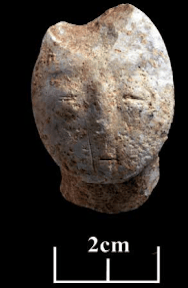
Figurines and symbolic artifacts have been found
Flint tools (arrowheads, axes, blades and knives); ox figurines; stone carved human face; stone bracelets and other object unique stone made objects have been found at the site. Bone tools, and artifacts including shells from the mediterranean. And, obsidian too.
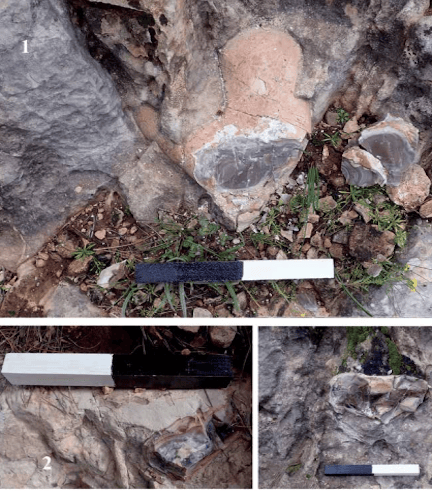
The shift to rectilinear architecture also hints at social reorganization — households became more standardized, possibly reflecting new ways of structuring community and property.
Tell Motza is one of the earliest known Neolithic villages in the Judean Hills, showing that the farming revolution spread from the Jordan Valley into the uplands
Its location in a fertile valley west of Jerusalem, near springs and arable land, made it ideal for early agriculture.
It later became a significant site again in the Bronze and Iron Ages, but its Neolithic phase marks the very beginnings of sedentary farming in the region.
During the Neolithic, Tell Motza was a PPNB farming village with rectangular houses, domesticated crops and animals. It had household burials, and evidence of ritual life. And, it represents the expansion of agriculture and sedentary communities into the Judean Hills. Part of the broader transformation and neolithic architecture of the Levant.

Bibliography: Khalaily, Hamoudi; Bar-Yosef, Ofer; Barzilai, Omri; Boaretto, Elizabetta; Bocquentin, Fanny; Le Dosseur, Gaëlle; Eirikh-Rose, Anna; Goring-Morris, A. Nigel; Greenhut, Zvi; Marder, Ofer;
Sapir-Hen, Lidar (2007). “Excavations at Motza in the Judean Hills and the Early Pre-Pottery
Neolithic B in the Southern Levant” (https://hal-univ-paris10.archives-ouvertes.fr/hal-01996987/
file/Khalaily%20et%20al%202007%20MOTZA.pdf) (PDF). Paléorient. 33 (2): 5–37.
doi:10.3406/paleo.2007.5218 (https://doi.org/10.3406%2Fpaleo.2007.5218). ISSN 0153-9345
(https://search.worldcat.org/issn/0153-9345). JSTOR 41496809 (https://www.jstor.org/stable/41
496809).
Friedman, Matti (August 29, 2012). “Ancient animal figurines unearthed outside Jerusalem:
Two 9,000-year-old statuettes come from era that saw start of domestication of animals” (http
s://www.timesofisrael.com/ancient-figurines-unearthed-outside-jerusalem/). The Times of
Israel.
“Tel Moẓa Excavation” (https://www.telmoza.org/)
Khalaily, H., O. Bar-Yosef, O. Barzilai, E. Boaretto, F. Bocquentin, A. Eirikh-Rose, Z. Greenhut,
A. N. Goring-Morris, G. L. Dosseur, O. Marder, L. Sapir-Hen and M. Yizhaq. 2007. Excava-
tions at Motza in the Judean Hills and the early Pre-Pottery Neolithic B in the southern Levant.
Paléorient 33:5–38
Khalaily, H., Re’em, A., Vardi, J., & Milevski, I. (Eds.). (2020). The Mega Project at Motza (Moẓa): The Neolithic and Later Occupations up to the 20th Century: Vol. Supplementary volume. Israel Antiquities Authority / רשות העתיקות. https://doi.org/10.2307/j.ctv1b9f5bh
Leave a Reply