< home # store # services # articles # game # app #contact >

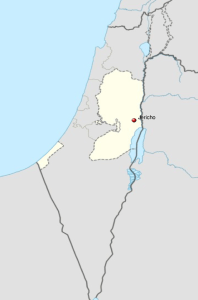
Because of its fresh water springs, Tell es Sultan or ancient Jericho was a natural oasis in the desert all could enjoy. North of Dead Sea, and west of Jordan river. The buildings and towers raised above the wide area known as the the Jordan valley. Height upon height, a result of layers of human habitation; construction and architecture.
The site of Ancient Jericho/Tell es-Sultan is located 1.5 kilometers north of the center of modern Jericho
250m below sea level. It is in the Lower plain of the Jordan Valley, approximately 10 kilometers north of the Dead Sea.

Dated to more than 12,000 years ago, it provides great archaeological importance. It shows evidence of the first development of permanent settlements and trade, and there so, the first steps towards great civilizations
The 10th millennium BCE makes Jericho among the oldest continually inhabited cities in the world.(3)
Around 9600 BCE, the Younger Dryas came to an end
The warmer climate, and water source, could have made it possible for Natufian groups to extend there duration and stay.
At the Ein es Sultan spring, scientists have found remains of circular homes made with mud brick and topped with domed roofs
During this era they probably hadn’t discovered blast pottery, or ceramics yet. They did build, grow plants, and keep animals though.
8,500 to 7,500 BCE was pre-pottery neolithic A (4)

Characteristics included small circular dwellings, and burials of dead under floors
Wikipedia said the site was around 430,000sq feet. There was mud brick homes built of straw and clay but they had no street planning yet. (5)
Hearths located within and outside the homes (6)
They still had a reliance on wild game, and there was cultivation of wild and domestic cereals.
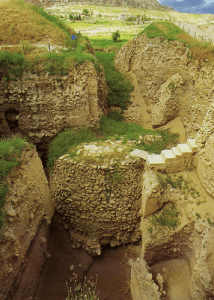
Wall, ditch and Tower
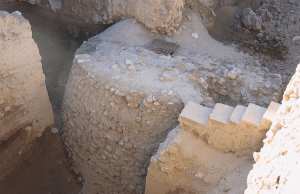
Around 10000 years ago the site became surrounded by a massive stone wall 12 feet (or, 1.8 meters) high. At the base stood a 28 foot (or 8.5 meters) high stone tower (similar to Tell Qaramel in Syria). They are both, one of the oldest towers ever discovered by humans.
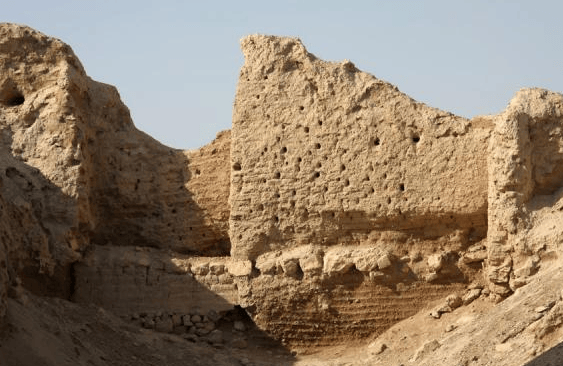
Surrounding the wall was a ditch 8.2 metres (27 ft) wide by 2.7 metres (9 ft) deep, cut through solid bedrock. It had a circumference around the town as much as 600 metres (2,000 ft).
Wall was built around 10000 years ago (7)(8)
It took a lot of people a significant time to construct.
The tower is among the earliest stone monuments (9)
Its shape, is almost 9 metres (30 ft) in diameter at the base, decreasing to 7 metres (23 ft) at the top. It has walls 1.5 metres (5 ft) thick and contain an internal staircase with 22 stone steps.[10][11]
Did you know? Based on scientific evidence and study, about 8800 years ago, Tell es Sultan (or Jericho), and its additional surrounding village, have signs and results of an invasion.
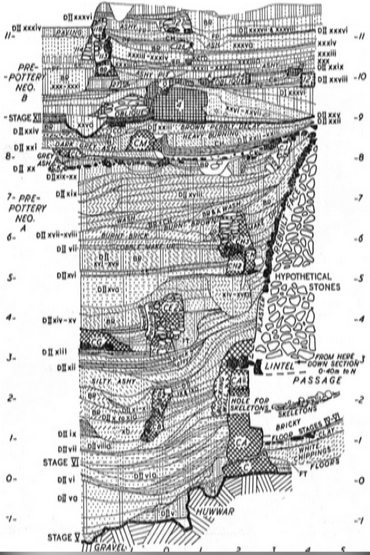
Wikipedia said PPNB was established in 6800 BCE
After a several century hiatus, a new settlement was founded, on eroded surface of the previous tell.
Architecture included rectilinear buildings made of mudbricks, on stone foundations
Bricks were similarly shaped, and plastered together.
Some of the buildings had red or pinkish terrazzo floors
The courtyards had clay floors.
Did you know? Impressions of mats constructed using reeds or rushes have been preserved
Humans begin expanding the range of domesticated plants, and domesticating sheep
There is debate about cultic practices during this period. Involving plasterization and art decoration of human skulls. Similar artistically decorated plastered skulls have been found at other sites. Such as Tell Ramad, Beisamoun, Kfar Hahoresh, Ain Ghazal and Nahal Hemar.
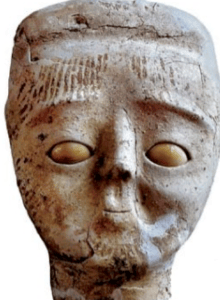
As the neolithic age expanded many came thru the area
It probably reached a peak late neolithic or during the bronze age.

Archaeological finds included obsidian, flint tools such as arrowheads, scrapers, axes, sickles, burins, and knives. Dishes and bowls carved from limestone. Spatulae, drills, hammer and grinding stones
There was some green obsidian from an unidentified source. Loom weights, and spindle whorls where there. Also, the life sized plasterized figures. And, shell and malachite beads

By the bronze Age, Jericho was a small prominent city
Though, as show by its many destruction layers. That had changed many times.
Less remains from later periods. When new and different kings, queens, rulers and empires came, and fought for control of the area. It’s considerably less interesting, then its first establishment and growth from a spring and campsite, to great neolithic era.
Cite: 1) “Photos: Jericho’s Tell es-Sultan added to UNESCO World Heritage list” (https://www.aljazeera.com/gallery/2023/9/18/jerichos-tell-es-sultan-added-to-unesco-world-heritage-list). http://www.aljazeera.com. Retrieved 2023-09-20.
2) “Ancient Jericho/Tell es-Sultan” (https://whc.unesco.org/en/list/1687/). UNESCO World Heritage Centre
3) Agencies, The New Arab Staff & (September 18, 2023). “UN committee lists W.Bank’s Jericho as a World HeritageSite” (https://www.newarab.com/news/un-committee-lists-wbanks-jericho-world-heritage-site). The new Arab
4) Nigro, Lorenzo (2014). “The Archaeology of Collapse and Resilience: Tell es-Sultan/ancient Jericho as a Case Study” (https://www.academia.edu/8688397). Rome “la Sapienza” Studies on the Archaeology of Palestine & Transjordan. 11:
5) “Old Testament Jericho” (https://web.archive.org/web/2008 0220035014/http://www.ourfatherlutheran.net/biblehomelands/palestine/jericho/jericho.htm). OurFatherLutheran.net.20 February 2008.
6) Mithen, Steven (2006). After the ice: a global human history, 20,000-5000 BCE. Cambridge, Massachusetts: Harvard University Press. ISBN 0-674-01999-7 pg. 54
7) O’Sullivan, Arieh (14 February 2011). ” ‘World’s first skyscraper sought to intimidate masses’ “(http://www.jpost.com/VideoArticles/Video/Article.aspx?id=208206). The Jerusalem Post.
8) Kenyon, Kathleen M.; Holland, Thomas A. (1960). Excavations at Jericho: The architecture andstratigraphy of the Tell: plates (https://books.google.com/books?id=rbptAAAAMAAJ). Vol. 3.
British School of Archaeology in Jerusalem. p. 6. ISBN 978-0-9500542-3-0.
9) Wynne Parry (February 18, 2011). “Tower of Power: Mystery of Ancient Jericho Monument Revealed” (https://www.livescience.com/12918-tower-jericho-hunter-gatherer-monument.html).
10) Mithen 2006, p. 59.
11) Watson, Noelle, ed. (1996). “Jericho (West Bank)” (https://books.google.com/books?id=R44VRnNCzAYC&pg=RA1-PA367). International Dictionary of Historic Places. Vol. 4: Middle East and Africa. Chicago: Fitzroy Dearborn Publishers. pg. 367–370. ISBN 1-884964-03-6
Bibliography:
“Jericho” (http://www.britannica.com/eb/article-9043547/Jericho), Encyclopædia Britannica
Prehistoric Cultures” (https://web.archive.org/web/2018080
3074340/https://www.mama.org/exhibits/ancient/prehistori
c/). Museum of Ancient and Modern Art. 2010. Archived
from the original (http://www.mama.org/exhibits/ancient/pre
historic/) on 3 August 2018
Kenyon, Kathleen Mary (1957). Digging up Jericho: the results of the Jericho excavations,
1952–1956 (https://books.google.com/books?id=3naFAAAAIAAJ). Praeger. p. 68. ISBN 9780758162519. Archived (https://web.archive.org/web/20170409021521/https://books.google.com/books?id=3naFAAAAIAAJ)
Akkermans, Peter M. M; Schwartz, Glenn M. (2004). TheArchaeology of Syria: From Complex Hunter-Gatherers to Early Urban Societies (c. 16,000–300 BCE) (https://books.google.com/books?id=_4oqvpAHDEoC&pg=PA57). Cambridge University Press. p. 57. ISBN 978-0-521-79666-8
Cremin, Aedeen (2007). Archaeologica: The World’s Most Significant Sites and Cultural Treasures. Frances Lincoln. pp. 209ff. ISBN 978-0-7112-2822-1
Leave a Reply