<home # start here # guides # builds # services # shop # about # categories>
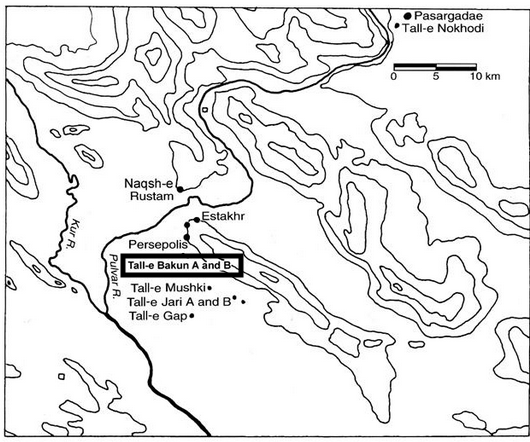
Tall-i Bakun, the famous prehistoric twin mound near Persepolis in Fars. Importantly, Tall-e Bakun is not a PPNB site; its main occupations belong to the 5th–4th millennia BC Chalcolithic/Bakun sequence. The earlier Neolithic settlements of the same Marv Dasht/Kur River region are Tall-e Mushki and Tall-e Jari (Alizadeh, 2006; Nishiaki, 2003).
A remarkable site in the Persepolis plain
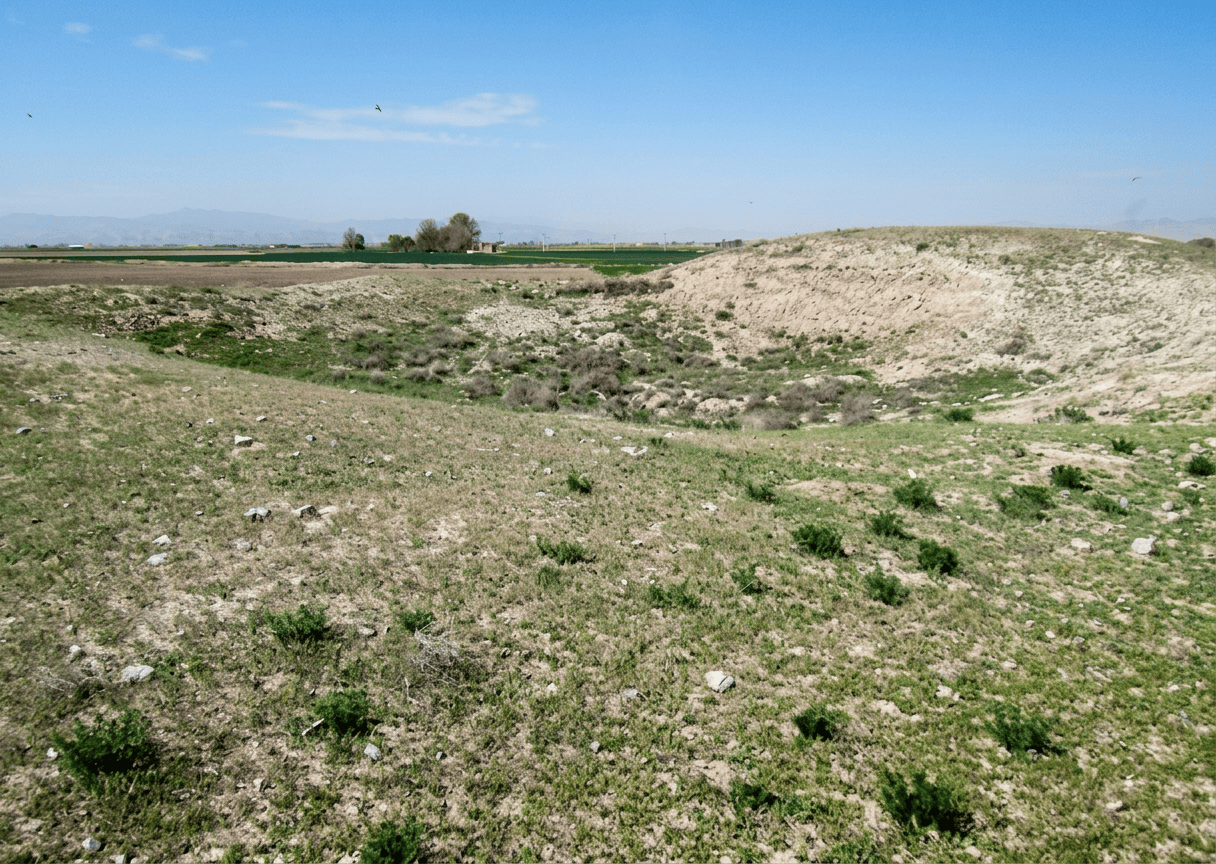
Tall-e Bakun is one of the most important prehistoric settlements of Fars Province, southwestern Iran. It consists of two low mounds, Bakun A and Bakun B, on the fertile Marv Dasht Plain, only about 3 km south of Persepolis (Alizadeh, 2006). The plain lies within the Kur/Kor River Basin.
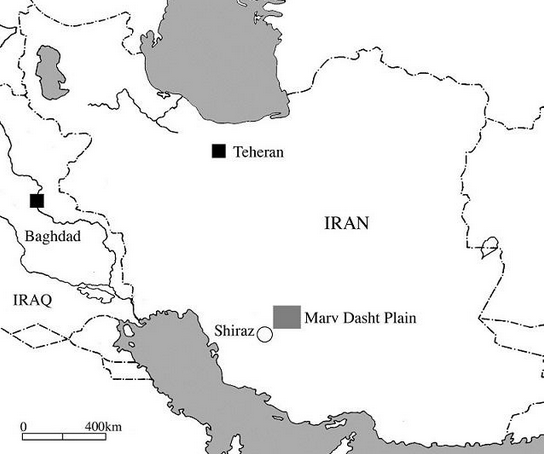
The setting is striking: a broad agricultural plain surrounded by the Zagros ranges, with the Kuh-e Rahmat immediately to the east and higher mountains rising around the plain. The Marv Dasht plain averages about 1,600–1,650 m above sea level; nearby mountains rise to more than 4,000 m (Alizadeh, 2006; Alizadeh et al., 2004).
Modern landmarks are unusually easy to understand: Persepolis is 3 km north; and, Shiraz 60 km southwest
Kur/Kor Rivers are the principal river system of the plain. And, the Sivand/Pulvar Rivers forms the northwestern side of the wider plain. Tall-e Bakun is in Fars, in the Kur River Basin (Alizadeh, 2006).
The interesting modern environmental twist
The Marv Dasht plain today has no functioning river through its central agricultural area comparable to the prehistoric/early historic hydrological landscape. Springs and qanats that formerly supplied water have largely dried, and modern farming relies heavily on deep wells (Alizadeh et al., 2004).
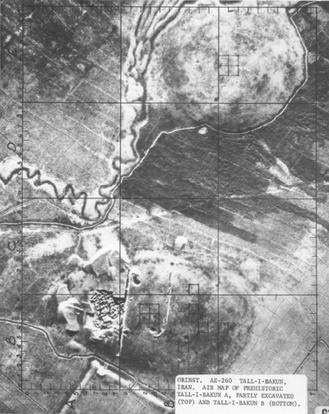
Tall-e Bakun is better classified as Chalcolithic than PPN/early Neolithic
The broader sequence is: Tall-e Mushki to Tall-e Jari to Tall-e Bakun B to Tall-e Bakun A. With Mushki representing the early farming phase, Jari the succeeding Neolithic phase, and Bakun the later Chalcolithic development (Miller & Kimiaie, 2006; Alizadeh, 2006).
The current chronology used in the major excavation publication is approximately: Site/phase Approximate date
Tall-e Mushki late 7th millennium BC
Tall-e Jari 6th millennium BC
Tall-e Bakun B1 5400–5200 BC
Tall-e Bakun B2 5200–4800 BC
Tall-e Bakun A broadly 5th–early 4th millennium BC
Later Bakun/Lapui developments into the 4th millennium BC
The University of Chicago’s current project overview gives Bakun B approximately 5000–4200 BC and Bakun A approximately 4000–3500 BC, reflecting a broader phase chronology. The detailed 2006 publication gives the more finely divided B1/B2 sequence above (Alizadeh, 2006).
The food story is unusually interesting
This is where Tall-e Bakun gets much more interesting than simply “another wheat-and-barley village.” The archaeobotanical evidence is admittedly small. Only four of the flotation samples ultimately provided useful data for Bakun A/B. And, Naomi Miller and Masoumeh Kimiaie explicitly caution against overinterpreting presence/absence (Miller & Kimiaie, 2006). But what was found is fascinating. Barley, yes. Six-row barley (Hordeum vulgare var. hexastichum) occurs, with grain and rachis fragments. Two-row barley may also have been grown (Miller & Kimiaie, 2006). Wheat, yes—several kinds. Including einkorn wheat; emmer wheat; bread/hard wheat; and unidentified wheat.
Einkorn is particularly interesting because many einkorn spikelet forks were identified in the Tall-e Bakun A samples (Miller & Kimiaie, 2006). So this was not simply “barley agriculture.”
The surprising nuts: almond and possibly pistachio
Almond: YES. A few nutshell fragments were identified as wild-type almond (Prunus), with wild almond species forming part of the natural vegetation of the Kur River Basin (Miller & Kimiaie, 2006).
Pistachio: possible, not certain
A large fruit was identified as Pistacia/Rhus. It could be pistachio or sumac. Several wild pistachio species grow naturally in the region, but the archaeobotanists could not confidently distinguish the archaeological specimen (Miller & Kimiaie, 2006).
Peas and a very rich wild-food landscape
A possible pea (Pisum) seed was identified, although large-seeded vetch cannot be ruled out (Miller & Kimiaie, 2006). The wild plant assemblage is actually enormous compared with the cultivated crop sample: at least 20 plant families and 35 genera were represented. Legumes, grasses and sedges were especially common. Particularly interesting are: Astragalus; Medicago; Trifolium; Melilotus; Trigonella; sedges; grasses; mustard-family plants; wormwood; poppy; dock; and knotweed. Many of these were probably fodder or landscape weeds rather than deliberately cultivated foods. Astragalus was extraordinarily abundant—2,366 seeds in the assemblage. And, many of these legumes are good animal fodder (Miller & Kimiaie, 2006).
That gives Bakun a distinctive agricultural signature: cereal farming + wild almond gathering + possible pistachio/sumac + legumes + extensive grazing resources. That is more interesting than a simple wheat/barley package.
By Bakun A, sheep and goats overwhelmingly dominate the identified livestock remains—about 80% of the NISP in the 2004 sample (Mashkour, Mohaseb & Debue, 2006)
The sheep-to-goat ratio at Bakun A was approximately: 1 sheep : 3 goats (Mashkour et al., 2006). That is particularly interesting environmentally because goats are generally better adapted than sheep to drier, rougher terrain. The authors caution that the sample is too small to prove that climate caused the shift, however (Mashkour et al., 2006).
Cattle, pigs and wild animals
Cattle. Present, but relatively uncommon at Bakun A.
Pig. Absent from the Bakun A sample.
Pig remains occur at the earlier Tall-e Mushki but disappear from the later Marv Dasht sequence represented by Bakun A (Mashkour et al., 2006).
Dog/canid. Canid remains occur in the broader assemblages, but a securely identified domestic dog is not prominent in the Bakun A faunal sample.
Aurochs. Aurochs are clearly identified at Tall-e Mushki, the earlier site in the sequence, but the Bakun A assemblage does not provide comparable evidence for an important aurochs-hunting economy (Mashkour et al., 2006).
Gazelle. Gazelle hunting was important earlier, but its representation declines through Jari and is absent from the Bakun A sample.
So the long-term transition is: wild cattle/equids/gazelle, mixed hunting and herding, to highly specialized sheep-and-goat pastoralism.
Architecture: this is where Bakun really shines
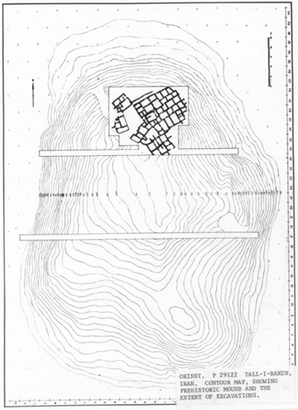
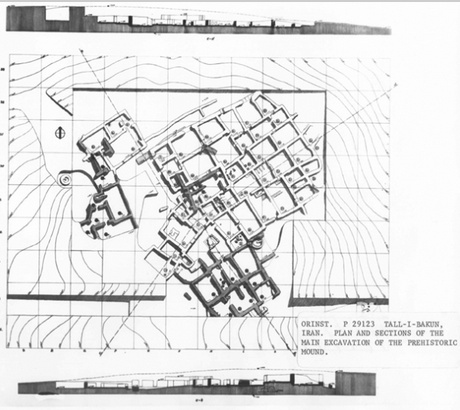
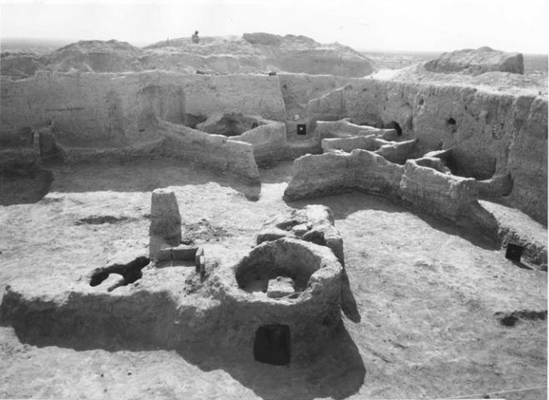
Tall-e Bakun A is much more than a pottery site. Its best-preserved Level III settlement contained: rectangular houses; warehouses; common walls; storage rooms; administrative quarters; production areas; and, carefully aligned buildings.
The buildings were laid out on a planned northeast–southwest orientation, with walls carefully aligned and abutted (Alizadeh, 2006). This is a major architectural change from the small, more household-oriented Neolithic settlements of Mushki and Jari.

Houses were not isolated cottages
The Level III buildings were packed together with shared walls. But the settlement did not simply become a dense maze. Different areas appear to have had different functions. Including residential, storage, administration and production. This spatial segregation is one of the most important features of Bakun A (Alizadeh, 2006). It makes the site an excellent case study for the transition village architecture to functional zoning to administrative architecture and early complex society.
Doors and woodwork
Yes, and the evidence is unusually good. The original excavation report records doorways in House VIII, while the architecture also preserves evidence for wooden structural elements. A particularly valuable discovery was a cast of a mud-plastered wooden column in one room (Langsdorff & McCown, 1942). There were also: wooden architectural elements; reed impressions; roofing material; pivot stones; doorways; and door sealings. So this was emphatically not an all-earth architecture. The building system appears to have been approximately: mudbrick walls, timber structural members, reed/organic roofing and mud plaster. The doors were part of an administrative system
This is one of Bakun’s most exciting features. About 140 fired-clay sealings were found in the excavated areas, many associated with doors. These were produced using stamp seals and appear to have controlled access to stored commodities (Alizadeh, 2006). That means a door was no longer merely: “the hole you walk through.” It had become: a security device, accounting device and administrative checkpoint. That is a remarkable architectural development.
Was there a ritual or communal building?
Not a clearly identified temple. There is no securely identified Neolithic-style communal ritual building comparable to Göbekli Tepe, nor should Bakun A’s administrative buildings automatically be called temples. Instead, the strongest interpretation is that Bakun A contained a combination of: residences; warehouses; workshops; administrative areas; and elite/important residences.
One building, Building VIII, has been interpreted as a particularly important residence or “chief residence” within the administrative quarter (Alizadeh, 2006). So the site’s “special building” story is about administration and social organization, rather than a clearly identifiable temple.
Pottery: spectacular, and technologically important
The famous Bakun A painted pottery is one of the great artistic traditions of prehistoric Iran. The vessels are typically: fine buff/cream ware; thin-walled;
handmade; painted in dark pigments; covered with geometric designs; and decorated with animals, birds and human figures.
The designs could be remarkably sophisticated, including highly stylized horned animals, birds, geometric panels and human forms (Langsdorff & McCown, 1942; Alizadeh, 2006).
Some vessels are so thin and finely manufactured that they approach eggshell-like ceramics. The Metropolitan Museum describes one conical vessel as dating approximately to 4500–4100 BC.
And, there were kilns
The excavation recorded kilns and pottery-production installations, including a kiln in the excavated settlement. Pottery was therefore not merely imported; there is strong evidence for local production (Langsdorff & McCown, 1942).
Pottery production appears to have been sufficiently sophisticated to support: specialized vessels; painted decoration; firing technology; standardized forms; and, large-scale production. This is one of the clearest signs of craft specialization at the site.
Figurines: some genuinely exceptional pieces
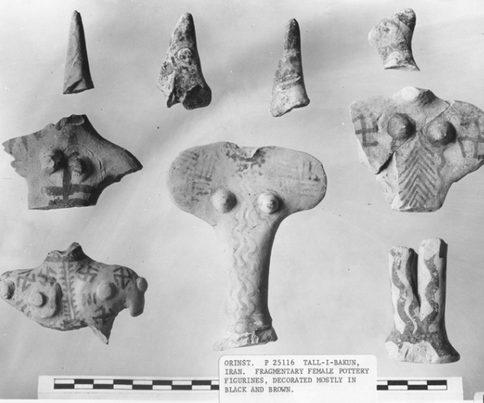
Tall-e Bakun A produced numerous human and animal figurines. Animal figurines represent: sheep; goats; cattle; dogs; birds; bears; lions; and leopards. One goat figurine is described as remarkably naturalistic, with a carefully modelled face and beard (Alizadeh, 2006).
But the human figurines are even more remarkable. Most appear to represent female bodies, often decorated with painted patterns interpreted as tattoos, body decoration or pubic hair. One exceptionally unusual example has a long beard, a feature described as unique among the surviving examples. Two particularly sophisticated figurines are naturalistic enough that Alizadeh calls them statuettes rather than ordinary figurines (Alizadeh, 2006).
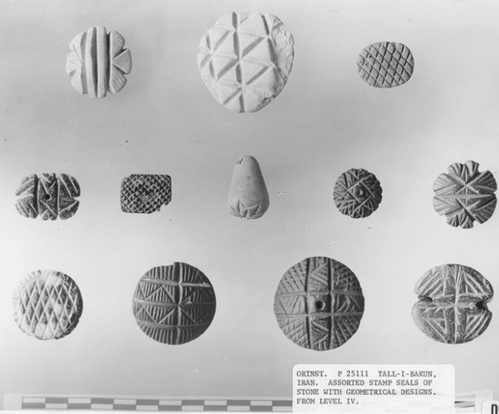
Game pieces and tokens
Yes—but don’t call them a board game. Tall-e Bakun A produced numerous clay tokens, including: tetrahedrons; cones; spheres; discs; cylinders; triangles; painted tokens; heart-shaped forms; and, peg-shaped forms. The excavation also recorded objects described as pawns.
The safest interpretation is: administrative/counting objects, with some ambiguous pieces that may have had gaming or other functions. The important story is therefore not “they played chess.” It is: people were turning clay into information.
Flint and obsidian
Flint: abundant. Bakun B produced substantial quantities of flint blades, while Bakun A contained blades, scrapers, borers, drills and other chipped-stone tools (Alizadeh, 2006).
Obsidian: yes Unlike some southern Iranian sites where obsidian is obscure, obsidian blades are actually documented at Tall-e Bakun A. That is evidence for access to material originating outside the immediate Marv Dasht landscape.
Long-distance trade was much bigger than obsidian
Bakun A is particularly impressive because its exchange network included: copper; copper ore; turquoise; lapis lazuli; shell; steatite; carnelian; obsidian; and, possibly wool and dairy products. Alizadeh argues that the settlement participated in extensive interregional exchange linking Fars, the Zagros, the Central Plateau, lowland Susiana and farther regions (Alizadeh, 2006). So Tall-e Bakun was not an isolated mountain village. It was becoming a regional economic node.
Weapons and metalworking
There are some excellent examples. The assemblage includes: copper points; copper needles; copper blades; chisels; a 25 cm copper dagger; copper ore; stone maceheads; sling missiles; and stone axes. (Alizadeh, 2006).
The 25-cm copper dagger is particularly worth highlighting because it illustrates the transition from stone-dominated technology toward specialized metallurgy.
Climate: greener than today’s landscape?
The answer is complicated. The Marv Dasht region today has a relatively dry climate, with average annual precipitation reported around 334 mm, concentrated mainly between October and April (Alizadeh, 2006). The prehistoric environment was not necessarily dramatically wetter in every period, but the landscape clearly supported a much richer combination of: cultivated fields; grazing; streams and wetlands; steppe vegetation; pistachio-almond vegetation; and mountain resources.
The archaeobotanical assemblage contains numerous plants associated with moist ground and watercourses, including sedges, while other plants represent open steppe and pasture (Miller & Kimiaie, 2006). The authors also emphasize that the post-Pleistocene expansion of Zagros woodland is not yet fully understood. During the last glacial period, cold dry steppe dominated much of the Zagros; subsequent Holocene woodland expansion occurred at an uncertain pace (Miller & Kimiaie, 2006). Bakun occupied a productive but seasonally dry highland plain whose vegetation and water systems differed substantially from today’s landscape.
Who studied Tall-e Bakun?
Bakun has an unusually good Iranian + American + Japanese + French research history.
Was it abandoned?
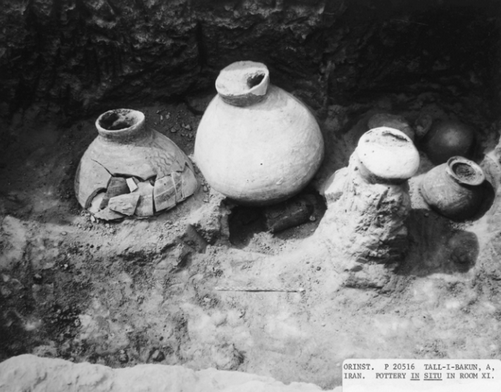
Probably suddenly—at least one major occupation level. The Oriental Institute reports that the principal preserved level of Bakun A was found with remarkably intact architecture and objects. Many vessels remained on floors, sometimes nested together, suggesting a rapid or sudden abandonment rather than gradual emptying (ISAC; Langsdorff & McCown, 1942). However, I would not say that Tall-e Bakun was abandoned “many times” without qualification. It has several archaeological levels, and the two mounds have different occupational histories. The evidence is better described as: multiple occupation phases, with at least one conspicuous sudden abandonment of the main Bakun A settlement.
Later occupation/development in the region belongs to subsequent Lapui/Banesh and later prehistoric traditions, rather than a simple uninterrupted Bakun A village.
The Tall-e Bakun architectural story in one paragraph
EARLIER NEOLITHIC FARS: Tall-e Mushki and Tall-e Jari
BAKUN B: simple settlement, painted pottery and flint production
BAKUN A: RECTANGULAR HOUSES, SHARED WALLS, STORAGE ROOMS, WORKSHOPS, PLANNED NEIGHBOURHOODS, ADMINISTRATIVE QUARTERS, DOOR SEALINGS, ELITE / CHIEF RESIDENCE and REGIONAL EXCHANGE CENTER.
This is why Tall-e Bakun is so important to Neolithic Architecture. A great innovation isn’t a single spectacular building. It is the organization of an entire settlement.
What makes Tall-e Bakun special?
If we strip away the enormous archaeological literature, We would highlight five things: 1. surprisingly diverse agricultural package. Not simply wheat and barley: barley + einkorn + emmer + bread wheat + possible pea + wild almond + possible pistachio/sumac + enormous wild-legume/fodder component (Miller & Kimiaie, 2006).
2. Extreme sheep-and-goat specialization. By Bakun A, caprines dominate the meat economy, with approximately four-fifths of identified animal remains in the analyzed sample (Mashkour et al., 2006).
3. Planned architecture. Rectangular buildings were carefully aligned, shared walls, and were spatially differentiated into residential, storage, production and administrative areas (Alizadeh, 2006).
4. The door became an administrative machine. Door sealings controlled access to commodities. That makes the architecture itself part of an emerging information and management system (Alizadeh, 2006).
5. Extraordinary craft production. Painted ceramics, naturalistic figurines, copper metallurgy, obsidian, seals, tokens and long-distance exchange show a society already well beyond the simple village economy of the earlier Neolithic (Alizadeh, 2006).
References: Alizadeh, A., Zeidi, M., Askari, A., Niakan, L., & Atabaki, A. (2004). Excavations at Tall-e Bakun A and B, Jari A and B, and Mushki: Reconstruction of the Prehistoric Environment in Marvdasht. Oriental Institute Annual Report.
Langsdorff, A., & McCown, D. E. (1942). Tall-i-Bakun A: Season of 1932. Oriental Institute Publications 59. University of Chicago. Mashkour, M., Mohaseb, A., &
Debue, K. (2006). “Towards a Specialized Subsistence Economy in the Marvdasht Plain.” In Alizadeh, The Origins of State Organizations in Prehistoric Highland
Fars, pp. 101–105.
Miller, N. F., & Kimiaie, M. (2006). “Some Plant Remains from the 2004 Excavations at Tall-e Mushki, Tall-e Jari A and B, and Tall-e Bakun A and B.” In Alizadeh, The Origins of State Organizations in Prehistoric Highland Fars, pp. 107–118.
Nishiaki, Y. (2003). Prehistoric Pottery from the Marv Dasht Plain, Iran. University of Tokyo.
Primary visual/archive source: the University of Chicago’s Institute for the Study of Ancient Cultures has an extensive Tall-e Bakun photographic archive, including aerial photographs, excavation photographs and architectural plans.
University of Chicago — Tall-e Bakun ProjectUniversity of Chicago — Tall-e Bakun photographic archive
Leave a Reply