<home # start here # guides # builds # services # shop # about # categories>
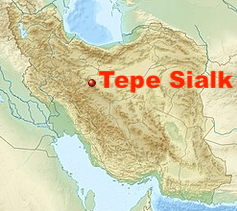
Tepe Sialk is one of the most important early farming settlements of the Iranian Plateau. It stands on the Kashan Plain of central Iran, about 3 km southwest of modern Kashan, near the famous Fin spring and Fin Garden. The site consists of two principal mounds: the North Mound, which contains the Neolithic settlement, and the later South Mound, occupied from the Chalcolithic into the Iron Age and later periods [1][2].
What makes Sialk especially interesting is its setting. It was not beside a huge permanent river such as the Euphrates or Tigris. Instead, the settlement occupied an alluvial landscape supplied by springs, temporary streams and a former river channel. Geomorphological work has identified an ancient watercourse running between the North and South mounds [3]. The modern Fin spring is about 4 km south of the site and remains an important water source today [4].
Mountain, desert and water
Tepe Sialk lies at roughly 1,000 m above sea level. The site is on the eastern side of the Karkas Mountains, whose highest summit reaches about 3,895 m [5]. These mountains are part of the broader mountain system separating the central Iranian Plateau from the Zagros region.
So, although Sialk is sometimes discussed in relation to the Zagros, it is not a Zagros foothill settlement in the same sense as Ganj Dareh or Jarmo. It occupies a fascinating transition zone: mountain resources to the west, fertile alluvial soils around Kashan, and the great salt-desert environment of the Dasht-e Kavir immediately to the east [3][5].
Sialk’s own water system was much smaller: springs, runoff from the mountains, groundwater and a former local river channel. That channel is no longer a normal flowing river. The landscape today is considerably drier, although the Fin spring still flows [3][4].
There was also a much larger environmental feature nearby: the salt-desert basin of Dasht-e Kavir. Sialk therefore occupied the edge of a desert ecosystem rather than the shore of a permanent freshwater lake [3].
What did the landscape look like?
The Neolithic landscape was probably greener than the modern one. Today the Kashan region is strongly arid. Archaeological and charcoal evidence, however, indicates that during the Neolithic there were more substantial riparian environments, including species such as willow (Salix), tamarisk (Tamarix) and Elaeagnus/Hippophaë. Later sequences show an increasing importance of steppe vegetation [7]. The surrounding mountains also provided a very different ecological zone. The regional vegetation included oak and pistachio woodland, while the mountain valleys could support a considerably greater variety of plants and animals than the desert plain [3]. This ecological contrast may have been one of Sialk’s greatest advantages: people could combine cultivated crops on the plain, grazing animals, spring water, mountain resources and desert-edge hunting within a relatively small territory.
Farming: wheat and barley were the stars
The archaeobotanical evidence is one of Sialk’s strongest features. The Neolithic assemblage contains substantial quantities of: Emmer wheat (Triticum dicoccum), other hulled wheat, Barley (Hordeum vulgare), grape (Vitis vinifera)
and, in some syntheses, small quantities of lentil (Lens) [8][9]. The most secure interpretation is that hulled wheats and barley were important crops from the earliest occupation [8].
There is an interesting regional twist here. The Neolithic Sialk assemblage appears to have relied heavily on glume wheats such as emmer, rather than the free-threshing bread wheats that became more prominent later. Glume wheats are well suited to relatively dry conditions and poorer soils, making them an excellent fit for Sialk’s environment [8].
What about legumes?
This needs a little caution. Some broader syntheses report lentil from Sialk, but the detailed study of the Neolithic botanical assemblage emphasized wheat and barley and did not identify a strong assemblage of cultivated pulses. The absence of peas or lentils in the recovered material therefore may be real—or may partly reflect preservation and sampling [8][9]. That makes Sialk somewhat different from several western Iranian Neolithic sites where pulses are much more prominent.
Grapes, figs, almonds and pistachios
Grape is securely documented, particularly in later occupation [8]. For fig, almond and pistachio, however, it is important not to overstate the evidence. The wider Kashan/Karkas environment naturally supported or could support wild pistachio and almond, and these plants occur in the regional vegetation zone [3][7]. But there is not equally strong published archaeobotanical evidence demonstrating that Neolithic Sialk farmers were deliberately cultivating pistachio, almond or fig. So the safest reconstruction is: Definitely cultivated: wheat and barley. Evidence for/use: grape and probably a wider gathering economy Regionally available: wild pistachio and almond. Not securely demonstrated as Neolithic Sialk crops: fig, almond and pistachio [3][8]. That distinction matters.
Sheep, goats, cattle, pigs and dogs
The animal economy was strongly pastoral. Recent faunal studies indicate a large predominance of domestic sheep and goats, with domestic cattle present but in much smaller numbers [10]. The wild-animal component is particularly interesting.
Major hunted animal: gazelle
Gazelle appears to have been the principal hunted large herbivore. Wild sheep and wild goats occurred, but in relatively small numbers [10]. There were also: equids, especially wild asses/hemiones; wild boar/suids; dogs; foxes; hyena; leopard; birds; and turtles [10]. So Sialk was not simply a farming village living exclusively on domesticated animals. It maintained a mixed farming–herding–hunting economy.
Aurochs?
Cattle are present, but the available evidence does not make aurochs a major feature of the Sialk Neolithic assemblage. Domestic sheep and goats dominate the faunal picture, while gazelle provides the clearest evidence for continued hunting [10].
Pigs?
Yes—but apparently not in large quantities. Pig/boar remains are present, but suids contributed relatively little to the overall diet [10]. This is a useful environmental clue: pigs can survive in many environments, but their relatively minor role at Sialk contrasts with their importance at some other Neolithic settlements.
The architecture: from light huts to mud-brick houses
This is where Sialk becomes especially valuable for an architecture study. The earliest Sialk I occupation is difficult to reconstruct because the excavators found little conventional architecture in the deepest levels. Roman Ghirshman proposed that the earliest inhabitants used structures made from timber, brush and other perishable materials [11].
Later architecture became much more substantial. The sequence appears to move broadly from: light/perishable structures to packed-earth or pisé construction to mud-brick houses to increasingly organized multi-room architecture. [11][12]
The North Mound ultimately accumulated more than 14 m of Neolithic and Chalcolithic deposits, creating a remarkably deep architectural archive [12].
The earliest houses therefore should not be imagined as miniature versions of later Mesopotamian cities. They were comparatively simple buildings adapted to a dry environment, using materials that were immediately available: earth, mud, brush, reeds and timber.
A very interesting architectural clue: dung
Micromorphological study of the settlement sediments found trampled herbivore dung and dung-rich surfaces, interpreted in some contexts as evidence for stabling or dung-plastered floors [13]. That gives us an unusually intimate glimpse of daily life: animals were not simply kept somewhere outside the village. Their presence became incorporated into the architecture and floors of the settlement.
Were there communal or ritual buildings?
This is one place where Sialk should not be exaggerated. There is no securely identified Neolithic equivalent of the monumental communal buildings at Göbekli Tepe, Çayönü or later Mesopotamian temples. Instead, the evidence for ritual life comes more subtly through: burials beneath or around houses; ochre associated with some burials; animal figurines; decorated pottery; symbolic animal imagery; andspecial objects and deposits [11][14].
The famous massive Sialk “ziggurat” belongs much later, principally to the Chalcolithic/Proto-Elamite and later sequence of the South Mound. It should not be presented as a Neolithic structure [15]. That distinction is important for a Neolithic architecture article.

Pottery: Sialk was already a pottery-making community
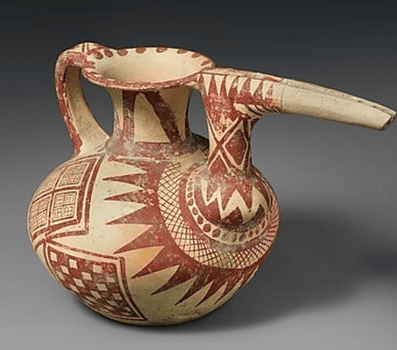
Sialk is not a Pre-Pottery Neolithic settlement. The earliest known occupation of the North Mound already contains handmade pottery. The earliest ceramics are coarse, chaff-tempered and relatively simple; later vessels become increasingly sophisticated [11][16].
The principal early ceramic traditions include:
Sialk I — Late Neolithic, approximately 6000–5200 BCE. Buff wares; red-slipped/coarse wares; simple black-painted decoration; geometric motifs; basket-like painted designs; and, handmade and relatively low-temperature firing [11][16].
Sialk II — Transitional/Early Chalcolithic, approximately 5200–4900 BCE. Finer red pottery; black-painted geometric designs; increasingly controlled firing; and, greater specialization in pottery production [16][17].
Scientific analysis of the ceramics using XRF, XRD and SEM/EDX demonstrates increasingly sophisticated control of raw materials, firing atmosphere and temperature [17]
That is a remarkable architectural-industrial story: the settlement was not only learning to farm; it was becoming technically specialized in ceramic production.
Tools and food-processing technology
The Neolithic inhabitants possessed the basic tool kit expected of a farming community: flint/chert blades; sickle blades; grinding stones; mortars and pestles; stone axes; bone tools; and tools for hide working and butchery [8][18].
Sickle blades are particularly important because they connect the architecture to agriculture. The houses were not merely shelters: they were places where crops were stored, processed and consumed. The discovery of emmer and grinding equipment suggests that cereal processing occurred within the settlement [8].
Woodworking and doors
Stone axes provide good evidence for woodworking, and the earliest structures were probably heavily dependent on timber, brush and reed [11]. But there is a difference between evidence for woodworking and evidence for a surviving door. There is no securely documented Neolithic wooden door at Sialk comparable to some later archaeological examples. Wood normally disappears in this environment unless carbonized or mineralized. So we can reasonably reconstruct: wooden structural elements, roof supports and perhaps door frames, but should not claim that a specific Neolithic door has been excavated unless a particular context is demonstrated [11].
Figurines and game pieces
Sialk produced small animal figurines, including examples from Sialk II [14]. These are potentially significant because they provide evidence for symbolic representation of animals beyond their depiction on pottery. However, the famous board-game evidence from Sialk is much later, belonging to the Bronze/Iron Age sequence rather than the earliest Neolithic occupation [19]. So: Neolithic: animal figurines and symbolic animal imagery. Later periods: board-game material and gaming pieces.
Flint, obsidian and trade
Local stone resources were important, but Sialk was not isolated.
Obsidian was imported into the Kashan region during the Late Neolithic, although it appears to have been relatively rare there. Its precise source for Sialk’s earliest material is not always known [20]. This is significant because obsidian does not naturally occur around Kashan. Its presence demonstrates that Sialk participated in wider exchange networks linking the Iranian Plateau with regions farther west and north.
Later provenance studies have identified Anatolian obsidian among prehistoric Iranian assemblages, while material-network studies place Sialk within a broader exchange system involving obsidian and marine/cowrie shells [20][21].
Thus a Sialk farmer could be living beside a small spring-fed river while using a volcanic glass tool whose geological source lay hundreds of kilometres away.
A surprisingly early connection to metal
Metalworking becomes increasingly important after the Neolithic.
Native copper objects occur at Sialk, including pins, projectile points, awls and spiral objects, although these belong principally to later Chalcolithic phases rather than the earliest farming settlement [22]. This makes Sialk particularly valuable as a long-term technological sequence: stone tools to pottery specialization to copper to increasingly sophisticated metallurgy to later monumental mud-brick architecture.
Climate change: a greener Sialk becomes a drier Sialk
The Neolithic environment was not identical to today’s. Modern Kashan is strongly arid. Regional reconstructions place present-day annual precipitation in roughly the 230–300 mm range, although other local estimates vary according to the precise ecological zone [3].
Charcoal studies indicate that Neolithic Sialk had more substantial riverine vegetation, including willow and tamarisk, than later periods [7]. Over time, there was an increase in steppe and arid-adapted vegetation. This suggests that the landscape became progressively drier, although climate was not the only factor: human land use, grazing, wood cutting, irrigation and geomorphological change also mattered [7]. This is one reason Sialk is so interesting for modern climate-adaptation studies. The settlement demonstrates that water management and architecture were inseparable in an already dry environment.
Was Sialk abandoned?
Yes—but the story is more complicated than a single abandonment. The North Mound was occupied from roughly 6000 BCE, with the Late Neolithic Sialk I sequence followed by Sialk II. Recent radiocarbon modeling places the end of North Mound occupation around 4900 BCE [12][17]. There was then a major hiatus of roughly 800 years. Occupation resumed on the South Mound around 4100 BCE [15][17].
Later there were additional interruptions in the very long sequence, including a substantial gap in the Early Bronze Age sequence. The site was subsequently occupied again during the later Bronze and Iron Ages [15][17].
Archaeoseismic and environmental studies suggest that earthquakes, changes in river systems, climatic deterioration and other environmental stresses may all have contributed to episodes of abandonment or disruption. It is therefore misleading to blame a single “climate event” for every abandonment [5]
By the first millennium BCE, Sialk’s ancient settlement had undergone another major transformation, and around the late 9th/8th century BCE there appears to have been a major destruction/abandonment episode [2]. So rather than saying “Sialk was abandoned once,” the better interpretation is: Sialk was repeatedly reorganized, abandoned and reoccupied over thousands of years.
Who excavated and studied Sialk?
The site’s archaeological history is unusually international.
Roman Ghirshman and the French Archaeological Mission
Roman Ghirshman excavated Sialk in 1933, 1934 and 1937, producing the foundational two-volume publication Fouilles de Sialk près de Kashan [23]. His work established Sialk as one of the key sites for understanding Iranian prehistory.
Sialk Reconsideration Project
From 1999/2001 onward, Iranian archaeologist Sadegh Malek Shahmirzadi led major new investigations, particularly on the South Mound and later prehistoric phases [24].
University of Tehran and British collaboration
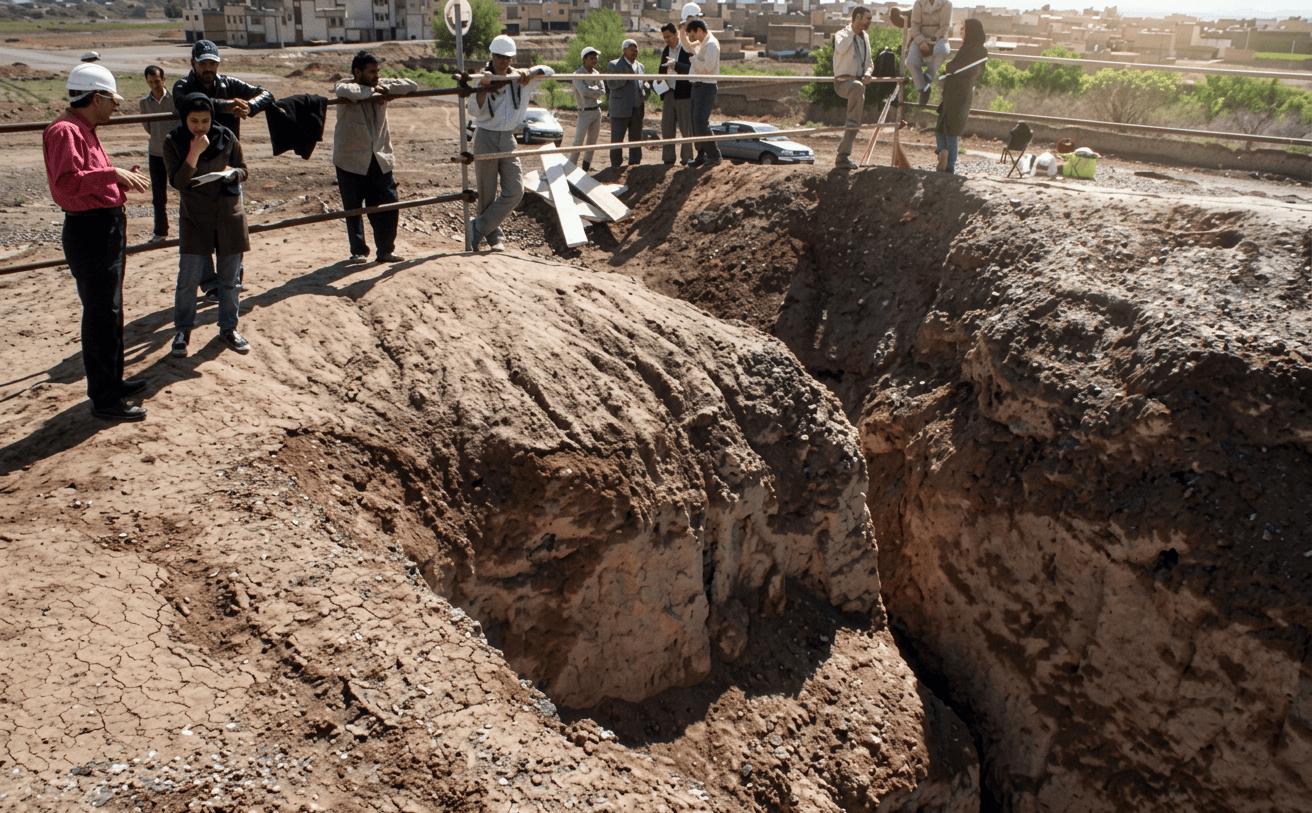
From 2008–2009, work on the North Mound was undertaken under Hassan Fazeli Nashli of the University of Tehran, with collaboration involving Durham University and the University of Stirling, among others [12][24]. This newer work was particularly important because it applied: radiocarbon dating; sediment micromorphology; archaeobotany; archaeozoology; ceramic petrography; XRF/XRD/SEM; geomorphology; and environmental archaeology.
Researchers including Nikos Kourampas, Ian Simpson, Hassan Fazeli Nashli, Mark Manuel, Robin Coningham, Armineh Marghussian, Mark Pollard, Marjan Mashkour and Zohreh Shirazi have contributed to different aspects of the site’s environmental, agricultural, architectural, faunal and technological history [7][8][12][17].
Why Sialk matters for Neolithic architecture
Sialk is not the site with the most spectacular building. That is precisely why it is useful. Its importance is the transition. Here we can see a dry-land community adapting architecture to: spring water + former river channel + seasonal runoff + cultivated fields + sheep/goat herding + cereal processing + animal stabling + local earth + timber/brush + increasingly sophisticated pottery + long-distance exchange. The architecture is therefore an expression of an entire environmental system.
The earliest buildings were light and probably relatively ephemeral. Later structures became increasingly substantial and mud-brick based. Floors incorporated activities involving animals. Grinding and food preparation took place within the settlement. Storage and craft production became increasingly important. Eventually, hundreds and then thousands of years later, the same place supported monumental mud-brick construction.
That is the real architectural story of Sialk: A village learned to turn a dry landscape into a permanent settlement, and then kept rebuilding it for millennia.
References: [1] Ghirshman, R. (1938). Fouilles de Sialk, près de Kashan, 1933, 1934, 1937. Vol. I. Paris: Paul Geuthner.
[2] Encyclopaedia Iranica. “Kashan ii. Historical Geography.”
[3] Kourampas, N., Simpson, I. A., Fazeli Nashli, H., Manuel, M., & Coningham, R. (2013). “Sediments, Soils and Livelihood in a Late Neolithic Village on the Iranian Plateau: Tepe Sialk.” In R. Matthews & H. Fazeli Nashli (Eds.), The Neolithisation of Iran (pp. 189–200). Oxbow Books.
[4] Shirazi, Z., & Tengberg, M. (2012). Studies of vegetation and charcoal from the Central Iranian Plateau.
[5] Berberian, M. et al. (2012). “Archeoseismicity and environmental crises at the Sialk Mounds, Central Iranian Plateau, since the Early Neolithic.” Journal of Archaeological Science.
[7] Shirazi, Z., & Tengberg, M. Studies of charcoal and vegetation history at Tepe Sialk and Tepe Zagheh.
[8] Tengberg, M. (2004). “Archaeobotanical analysis at Tepe Sialk. Results from the 2003/04 season.” In S. M. Shahmirzadi (Ed.), The Potters of Sialk, Sialk Reconsideration Project Report No. 3, pp. 25–32.
[9] Fazeli Nashli, H. et al. Research on Neolithic subsistence and archaeobotany of the Kashan Plain.
[10] Mashkour, M. (2002, 2004 and subsequent studies). Archaeozoological studies of Tepe Sialk.
[11] Ghirshman, R. (1938). Fouilles de Sialk. Architectural and material sequence of Sialk I–II.
[12] Fazeli Nashli, H., Coningham, R., Marghussian, A., Manuel, M., Azizi Kharanaghi, H., & Pollard, M. (2013). “Mapping the Neolithic Occupation of the Kashan, Tehran and Qazvin Plains.” In The Neolithisation of Iran.
[13] Kourampas et al. (2013). Sediment micromorphology and evidence for animal dung/stabling at Sialk.
[14] Revisiting Sialk I and II from Ghirshman’s excavations.
[15] Fazeli Nashli, H., Theodorakopoulou, K., Stamoulis, K., Athanassas, C., Nazari, H., Yeganeh, S. J., Nokandeh, J., & Shokri, M. (2023). “Deciphering the chronology of Tepe Sialk (South) ‘Ziggurat’… through optically stimulated luminescence.” Journal of Archaeological Science: Reports, 48, 103860.
[16] Dyson, R. H. “Ceramics: The Neolithic Period through the Bronze Age in Northeastern and North-Central Persia.” Encyclopaedia Iranica.
[17] Marghussian, A. K., Coningham, R. A. E., & Fazeli, H. (2017). “The Evolution of Pottery Production During the Late Neolithic Period at Sialk on the Kashan Plain, Central Plateau of Iran.” Archaeometry, 59(2), 222–238.
[18] Vidale, M., Fazeli Nashli, H., & Desse, F. (2018). “The Late Prehistory of the Northern Iranian Central Plateau (c. 6000–3000 BC): Growth and Collapse of Decentralised Networks.”
[19] Schädler, U., & Dunn-Vaturi, A.-E. “Board Games in Pre-Islamic Persia.” Encyclopaedia Iranica.
[20] Gratuze, B. and colleagues; Blackman, M. J. Research on the distribution and provenance of obsidian in Iran.
[21] British Institute of Persian Studies. Tappeh Sialk and Ancient Kashan International Conference.
[22] Encyclopaedia Iranica. “Bronze i. In Pre-Islamic Iran.”
[23] Ghirshman, R. (1939). Fouilles de Sialk, près de Kashan, 1933, 1934, 1937. Vol. II. Paris: Paul Geuthner.
[24] Malek Shahmirzadi, S. (2002–2006). Sialk Reconsideration Project monographs.
Leave a Reply