<home # start here # guides # builds # services # shop # about # categories>
Tabarja Wata Slam 100, usually abbreviated TWS100, is one of the most important newly excavated Neolithic sites in Lebanon. It is dramatically different from Tahun ben Aissa or Neba’a Faour.
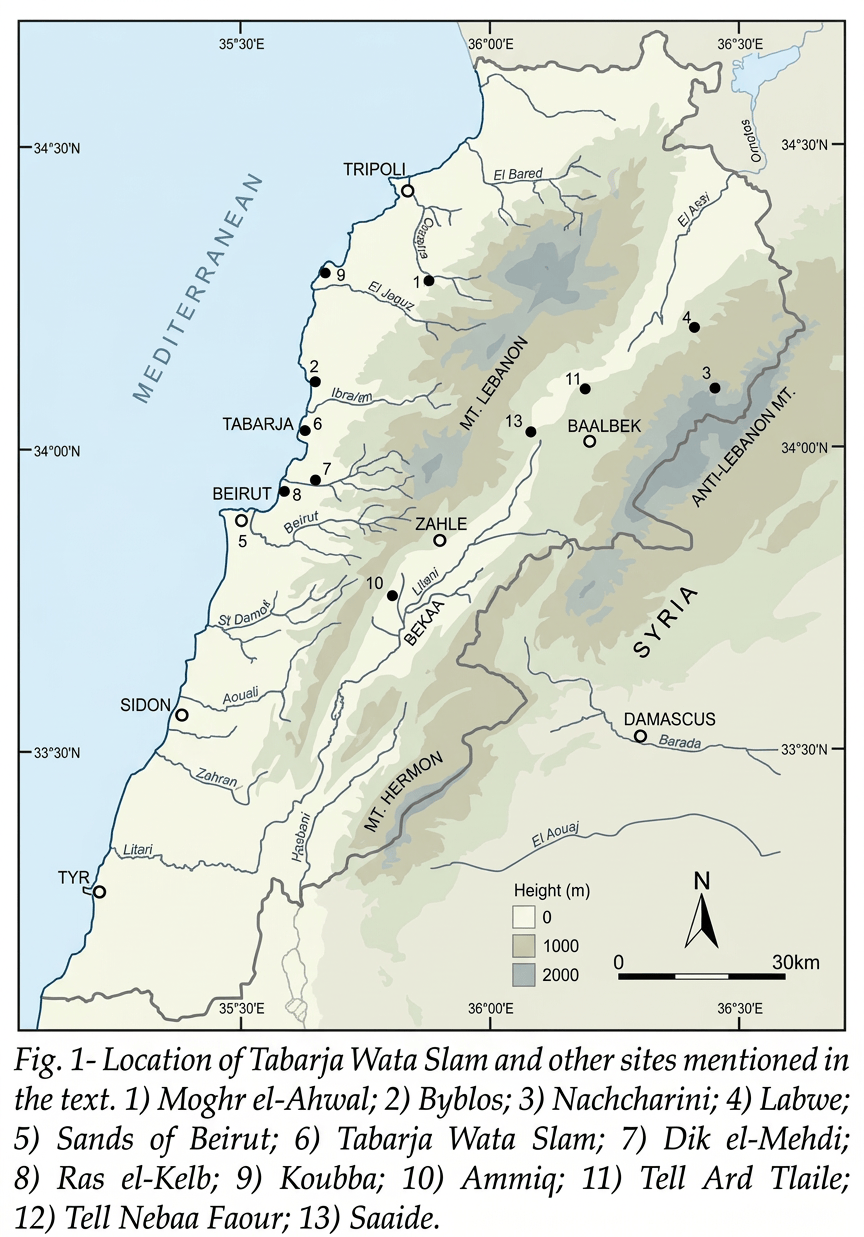
It is a coastal settlement only about 60 metres from the present shoreline, approximately 28 km north of Beirut and 11 km south of Byblos. Large-scale rescue excavations between 2016 and 2019 exposed approximately 35,000 m² of archaeology. The Neolithic sequence runs from the Middle PPNB through Late PPNB and into the Pottery Neolithic, roughly covering the eighth through seventh millennia BC. [1–3]
TWS100 is remarkably rich
Archaeologists found: rectangular stone-built houses; plastered floors; wooden roof-support posts; hearths and possible ovens; sunken floor installations; storage bins; pits and possible huts; agricultural tools; cereal and pulse remains; domestic goats, pigs and cattle; wild gazelle and deer; tuna, grouper and seabream; bone fishhooks; stone fishing weights; stone anchors; more than 300 stone figurines and incised objects; obsidian; shell ornaments; bone, ivory and antler tools; White Ware; human burials inside and beneath buildings; and, evidence for repeated manipulation of the dead. [1–3]
It is one of the best Lebanese sites for telling the story of the Neolithic as a combination of architecture, farming, herding, fishing, craft, ritual and maritime connection.
Where is it? The site lies at Tabarja, in the Keserwan area of Mount Lebanon, on the Mediterranean coast
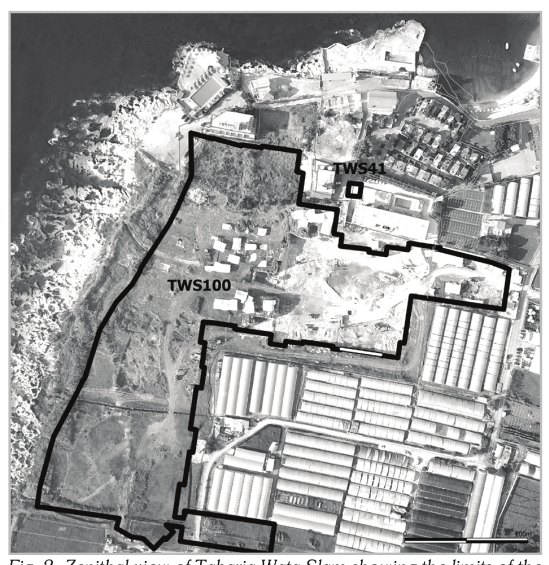
The archaeological site occupies the area known as Wata Slam / Ouata Sillâm. The name wata apparently refers to a lowland or small plain. The site sits on a rocky coastal promontory composed largely of Cenomanian chalky and marly limestone. [1] Its position is extraordinary because the Mediterranean Sea is only 60 m away. And, Byblos is 11 km north; and, Beirut 28 km south.
The Wata Slam promontory stretches roughly 1.8 km north to south, is about 500 m wide at its broadest, and is bounded by Tabarja Creek to the north and Daoura Creek to the south. [1]
TWS100 is an especially important site for studying what happens when early farming communities live directly beside the sea
This was not an inland settlement that happened to have maritime contacts like Neba Faour. The people could potentially combine: agriculture; herding; freshwater resources; shell collecting; coastal fishing; offshore fishing; stone-working; woodland resources from Mount Lebanon; and, exchange along the coast.
Water
The site was bordered by coastal creeks, and its limestone bedrock is strongly karstified, containing sinkholes. Two sinkholes were investigated archaeologically. The excavators suggest that some may have functioned as water wells, although they found no conclusive evidence that they were intentionally cut as wells. [1]
Two springs, Ayn Sghire and al-Ayn, are recorded approximately 1.5 km north of Tabarja, in the Safra locality, although their ancient condition and function are unknown. [1]
So the water situation was probably: Sea: 60 m;
Creeks: immediately around the promontory;
Karst/sinkholes: within the settlement landscape; and,
Documented springs: 1.5 km north.
Was it close to Jerf el-Ahmar and the Euphrates?
Using the published location the straight-line distance is approximately 315 km. A couple week trip would have been plausible.
Jerf el-Ahmar, in northern Syria, belongs to an earlier phase of the Neolithic than much of the substantial TWS100 sequence, although there is chronological overlap within the broad PPNB transformation.
The important connection is not walking. It is that both belonged to a network of communities sharing technological and social innovations: rectangular architecture; food production; stone tools; storage; communal activities; complex mortuary practices; and long-distance movement of materials.

The TWS100 excavation report includes a useful regional map showing: Byblos, Moghr el-Ahwal, Dik el-Mehdi, Ras el-Kelb, Koubba, Sands of Beirut, Nachcharini, Tell Labwe, Ammiq, Tell Ard Tlaile, Tell Neba’a Faour and Saaide [1]
Several important comparisons: Byblos. Only about 11 km north. Byblos became one of the great reference sites for the Lebanese Neolithic and provides an important comparative sequence for TWS100. [1]
Ras el-Kelb. A major prehistoric cave locality north of Beirut. Its earlier occupations are especially important for understanding hunter-gatherers and the transition toward later settlement. [1,4]
Dik el-Mehdi. Another coastal/open-air prehistoric locality, although much less securely preserved than TWS100.
Koubba. A coastal prehistoric locality included in the regional archaeological network.
Moghr el-Ahwal. A highland cave site in northern Lebanon with Epipalaeolithic and PPNB burials, providing an excellent comparison for the treatment of the dead. [5]
Tell Labwe South. One of Lebanon’s important PPNB village sites in the Beqaa. And,
Neba’a Faour. The site we discussed in the previous study—another important Neolithic settlement, but inland rather than coastal.
How was TWS100 discovered? A remarkable archaeological discovery story
The site was accidentally discovered in August 2016 by Fady Beayno during a fishing trip. Archaeological rescue excavations began in September 2016 under the Directorate General of Antiquities (DGA), and from 2017 the excavations were under the scientific direction of Corine Yazbeck. [1]
The earliest evidence consists of Middle Palaeolithic Levallois artefacts
Francis Hours had already identified Levallois material in the area in 1965. The new excavation recovered two distinct lithic groups, including material described as “Golden Mousterian” and rolled artefacts with worn edges. [1] Then came natural soil formation. Then came the Neolithic. That gives TWS100 an unusual long-term story: Middle Palaeolithic hunters, Neolithic farmers/fishermen, Pottery Neolithic communities, Roman/Byzantine occupation and Ottoman settlement.
The later occupations include substantial Roman/Byzantine domestic and cultic architecture, including a Christian basilica, but those are not Neolithic and should not be confused with the earlier buildings. [1]
Excavators currently divide the Neolithic sequence into four broad stages
Stage Approximate period Main evidence
Stage 4 8012 to 7580 BC basal pits, hearths, early settlement, food remains
Stage 3 7520 to 7000 BC cobble-floored stone buildings
Stage 2 later PPNB plaster-floored rectangular village
Stage 1 Pottery Neolithic pottery, storage rooms, later buildings
The exact chronological boundaries continue to be refined, but the sequence spans the Middle and Late PPNB and Pottery Neolithic, broadly the eighth through seventh millennia BC. More recent summaries give the wider occupation as approximately 8164–6593 calibrated BC. [1,3,6]
Stage 4: the earliest Neolithic occupation was not initially a neat village of rectangular houses
Instead archaeologists found: large numbers of pits; circular pits; combustion features; cobble layers; burials; animal burials; possible huts; storage structures; and, a few early architectural features. The occupation covered more than 20,000 m². [1] Some of the larger pits contained multiple occupation surfaces and may have been habitation features. Importantly, the excavators did not find abundant postholes in these possible hut structures. So the earliest settlement may have looked much less like the later rectangular village.
Were there subterranean or sunken buildings? Yes but with important qualifications
TWS100 contains numerous dug pits, and some may represent habitations, storage facilities, wells or refuse pits. The earliest stage also contains two circular, stone-built, buried structures that may have functioned as granaries or storage containers. [1] But these are not the same thing as saying that TWS100 was a settlement of subterranean houses. Early TWS100 used pits and partially buried installations extensively, while later phases developed substantial above-ground rectangular buildings.
Stage 3: the stone-house village
By roughly 7500–7000 BC, the settlement had developed substantial rectilinear architecture. The buildings were constructed from local limestone fieldstones and boulders. Walls generally consisted of: two parallel rows of stones; smaller stones, gravel or cobbles filling the interior; and no obvious mortar. Wall thicknesses were around 54 to 72 cm. Some walls survived to nearly 95 cm high. [1]
Stage 3 produced freestanding rectilinear buildings, including rectangular structures and multi-room buildings
One particularly interesting building had four rooms. It included one room with a slab floor; two rooms with cobbled floors; and, an incised stone incorporated into the floor. [1] That is already recognizably domestic architecture.
Yes, they probably used timber
In the later plaster-floor buildings, postholes were found on the plaster surfaces in three buildings, suggesting wooden posts or pillars that supported roof beams. The excavators caution that the precise roofing reconstruction requires further study. [1]
So we can safely reconstruct: stone walls, wooden roof-support posts and roof beams
But we should not automatically call it a timber-frame house. There is no evidence for a full exposed timber frame like a modern post-and-beam house.
Mudbrick or adobe? It is possible but not yet securely established
The excavation report specifically says that the use of adobe is still under investigation. [1]
The primary demonstrated wall technology is: dry-laid stone construction. And because of archaeological remains, classification is best described as a stone-and-timber/hybrid architectural tradition, with adobe still requiring confirmation.
No securely identified wattle-and-daub wall has been reported. But the evidence for fibre and organic technology is present.

Stage 2 is particularly important. Plastered floors: one of the great architectural technologies
More than 20 plastered-floor buildings were preserved in Areas B and C, across an area exceeding 12,000 m². [1] The buildings were generally: rectangular or square; one major plastered room; sometimes accompanied by a beaten-earth or cobbled surface; constructed with double-row stone walls; and repeatedly renovated. The plaster floors were usually approximately 5–10 cm thick and were laid over prepared foundations containing cobbles and pebbles. [1]

This is sophisticated architecture. Around 8000 years ago, people weren’t simply occupying a naturally convenient surface. They were deliberately engineering level ground, stone/cobble preparation, plaster floors and repeated resurfacing
The excavators note that it is quite possible that plaster also covered walls, but the surviving evidence was insufficient to demonstrate this securely. [1]
What about fireplaces, or hearths?
More than 30 combustion features were recorded in the earliest stage. Many were circular or oval pits filled with limestone and basalt cobbles, animal bones and lithic material, and some are interpreted as hearths used for cooking. [1]
Later buildings also contained: hearths; plastered bins; possible ovens; and sunken floor installations. One building had a sunken plastered depression built directly into the floor. It may have been a hearth or storage pit. Another contained a plastered bin constructed from small cobbles that may have functioned as a hearth or oven. [1]
Storage was a major part of the architecture
One Pottery Neolithic building measured approximately 5 × 3.76 m and was divided into two small units. Two small cells alongside its northern wall may have been granaries. [1]
Earlier phases also produced: buried storage structures; plastered bins; pits; and possible storage containers
This suggests that the architecture was intimately connected with the agricultural economy.
No securely identified beds, chairs or tables have been reported
The buildings seem to have relied heavily on: floors; bins; storage installations; pits; containers; and portable stone equipment. Wooden furniture would be particularly difficult to preserve.
TWS100 has symbolic and mortuary activity, but no clearly identified monumental communal building equivalent to a “temple” or Göbekli Tepe-style sanctuary has been demonstrated
There are: numerous figurines; incised stones; unusual foundation deposits; animal burials; human burials; and complex mortuary treatment. But no securely identified Neolithic monumental sanctuary. The later Roman/Byzantine basilica at the site is, of course, a completely different period. [1]

One of the most important features of TWS100. The dead were buried inside the settlement
More than 300 human skeletal remains were recovered from the excavations, distributed across different phases of occupation. Many were associated with domestic installations, especially the plaster-floor village. [1]
In Stage 2, for example, one building contained nine burials, including: one primary subfloor burial; two secondary burials in the same pit; and additional burials associated with the building and later use. [1] Some burials actually cut through earlier plaster floors. Architecture and ancestry were physically intertwined.
The TWS100 report records cases of: secondary burial; body-part removal; occasional skull removal; multiple burials; tightly flexed bodies; and graves cut into plaster floors [1]
This becomes particularly interesting when compared with Tabarja Wata Slam 41, an adjacent site only about 24 metres northeast of TWS100. TWS41 produced a much more elaborate funerary complex with skull deposits, bone bundles, a possible funeral pyre and more than 100 individuals. [7]
Do not merge TWS41 and TWS100
They are separate archaeological sites, but their proximity makes them an extraordinary paired case study of Neolithic life and death on the Lebanese coast.
Agriculture: extraordinarily good evidence
Recent research has transformed the significance of TWS100. The site has yielded large quantities of charred plant material. Approximately 70,000 litres of systematically sampled sediment were floated for botanical research. [8] The preliminary archaeobotanical results reported in 2025 identify Cereals: wheat, barley; Pulses: peas / vetchlings, lentils, broad beans, vetchlings; and, Fruit trees. The currently published preliminary summary does not give a complete fruit tree species list. [8,9]
TWS100 is not merely a site where archaeologists assume agriculture because they found sickles.
The animal evidence is extraordinary because it changes through the Neolithic sequence (stage 1, stage 2, stage 3, stage 4)
Stage 1. Animal remains were dominated by: caprines: 56% NISP, pig: 32%, and cattle: 6%. Almost 90% of the ungulates were considered domestic, with goats especially abundant. Sheep were surprisingly rare. Wild gazelle and cervid made up another component. [1]
Stage 2. The dominant animals were: pig: 49%, goat: 45% and, cattle and wild gazelle: rare. [1]
Stage 3. Goat and pig remained dominant.
Stage 4. The picture changes dramatically: pig: 74%, goat: 14% and cattle: 10%. And, nearly 60% of the ungulates were wild. [1]
The earliest coastal community may have relied much more heavily on wild animals and hunting, while later communities show stronger evidence for domestic animal management.
Pigs are one of the most interesting animals at TWS100
The excavators have suggested that the evidence may indicate local domestication or management of wild boar, although the interpretation remains under investigation. [1,6]
There is also a remarkable pig/boar burial associated with a Stage 3 building. The animal was deliberately placed in a pit cutting the building’s occupation deposits. [1] That makes pigs important not merely as food. They may have had economic, symbolic and architectural/foundation significance.
Cattle, goats and sheep
Cattle are present but generally much less abundant than goats and pigs. Goats were an important domestic animal.
Sheep are surprisingly rare in some of the reported assemblages.
This suggests that the community’s herding strategy was not simply the familiar later Near Eastern “sheep and goat package.” It appears to have been more complicated.
Agriculture and herding did not eliminate hunting because wild animals remained part of the economy
The site has yielded: gazelle; cervids/deer; and other wild animals.
Fish, and some very large fish
This may be the most exciting part of TWS100. Fish remains include: seabream, groupers and tuna. Fish account for significant proportions of the identified faunal assemblage in several phases. [1] Tuna are particularly significant because they are pelagic/offshore fish. This implies that the inhabitants were not merely collecting small fish in a nearby tidal creek. They were accessing the open Mediterranean.
The site produced bone fishhooks
There are also: stone fishing weights; perforated stones interpreted as possible net weights; waisted stone objects that may have been fishing weights; and stone anchors. [1] A technological chain and astonishing combination for a PPNB settlement.

Boats themselves have not survived
But the evidence strongly supports some form of watercraft. Three limestone anchors were recovered from pits. One was associated with a limestone grinding slab. [1] The excavators describe the anchors and fishing equipment as potentially representing some of the earliest evidence for deep-sea fishing on the Lebanese coast. [6] It is difficult to explain offshore fishing for tuna without some kind of watercraft.
Boat tech: the site contains: axes; adze-like tools; blades; borers; grooved stones; stone weights; and woodworking-compatible tools
But there is no surviving boat or direct use-wear study proving: “This particular axe made a boat.” A responsible interpretation is: ‘the technological toolkit was compatible with woodworking and watercraft construction, and the anchors/fishing system strongly indicate boats, but the exact construction technology remains unknown.’
Shells, baskets and fibre technology
More than 500 shell artefacts were recovered, including numerous beads made from gastropods and other shell objects. [1]
There were also more than 250 objects made from: bone; ivory; and antler. These included fishhooks, awls and other objects. [1]
Directly preserved textiles are not reported. Because baskets and reeds are also unlikely to survive in the normal coastal archaeological conditions. Nevertheless, the combination of fishing technology; fibre/string requirements; basketry-compatible technologies; shell beads; and bone awls. Strongly suggests a sophisticated organic-material technology.
Stone technologies
The lithic industry includes: projectile points; Byblos points; bifacial points; sickle segments; axes; blades; cores; scrapers; grooved stones; stone weights; and stone anchors.
One particularly interesting observation is that there was a high proportion of finished tools and relatively little manufacturing waste in some obsidian assemblages, suggesting that objects may have arrived at the settlement already finished or semi-finished. [2] Potential evidence for exchange or organized movement of specialized materials.
Greenstone, serpentine and exotic materials
The site produced numerous small green stone objects. Some of the raw material does not appear to be local. An unworked worn green stone—possibly serpentine—was found, suggesting either imported raw material or exchange. Small axes and other objects were made from similar material. [1]
The figurines: one of the site’s great surprises
TWS100 produced more than 300 stone figurines and other symbolic objects. [1,6] Many are made from local limestone, while some use other materials. Some have: anthropomorphic forms; incised bodies; stylized facial features; exaggerated hips/buttocks; and other deliberately shaped characteristics. One particularly striking limestone female figurine is approximately: 11 cm high × 7 cm wide × 6 cm thick. It has large hips, a large belly, folded arms and stylized facial characteristics. A radiocarbon date associated with the context produced a calibrated range of approximately 8530–7650 BC, although the stratigraphic context was disturbed. [1] The excavators suggest that the figurine may represent a local/autochthonous tradition, rather than simply being an imported style. [1] Perhaps a deliberately crafted anthropomorphic female stone figurine with exaggerated body features. Yet its symbolism remains open to interpretation. The important fact is not that we know what she meant. It is that Neolithic people at TWS100 were investing considerable labour in symbolic three-dimensional objects.

Incised and grooved stones occur throughout the sequence
They seem particularly frequent in association with the cobbled-floor and plaster-floor phases. [1] Some may have been tools. Others may have had symbolic meaning. The combination of: figurines, incised stones, foundation deposits and burials. Suggests that symbolism was integrated into ordinary domestic life rather than confined to a monumental temple.
No monumental ritual building has been securely identified
But there is strong evidence for ritualized behaviour within domestic architecture. Ie. Burials beneath floors; multiple burials; secondary burial; body-part removal; a possible foundation deposit; a pig/boar burial; figurines; and unusual stone objects. This is important for understanding the Neolithic. Ritual did not necessarily require a temple. The house itself could be ritual space.
The burials are one of the most significant parts of the site
At least three burial horizons have been identified. People were: buried in pits; buried beneath floors; buried in crouched or flexed positions; buried singly; buried in multiple groups; sometimes reburied; sometimes subjected to removal of body parts; and occasionally accompanied by grave goods. [1]
Some graves were constructed with stones.
Others were simple pits.
Some later burials actually cut into earlier buildings.
The site itself is now the subject of a major archaeobotanical and anthracological study. Christelle Kabboul’s research uses both: carpology, or seeds, fruits and plant remains; and, anthracology: charcoal/wood remains
The purpose is specifically to reconstruct the environment and agricultural practices of the coastal Neolithic community. [8,9] It does not claim the site had access to particularly ancient cedar or oak forest. The geographical setting would have had access to: coastal scrub; agricultural fields; streamside vegetation; mountain woodland; open grassland; and, the Mediterranean itself.
This may be the most accurate summary of TWS100’s economy: Land: wheat; barley; peas/vetchlings; lentils; broad beans; fruit trees.
Herding goats; pigs/boar; cattle.
Hunting: gazelle; deer/cervids; wild pigs and other animals.
Sea: tuna; grouper; seabream; fishing hooks; net weights; and anchors.
Gathering/coastal resources: shells; gastropods; and, other marine resources.
This is not a simple “farming village.” It is a mixed land-and-sea economy.
Almost certainly participated in exchange networks, although the exact routes remain to be demonstrated
Evidence includes: obsidian; exotic greenstone; shells; bone/antler objects; and specialized finished tools. TWS100 sat at a crossroads: Lebanese coast, northern Levant, inland Lebanon, Anatolia and Cyprus
The Tabarja/Wata Slam coastal landscape remains densely occupied
The original Neolithic settlement itself has been heavily affected by modern construction. The rescue excavation happened precisely because development threatened the archaeological remains. [1] There is therefore very active research continuing after the original 2016–2019 excavation.
Tabarja Wata Slam 100 had 5 major themes (building technology, food architecture, maritime technology, social structure & symbolic architecture)
A. Building technology. Dry-stone walls; double-row construction; cobble infill; plaster floors; repeated resurfacing; timber roof supports; possible adobe; storage cells; bins; and hearths.
B. Food architecture. Granaries; storage rooms; grinding equipment; sickle technology; food-processing floors; pits; and, cooking installations.
C. Maritime technology. Fishhooks; net weights; fishing weights; stone anchors;
tuna/grouper/seabream; probable boats; and offshore fishing.
D. Social architecture. Burials beneath floors; multiple burials; secondary burial; body-part removal; animal deposits; and foundation deposits.
E. Symbolic architecture. 300+ stone figurines; incised stones; unusual stone objects; decorated bowls; and possible ritual deposits.
Tabarja Wata Slam 100 was a Neolithic coastal community where early farmers and herders lived in stone-and-timber houses, buried their dead beneath their floors, cultivated wheat, barley and pulses, hunted and herded animals, and apparently ventured onto the Mediterranean to catch fish such as tuna. But there is an even bigger lesson. For a long time, the Neolithic story was presented as: people move inland, invent farming and build villages. TWS100 complicates that story. These people were simultaneously: farmers, herders, hunters, fishermen, builders, sailors, stoneworkers, artists and traders. Their architecture was not merely a shelter. It incorporated: stone walls, timber roof supports, plaster floors, hearths, bins, storage, burial and ancestry.And, their economy was not merely terrestrial. It extended: field, house, storage, coast, boat and open sea.
References: [1] Yazbeck, C., Beayno, F., Chahoud, J., et al. (2020). “Tabarja Wata Slam 100 (TWS100): a Multi-Period Pre-Pottery and Pottery Neolithic Site on the Lebanese Coast.” Bulletin d’Archéologie et d’Architecture Libanaises (BAAL), 20, 185–226. This is the essential primary preliminary report for the excavation.
[2] Yazbeck et al. (2020), TWS100 lithic and obsidian sections, including the discussion of finished/semi-finished obsidian artefacts and potential trade routes.
[3] Kabboul, C., Tengberg, M., Chahoud, J., & Yazbeck, C. (2025). “Archaeobotanical approach to plant environments and agrarian practices of coastal Neolithic communities in the Central Levant: the case of Tabarja Wata Slam 100.” 14th ICAANE, Lyon. Preliminary results identify wheat, barley, pea/vetchling, lentil, broad bean/vetchling and fruit-tree remains.
[4] Yazbeck, C. (ed.) and related Lebanese prehistoric research on Ras el-Kelb and the prehistoric coastal sequence.
[5] Garrard, A. N., Yazbeck, C., et al. Research on the Epipalaeolithic and PPNB burials at Moghr el-Ahwal, northern Lebanon.
[6] Yazbeck, C. et al. TWS100 conference synthesis, World Neolithic Congress 2024. The authors describe the site as a Middle/Late PPNB and Pottery Neolithic farming, herding and fishing community and highlight the possible local management/domestication of boar, pelagic fishing and more than 300 stone figurines.
[7] Yazbeck, C., & Zaven, T. (2020). “Crouched Skeletons, Skull Deposits, Bone Bundles and a Funeral Pyre: A Unique Early-Middle PPNB Funerary Area from Tabarja Wata Slam 41 (TWS41), Lebanon.” BAAL, 20, 227–257. TWS41 is a separate site immediately adjacent to TWS100 and is particularly valuable for comparison of Neolithic funerary practices.
[8] Kabboul, C. Archaeobotanical research project, Muséum national d’Histoire naturelle / Lebanese University / Ifpo. The project has processed nearly 70,000 litres of systematically sampled sediment from TWS100 and TWS41.
[9] Honor Frost Foundation, “Christelle Kabboul PhD Scholarship,” documenting the ongoing archaeobotanical and environmental research at TWS100.
[10] ARWA XPress, 2022, reporting the multidisciplinary TWS100 research programme on the interaction between the Neolithic population and the Mediterranean, including maritime exploitation, navigation and possible links with Cyprus.
[11] Lebanese University / Corine Yazbeck research profile, documenting continuing post-excavation work on TWS100.
[12] ARPAMED, 2025, “Origine de la population néolithique de Tabarja Wata Slam 100.” Current project involving Bérénice Chamel, Lebanese University and Durham University, using strontium and oxygen isotopes to investigate population origins, mobility and water sources.
[13] Honor Frost Foundation, Lebanon Projects: “Tabarja Wata Slam 100 – 2019–ongoing.”
Leave a Reply