<home # start here # guides # builds # services # shop # about # categories>
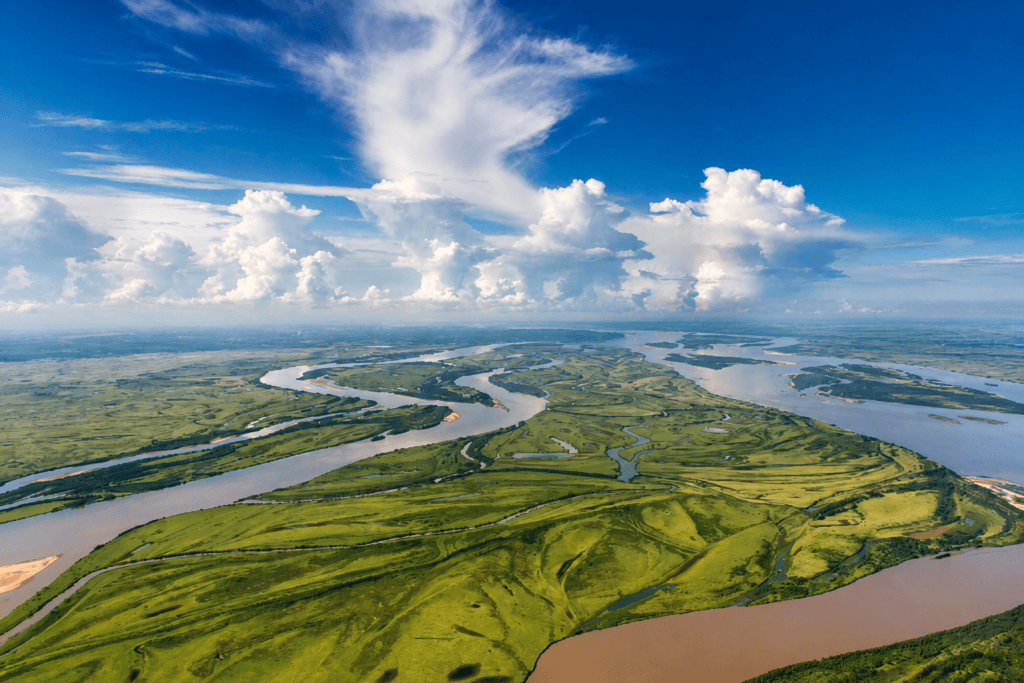
Suchu Island (Остров Сучу) is one of the most remarkable Neolithic settlements in the Russian Far East. It was not in central Russia or western Siberia. It lies in the Lower Amur region of the Russian Far East, in present-day Khabarovsk Krai, near the village of Mariinskoye. The site is an island settlement in the Amur River system, about 2.5 km from Mariinskoye. Archaeologists have identified more than 130 house depressions, along with workshops, ritual features, enormous quantities of pottery and stone tools, and evidence for several successive Neolithic cultural traditions. [1–4]
What makes Suchu especially interesting for an architectural study is that its inhabitants combined semi-subterranean architecture, timber structural framing, central hearths, built-in earthen benches/sleeping platforms, storage pits, sophisticated pottery, fishing and hunting technology, and an unusually elaborate ritual tradition.
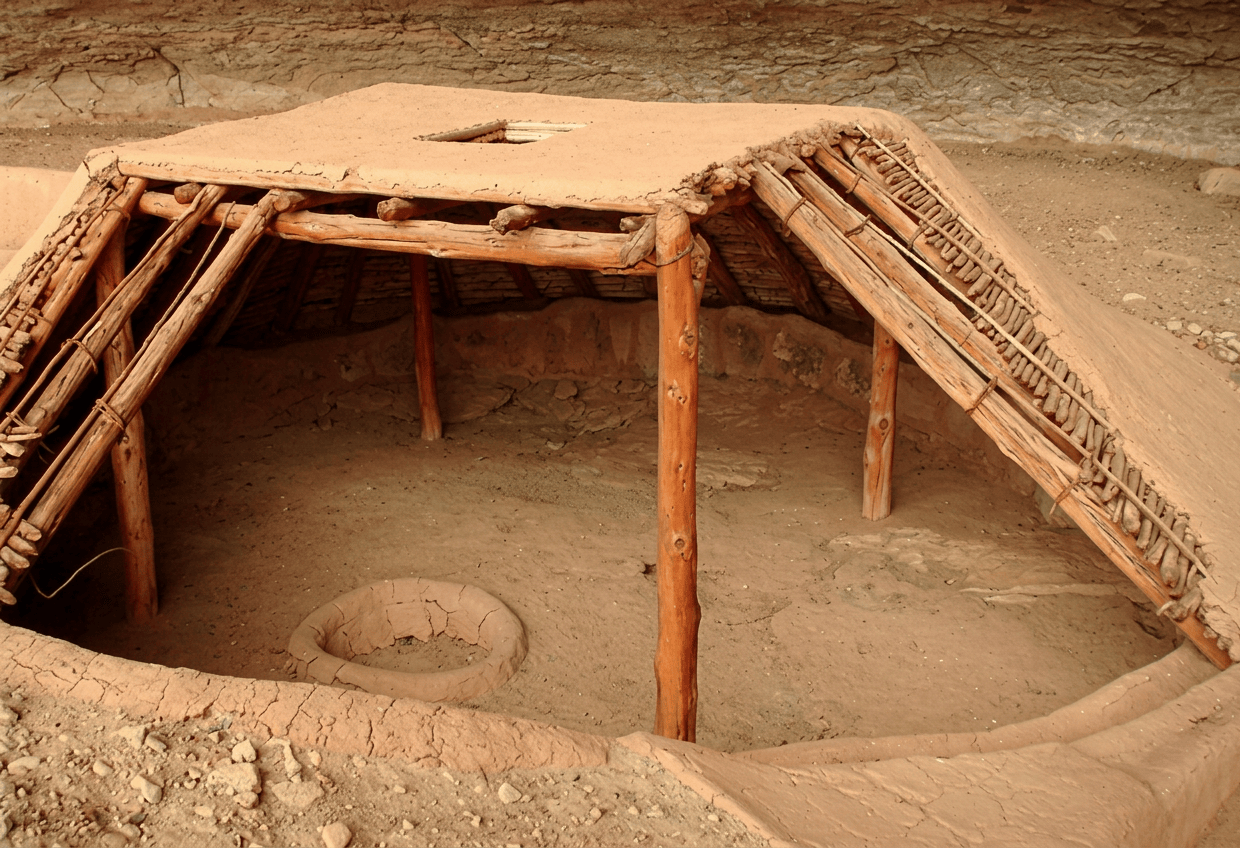
Most remarkably, researchers report evidence for an exceptionally early kana-type heating system. Wooden channels coated with clay through which hot air and smoke circulated. The Russian Academy of Sciences describes this as the world’s earliest known example of this type of heating, although that wording should be treated as a research claim rather than an uncontested global archaeological consensus. [5]

A good way to think of the sites geography is this way: Central Russia, Siberia, Russian Far East, Khabarovsk Krai, Lower Amur and Suchu Island
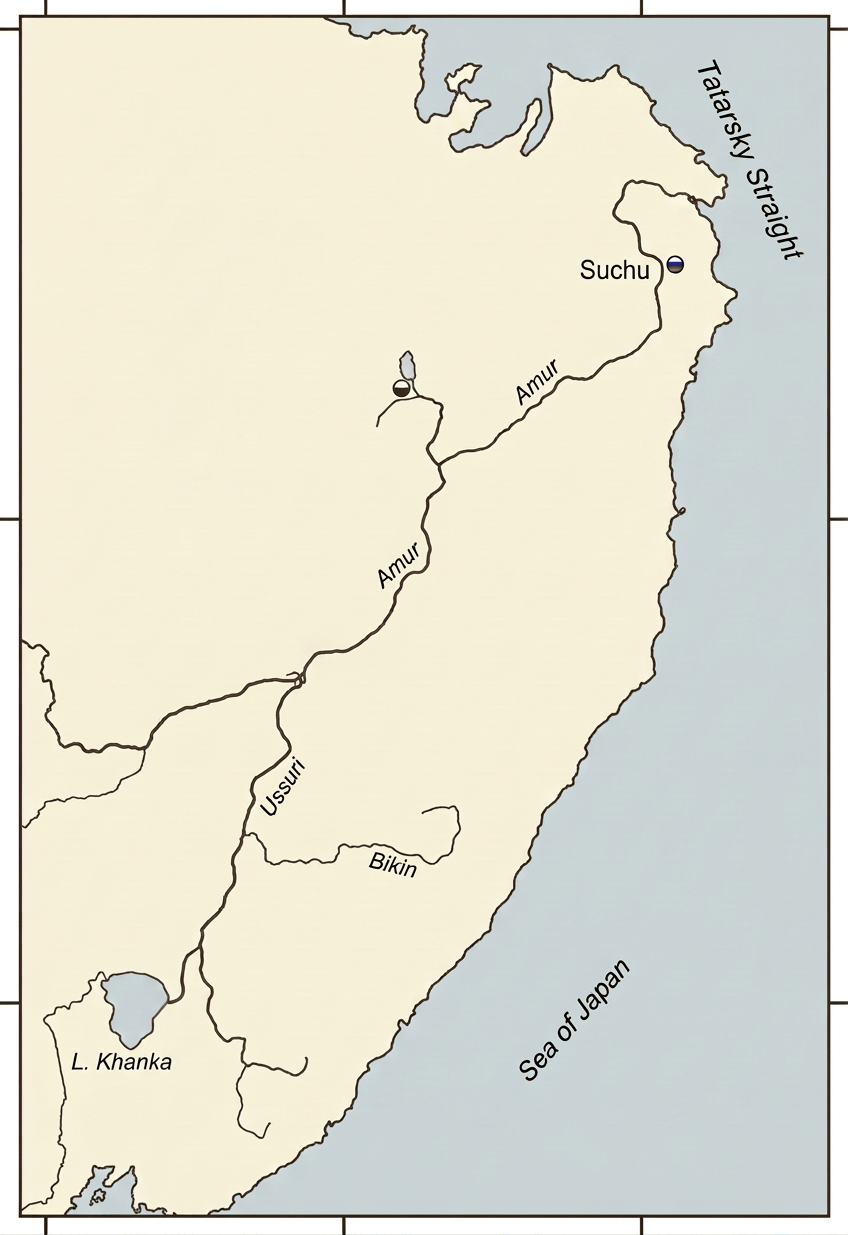
The settlement was approximately 2.5 km from modern Mariinskoye, in the Ulchsky area of Khabarovsk Krai. The Amur here is already in its enormous lower course, approaching the Pacific side of Eurasia. [1, 6] It therefore belonged to a very different world from the Neolithic settlements of the Russian steppe or European Russia.
Wasn’t it near the ocean?
Suchu was not a seaside settlement. It was a river-island settlement, situated well upstream within the Lower Amur system. Downstream, the Amur eventually reaches the Amur Liman and the Tatar Strait, opening toward the Sea of Okhotsk and the wider North Pacific. This is important because the inhabitants had access to an enormous riverine transportation corridor connecting inland Siberia; the Lower Amur; tributary valleys; the Pacific coast; Sakhalin; Primorye; and, ultimately, northern Japan.
The archaeological evidence demonstrates that this was not an isolated community. Some obsidian at Suchu came from Shirataki-A on Hokkaido, Japan, roughly 550–850 km away, providing spectacular evidence for long-distance exchange. [7]
Suchu itself was situated in a lowland river environment, rather than high mountain terrain. But the Lower Amur is framed by major mountain systems
The principal geographical mountain system to the east and southeast is the Sikhote-Alin, while the western and northwestern parts of the Lower Amur are bounded by systems including the Malyi Khingan, Bureya, Dusse-Alin, Yam-Alin and related ranges. [8] So the landscape was essentially mountains; forest; enormous river; islands, channels and wetlands; more forest; mountains/coastal ranges; and, Pacific This mattered enormously for archaeology. The mountains supplied stone, timber, animals and probably people and information, while the Amur provided an extraordinary transportation route.
Was it an extreme? A good description was demanding rather than barren
Suchu was not an Arctic desert or a treeless steppe. The Lower Amur is biologically rich, but its climate presents an extraordinary architectural challenge. The region experiences a strong East Asian monsoon climate: warm and wet summers; cold, dry winters; substantial seasonal temperature differences; heavy summer precipitation; flooding and changing river channels; frozen winter ground and waterways. The Lower Amur is actually a remarkable ecological transition zone between boreal and temperate forests. [8] That means the people could obtain enormous quantities of biological resources—but they needed architecture capable of handling winter cold, snow, wind, summer rain, flooding and seasonal changes.
The house architecture: enormous semi-subterranean buildings
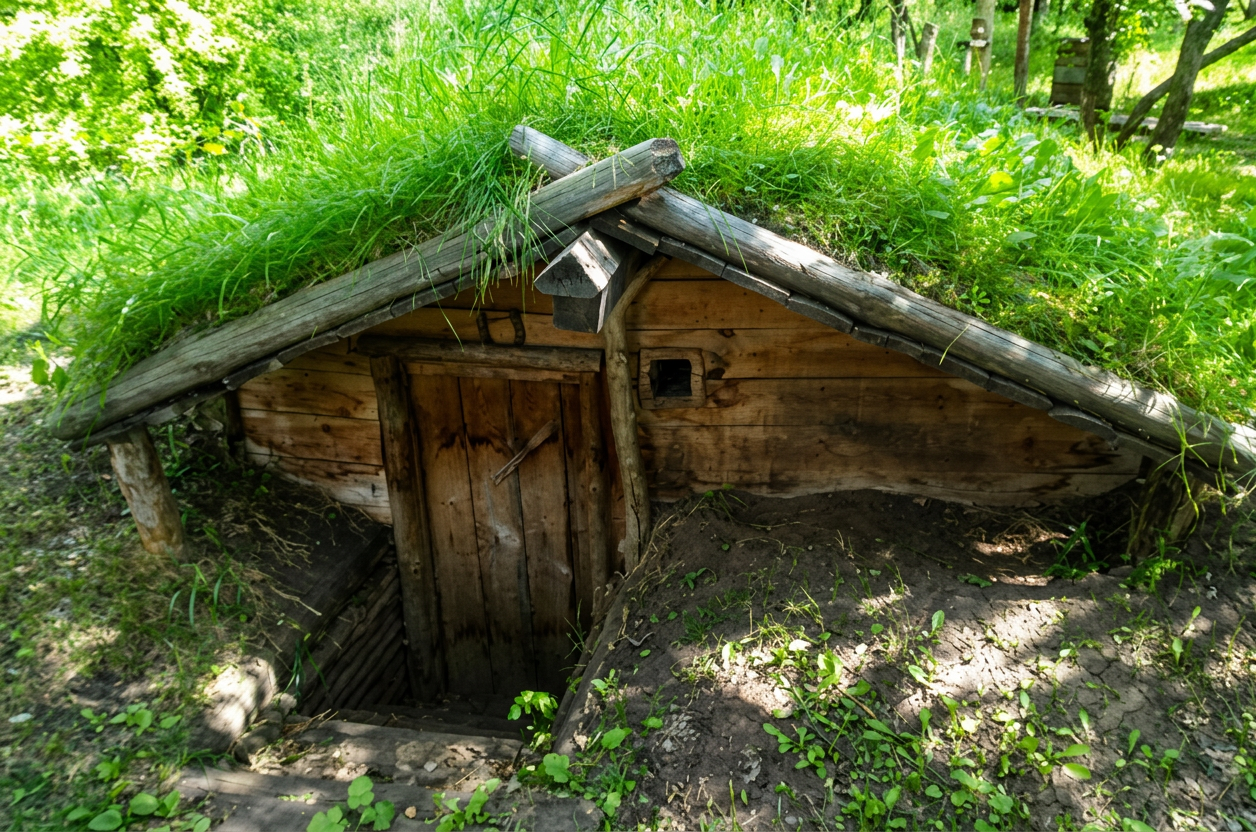
This is one of Suchu’s most important architectural lessons. The houses were generally semi-subterranean, or pit houses. Some were relatively shallow. Others were surprisingly deep. One excavated dwelling, Dwelling B, was approximately 16 m in diameter and had been cut into sandy geological deposits to a depth of approximately 3 m below the modern surface. [9]
Another excavated dwelling was approximately: 13 × 14.5 m at its foundation; about 10 m across the floor; with the pit generally 0.6–1.1 m deep; and steep walls. [10] This is not a little hunting hut. These could be very substantial houses.
Were they timber-framed? Almost certainly
The archaeological evidence includes numerous postholes.
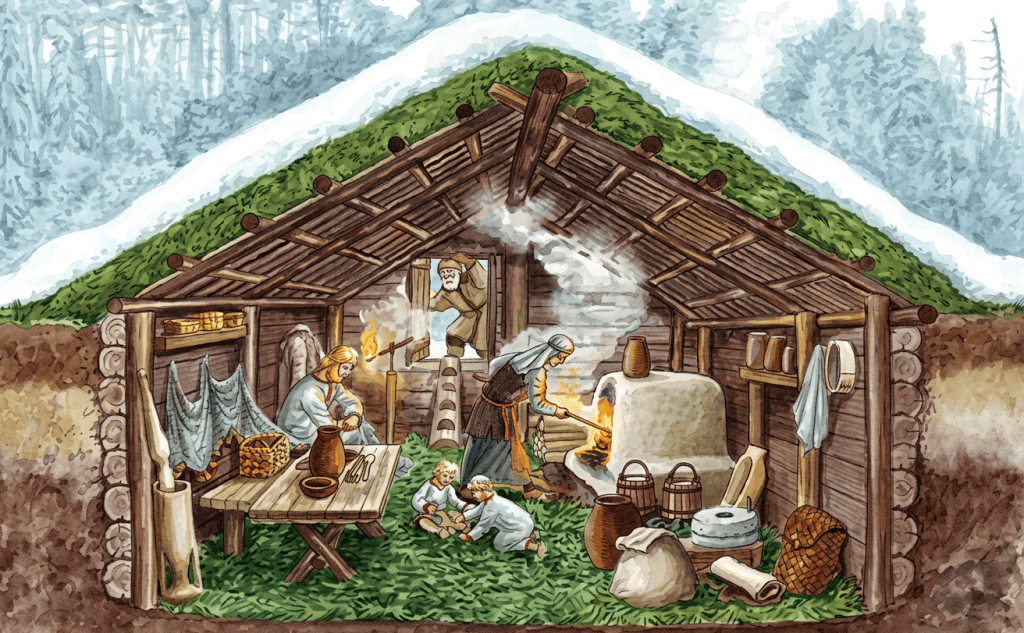
These are particularly important because the timber itself normally rotted away thousands of years ago. What survives is the hole where a post once stood. At Suchu, postholes occur along the walls and in interior positions. In one dwelling, numerous postholes demonstrated that timber poles had supported the roof. [11] A reasonable architectural reconstruction is therefore: deep circular/rounded pit; timber posts around the perimeter; additional internal structural posts; large timber roof framework; roofing material, probably bark/wood and earth or other insulating materials. This is essentially a large timber-framed earth-sheltered building. The earth did some of the work of the modern insulation system.

The earth itself became architecture
This is one of the most interesting features of Suchu. The excavation did not merely reveal a hole in the ground. The inhabitants deliberately shaped the interior. Many houses contained terraces or ledges around the perimeter. These were interpreted as: sleeping platforms; benches/couches; shelves; working surfaces; and, possibly places for storage.
In one dwelling, the lowest ledge was approximately 25–30 cm above the floor and about 1–1.3 m wide. Higher ledges formed additional platforms around the walls. [10] Another enormous house had multiple stepped levels, niches and protrusions. Some niches penetrated the walls by as much as 1.5 m. [9]
Hearths: the centre of domestic life
Hearths are repeatedly documented. In one round semi-subterranean dwelling, a hearth occurred in the centre of the floor. [11] Another dwelling had a rectangular central hearth approximately: 120 cm × 60 cm × 18 cm deep with rounded corners and a flat bottom. Birchbark was recovered from it. [10]
Other Lower Amur houses could have more than one hearth.
The arrangement makes architectural sense: central fire meant cooking, warmth, light, drying, smoke management and social focus. With sleeping/storage platforms around the perimeter.
And, then comes the extraordinary heating technology
This is arguably the most exciting architectural feature of Suchu. Researchers from the Institute of Archaeology and Ethnography of the Siberian Branch of the Russian Academy of Sciences report an extremely early kana-type heating system. The system consisted of wooden channels coated with clay, through which: hot air and smoke were conducted.
In other words, rather than simply putting a fire in the middle of a room and allowing the heat to escape through a roof opening, the builders appear to have experimented with moving heat through the building. [5]
An astonishing architectural concept for the Neolithic. But, the statement that this is “the oldest in the world” comes from the Russian Academy of Sciences’ description of the site. It is safer to say “Researchers have identified Suchu’s kana-type system as among the earliest—and, according to the Institute of Archaeology and Ethnography, the earliest known—examples of this heating technology.”
What would the interior have looked like?
A reasonable reconstruction would be something like. Imagine entering a large circular or rounded depression. Around you, an earth bench; sleeping platforms; storage niches; wooden posts; hanging equipment; pottery vessels; stone tools; baskets or organic containers that have mostly disappeared; a central hearth; smoke rising toward the roof, and, in some buildings, specialized heating channels.
It would have been dark, warm, smoky, crowded and highly functional. And, probably much more comfortable in winter than the surface archaeology initially suggests.
Was there a settlement or just scattered houses?
There was a substantial settlement complex. More than 130 house depressions have been recorded on the island. Korean-Russian excavations between 2000 and 2002 also documented numerous archaeological features, including houses, ritual structures and workshops. [4, 12] The houses were not necessarily all occupied simultaneously. Instead, Suchu appears to represent a long-lived archaeological landscape, repeatedly occupied, abandoned, rebuilt and revisited. The site contains evidence belonging to several cultural phases: Mariinskaya/Mariinskoye, Early Neolithic; Kondon; Malyshevo, Middle Neolithic; Voznesenovskoye, Late Neolithic; and later occupations as well.
The Institute of Archaeology and Ethnography summarizes occupation of the island from roughly the 8th to 2nd millennia BC, although individual structures belong to particular episodes rather than one continuous settlement. [5]
Was there ritual or communal architecture? Yes but with an important distinction
There are ritual structures and areas, but Suchu does not give us a straightforward equivalent of a giant Göbekli Tepe-style monumental communal temple. Instead, ritual activity appears to have been integrated into houses and particular spaces within the settlement. One Malyshevo dwelling contained an unusually concentrated group of artistic and ritual objects. Researchers have interpreted this as evidence for a domestic shrine. [13]
The Korean-Russian project also reports structures for ritual service among more than 100 archaeological features. [12] This is fascinating architecturally. At Suchu the house could be a dwelling, workshop, storage facility and sacred space at the same time.
The art is extraordinary
Suchu is famous for its anthropomorphic and zoomorphic sculpture. Objects include: human figures; animal figures; hybrid human-animal figures; miniature vessels; ritual objects; decorated ceramic balls; ornaments; and, unusual clay objects. A particularly striking tradition consists of anthropozoomorphic/gynandromorphic figures, in which male and female characteristics are combined. Researchers have connected these objects with ideas concerning fertility and cosmology. [14]
There are also representations connected with animals such as: bears; birds; fish; possibly waterfowl; and other animals. One unusual find was described as a hybrid bear-headed animal figure. [14]
One of the most unusual discoveries is a tiny ceremonial assemblage sometimes described as a ceramic “necklace”
It consisted of 17 miniature objects, including miniature vessels and other pieces. Researchers argue that the set was probably ritual rather than an ordinary toy because of its archaeological context and association with other cult objects. The interpretation is not absolutely certain, but it is one of the site’s most intriguing discoveries. [14] This gives us a glimpse of something that archaeology rarely preserves: portable ritual equipment.
Red ochre and ritual space
Red ochre was also important. One unusual Suchu dwelling—House 4—was described as lacking some of the normal domestic features, including the usual central hearth and perimeter sleeping ledges. Instead, a concentration of red ochre occurred in one corner, together with unusually high numbers of finished stone artifacts and relatively little production debris. This has been interpreted as a special ritual or “sun cult” context. [15] Again, we should distinguish archaeological evidence, red ochre and unusual artifact concentration. From interpretation and sanctuary / solar ritual. The first is secure; the second is a scholarly interpretation.
Did they have burials?
This is particularly interesting. A 1975 excavation discovered two burials inside Dwelling B: one Neolithic; and, one Early Iron Age. Importantly, both were placed after the dwelling had been abandoned. [16] The discovery was particularly important because Neolithic burials were extremely rare in the Lower Amur archaeological record. An abandoned house was subsequently reused as a burial place. That tells us something about how the memory of buildings could survive after their practical lives ended.
Did they use ochre? What about burials?
The strongest published evidence currently available identifies the burials and their post-abandonment context, while the ochre evidence is particularly associated with ritual activity elsewhere in the settlement. [15–16]
What did they eat?
Suchu appears to have had a broad-spectrum river-and-forest economy. The stone-tool assemblages include equipment for: hunting; fishing; butchering; processing fish; processing wild game; woodworking; bone working; processing plants; and digging. [17] The fishing evidence is particularly important. Tools include: projectile points; inserts; knives; plummets; and other fishing-related implements. [18]
So was it a water-based economy? Yes
Very strongly. I would describe Suchu as a riverine economy with substantial fishing, rather than simply calling it a fishing village.
The Lower Amur was an enormous ecological highway
It provided: fish; waterfowl; molluscs; transportation; drinking water; reeds and other wetland plants; access to tributaries; and access to other settlements.
What about salmon?
The broader Lower Amur is famous for its salmonid resources, but I would not automatically assign a particular fish species to Suchu without a published faunal report. The archaeological evidence securely demonstrates fishing; the specific species eaten at Suchu requires more detailed zooarchaeological documentation.
Plants
Archaeobotanical research in the Lower Amur demonstrates that Neolithic populations used wild edible plants, including resources such as barnyard-grass-type wild cereals; water chestnut; wild fruits; and rose-family fruits and other gathered plants. However, those data come from several Lower Amur sites rather than proving that every species was consumed specifically at Suchu. [19] It suggests an important model: intensive exploitation of a rich wild landscape rather than dependence upon domesticated agriculture.
What animals did they have?
Potential hunting resources in the wider region included: deer; elk/moose; wild boar; bear; smaller mammals; waterfowl; and other birds.
Boats and watercraft. One of the most tantalizing questions
There is strong circumstantial evidence for a water-oriented society, but no famous preserved wooden boat from Suchu itself. The fishing toolkit, island location and position on the Lower Amur all make water transport extremely plausible. And, there is a particularly interesting regional clue: the Neolithic art of the Lower Amur includes boat imagery in the wider archaeological tradition. A clay boat model is also known from the Gasya site, while later Lower Amur rock art depicts boats and paddlers. [20] But: a boat-shaped object elsewhere in the Lower Amur is not proof that a boat was excavated at Suchu. The safest wording is: “Suchu’s inhabitants were strongly adapted to riverine life and almost certainly used watercraft, but direct archaeological evidence for boat construction at Suchu remains limited.”

Stone tools: flint, jasper and chalcedony
The stone technology is impressive. Tools were made from: siltstone; argillite; jasper; flint; chalcedony; quartzite; sandstone; granitoid; and other siliceous rocks. [21] There were: adzes; knives; scrapers; borers; projectile points; inserts; chopping tools; digging tools; and grinding implements. Some knives were carefully made bifacially, including specialized forms interpreted as fish knives and meat knives. [18] People could perform a wide range of construction-related tasks: cut wood, split wood, shape wood, dig earth, process hide, process food and build houses.
Obsidian: the really spectacular trade story
Here is one of the best discoveries associated with Suchu. Researchers conducted geochemical sourcing of prehistoric obsidian from the Amur basin. At Suchu’s Early Neolithic occupation, they identified obsidian from the Shirataki-A source on Hokkaido, Japan. The estimated transport distance was approximately 550–850 km from the remote source to sites in the Amur basin. [7] That means the Lower Amur was connected to an enormous interaction network. The material could have moved through chains of exchange, probably involving multiple communities. That makes Suchu important to the study of Neolithic communication networks.
Where were the sources of obsidian?
Several obsidian sources were used in the broader Amur system. One particularly important source was the Obluchie Plateau in the middle Amur region. But Suchu’s Early Neolithic assemblage is especially significant because of the identification of the Shirataki-A source on Hokkaido. [7, 22] This is one of those archaeological discoveries that completely changes how we imagine a supposedly “isolated” prehistoric community. Suchu was not isolated.

Jade/nephrite?
The Lower Amur and adjacent regions have important nephrite/jade resources, and nephrite became an important prestige material in Northeast Asia.
As demonstrated particularly clearly by the obsidian evidence the site participated in long-distance exchange networks. Also, by similarities in pottery and material culture with communities extending toward Primorye, Siberia, Korea and Japan. [7, 12]

Extraordinary materials were: stone, clay, wood, animal products, river resources and symbolic objects
Archaeological richness is measured in thousands of artifacts; elaborate pottery; sculpture; ritual equipment; exotic stone; specialized tools; and, architectural investment.
There are certainly weapons and hunting equipment
Projectile points, inserts and other bifacial implements are well documented. [18] There are also unusual clay and stone objects whose exact functions are uncertain.

Pottery was extraordinarily important
Suchu produced an enormous quantity of pottery. The vessels were generally: handmade; coil-built; decorated; fired at relatively low temperatures; sometimes soot-covered; and frequently decorated with comb, cord, incised and impressed patterns. One later Voznesenovskoye assemblage contained vessels fired at roughly 650–700°C. [23]
The ceramics are not merely cooking pots. Their decoration provides some of the strongest evidence for: cultural identity; regional interaction; chronology; and ritual traditions.
The settlement was culturally connected to a huge region
This is perhaps the most important thing to understand about Suchu. Its archaeology links the Lower Amur with Siberia, Lower Amur, Primorye, Korean east coast, Sakhalin and Hokkaido/Japan
The Korean-Russian research program specifically interpreted the Suchu discoveries as evidence for exchange relationships extending toward the Korean east coast. [12]
When was it occupied?
The island was used repeatedly over a very long period. The broad archaeological sequence includes approximately: Period Approximate date Cultural association
Early Neolithic 8th–7th millennium BC Mariinskaya/Mariinskoye
Middle Neolithic 5th–4th millennium BC Kondon / Malyshevo
Late Neolithic later 3rd–2nd millennium BC Voznesenovskoye
Later periods after Neolithic Bronze Age, Iron Age and later occupations
The Malyshevo houses are particularly important and are generally associated with the late 5th–early 4th millennium BC in recent publications. [13] One excavated Voznesenovskoye dwelling from the 1977 campaign dates to approximately the middle of the 2nd millennium BC. [24]
Why was Suchu abandoned?
There was not one single “Suchu abandonment.” The island was occupied repeatedly for thousands of years. Individual houses were abandoned, later houses were constructed, and some old houses were subsequently reused—for example, as burial locations. [16] The archaeological evidence does not currently support a single catastrophic abandonment event for the entire island.”
Certainly the inhabitants experienced major Holocene environmental changes. But linking a particular climate event directly to the abandonment of a particular Suchu house is difficult
Pollen records from the Lower Amur identify several Holocene warm periods, including approximately 8900–8300 BP, 5700–5000 BP and 4200–3200 BP. A major expansion of forest diversity around 5700–5000 BP. [25] These changes would have affected: forests; fish; wetlands; river channels; animal populations; plant resources; and flood regimes. But Suchu’s long archaeological sequence demonstrates something even more interesting: people were able to adapt to changing environments for thousands of years.
The site has an unusually long research history
The Institute of Archaeology and Ethnography, Siberian Branch of the Russian Academy of Sciences in Novosibirsk has been central to the modern research program. [1–6]
There was also a major Russian–Korean archaeological collaboration, involving the National Research Institute of Cultural Heritage of Korea, which excavated at Suchu in 2000–2002. [12]
Suchu demonstrates that “primitive” architecture is a misleading category
These people were solving multiple engineering problems simultaneously: Problem 1 — Winter cold. Solution: excavate the house into the earth.
Problem 2 — Heat loss. Solution: use an earth-sheltered envelope and substantial timber roofing.
Problem 3 — Structural loads. Solution: timber posts.
Problem 4 — Sleeping and seating. Solution: build them into the earth walls.
Problem 5 — Cooking. Solution: central hearths.
Problem 6 — Smoke and heat. Solution: increasingly sophisticated ventilation/heating arrangements.
Problem 7 — Storage. Solution: pits and wall niches.
Problem 8 — Food procurement. Solution: fishing + hunting + gathering.
Problem 9 — Long-distance materials. Solution: exchange networks extending hundreds of kilometres.
Problem 10 — Social meaning. Solution: ritual objects and dedicated sacred spaces within the settlement.
That is systems architecture.
Global neolithic comparison: Suchu versus the Fertile Crescent
Suchu Early Fertile Crescent
Lower Amur Levant / Mesopotamia
Semi-subterranean houses Increasingly rectangular houses
Timber + earth Stone, mudbrick, earth
Fishing extremely important Farming increasingly important
Wild resources Domesticated cereals/animals
No established wheat economy Wheat/barley major crops
Elaborate pottery Pottery develops later in many regions
Long-distance obsidian exchange Long-distance obsidian exchange
Anthropozoomorphic sculpture Anthropomorphic figurines
Ritual within domestic architecture Domestic + communal ritual architecture
Earth benches/sleeping platforms Plastered floors/benches
Riverine transportation Riverine and overland transportation
The fascinating thing is that both regions independently arrived at sophisticated architectural solutions, but their economies were completely different. Jericho needed to solve: How do we live in a farming settlement? Suchu needed to solve: How do we live productively in an enormous, cold, wet, forest-and-river environment?
A typical Suchu dwelling could be reconstructed like this
Ground level. Circular/rounded timber-framed roof; bark/wood/earth insulation; smoke outlet/opening; and, structural posts.
Below ground: stepped earth walls; sleeping/bench platforms; niches and storage pits; central hearth; cooking/work area and possibly specialized heating channels
Around the settlement: other pit houses; workshops; storage areas; ritual spaces; paths/access to the river; fishing activity; and, forest resources.
Suchu shows that a Neolithic settlement could become a large, long-lived, semi-subterranean river community with sophisticated heating, architecture, ritual life and long-distance trade without becoming an agricultural village
And, there is an even more surprising second point, The people living in these houses were connected to places hundreds of kilometres away. The Hokkaido obsidian is especially powerful evidence. A person living in a semi-subterranean house beside the Lower Amur could possess a piece of volcanic glass whose geological origin was on another island, in what is now Japan. [7] That is not isolation. That is communication. A useful architectural reconstruction.
References: [1] Medvedev, V. E., & Filatova, I. V. (2019). Archaeological Findings on Suchu Island (Excavation Area I, 1975). Archaeology, Ethnology & Anthropology of Eurasia, 47(4), 30–42. DOI 10.17746/1563-0110.2019.47.4.030-042.
[2] Medvedev, V. E., & Filatova, I. V. (2016). Tentative Findings from Excavations on Suchu Island, Amur (1973 Season, Excavation I). Archaeology, Ethnology & Anthropology of Eurasia, 44(4), 46–59. DOI 10.17746/1563-0102.2016.44.4.046-059.
[3] Okladnikov, A. P., Medvedev, V. E., & Filatova, I. V. (2015). The First Systematic Excavations on Suchu Island and Radiocarbon Dates of the Site (1972). Archaeology, Ethnology & Anthropology of Eurasia, 43(3).
[4] National Research Institute of Cultural Heritage of Korea. KOR-RUS Joint Excavation Research of the Amur River Valley, 2000–2009. Particularly useful for the 2000–2002 Suchu excavations and the Korean connection.
[5] Institute of Archaeology and Ethnography, Siberian Branch, Russian Academy of Sciences. Study of the Neolithic in the Russian Far East. Especially useful for the chronology and the reported ancient kana-type heating system.
[6] Medvedev, V. E., & Filatova, I. V. (2020). A Multidisciplinary Study of Finds from Suchu Island (1973 Season, Excavation II, Dwelling 1). Archaeology, Ethnology & Anthropology of Eurasia, 48(2), 3–13. DOI 10.17746/1563-0102.2020.48.2.003-013.
[7] Glascock, M. D., Kuzmin, Y. V., Grebennikov, A. V., et al. (2011). Obsidian provenance for prehistoric complexes in the Amur River basin (Russian Far East). Journal of Archaeological Science. Important for the Shirataki-A/Hokkaido obsidian at Suchu and long-distance exchange.
[8] Ecological and Geographical Structure of the Plant Cover of the East Asian Boreal–Nemoral Ecotone (the Lower Amur Region, Far East Russia). Useful for the geography, mountains, forests and monsoon environment of the Lower Amur.
[9] Medvedev, V. E., & Filatova, I. V. (2019). Detailed analysis of Dwelling B, including its approximately 16 m diameter, stepped interior, niches and hearths.
[10] Medvedev, V. E., & Filatova, I. V. (2021). Materials from Dwelling 2 on Suchu Island, the Lower Amur (1977 Season, Excavation III). Archaeology, Ethnology & Anthropology of Eurasia, 49(3), 13–23.
[11] Medvedev, V. E., & Filatova, I. V. (2020). Dwelling 1: semi-underground circular house, central hearth, numerous roof-support postholes and evidence for hunting, fishing and plant processing.
[12] Korean-Russian research at Suchu: more than 100 features, approximately 130 pit houses, ritual structures, workshops and more than 30,000 pottery and stone artifacts documented during the joint investigations.
[13] Medvedev & Filatova, research on the unusual ritual assemblage from Dwelling 1, interpreted as evidence for a domestic shrine.
[14] Medvedev, V. E. Ceramic “necklace”: a Neolithic ritual artifact from the Lower Amur. Important discussion of the 17-piece miniature ritual assemblage and anthropozoomorphic art.
[15] Nelson, S. M. (ed.). Archaeology of the Russian Far East: Essays in Stone Age Prehistory. Useful synthesis of Suchu ritual spaces, red ochre and figurative art.
[16] Medvedev & Filatova (2019), Suchu Dwelling B: Neolithic and Early Iron Age burials placed after abandonment.
[17] Medvedev & Filatova, lithic studies of Suchu: hunting, fishing, butchering, woodworking, bone-working, plant processing and digging technologies.
[18] Medvedev & Filatova (2021), lithics from Dwelling 2: projectile points, inserts, knives, plummets and bifacial technology.
[19] Sergusheva, E. A. (2025). Use of Plants by the Lower Amur Region Communities in the Neolithic: Results of Testing of the Archaeobotanical Approach. Useful regional evidence for wild-plant exploitation.
[20] Derevianko & Medvedev, Archaeology of the Russian Far East, discussion of Lower Amur boats, rock art and a clay boat model from Gasya.
[21] Medvedev & Filatova, 2021: Suchu lithics made from jasper, flint, chalcedony, siltstone, quartzite, granitoid and other rocks.
[22] Glascock et al., obsidian sourcing in the Amur basin, including the Obluchie Plateau and remote Shirataki-A source.
[23] Medvedev & Filatova, 2021: ceramic technology and firing temperatures of the Voznesenovskoye assemblage.
[24] Medvedev & Filatova, 2021: Dwelling 2 and the mid-second-millennium BC Voznesenovskoye occupation.
[25] Bazarova, V. B., Klimin, M. A., Mokhova, L. M., & Orlova, L. A. (2008). New pollen records of Late Pleistocene and Holocene changes of environment and climate in the Lower Amur River basin, NE Eurasia. Quaternary International, 179, 9–19.
Leave a Reply