< home # store # services # articles # game # app #contact >


Another important archaeological site in the Zagros Mountains exists. The cave has produced several Neanderthal burials, dating back to around 50,000 years ago
One of the most significant discoveries at the site. Is the Shanidar 1 burial. This individual’s remains show evidence of injuries and deformities. In turn, which sparked discussions about caring for the injured and sick. And, in some combination with the other 10 graves. Burial practices.

Another famous burial Shanidar 4. Had a flower grave
Earliest known H. sapiens in Europe, the Cro-Magnons. Were previously the only individuals known for purposeful, ritualistic burials.

The cave entrance is triangular, 82 feet wide by 26 high
Its dimensions inside, are 175x 45x 130 feet deep.
The university of Michigan first explored the site in the early 1950s
Anthropologist Ralph Solecki, part of the university’s expedition to the near east, first explored the site with a sounding in 1951. They returned a couple years later. With the directorate general of antiquities of Iraq, and the Smithsonian Institution. They begin to find a number of neanderthal bones, skeletons and there remains.

Did you know? When encasing it in sediment block, remains of Shanidar 9 were discovered in the removal of Shanidar 4.
Overall the universities excavations found the remains of seven adult and two infants Neanderthals
Dated from around 65,000–35,000 years ago. Accompanying them was various stone tools and animal remains. Including points, side-scrapers, and flakes. As well, there were bones from animals including wild goats and spur-thighed tortoises.
There was also proto neolithic remains. Containing 35 individuals.
Information on some of the more interesting skeletons and burials:
Shanidar 1 was an 30 to 45 year old Neanderthal male known as ‘Nandy’
He displayed severe signs of deformity. Suffering a violent blow to the left side of his face. There was a crushing fracture to his left eye which could have left him blind. There are also number of other theories involving hearing loss and amputation of an arm.
Shanidar 2 had a small pile of stones, lithic points and a fire by his grave
Shanidar 3 was stabbed by something sharp. Near his left 9th rib
It could be the earliest example of interpersonal or inter specific violence. In the entire human fossil record.
This skeleton is on display at the ‘Hall of Human Origins’
At the National Museum of Natural History in Washington, DC
Shanidar 4, is the “flower burial”: represented in the pollen samples were Yarrow, cornflower, bachelor’s button, St Barnaby’s thistle, ragwort, grape hyacinth, horsetail and hollyhock
All of which, have been traditionally used as diuretics, stimulants, astringents and anti-inflammatories. Leading to the possibility the man/women could have known medicine, or acting as a shaman.
Land snails were discovered. And, probably a part of the cave peoples diet
Cultures and lineages from Africa had also been found to use this diet. And, scientists have determined it was significant enough to be apart of what the people would have ate. There is evidence dating back to about 12,000 years ago, and thus it went on for quite some time.
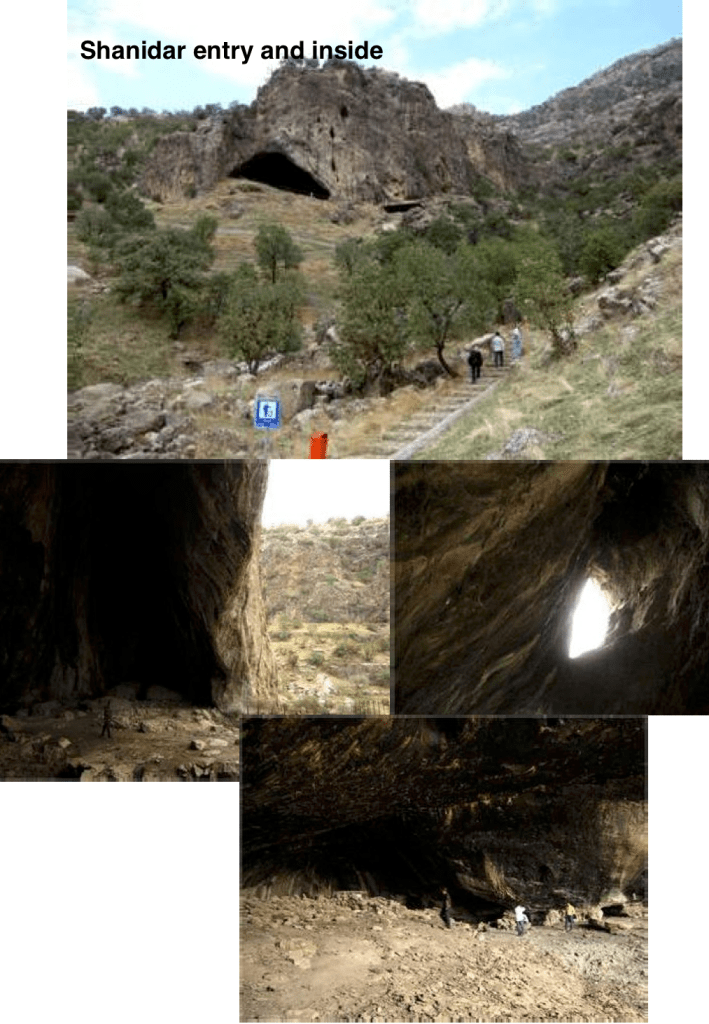
The Shanidar Cave has been a subject of extensive archaeological research. Its findings have contributed to our understanding of Neanderthal anatomy, behavior, and culture during the late Pleistocene period. These discoveries have been crucial in shaping our knowledge of human evolution, and the relationships between different hominin species.
Bibliography: Ralph S. Solecki; Rose L. Solecki & Anagnostis P. Agelarakis (2004). The Proto-Neolithic Cemetery in Shanidar Cave (https://books.google.com/books?id=bSVZKJQ5GmIC&pg=PR6). Texas A&M University Press. ISBN 978-1585442720.
Trinkaus, Erik (1983). The Shanidar Neanderthals. Academic Press. ISBN 978-0-12-700550-8.
Solecki, Ralph S. (June 1961). “Division of Anthropology: New Anthropological Discoveries at Shanidar, Northern Iraq” (https://onlinelibrary.wiley.com/doi/10.1111/j.2164-0947.1961.tb01403.x). Transactions of the New York Academy of Sciences. 23 (8 Series II): 690–699.doi:10.1111/j.2164-0947.1961.tb01403.x (https://doi.org/10.1111%2Fj.2164-0947.1961.tb01403.x).
Solecki, R. S., “Shanidar, the first flower people.”, New York: Knopf, 1971 ISBN 978-0394445113
Smithsonian Shanidar 3 pages (https://humanorigins.si.edu/evidence/human-fossils/shanidar-3-neanderthal-skeleton)
Leave a Reply