<home # start here # guides # builds # services # shop # about # categories>
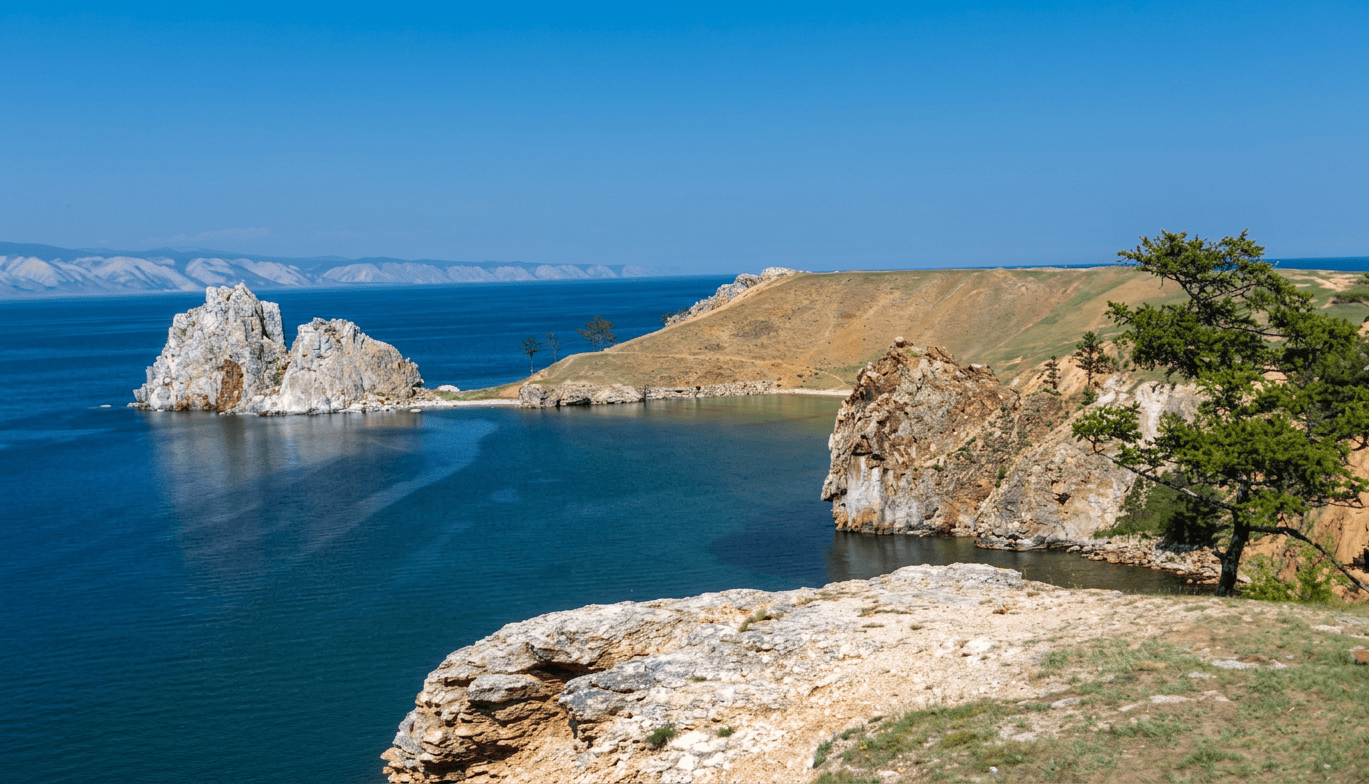
Imagine standing beside Lake Baikal roughly 7,500 years ago. Behind you are forests and mountains. In front of you is one of the largest freshwater lakes on Earth. Fish are moving through the cold water. Deer and elk occupy the surrounding forests. Bears, sable, wild boar and other animals move through the landscape. Waterfowl use the lake and its wetlands.
There are no wheat fields. No barley fields. No sheep or goats. No cattle. No mud-brick village. Instead, people are living as hunter-fisher-gatherers in a landscape where water, animals, forests and stone provide the raw materials for survival. At a narrow peninsula projecting into Lake Baikal, they repeatedly bury their dead. This is Shamanka II. It is one of the most important Early Neolithic archaeological sites in Siberia—and one of the clearest demonstrations that the word Neolithic does not necessarily mean farming.
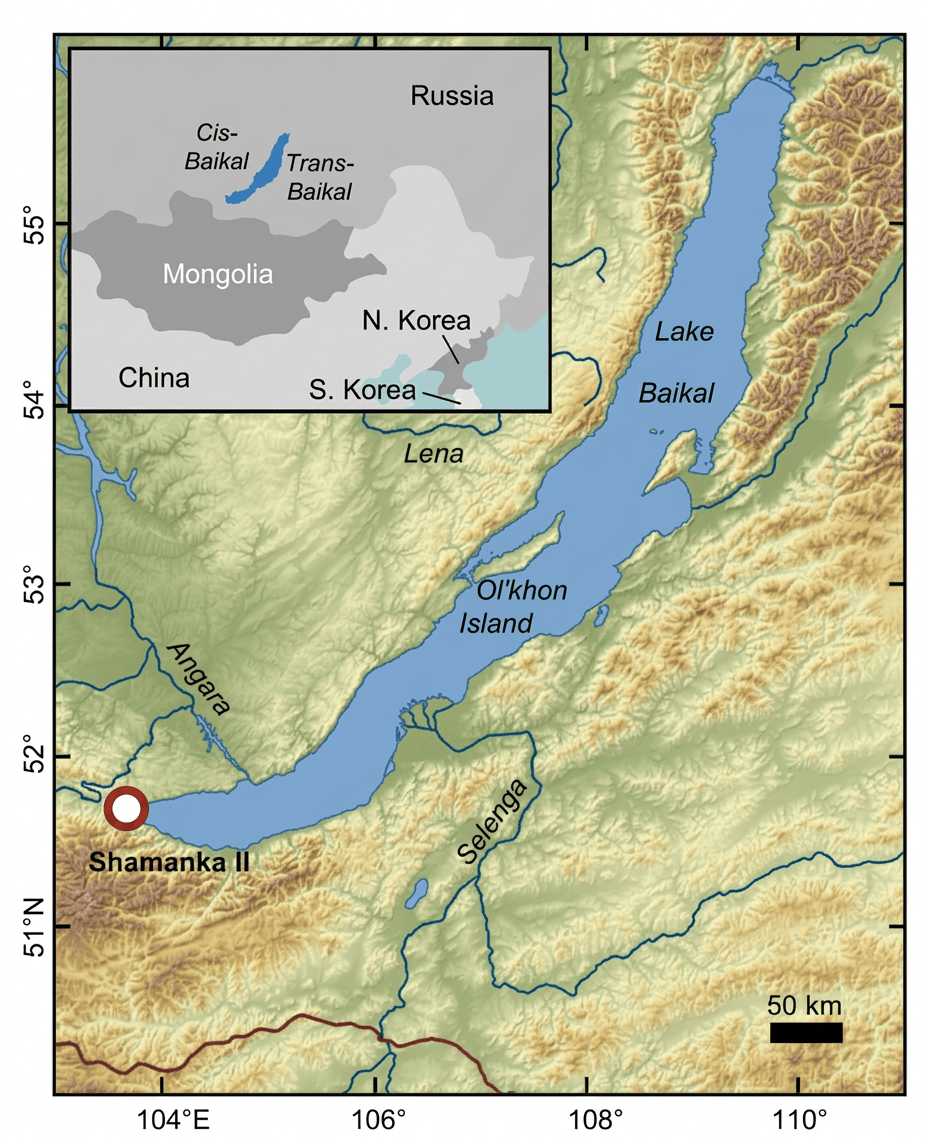
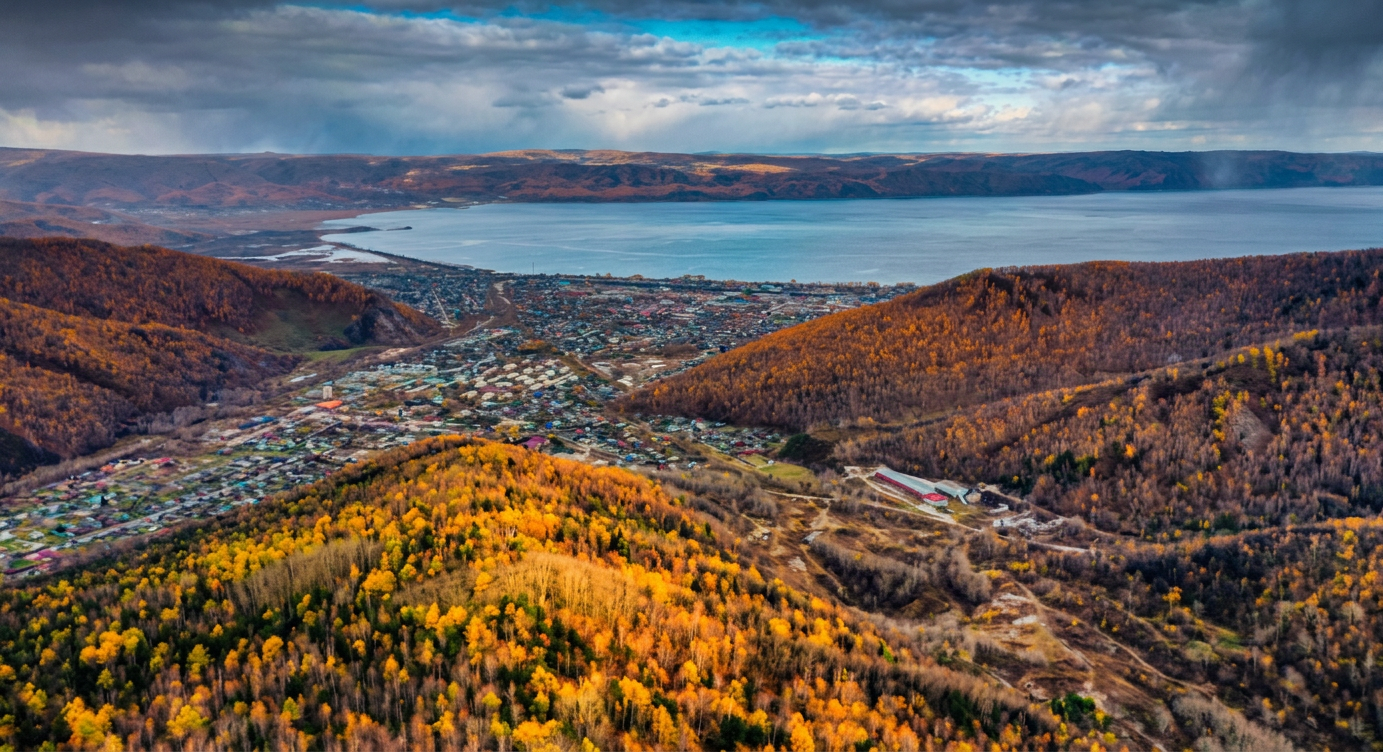
Shamanka II is in southern Siberia, in the Cis-Baikal region of Russia, on the southwestern end of Lake Baikal
Its approximate coordinates are: 51°41′54″ N, 103°42′11″ E. [3,4] The cemetery occupies a narrow peninsula known as Shamanskii Mys, projecting approximately 600 metres into Kultuk Bay, at the southwestern corner of Lake Baikal. [3] The location is spectacular. The peninsula consists of two hills joined by a low saddle. The archaeological cemetery occupies the slope of the second hill, overlooking the lake. Earlier graves were actually exposed as erosion removed parts of the lakeside slope. [3,5]
Modern Slyudyanka is only several kilometres away, while the site lies between Slyudyanka and Kultuk. [5] So, geographically, this is not “central Russia.” It is much farther east, in southern Siberia / northern Asia, immediately beside Lake Baikal.
Lake Baikal: literally next door
The cemetery is not merely “near” Lake Baikal. It is on Lake Baikal. The peninsula projects into Kultuk Bay, putting the cemetery directly beside one of the world’s great freshwater ecosystems. Five small rivers—including the Slyudyanka, Pokhabikha, Talaia, Kultuchnaia and Medlianka—enter the lake in the surrounding area. None is more than roughly 25 km long. [3] This geographical setting helps explain almost everything about the site.
Shamanka II lies in a spectacular mountain environment
The Khamar-Daban Range rises south of Lake Baikal. The Eastern Sayan Mountains lie farther west and southwest, with the landscape around the Irkut and southern Baikal bounded by major mountain systems. [6] This matters because Shamanka II was not sitting on an enormous open Eurasian grassland. It occupied a boundary between: lake, rivers, forest, mountain environments, rocky shorelines and small areas of open land. The mountains were therefore not simply scenery. They helped create the ecological conditions from which people obtained timber, stone, animals, plants and water.
The region eventually became increasingly forested during the Middle Holocene. Researchers describe a major environmental transformation in which more diverse open landscapes became increasingly dominated by dense taiga, leaving particularly important open environments along lake shores and river banks. [1] That environmental change is one of the keys to understanding what happened at Shamanka II.
When did people use Shamanka II?
The Early Neolithic component belongs to the Kitoi cultural tradition. The most recent comprehensive publication places the Early Neolithic cemetery broadly around: 7,560–6,660 calibrated years BP, or approximately 5,600–4,700 BC. [1]
The chronology is complicated because people eating large amounts of freshwater fish can acquire an old-carbon or freshwater reservoir effect, making radiocarbon dates on human remains appear artificially old. Once this effect is taken into account, two principal phases of Early Neolithic cemetery use have been identified. Approximately: Phase 1. 7,555–7,170 cal BP
Phase 2. 6,925–6,585 cal BP. With an interval between them. [4]
Shamanka II was not necessarily one continuously occupied village. Instead, it appears to have been a special place repeatedly returned to by Kitoi hunter-fisher-gatherers.
The biggest archaeological warning: Shamanka II is a cemetery
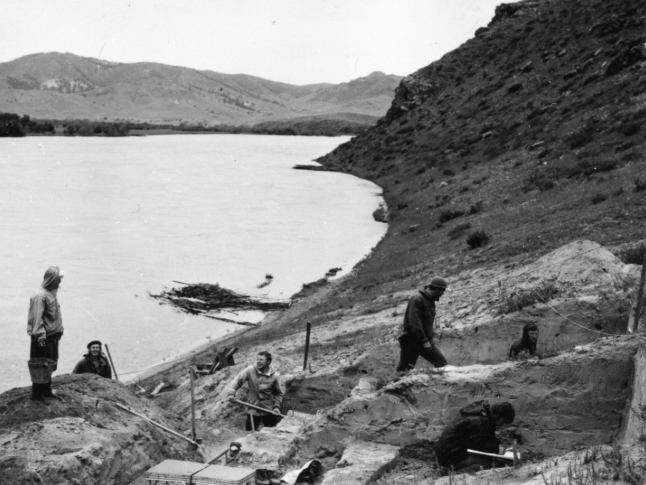
A distinction is essential. Shamanka II is sometimes discussed as though it were a “Neolithic settlement.” It wasn’t. It is primarily an Early Neolithic cemetery with an associated cultural layer and ritual activity. The major evidence consists of graves, human remains, animal remains, tools, ornaments, pottery and ritual features. [1,5]
The 2024 three-volume publication records approximately: 97 Early Neolithic graves. Containing approximately 156 individuals, and roughly 15,000 archaeological objects across the site assemblage. [1] That makes Shamanka II an extraordinarily rich archaeological archive. But it does not mean that 156 people lived there simultaneously. Nor does it mean that 15,000 objects were household possessions. Many were grave offerings.
Did Shamanka II have houses? We don’t know—and we should not invent them
There is currently no sound archaeological basis for reconstructing a Shamanka II house as: a mud-brick building, a wattle-and-daub house, a post-and-beam house, a timber-frame house, a stone house and a semi-subterranean house. The site simply does not preserve the necessary evidence for such a reconstruction. This is one of the most useful lessons Shamanka II can teach us. A Neolithic landscape does not have to be reconstructed as a village of rectangular houses.
The Early Neolithic Kitoi archaeological record is dominated by hunter-fisher-gatherer camps and cemeteries, and habitation sites occur elsewhere in the Cis-Baikal region. Contemporary habitation sites such as Gorelyi Les provide much better evidence for domestic activities. [2] Therefore, for an architectural reconstruction of Shamanka II itself, the safest description is: No securely identified Early Neolithic house plan is known from Shamanka II. That is much stronger academically than drawing a hypothetical “Kitoi house” and presenting it as an excavated structure.
What about subterranean huts?
The graves themselves were pits dug into the ground. They could be approximately 1.1–1.8 metres deep and reached the underlying limestone. But these are burial pits, not subterranean houses. [3,7]
What were the graves like?
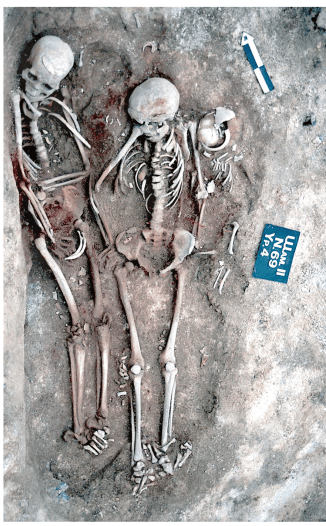
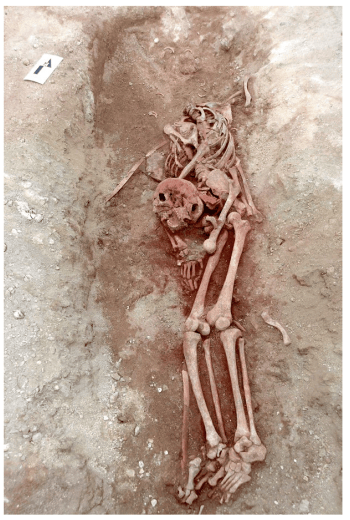
The Kitoi graves at Shamanka II were generally relatively simple excavated pits. Bodies were normally placed: extended, on their backs, in supine position and generally oriented toward the northeast in the classic Kitoi pattern. Some graves contained more than one individual.
There were single burials, double burials, triple burials and larger multiple interments. [1,8] The graves generally did not have substantial stone-built structures. This is particularly interesting from an architectural perspective. The “architecture” was created primarily through earth, body, orientation, objects, colour, fire and repetition. Rather than building a permanent stone monument, people transformed a patch of ground into a meaningful place.
Red ochre: architecture through colour
One of the strongest characteristics of the Kitoi mortuary tradition was the use of red ochre. At Shamanka II, ochre was extensively used in Early Neolithic graves. Earlier studies reported ochre in approximately 96% of Kitoi Early Neolithic graves. [8] Red ochre transformed the appearance of the burial.
Imagine an otherwise brown earth grave containing a human body deliberately coated or surrounded by vivid red mineral pigment. The pigment was not structural in the conventional architectural sense. But it was spatially and symbolically architectural. It marked the transformation of an ordinary hole in the ground into a place of ceremony.
Fire was part of the architecture
Shamanka II also provides evidence for fire-related mortuary activity. Fire pits sometimes cut into or disturbed earlier graves. Their presence has been interpreted as evidence for ritual use of fire. [8,9] This is remarkable. The cemetery was not necessarily a quiet place where people simply buried the dead and walked away. Instead, graves could be: reopened, altered, disturbed, revisited, accompanied by fire, supplemented with objects, and associated with animal remains. The cemetery was therefore a changing architectural landscape. It was built repeatedly through human actions rather than through masonry.
Bear rituals
One of the most unusual characteristics of Shamanka II is the presence of bear remains associated with graves. Bear skulls, mandibles, teeth and other bear remains occur in the mortuary assemblage. [8,9] This is unusual enough to make Shamanka II particularly important. Bears were not simply another source of meat. The deliberate placement of bear remains in human graves suggests that bears had a special cultural or ritual significance. The site therefore combines: human death, animal symbolism, fire, red ochre, tools and landscape. That is an unusually rich ritual system for an Early Neolithic hunter-gatherer cemetery.

The cemetery itself had organization
The graves were not scattered randomly. Researchers have identified spatial sectors and clusters within the cemetery, including northern and southern sectors and northwest and southeast clusters. [3,10] This means the cemetery was developing as a planned social landscape. There were places where particular people were buried. There were relationships between graves. Some areas accumulated more artefacts than others. Some individuals received enormous numbers of grave goods, while others received very few. In one analysis, some graves contained hundreds of artefacts. [10] That variation provides evidence for differences in social roles, status, age, identity or other dimensions of social organization.
What did they eat?
This is where Shamanka II becomes extraordinary. The people buried here were hunter-fisher-gatherers, not farmers. The term “Early Neolithic” in this region refers primarily to the appearance of pottery and associated technological/cultural changes—not to the adoption of agriculture. [2,4] There is no evidence for domesticated wheat, barley, sheep, goats, pigs or cattle at Shamanka II. The only domesticated animal associated with the Early Neolithic population is the dog. [4]
No wheat fields. No barley fields
There is no evidence that the Shamanka II population was growing: wheat, barley, peas, lentils, chickpeas and/or cultivated fruit trees. And, certainly not orchards of: apples, pears and apricots. Those belong to very different agricultural histories and regions. The Kitoi economy was based overwhelmingly on wild resources. This is an important reminder that “Neolithic” was not a single worldwide lifestyle.
Plants were still important. “No farming” does not mean “no plants”
People were gathering wild plant resources. Stable isotope and dietary research suggests that plants contributed importantly to individual diets, and recent multi-isotopic work indicates that variation in plant consumption may even help explain evidence for individual mobility. [11]
At nearby Early Neolithic habitation sites, pottery residues demonstrate that vessels could be used for processing combinations of: animal products, fish, plants and possibly pine-derived materials such as resin. [2] So the cooking pot was not necessarily a “farming pot.” It was a general-purpose hunter-gatherer technology.
Fish were enormously important
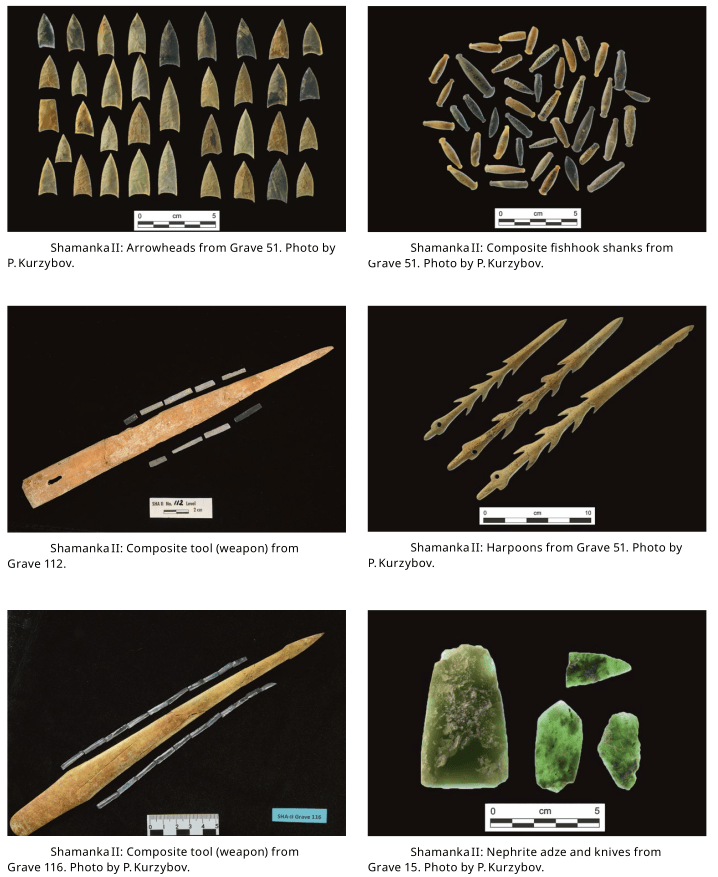
This may be the most important economic fact about Shamanka II. The cemetery contains large numbers of fishhooks, composite fishhook components, harpoons and other fishing equipment. Kitoi composite fishhooks are particularly distinctive. The archaeological and isotopic evidence indicates increasing reliance on aquatic resources during the Early Neolithic. [10] Stable isotope studies show changing contributions from fish and other aquatic resources through time. [3,10,12] This suggests that the Lake Baikal shoreline was not merely a scenic location. It was an economic machine.
Was it a water-based economy?
Very probably—but not exclusively. The economy was a mixed hunter-fisher-gatherer system. People hunted terrestrial animals, gathered plants and exploited fish and other aquatic resources. But the importance of fishing appears to have increased through time at Shamanka II. [10,12] The location was ideal mountains, forests, rivers, lake, fish, waterfowl and terrestrial animals. It was an ecological crossroads.
What animals did they hunt?
The Early Neolithic faunal assemblage from Shamanka II is remarkably diverse. Researchers identified at least approximately: 18 mammal genera, 14 bird genera, 2 fish genera and 1 invertebrate genus. Within the analysed assemblage. [13] The animals included: Large and medium mammals, red deer, elk / moose, roe deer, wild boar, musk deer, brown bear, sable, marmot, fox, otter, weasel and Baikal seal. The assemblage also contains a variety of other mammalian remains. [13]
Dogs? Yes
A whole dog was buried in association with a human grave, and isotope evidence indicates that the dog consumed substantial freshwater protein. [14] The dog is therefore one of the most interesting examples of the relationship between humans and animals at Shamanka II.

Bears, elk and seals
Three animals are especially interesting. Bear. Bear remains appear in graves and may have formed part of mortuary rituals. [8,9]
Elk. Elk or moose imagery occurs repeatedly in Kitoi portable art.
Baikal seal. The Baikal seal (Pusa sibirica) appears both archaeologically and symbolically. A particularly remarkable object from Shamanka II depicts a seal head. It was found in Grave 18, associated with a young adult male, although disturbance of the grave makes the exact association somewhat uncertain. [15]
This tells us something important: The animals around Shamanka II were not merely food. They were also part of the symbolic world.
Birds and smaller animals
Bird remains are significant as well. The Early Neolithic assemblage includes hundreds of bird remains representing numerous taxa. [13] Waterfowl were particularly logical resources in a landscape dominated by Lake Baikal and its wetlands. Small mammals such as marmot and sable also appear. So the diet was not a simple “fish diet.” It was a flexible strategy involving: fish, deer, birds, smaller mammals, plants and occasional aquatic mammals.
Did they build boats?
This is one of the most intriguing questions—and one of the places where archaeology requires caution. There is strong evidence for intensive fishing and aquatic movement, but there is not a well-preserved Early Neolithic Shamanka II boat sitting in the ground waiting for archaeologists. Wooden boats are exceptionally difficult to preserve in many Siberian archaeological contexts. However, the fishing technology is impressive. The Kitoi toolkit includes: composite fishhooks, harpoons, fishing-related equipment and stone axes and adzes.
Researchers have also emphasized that some generalized tools could have been used in maintaining fishing equipment or watercraft, although the exact function of individual tools cannot always be established. [10] Thus: A water-oriented technology is certain; a specific Shamanka II boat design is not. It is reasonable to infer that people moved around the lake and rivers, but a reconstructed boat should be presented as a regional experimental reconstruction, not as a directly excavated Shamanka II object.
The tool kit
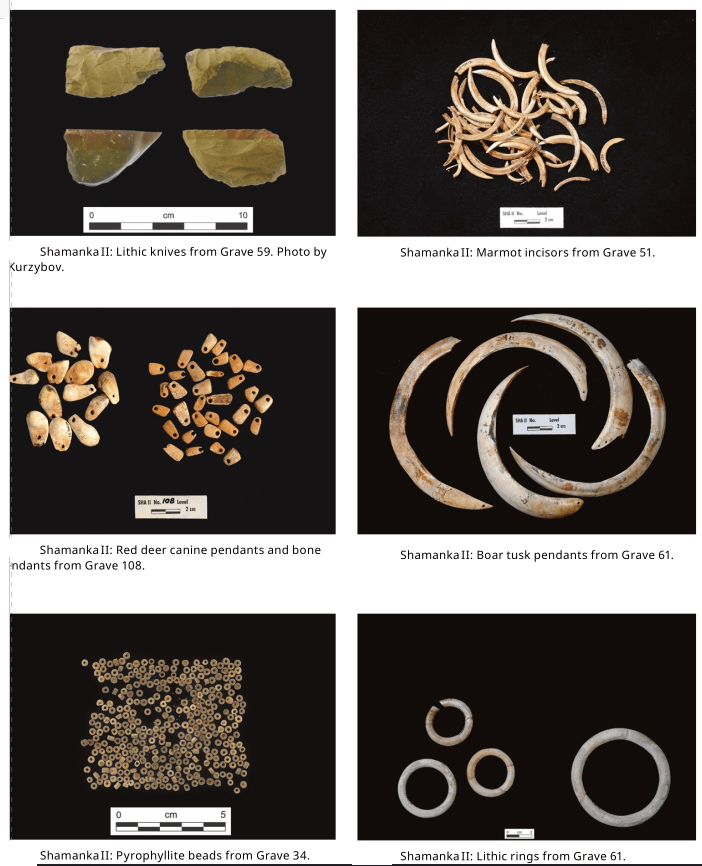
The Kitoi tool kit was sophisticated without being dependent upon metallurgy. Important materials included chert/chipped stone, quartz, micro-quartzite, nephrite, slate, argillite, antler, bone, shell and teeth. Stone tools included: axes, adzes, knives, projectile points, scrapers and blades. The combination of ground and chipped stone technology is particularly significant. [10,16]

Nephrite: the green stone of Siberia
One of the most visually impressive materials associated with the Baikal Neolithic is nephrite. Nephrite was used for: axes, adzes, knives and ornaments. Green nephrite sources occur in the broader Baikal–Sayan region. Research on nephrite provenance has distinguished sources including the Eastern Sayan and Vitim areas. Eastern Sayan nephrite is particularly associated with intensely green material used for tools. [17] This creates an important connection between mountains, stone sources, craft production, rivers, lake and communities.
Regional interaction occurred across southern Siberia and the Baikal region
The Kitoi tradition itself is distributed over a substantial area, including: the Angara basin, Southwest Baikal, parts of the Upper Lena, Olkhon and Transbaikal. Archaeological similarities indicate communication between communities, but that does not necessarily mean formal long-distance “trade” in the modern sense. [8] The circulation of stone, shell, technological ideas and artistic styles probably involved combinations of exchange, travel, marriage, migration, seasonal movement and gift-giving.
Shell and ornaments
The grave assemblages contain impressive personal ornaments. These include shell ornaments, mother-of-pearl, calcite rings, bone pendants, animal teeth, red deer canine pendants and boar-tusk ornaments. Freshwater mussel shell was used to manufacture ornaments. [13]
Animal teeth were also deliberately incorporated into the material culture.
The people were therefore carrying a surprisingly sophisticated personal visual language.
There’s no gold. The wealth of Shamanka II is expressed differently
Its extraordinary objects include nephrite tools, fishing equipment, antler art, bone tools, shell ornaments, animal teeth, projectile points, fish imagery, elk imagery and seal imagery. Its “wealth” is therefore primarily a wealth of technology, animal relationships, craftsmanship and social identity.
Figurines and animal art
Shamanka II contains remarkable examples of portable art. Among the most distinctive are carved animal representations. Elk/moose heads appear in antler. An antler object from Grave 8, for example, has a handle shaped like a stylized moose head. [16]
There are also representations of fish and seals within the wider Kitoi artistic tradition.
The art is important because it shows that the animals being hunted were also being transformed into symbols. The elk was not simply dinner. The seal was not simply meat. The bear was not simply dangerous. The animal world had social and ritual meanings.
Weapons and hunting technology
The people of Shamanka II possessed projectile technology including stone projectile points, bone projectile points, harpoons and powerful composite bows.
The bow technology is particularly significant because composite hunting bows represent a sophisticated technological adaptation to hunting in the regional environment. [2] The archaeological record therefore combines hunting, fishing, woodworking, stoneworking, boneworking and textile/clothing-related ornamentation.
What was the cemetery really like?
Picture the peninsula. The lake lies below. The surrounding hills rise behind and around it. Graves are dug into the earth. Bodies lie extended in the ground. Red ochre stains the burial spaces. Stone tools, bone implements, teeth, ornaments and fishing equipment accompany some of the dead. Some graves contain multiple people. Some contain astonishing quantities of objects. Fire is used in parts of the mortuary landscape. Bear remains appear. People return. Earlier graves are reopened or disturbed. New graves are placed nearby. The cemetery becomes layered. It is therefore not a “building” in the conventional sense. It is a constructed landscape.
The architecture of Shamanka II
If we translate the archaeological evidence into architectural language, we can describe the site as having at least five architectural systems. 1. Earth architecture. The fundamental structure is the grave pit.
2. Spatial architecture. Graves were organized into sectors, clusters and rows.
3. Material architecture. Objects were deliberately positioned around human bodies.
4. Ritual architecture. Ochre, fire, animal remains and repeated reopening transformed the cemetery.
5. Landscape architecture. The cemetery was deliberately positioned on a prominent peninsula overlooking Lake Baikal. This is architecture without walls.
Perhaps the most important lesson. A very different kind of “Neolithic house”
When we think about Neolithic architecture, we tend to imagine: house, walls, roof, hearth and furniture. Shamanka II gives us another model: landscape, graves, people, objects, animals, colour, fire and memory. The site shows that architecture can organize relationships between people, places, resources and ancestors, even when almost no standing structure survives.
Climate change is particularly important here
The Early and Middle Holocene environment of southern Siberia was changing. Over time, forests expanded substantially. The researchers describe a transition toward increasingly dense taiga, reducing open landscapes available for terrestrial game. [1,6] This would have changed the economics of hunting. Imagine a hunter walking through increasingly dense forest. Large grazing animals become harder to locate. Open country becomes scarcer. Meanwhile, lake and river environments remain productive. That creates a powerful ecological incentive: when the forest closes in, the shoreline becomes more valuable.
Fishing becomes more important
The archaeological and isotopic evidence indicates increasing reliance on fish through parts of the Early Neolithic sequence. This is particularly visible in the Shamanka II evidence. [10,12] The change was not necessarily an instantaneous “switch” from hunting to fishing. Rather, it appears to have been an adaptation to changing ecological opportunities. The people were extraordinarily flexible. Instead of abandoning the region when conditions changed, they could intensify the resources that remained productive.
Why was Shamanka II abandoned?
We should be careful with the word abandoned. The archaeological record shows episodes of cemetery use separated by a substantial interval, followed by later activity. [4,10] It is therefore safer to say that the Early Neolithic cemetery experienced a hiatus or reduction in use, rather than claiming that an entire village suddenly packed up and disappeared. The environmental explanation is compelling. Increasing forest cover reduced some terrestrial hunting opportunities. The Kitoi strategy may therefore have become more dependent upon aquatic resources.
Researchers have proposed that the changing forest environment and associated resource structure contributed to the changing use of the region. [6] The people did not necessarily leave because the climate became simply “too cold.” The more interesting story is: the landscape changed, and the economic balance between resources changed with it.
A surprising lesson about climate adaptation
Shamanka II is therefore highly relevant to modern discussions of climate adaptation. These people did not have weather satellites, climate models, central governments, concrete infrastructure and fossil-fuel-powered transport. But they were constantly reading their environment. They responded to changing conditions by modifying where they moved, what they hunted, how intensely they fished, which resources they emphasized, where they maintained social connections and how they organized mortuary practices. Their survival strategy was not technological gigantism. It was flexibility.
Who researched Shamanka II?
The site has an unusually long research history. Early discoveries were made during archaeological exploration of the Shamanka peninsula in the twentieth century.
The major modern research program involved collaboration between Irkutsk State University and the University of Alberta, together with numerous international laboratories and researchers. [1,5,18]
The 2024 publication is particularly important because it brings together archaeology, osteology, zooarchaeology, radiocarbon dating, stable isotopes, genetics, lithic studies and mortuary analysis in a three-volume study. [1]
The new three-volume Shamanka II study is effectively a major reference work for the site. It contains chapters dealing with site stratigraphy, grave descriptions, human osteology, health activity, animal remains, chronology, diet, mortuary practices, art, fire, bears, human bone manipulation, lithic materials and radiocarbon and isotope data. It represents roughly three decades of research by the Baikal Archaeology Project. [1] This makes Shamanka II unusually valuable because the site can be studied simultaneously as: an archaeological site, cemetery, ecological archive, biological population, technological assemblage and ritual landscape.
One of the most fascinating discoveries: people moved
Isotopic studies have identified evidence suggesting that some individuals buried at Shamanka II may have spent portions of their lives elsewhere. Strontium, carbon and nitrogen isotope studies can help distinguish local from non-local life histories, although interpreting mobility is complicated because diet itself can affect isotope signatures. [11] One particularly interesting case involved a burial where childhood and adult isotope values differed dramatically. Later research showed that what had initially been interpreted as a single individual’s remains actually included a mandible from another person—a fascinating result in itself because it demonstrates that graves were being disturbed and human skeletal elements could be moved. [4] This tells us something profound: the cemetery was not a sealed archive to its original users. It was a place people could return to and interact with the dead.
Shamanka II and the idea of “property”
Some graves contain only a few objects. Others contain dozens or hundreds. Fishing gear, axes, knives, ornaments, teeth and art objects were not distributed equally. [10] This raises questions about: social status, age, gender, occupation, fishing specialization, hunting roles, ritual specialists, inheritance and personal identity.
Researchers have found evidence consistent with some degree of social differentiation and perhaps specialized roles. [10] Yet this was still a hunter-gatherer society. That’s important. Complex social organization does not require agriculture.
Shamanka II shows how a mobile hunter-fisher-gatherer society could create a remarkably complex social and ritual landscape without agriculture, monumental architecture or permanent masonry buildings
That is what makes it so important.
Shamanka II is not primarily a “house architecture” study
Instead, more of a Landscape, Mortuary and Resource Architecture case. With four interconnected systems: WATER. Lake Baikal. Fish, fishing technology, mobility;
FOREST. Timber. Bows / tools / fuel, hunting, changing ecology;
STONE. Nephrite, chert, slate, argillite & axes / adzes / knives / projectile points;
MEMORY. Grave, ochre, fire, animals, objects, reopening and ancestral landscape
This is architecture as a system of survival and communication.
Shamanka II was not a primitive village waiting to discover farming. What should everyone remember? It was something more interesting
It was a society that had already developed an elaborate relationship with one of the world’s greatest freshwater environments. They understood fish. They understood forests. They understood animals. They worked nephrite. They made sophisticated fishing equipment. They made bows. They made pottery. They buried their dead with extraordinary care. They used red ochre. They sometimes used fire. They represented elk and seals in art. They maintained relationships with the dead by reopening and modifying graves. And, they adapted as the landscape itself changed.
The great lesson is therefore not simply that Neolithic people lived beside Lake Baikal. It is that: A society does not need brick walls, monumental buildings or agriculture to build a complex civilization of knowledge. At Shamanka II, the architecture was partly invisible. It was built out of landscape, movement, memory, animals, tools, water, fire and human relationships. And, that may be one of the most useful definitions of Neolithic architecture we can carry into the modern world.
References: [1] Weber, A. W., Bazaliiskii, V. I., & Jessup, E. (Eds.). (2024). Shamanka II: An Early Neolithic Cemetery on the Southwest Shore of Lake Baikal, Siberia: Archaeological and Osteological Materials. Deutsches Archäologisches Institut. This three-volume study is the principal comprehensive modern publication of the site.
[2] Bondetti, M., Lucquin, A., Savel’ev, N. A., Weber, A. W., Craig, O. E., & Jordan, P. D. (2020). Resource processing, early pottery and the emergence of Kitoi culture in Cis-Baikal: Insights from lipid residue analysis of an Early Neolithic ceramic assemblage from the Gorelyi Les habitation site, Eastern Siberia. Archaeological Research in Asia, 24, 100225.
[3] Weber, A. W., et al. (2016). Biogeochemical data from the Shamanka II Early Neolithic cemetery on southwest Baikal: Chronological and dietary patterns. Quaternary International, 405, 233–254.
[4] Schulting, R. J., Scharlotta, I., Lieverse, A. R., Jessup, E., Bronk Ramsey, C., Bazaliiskii, V. I., & Weber, A. W. (2025). A 350 14C yr discrepancy between bone and tooth dates from the same grave at the Early Neolithic cemetery of Shamanka II, Lake Baikal, southern Siberia: Reservoir effects or a misplaced mandible? Radiocarbon, 67, 939–951.
[5] Bazaliiskii, V. I., & Weber, A. W. Research history and archaeological investigations of Mys Shamanka / Shamanka II, summarized in Weber, Bazaliiskii & Jessup (2024).
[6] Weber, A. W. (2020). Research on Kitoi adaptation, forest expansion and changing subsistence in Cis-Baikal. Archaeological Research in Asia.
[7] Weber, A. W., et al. (2016). Shamanka II grave construction, spatial organization and mortuary chronology. Quaternary International, 405.
[8] Scharlotta, I., et al. (2016). Social consequences of increased reliance on fishing in middle Holocene Cis-Baikal: Relating fishing gear, axes, and social status at the Shamanka II cemetery, Lake Baikal, Siberia. Quaternary International, 419, 99–132.
[9] Weber, A. W., Bazaliiskii, V. I., & Jessup, E. (2024). Shamanka II, especially the chapters on Kitoi mortuary practices, art, fire and bears.
[10] Scharlotta et al. (2016), especially analysis of fishing equipment, axes/adzes, grave goods, social differentiation and cemetery organization.
[11] Scharlotta, I., et al. (2022/2021). Multi-isotopic dietary and mobility research at Shamanka II, integrating carbon, nitrogen and strontium isotopes.
[12] Weber, A. W., et al. Research on chronology and changing aquatic resource consumption at Shamanka II.
[13] Losey, R. J., & Nomokonova, T. (2017). Holocene Zooarchaeology of Cis-Baikal. The Shamanka II Early Neolithic assemblage contains a remarkably diverse range of mammals, birds, fish and invertebrates.
[14] Losey, R. J., et al. (2013). Burying dogs in ancient Cis-Baikal, Siberia: Temporal trends and relationships with human diet and subsistence practices. PLoS ONE, 8.
[15] Nomokonova, T., et al. Research on people and seals in prehistoric Lake Baikal. The Shamanka II seal representation is associated with Grave 18.
[16] Weber, Bazaliiskii & Jessup (2024), Shamanka II, catalogue of grave goods and portable art, including antler elk/moose imagery, fishhooks and antler tools.
[17] Chemical and spectroscopic research on nephrite from Transbaikalia and the Baikal-Sayan region identifies Eastern Sayan and Vitim nephrite sources and their prehistoric use.
[18] Goriunova, O. I., & Weber, A. W. (2017). Results of the Russian-Canadian Archaeological Project of Irkutsk State University and the University of Alberta (1997–2017). Geoarchaeology, Ethnology, and Anthropology Series.
Leave a Reply