<home # start here # guides # builds # services # shop # about # categories>

If Tepe Sialk is a story about early farming on the edge of the desert, Sang-e Chakhmaq is the story of farming moving east. On the Bastam Plain, northeastern Iran 7200–5300 BCE
This remarkable site, whose name means roughly “Flintstone Mound,” lies beneath the southeastern foothills of the Alborz Mountains, about 8 km north of modern Shahroud and roughly 1 km north of Bastam. At about 1,400 m elevation, it occupies an unusually attractive ecological position: fertile alluvial soils, mountain runoff, springs, grasslands and access to both mountain and lowland resources [1][2].
Most importantly, Sang-e Chakhmaq preserves something rare: a sequence beginning with an aceramic, pre-pottery Neolithic settlement and continuing into a fully established pottery-producing farming village [1][3].
A village beside springs—not a major river
Sang-e Chakhmaq was not beside the Gadar River. The Gadar is far to the northwest, in the Lake Urmia basin. Nor was Chakhmaq built beside a large perinnial river. Instead, the settlement stood at the edge of an alluvial fan, where water emerged from the Alborz foothills as springs and seasonal drainage channels [2]. Modern investigations of the Bastam Plain report no perennial river today, although seasonal streams and numerous springs remain important water sources [4]. This is significant architecturally.
The villagers were living in a landscape where water was reliable enough for settlement and dry farming, but not necessarily available as a large year-round river. Their architecture therefore grew around spring-fed agriculture, seasonal water and the careful use of local soils. The Shahroud Plain extends around the settlement, while the much wetter Gorgan Plain lies north of the Alborz. The Caspian Sea is considerably farther north, beyond the mountain barrier. Sang-e Chakhmaq therefore belongs environmentally to the dry southern side of the Alborz, rather than to the lush Caspian lowlands [2].

Alborz, not Zagros
The mountains immediately behind Sang-e Chakhmaq are the Alborz, not the Zagros. The distinction matters. The Zagros Mountains lie far to the west and southwest. Yet archaeological evidence suggests that some of the farming package at Chakhmaq—including domestic cereals, livestock and harvesting technology—ultimately came from the eastern Fertile Crescent/Zagros sphere [3][5]. Sang-e Chakhmaq is therefore a kind of archaeological bridge: Zagros to Iranian Plateau to Alborz foothills to Central Asia. It is one of the best places to see that Neolithic expansion in action.
The landscape: greener than today
Modern Shahroud/Bastam is relatively dry, with a Mediterranean-type dry-summer climate. But the presence of springs, fertile alluvial soils and mountain vegetation made the area unusually productive compared with the surrounding Central Iranian Plateau [2].
The Neolithic inhabitants could exploit several ecological zones: irrigable or moisture-rich alluvial soils; dry-farmed cereal fields; mountain slopes; open steppe; spring and wetland vegetation; and desert-edge habitats. This is reflected in the plant and animal remains.
There is no strong archaeobotanical evidence that Neolithic inhabitants were cultivating orchards of pistachio, almond or fig. That is an important distinction from simply saying these plants could have grown in the wider region.
The securely identified food crops are much more interesting: einkorn wheat, hulled wheat and barley, with wild grasses, sedges and wild pulses also collected [3][6]
A surprisingly sophisticated farming system
The earliest farmers at Sang-e Chakhmaq did not merely experiment with wild cereals. They arrived with domesticated crops. The West Mound contains: one-grained einkorn (Triticum monococcum); two-grained einkorn; hulled tetraploid wheat (Triticum turgidum or T. timopheevii); barley, although in relatively small quantities; wild grasses; sedges; and, wild pulses including Astragalus [6].
The agricultural story becomes particularly exciting when the sickles are examined microscopically. Use-wear analysis shows that many sickle blades were used to harvest fully ripe cereals, demonstrating a well-established harvesting strategy rather than an experimental farming economy [7]. In other words, the people arriving at Chakhmaq already knew how to farm.
What makes the food economy unusual?
Compared with many western Neolithic sites, Chakhmaq’s archaeobotanical assemblage is notable for the strong emphasis on einkorn and hulled wheat, while barley is comparatively poorly represented [6]. There is also no convincing evidence for a major orchard economy. So this was not an early fruit-growing village. It was a cereal-and-goat economy, supplemented by hunting and wild-plant gathering. That is a very different agricultural package from later Iranian settlements famous for fruit, vineyards and irrigated agriculture.
Sheep, goats—and a lot of wild animals
The animal economy changed through the sequence. At the West Mound, goats were already domesticated, while hunting remained important [3][8]. People hunted: wild sheep; wild goat; gazelle; red deer; wild boar; onager; and, hare. Carnivores and other animals include: wolf; fox; dog; bear; beech marten; and tortoise [8].
The East Mound saw the domestic animal package expand, with sheep and cattle becoming more prominent [6][8].
This gives Sang-e Chakhmaq an unusually broad hunting radius. People were exploiting both the mountains and open plains/desert-edge environments.
Pigs?
Wild boar is documented. There is less evidence for a major domestic pig economy. Sheep and goats were much more important.
Dogs?
Yes. Dog remains occur in the faunal assemblage [8].
Aurochs?
Cattle eventually appear, but aurochs are not a defining feature of the Chakhmaq assemblage. Wild caprines, gazelle and later red deer are much more significant.
The architecture is the star
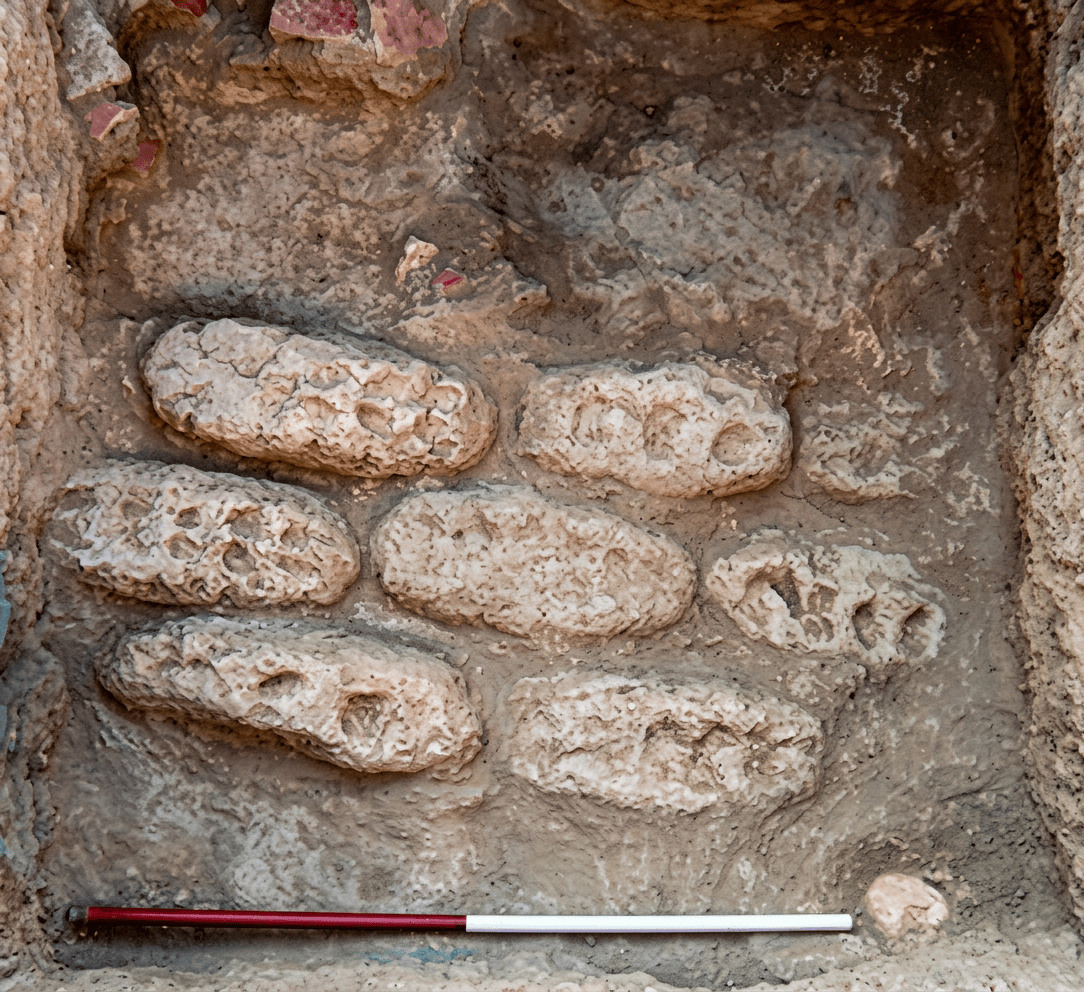
The West Mound is where Sang-e Chakhmaq becomes architecturally exceptional. The earliest settlement, dating roughly to 7200–6600 BCE, contained substantial mud-brick houses, even though it was still aceramic [3][5]. Buildings included rectangular rooms roughly 6 × 3–4 m, with different functions [9]. Some had: beaten-earth floors; hearths; blackened walls; plastered floors; and carefully finished interiors. Others were smaller rooms without hearths, with particularly carefully prepared floors [9]. Most excitingly, some buildings contained red-painted plaster floors and specially constructed hearths/fire installations. These have been interpreted as having possible ritual significance [1][10]. That makes Chakhmaq more than an ordinary farming settlement.
A ritual building?
There is no securely identified monumental communal building like those at Göbekli Tepe or Çayönü. But there are intriguing special-purpose rooms.
One building type had a carefully plastered, red-painted floor and a raised hearth interpreted by the excavators as a possible fire altar. Another small room contained figurines and other unusual objects and has been interpreted as a possible sacred/ritual space [10]. The interpretation should remain cautious—but this is considerably more interesting than simply saying “houses.”
And, then the architecture changes
The East Mound, occupied after a several-century gap (6300/6200–5300 BCE), developed a different architectural vocabulary. Here we find: rectangular houses + cigar-shaped mud bricks + courtyards/entrance areas + work spaces + ovens + circular and oval hearths + kilns [6][11]. Some buildings averaged around 5 × 8 m.
The later East Mound houses were increasingly organized around hearth rooms, while pottery kilns appeared in and around the buildings [11]. The architecture therefore tells a story of increasing specialization house, work space, food processing, pottery production and organized village.
Reed was also incorporated into construction
Marks left in walls indicate that reed was used in roofs, providing direct evidence for plant-based building technology [7].
Pottery: the great technological transition
Sang-e Chakhmaq is especially valuable because it contains both pre-pottery and pottery Neolithic occupations.
West Mound: Aceramic Neolithic
Levels 2–5 are essentially aceramic. Only a handful of pottery sherds have been recovered from the western sequence, and the earliest occupation is dominated by stone, bone, antler and clay objects rather than ceramic vessels [1][10]. So yes Sang-e Chakhmaq has genuine Pre-Pottery/Aceramic Neolithic architecture.

East Mound: Ceramic revolution
The East Mound contains abundant pottery. Early vessels include red-on-buff painted pottery with geometric decoration, strongly connected with the wider Jeitun tradition of southern Turkmenistan [6][11]. Later pottery includes: red/brown geometric designs; parallel lines; cross-hatched motifs; naturalistic and animal imagery; and, vessels related to the Sialk/Cheshmeh-Ali traditions [1][11]. This is one of the site’s great cultural stories: the settlement becomes a meeting point between Iranian and Central Asian traditions.
Obsidian: proof that Chakhmaq was connected
The name “Flintstone Mound” is appropriate, because local flint/chert was heavily used. But the villagers also possessed something that could not have come from the immediate landscape: Anatolian obsidian.
West Mound obsidian artifacts were chemically sourced using laser-ablation ICP-MS. Their geological origins demonstrate that Chakhmaq was connected to the wider Neolithic exchange network extending westward toward Anatolia and the Zagros [5]. The West Mound is currently described as the easternmost northeastern Iranian site with Anatolian obsidian [5]. That is a spectacular result. A small farming village on the southern Alborz could obtain volcanic glass from hundreds of kilometres away.
Figurines, sickles and an extraordinary house model
Chakhmaq produced an unusually rich collection of small finds. Among them are: anthropomorphic figurines; animal figurines; bone needles; bone spatulas; antler tools; stone axes; microliths; spindle whorls; cosmetic containers; sickles; clay objects; shell ornaments; turquoise; marble; alabaster; and shale [1][6][10]. One especially unusual object is a ceramic house model, found in the East Mound sequence [1][10]. That is particularly valuable for an architecture project because it provides a Neolithic community’s own miniature representation of a building.
The sickles are extraordinary
Several sickle handles were made from bone and decorated with animal imagery. Some have straight grooves designed to hold parallel flint inserts [7]. This creates a direct technological chain: local chert, pressure-flaked blades, decorated bone haft and cereal harvesting. Some of the handles are stylistically related to both Zagros sickles and Jeitun/Djeitun sickle traditions, making them evidence for technological transmission across Iran [7].
Woodworking?
Yes—more than might initially be expected. Microwear analysis shows that some sickle inserts were subsequently used for scraping wood, hide and other materials [7]. And, the site preserves actual evidence for wooden sickle handles, including animal-decorated examples [6]. So although wooden architecture itself is poorly preserved, Chakhmaq gives us evidence of woodworking through both tools and surviving impressions.
A bone flute: one of the great finds
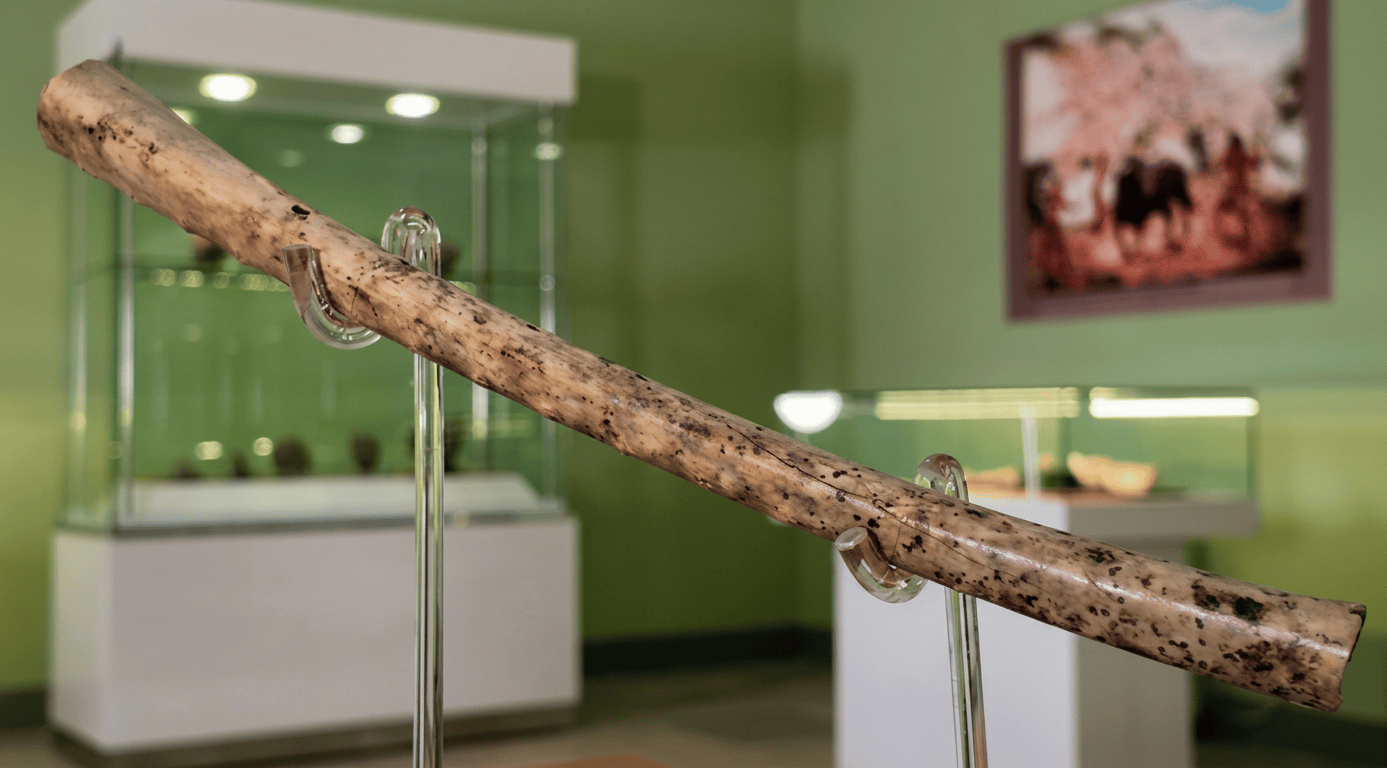
One of the site’s most memorable objects is an approximately 8,000-year-old bird-bone flute. It was made from the wing bone of a large migratory bird and has multiple finger holes. The object demonstrates sophisticated bone-working technology and provides a rare glimpse into music and sound in an early Iranian farming community [12]. It is exactly the sort of find that makes an archaeological site memorable: a farming village had cereal fields, goats, mud-brick houses—and someone was making music.
How many times was it abandoned?
This needs correcting from older descriptions of the site. The two mounds were not continuously occupied without interruption. The best current chronology is approximately: West Mound: ~7200–6600 BCE hiatus of roughly 300–600 years; and, East Mound: ~6300/6200–5300 BCE [3][5][13] So the site experienced at least one major occupational break between the West and East Mounds.
Importantly, research published in 2025 on nearby Rouyan, a proto-ceramic site, has begun to fill this chronological gap. This suggests that the apparent abandonment may represent a regional reorganization rather than the complete disappearance of Neolithic communities from the area [13].
Who studied Sang-e Chakhmaq?
The original major excavations were conducted by the Japanese archaeologist Seiichi Masuda and the Tokyo University of Education/University of Tsukuba team during four seasons in 1971, 1973, 1975 and 1977 [1][14].
Later Iranian research was led by Kourosh Roustaei of the Iranian Center for Archaeological Research, including new excavations in 2009 [3][14].
A major new final report by Roustaei was published in 2026, bringing together the 2009 excavations and the site’s nearly 2,000-year sequence [15].
Why Sang-e Chakhmaq matters
Sang-e Chakhmaq is one of the best archaeological sites for understanding how the Neolithic moved eastward across Iran.It was not simply a copy of a Zagros village. It was a place where traditions met. Zagros farming technology. Iranian Plateau ecology. Alborz mountain resources. Jeitun/Central Asian pottery traditions. Anatolian obsidian. Local flint. Goats, sheep and cattle. Wild deer and gazelle. Einkorn and hulled wheat. And, mud brick, reed roofs and decorated sickles.
Architecturally, perhaps the most important lesson is this: The first farmers did not need a great river to build a permanent village. At Sang-e Chakhmaq, springs, fertile alluvial soil, seasonal water, dry-farmed cereals, livestock, and mud brick were enough to create a durable settlement nearly 9,000 years ago.
That makes Chakhmaq an exceptionally useful case study for climate-adapted architecture: rather than conquering a dry landscape with enormous infrastructure, its inhabitants positioned their settlement where mountain water naturally emerged, then built their food system and architecture around it.
References: [1] Thornton, C. P. (2010/2016). “Sang-e Chakhmaq.” Encyclopaedia Iranica.
[2] Pichon, F., Ibáñez, J. J., Anderson, P. C., & Tsuneki, A. (2023). “Harvesting cereals at Tappeh Sang-e Chakhmaq and the introduction of farming in Northeastern Iran during the Neolithic.” PLOS ONE, 18(8), e0290537.
[3] Roustaei, K., Mashkour, M., & Tengberg, M. (2015). “Tappeh Sang-e Chakhmaq and the beginning of the Neolithic in north-east Iran.” Antiquity, 89(343), 573–588.
[4] Rezvani, H., & Roustaei, K. Research on the Bastam/Shahroud Plain and associated Neolithic settlements.
[5] Roustaei, K., & Gratuze, B. (2020). “Eastward expansion of the Neolithic from the Zagros: Obsidian provenance from Sang-e Chakhmaq, a late 8th–early 7th millennia BCE Neolithic site in northeast Iran.” Journal of Archaeological Science: Reports, 29, 101969.
[6] Pichon et al. (2023), archaeobotanical synthesis of the West and East Mounds.
[7] Pichon, F., Ibáñez Estevez, J. J., Anderson, P. C., & Tsuneki, A. (2023). Use-wear and harvesting technology at Tappeh Sang-e Chakhmaq.
[8] Mashkour, M. et al. Archaeozoological research on the Sang-e Chakhmaq faunal assemblage.
[9] Tsuneki, A. (2014). “The Site of Tappeh Sang-e Chakhmaq.” In The First Farming Village in Northeast Iran and Turan: Tappeh Sang-e Chakhmaq and Beyond. University of Tsukuba.
[10] Masuda, S. (1970s–1984). Preliminary excavation reports on the West and East Mounds of Sang-e Chakhmaq.
[11] Thornton, C. P. “Sang-e Chakhmaq,” Encyclopaedia Iranica, discussion of Djeitun and Sialk-related architecture and ceramics.
[12] National Museum of Iran. Neolithic collection and recent documentation of the Sang-e Chakhmaq bird-bone flute.
[13] Roustaei, K. (2025). “First radiocarbon dates for a long-standing chronological hiatus in the 7th millennium BCE Neolithic sequence of northeast Iran from Rouyan.” Radiocarbon.
[14] Encyclopaedia Iranica. “Japan v. Archaeological Missions to Persia.”
[15] Roustaei, K. (2026). Tappeh Sang-e Chakhmaq: A 2000-year Neolithic Sequence in the Shahroud Area, Northeast Iran. BAR International Series.
Leave a Reply