< home # store # services # articles # game # app #contact >
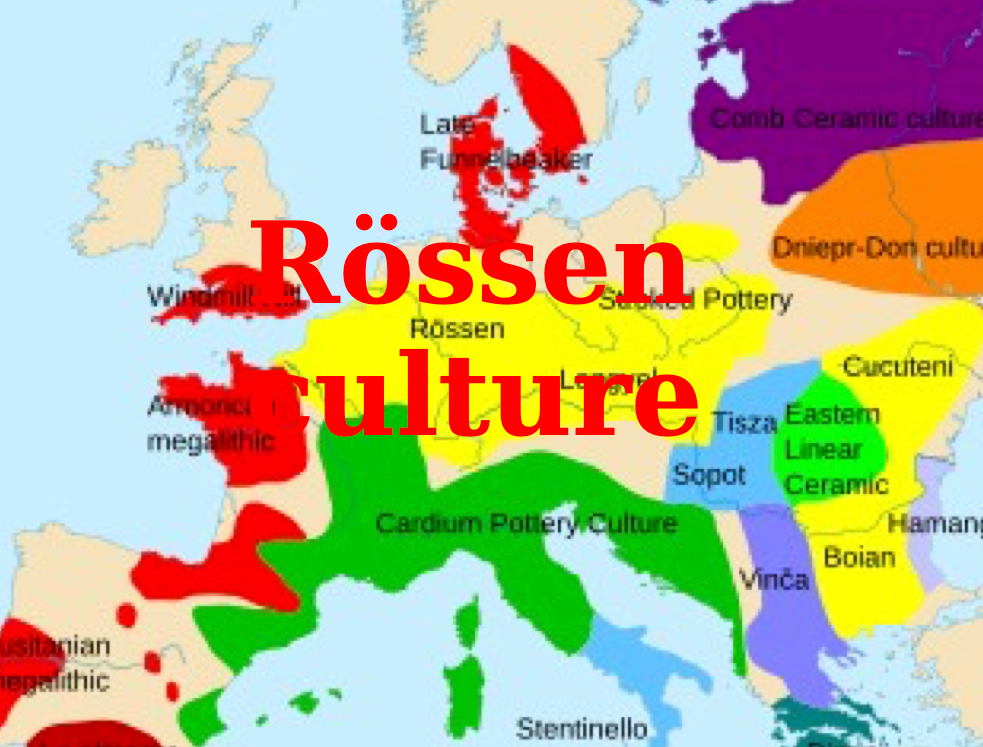
Another neolithic culture marks transition. Going back to central Europe’s earliest linear pottery times. From broad and widely distributed tradition. Towards the more diversified, middle and late neolithic times. Primarily from around 4600 to 4300 BC.
The culture is named after the necropolis of Rössen
An inhumation cemetery of 70 graves near Merseburg, in central German
It was a western branch of the neolithic Linear Pottery Culture. They were a successor to the Linearbandkeramik in the upper Danube and Rhineland

Including finely made, decorated ceramics. They had distinctive pottery with curvilinear incised patterns.
There pottery was made using coiling and hand-building techniques. Vessels are characteristically decorated with double incisions, “goat’s foot incision”, or, “Geißfußstich” in German. With incrustation of white paste.
Using there geometric designs grooved or stamped incisions were also common
Over time, the extent of the decorated areas appears to decrease. So on later vessels it is mostly restricted to the neck, or entirely absent.
Typical shapes include: tall footed bowls, globular cups, rectangular sheet-made bowls and boat-shaped vessels. The surfaces of vessels are usually burnished. Colours range from brown via reddish brown and dark brown to grey-black. Some vessels have elaborate designs, reflecting a high level of craftsmanship.
The economy of the Rössen culture was primarily based on agriculture
Evidence of farming activities, such as the cultivation of grains. Like wheat and barley was practiced. Also, animal husbandry was performed. Including the domestication of cattle, sheep, and pigs. The culture shows a significant shift towards a more settled, Agrarian lifestyle, compared to earlier periods.
Rössen cultural settlements were typically located in fertile river valleys and lowland areas. Ones that were suitable for agriculture

The Rössen longhouse of Deiringsen-Ruploh und Schöningen/ Esbeck
The structures were trapezoidal shape, or, boat-shaped long houses. They were up to 65 m in length. The ground plans suggest a sloping roofline,, and, multiple internal partitions. Suggesting several smaller units inhabited the house.
Scientists believe they had villages, and were ‘true’ communities
Some were even surrounded by earthwork enclosures. There were longhouses; wattle, and daub homes, and others. It reflecting a newer settled way of life.
The culture produced a variety of tools and artifacts, including stone and bone tools. That were used for farming, hunting, and everyday activities
A repertoire of tools was broadly similar to that of the Linear Pottery (LBK) tradition
Flint blades had pyramid-shaped cores but Rössen marked change. They used different materials. The Dutch Rijkholt flint replaced veined ‘Plattenhornstein’ (Abensberg-Arnhofen type flint). Of Bavarian origin.
A common solid rock tool was the pierced tall cleaver
Unpierced axes and adzes were also common. And, a number of sickles and plows, indicate advanced agricultural practices.

Burial practices include both individual and collective graves
Dead were mostly buried in a crouched position. Lying on their right side and to the east. Graves were dug to a depth of 40 to 160 cm. Occasionally they were covered with stone slabs. The exact shapes and sizes of graves are not well understood.
Less is known about possible cremation burials whose identification as belonging to Rössen is sometimes disputed
Cremated remains and pyre ashes were collected together and accompanied by unburnt grave goods.
Ceramic grave offerings include pedestalled cups, globular cups, lugged cups, bowls, flasks, amphoras, jugs and basins. Limestone rings, stone axes, flint blades and animal bones also occur.
It provides insights into the social and ritual aspects of the culture. And, a relatively advanced, level of social organization.
Rössen culture is known for its significant for its development of neolithic societies in southeastern Europe. It illustrates early farming communities to more complex societies. Using advanced social organization and agriculture. It marked an interesting change.
Bibliography: Joachim Preuß: Das Neolithikum in Mitteleuropa. Kulturen-Wirtschaft-Umwelt vom 6. bis 3. Jahrtausend v.u.Z., Übersichten zum Stand der Forschung. 3 Bde. Beier und Beran, Wilkau-Haßlau, Weißbach 1996, 1998, 1999. ISBN 3-930036-10-X
J. P. Mallory, “Rössen Culture”, Encyclopedia of Indo-European Culture, Fitzroy Dearborn, 1997
F. Niquet: Die Rössener Kultur in Mitteldeutschland. Jahresschr. Mitteldt. Vorgesch. 26, 1937
H. Behrens: Die Rössener, Gaterslebener und Jordansmühler Gruppe im MitteldeutschenRaum. Fundamenta A 3, Teil Va (Köln 1972.), 270 ff
H. Luley: Urgeschichtlicher Hausbau in Mitteleuropa. Grundlagenforschung,
Umweltbedingungen und bautechnische Rekonstruktion. Universitätsforsch. prähist. Arch. 7. Bonn 1992
Narasimhan, Vagheesh M. (September 6, 2019). “The formation of human populations in South and Central Asia” (https://www.ncbi.nlm.nih.gov/pmc/articles/PMC6822619). Science. 365 (6457). American Association for the Advancement of Science: eaat7487. bioRxiv 10.1101/292581 (https://doi.org/10.1101%2F292581). doi:10.1126/science.aat7487 (https://doi.org/10.1126%2Fscience.aat7487). PMC 6822619 (https://www.ncbi.nlm.nih.gov/pmc/articles/PMC6822619). PMID 31488661 (https://pubmed.ncbi.nlm.nih.gov/31488661).
Leave a Reply