<home # start here # guides # builds # services # shop # about # categories>

There is an important wrinkle with Qurayyah: the place has a Neolithic beginning, but the spectacular “Qurayyah Oasis” visible today is primarily a Bronze Age and later settlement
Archaeologists have identified human presence beginning at least in the Pre-Pottery Neolithic B (PPNB), but the large permanent oasis, irrigation system, walls and substantial buildings belong much later. [1]
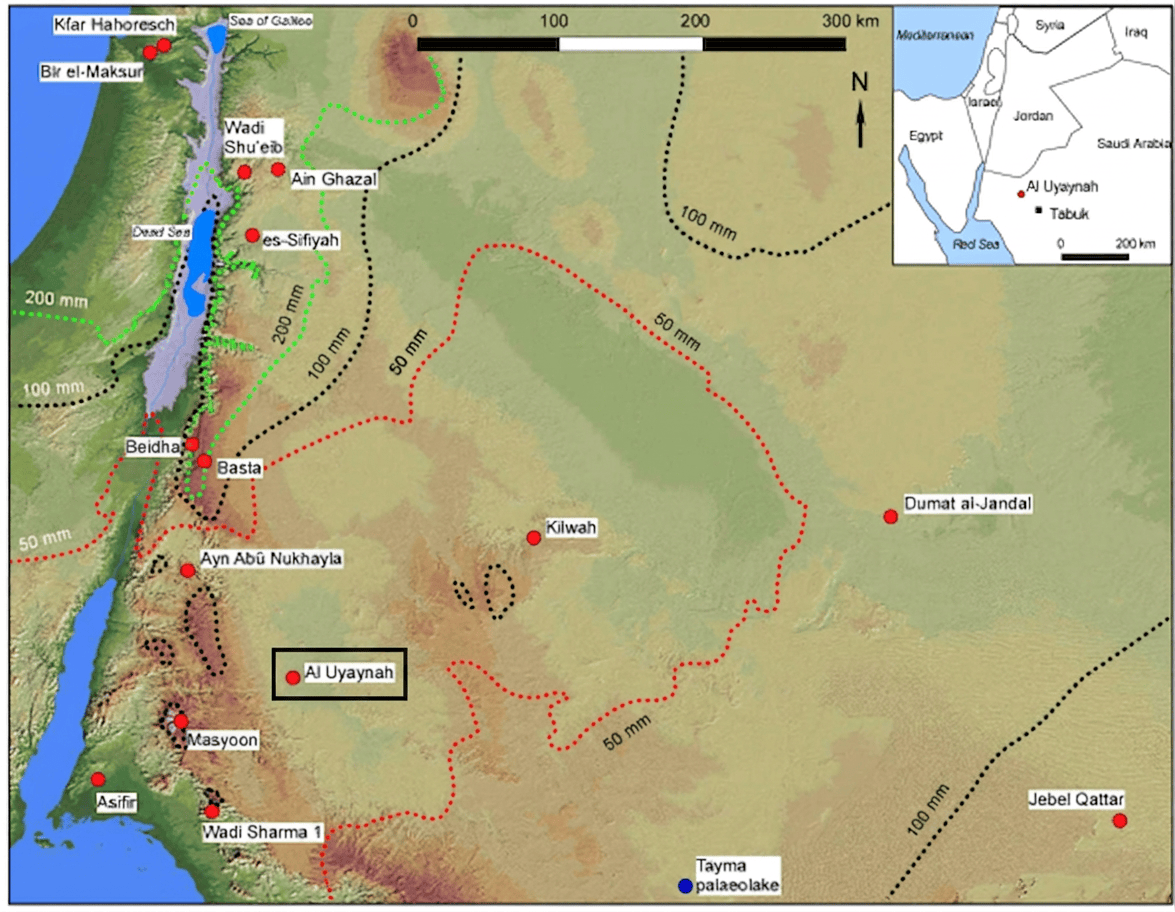
Even more importantly, the best-dated PPNB village in the Qurayyah plain is called Al Uyaynah (Al-‘Aynah), rather than the later walled oasis itself
The newly published 2026 excavation dates Al Uyaynah to about 7190–6900 cal BC, making it one of the clearest windows into early pastoral life in this part of Arabia. [2]
Where is Qurayyah?
Qurayyah is in northwestern Saudi Arabia’s Tabuk Province, at approximately 28°47′ N, 36°00′ E. [3] About: 76 km northwest of modern Tabuk; near the eastern foothills of the Hejaz mountain system; and on the western side of the Tabuk Basin. [1][4] The archaeological oasis covers more than 300 hectares, making it one of the enormous prehistoric/early historic oasis landscapes of Arabia. [5]
The settlement sits at the confluence of two major episodic wadis: Wadi Ghubai and Wadi Harif
These are not permanent rivers like the Jordan or Euphrates. They carry water following rainfall and flash-flood events. Their channels and palaeochannels are still visible today. [4]
The archaeological settlement occupies an unusually favourable position: mountain catchments, wadis, oasis and Tabuk Basin
That is the fundamental geographical secret of Qurayyah. The water was the architecture This is perhaps Qurayyah’s most important story.
The site sits where the plateau landscape falls away toward the Tabuk Basin. Rain falling on the higher terrain could be concentrated into the wadis and then captured downstream [4]
Under the later oasis, researchers found a huge engineered: dam to inlet to canals to weirs to outlet and fields system. Dating with radiocarbon and optically stimulated luminescence shows that the major surface-water harvesting and flood-control system was already operating around 2900–2600 BCE, in the Early Bronze Age. [5] It was large enough to supply: irrigation; drinking water; agricultural production; and the permanent settlement. This may be the largest documented Early Bronze Age surface-water harvesting system in Arabia. [5] So Qurayyah is an excellent architectural example of: water management becoming settlement architecture.
What about lakes?
Yes—but think palaeolake/playa, not a permanent modern lake. The oasis sits on or beside a landscape containing a relict Late Pleistocene playa. The later Bronze Age hydraulic system was constructed across this older wetland landscape. [5] During wetter phases of the Early and Middle Holocene, northern Arabia experienced much more effective rainfall and runoff than today. The old lake/playa deposits helped create the unusually favourable oasis environment. Today, the large permanent lake is gone.
Mountains and elevation
Qurayyah lies on the eastern foothills of the Hejaz Mountains, with the Hisma mountain/plateau landscape contributing to its drainage. [1][4] The immediate setting includes: sandstone plateaus; mesas; rocky hills; wadis; alluvial plains; and, the broad Tabuk Basin. The archaeological location is approximately 790 m above sea level according to geographic datasets. [6] So Qurayyah is much higher than the Gulf coast at Dosariyah, but substantially lower than many of the high Arabian mountain zones. No Zagros here. The Zagros are far away across Iraq and western Iran.
What did Neolithic people eat?
Here we need to separate the PPNB occupation from the much better documented Bronze Age oasis. The evidence for Neolithic Qurayyah’s plant economy is surprisingly thin.
Wheat or Barley? Not securely demonstrated from the PPNB Qurayyah evidence.
Lentils/peas? No secure published PPNB assemblage.
Pistachio, Almond, Fig, Pomogranate or Date Palm? No secure PPNB evidence from Qurayyah.
The oasis eventually became an agricultural environment, but a securely dated PPNB cultivated-date assemblage has not been established. This is a critical point: Qurayyah’s later fame as an oasis should not be projected backward into the PPNB. The first strong evidence for engineered agricultural production belongs to the Early Bronze Age, when the large water-harvesting system was constructed. [5]
So what made the Neolithic economy work?
The wider region was undergoing the Arabian transition toward pastoralism. The newly published Al Uyaynah excavation—within the Qurayyah plain—provides an unusually good comparison. At approximately 7190–6900 cal BC, Al Uyaynah’s animal assemblage was dominated by: sheep/goats; especially goats; smaller numbers of cattle; gazelle; hare; fox; and birds. [2] That is a remarkably useful picture of early northern Arabian agro-pastoralism. The Neolithic Qurayyah landscape was therefore probably not a wheat-field oasis. It was more likely: pastoral herding, hunting, plant gathering/processing and seasonal water.
Sheep and goats: yes
The Al Uyaynah assemblage contains abundant ovicaprids, with goats securely identified. [2] The researchers interpret the assemblage as evidence for animal husbandry, with whole carcasses being processed at the settlement. That puts the Qurayyah region firmly within the wider PPNB expansion of herding into increasingly arid parts of Arabia.
Cattle: surprisingly early
Al Uyaynah also produced cattle remains. They are fewer than the sheep/goats, but their presence is significant because cattle require considerably more water and pasture than goats. This suggests that during favourable climatic periods: grass, seasonal water and cattle was possible even this far into northern Arabia. [2]
Gazelle, hare and wild animals
Hunting remained part of the economy. At Al Uyaynah there is evidence for: gazelle, hare, fox and birds. [2] The wider PPNB landscape of the region also supported wild goats/ibex.
Deer?
Deer are not a characteristic component of the published Al Uyaynah assemblage.
Dogs and pigs
There is no strong evidence for pigs as a significant part of the Neolithic economy. Nor is dog a defining component of the PPNB assemblage. That makes Qurayyah/Al Uyaynah rather different from some Levantine Neolithic settlements. Its signature was: goat/sheep herding + some cattle + hunting. Rather than: large cereal-farming village + pigs + intensive mixed farming.
Was Qurayyah Pre-Pottery Neolithic?
Yes, with an important qualification. Archaeological research identifies human occupation in the Qurayyah oasis beginning at least in the PPNB. [1] But the large excavated PPNB settlement that gives us the clearest picture is Al Uyaynah, in the Qurayyah plain.
The new 2026 research gives it an exceptionally useful date: 7190–6900 cal BC
And, describes it as a small, short-lived village with stone architecture, animal husbandry and perhaps crop cultivation. [2] That is genuinely Pre-Pottery Neolithic B.
Al Uyaynah: the Neolithic side of Qurayyah
Al Uyaynah is particularly valuable because its 2026 excavation produced a stratified sequence rather than simply surface finds. That architecture includes: rectangular stone structures; circular arrangements; closely interlocking stone-built units; and, evidence for rebuilding/alteration. The largest rectangular structure was excavated in detail. [2] This is a very different architectural tradition from the later monumental walls of Qurayyah.

An unusual PPNB discovery: 200+ clay objects
This is one of the coolest finds in the entire Qurayyah region. More than: 200 small clay objects were recovered from the basal levels of Al Uyaynah. They are approximately 2–5 cm long and include: perforated objects; grooved objects; pieces containing inserted flint; cylindrical and spherical forms; and at least one object that appears vaguely animal-like, with flint inserts resembling horns. [2] The researchers are cautious about calling them figurines. But they are unquestionably unusual.
Flint technology
The Al Uyaynah PPNB toolkit is excellent. It includes: Amuq-type projectile points; burins; sickle inserts; perforators; awls; and, scrapers. [2] This tells us something very important about the economy. Sickle inserts suggest plant harvesting. But they do not prove wheat or barley cultivation. Wild grasses and other plants can also be harvested with sickles. The researchers therefore describe the economy as animal husbandry with perhaps some crop cultivation, rather than claiming a fully established cereal farming system. [2]
Architecture: from small houses to a hydraulic city
This is where Qurayyah becomes exceptionally useful as a long-term architectural case study.
Phase 1 — PPNB. Small stone-built village
Phase 2 — Early Bronze Age. Water harvesting and agricultural fields
Phase 3 — permanent oasis. Walls, houses, industrial areas and irrigation
Phase 4 — Late Bronze/Iron Age. Urban centre, specialized pottery production, cultic/funerary architecture.
The architectural transformation is enormous.
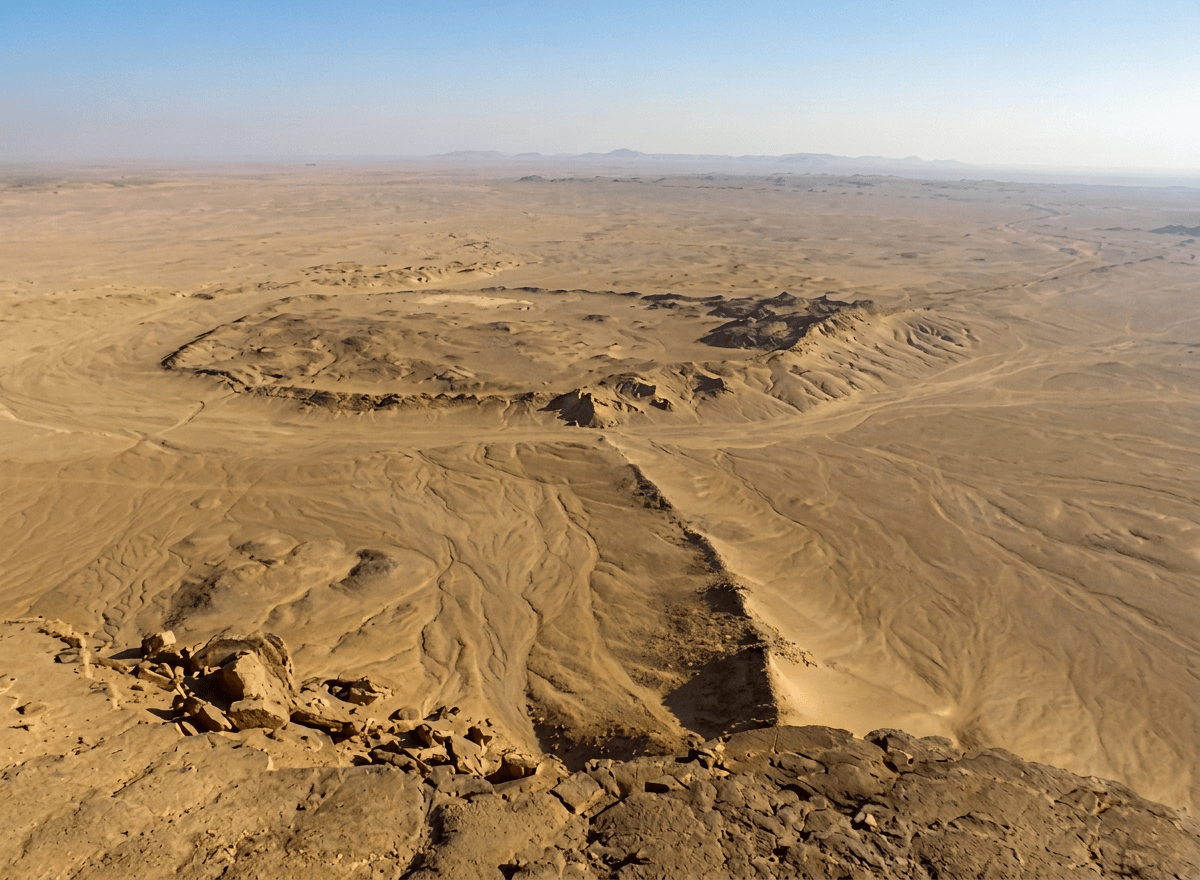
The Early Bronze Age breakthrough Around: 2900–2600 BCE
People built a sophisticated surface-water harvesting system. [5] The system incorporated: a large stone dam; water inlets; canals; weirs; an outlet; and agricultural land. The hydraulic infrastructure was constructed as an integrated system rather than as a series of unrelated features. [5] This is one of the strongest examples in Arabia of architecture responding directly to flash-flood hydrology.
The later oasis city
Eventually Qurayyah became a huge walled oasis. The settlement included: residential areas; agricultural fields; storage; industrial areas; pottery kilns; monumental walls; towers; and ritual/funerary buildings. The outer wall extends for approximately 13 km in the recently studied system, enclosing a landscape of more than 300 ha. [5][7] This is not Neolithic architecture. It belongs principally to the Bronze Age and later.
A ritual or communal building?
Yes, but again, later rather than PPNB. Qurayyah has produced evidence for cultic/ritual structures in its later occupation, including a sanctuary/temple-like complex and a remarkable funerary-cultic complex. The 2021 excavation of a circular stone tomb produced remains of approximately 12 people, along with extraordinary quantities of beads and imported materials. [7] These included: lapis lazuli; amazonite; turquoise; agate; hematite; quartz; shell; ivory; pearls; and other exotic materials. That is one of Qurayyah’s spectacular later discoveries—but it should not be confused with the PPNB occupation.
Weapons and special objects
The Neolithic Al Uyaynah assemblage includes projectile points and other flint tools. The later Qurayyah settlement has a much richer material culture, including: metal weapons; beads; specialized pottery; kilns; cultic objects; and imported materials. [8]
A particularly unusual later discovery is a copper-alloy caprine figurine, found in the wider Qurayyah archaeological landscape. It is interpreted cautiously because parallels are rare in northwest Arabia. [9]
Woodwork and doors
No preserved Neolithic wooden doors are known. That is unsurprising. The PPNB architecture was principally stone, and organic materials have survived poorly. The later oasis buildings used more substantial construction, but preserved wooden architectural components remain limited.
Pottery: almost none at the PPNB stage
This is another major point. PPNB Qurayyah AND Al Uyaynah: Pre-Pottery.
Bronze Age Qurayyah: Lots of pottery
Late Bronze Age: Qurayyah Painted Ware becomes famous
The later painted pottery is so distinctive that the site gave its name to Qurayyah Painted Ware (QPW), formerly often called “Midianite pottery.” A major 2026 study now argues that QPW developed locally at Qurayyah and was subsequently distributed widely, making it an unusually early example of recognizable ceramic “branding.” [10] But this belongs to the Late Bronze Age, not the PPNB.
Climate: the reason Qurayyah could exist
Qurayyah sits in one of the most interesting climatic transition zones in Arabia. During the early Holocene, northern Arabia experienced a much wetter period than today. The landscape contained: seasonal lakes; wetlands; grassland;
shrubs; better pasture; and active wadis. The PPNB occupation of Al Uyaynah appears to have occurred during a relatively favourable climatic window. The new research concludes that Al Uyaynah was short-lived and vulnerable to even relatively small changes toward greater aridity. ([2]) That is an important architectural lesson. The PPNB settlement was climate-dependent. The later Bronze Age oasis solved the problem differently: Don’t just wait for rain—capture it.
How many times was Qurayyah occupied?
This is one of the site’s great strengths. Qurayyah is a palimpsest, many occupations layered over the same favourable location.
The sequence includes: PPNB ~7190–6900 BCE in the Al Uyaynah settlement;
Later Neolithic / Chalcolithic activity
Early Bronze Age ~2900–2600 BCE: permanent oasis + hydraulic system
Middle/Late Bronze Age
Iron Age
Nabataean
Roman
Late ByzantineHuman activity therefore continued for thousands of years. [1][4] The exact number of “abandonments” cannot be reduced to a simple count because different parts of the enormous oasis were occupied, abandoned and reused at different times
Was the oasis abandoned?
Not in one dramatic event. The archaeological record indicates repeated transformation rather than a single abandonment.
Qurayyah remained important for roughly three millennia after the establishment of the permanent oasis, with occupation continuing into the first millennium CE. [3][7] Some areas ceased to be used while others continued. This is why “abandoned” is less useful than: reorganized, reduced and eventually transformed.
Who has studied Qurayyah?
The research history is unusually international. Earlier work Important early surveys were undertaken by Saudi and international archaeological teams, including the Comprehensive Archaeological Survey Program.
Modern project Since 2014, the major Qurayyah Joint Archaeological Project has been directed by: Marta Luciani — University of Vienna with Saudi archaeological partners including the Saudi Heritage Commission and Ahmed M. Abualhassan. [3][5]
Researchers have included specialists in: archaeology; geomorphology; hydrology; geoarchaeology; human osteology; archaeozoology; pottery; metallurgy; radiocarbon dating; OSL dating; and biomolecular archaeology. The University of Vienna, Saudi Heritage Commission, German Archaeological Institute and other international institutions have contributed to the work. [3][5]
The newer Al Uyaynah study adds researchers from the University of York, Flinders University and the University of Glasgow, among others. [2]
The plant story has just become much more interesting
Although there is little secure crop evidence for the PPNB occupation, modern biomolecular work at Qurayyah has recently demonstrated something remarkable for the Iron Age. Researchers recovered chemical residues of: Peganum harmala — Syrian rue / harmal from ancient fumigation vessels.
The residues contained characteristic harmala alkaloids, demonstrating that people were deliberately burning the plant. The study describes this as the earliest radiometrically dated material evidence of harmal fumigation yet identified globally. [11] This is Iron Age evidence, not Neolithic evidence, but it shows how valuable Qurayyah’s exceptional preservation can be for reconstructing ancient plant knowledge. It also gives the site an unusual food/plant story: Qurayyah wasn’t simply an agricultural oasis—it became a place where local botanical knowledge included medicinal, hygienic and potentially psychoactive plants.
Why Qurayyah is special 5 highlights
- A Neolithic water landscape became an engineered oasis. The location was already attractive because two major wadis converged there. Thousands of years later, people turned that natural advantage into one of Arabia’s most sophisticated water-harvesting systems. [4][5]
- Pastoralism reached the edge of viability. The nearby PPNB Al Uyaynah settlement shows goats/sheep dominating the economy, with cattle and hunting supplementing them. [2]
- The architecture changed radically PPNB: small stone-built village. Early Bronze Age: dam + canals + fields. later Bronze Age: huge walled oasis + industrial production + monumental buildings.
- The little clay objects are genuinely unusual. More than 200 enigmatic objects from Al Uyaynah—some pierced, grooved or containing flint—are among the strangest finds from the Arabian PPNB. [2]
- The botanical story reaches beyond food
The later discovery of harmal fumigation demonstrates that Qurayyah preserved evidence of sophisticated local botanical knowledge that cannot be seen from seeds alone. [11]
The big architectural story
Qurayyah is especially valuable because it lets us watch architecture and water management evolve together over roughly 8,000 years.
~7200 BCE Al Uyaynah. Small stone village to Goat/sheep husbandry to Seasonal wet climate
~2900 BCE Qurayyah oasis. Dam to Wadi capture to Canals to Fields to Permanent settlement. 2nd millennium BCE. Walls to Houses to Kilns to Specialized pottery to Trade. 1st millennium BCE. Urban residences to Cultic spaces to Fumigation to Long-distance trade
This is a superb case study in the principle: Architecture follows water—but architecture can also manufacture water security. The Neolithic inhabitants of the Qurayyah landscape were living at the edge of what rainfall could support. Their Bronze Age descendants solved the problem architecturally. They didn’t move to a river. They built a river system.
References: [1] Hüneburg, L., Hoelzmann, P., Knitter, D., Teichert, B., Richter, C., Lüthgens, C., Alsaud, A. S., & Luciani, M. (2019). Living at the wadi – integrating geomorphology and archaeology at the oasis of Qurayyah (NW Arabia). Journal of Maps 15(2), 215–226. The study establishes the early Holocene/PPNB presence and maps the Wadi Ghubai–Wadi Harif setting.
[2] Alasmari, K., Joly, D., Bickle, P., Bailey, G., et al. (2026). New Results From the Pre-Pottery Neolithic Site of Al Uyaynah, Tabuk, in Northwestern Saudi Arabia. Arabian Archaeology and Epigraphy. Dates the settlement to c. 7190–6900 cal BC and documents its architecture, fauna, lithics and >200 unusual clay objects.
[3] Luciani, M., & Alsaud, A. S. (2018). The new archaeological joint project on the site of Qurayyah, north-west Arabia: results of the first two excavation seasons. Proceedings of the Seminar for Arabian Studies 48, 165–183.
[4] Hüneburg et al. (2019), geomorphological mapping of Qurayyah: the settlement lies at the confluence of Wadi Ghubai and Wadi Harif, in a sheltered position between plateau and Tabuk Basin.
[5] Lüthgens, C., Luciani, M., Prochazka, S., Firla, G., Hoelzmann, P., Abualhassan, A. M., et al. (2023). Watering the desert: Oasis hydroarchaeology, geochronology and functionality in Northern Arabia. The Holocene 33(5). The Early Bronze Age hydraulic system is dated to 2900–2600 cal BCE.
[6] Geographic location/elevation data for Al Qurayyah.
[7] Saudi Heritage Commission/Saudipedia, Qurayyah Archaeological Site. Provides a concise overview of the walled oasis, irrigation system, later tombs, buildings and imported materials.
[8] Luciani, M., Binder, M., & Alsaud, A. S. (2018). Life and living conditions in north-west Arabia during the Bronze Age: first results from the bioarchaeological work at Qurayyah. Proceedings of the Seminar for Arabian Studies 48, 185–200.
[9] Archaeological report documenting a copper-alloy caprine figurine and Bronze/Iron Age material from the Qurayyah region.
[10] Luciani, M., Fragnoli, P., Gilstrap, W. D., Sterba, J. H., Klainscek, D., Greene, J. A., et al. (2026). Creating a brand: Genesis, transformation and diffusion of Qurayyah Painted Ware. PLOS ONE 21 (8), e0351296. This is a Late Bronze Age study, not Neolithic evidence, but it is important for Qurayyah’s later ceramic specialization and trade.
[11] Huber, B., Luciani, M., Abualhassan, A., Vassao, D. G., Fernandes, R., & Devièse, T. (2025). Metabolic profiling reveals first evidence of fumigating drug plant Peganum harmala in Iron Age Arabia. Communications Biology.
Useful full-text/official resources
Leave a Reply