<home # start here # guides # builds # services # shop # about # categories>
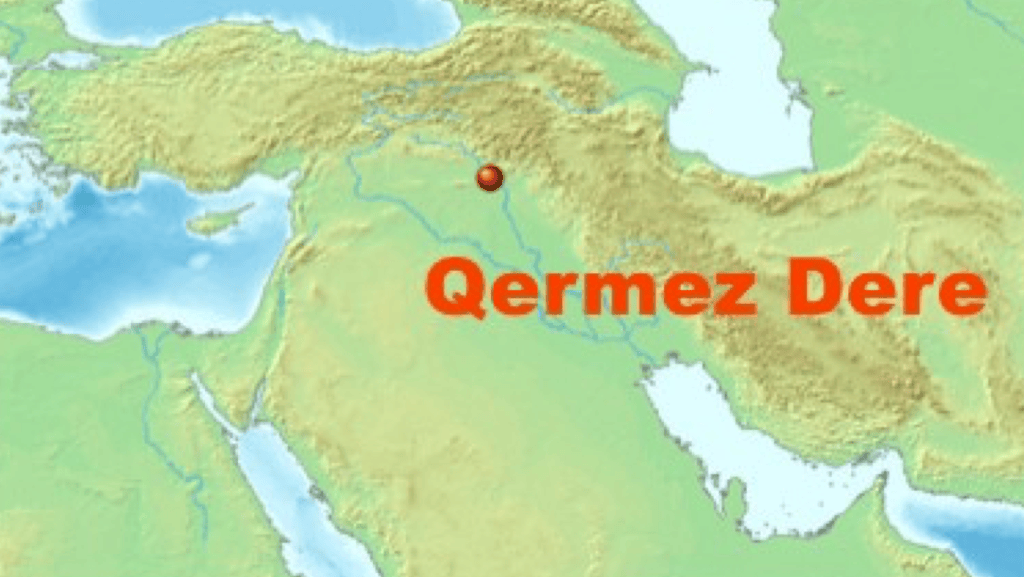
One of the key early Neolithic settlements in the eastern Fertile Crescent and northern Mesopotamia exists. It is called Qermez Deere. Broadly dated to the PPNA / early Pre-Pottery Neolithic horizon (roughly 10,500–9,500 BC, depending on calibration and phase definitions). It sits in the same long transition zone that includes sites like Nemrik 9, M’lefaat, and early Zagros foothill settlements.
It was a small PPNA village site north of the Mesopotamian plain. Representing an early sedentary settlement, the transitional economy between foraging and cultivation and one of the earliest clear architectural settlements in the eastern Fertile Crescent.
It was not a megasite like Göbekli Tepe, nor a dense tell like later Neolithic villages. It is a small community settlement with repeated occupation and rebuilding.
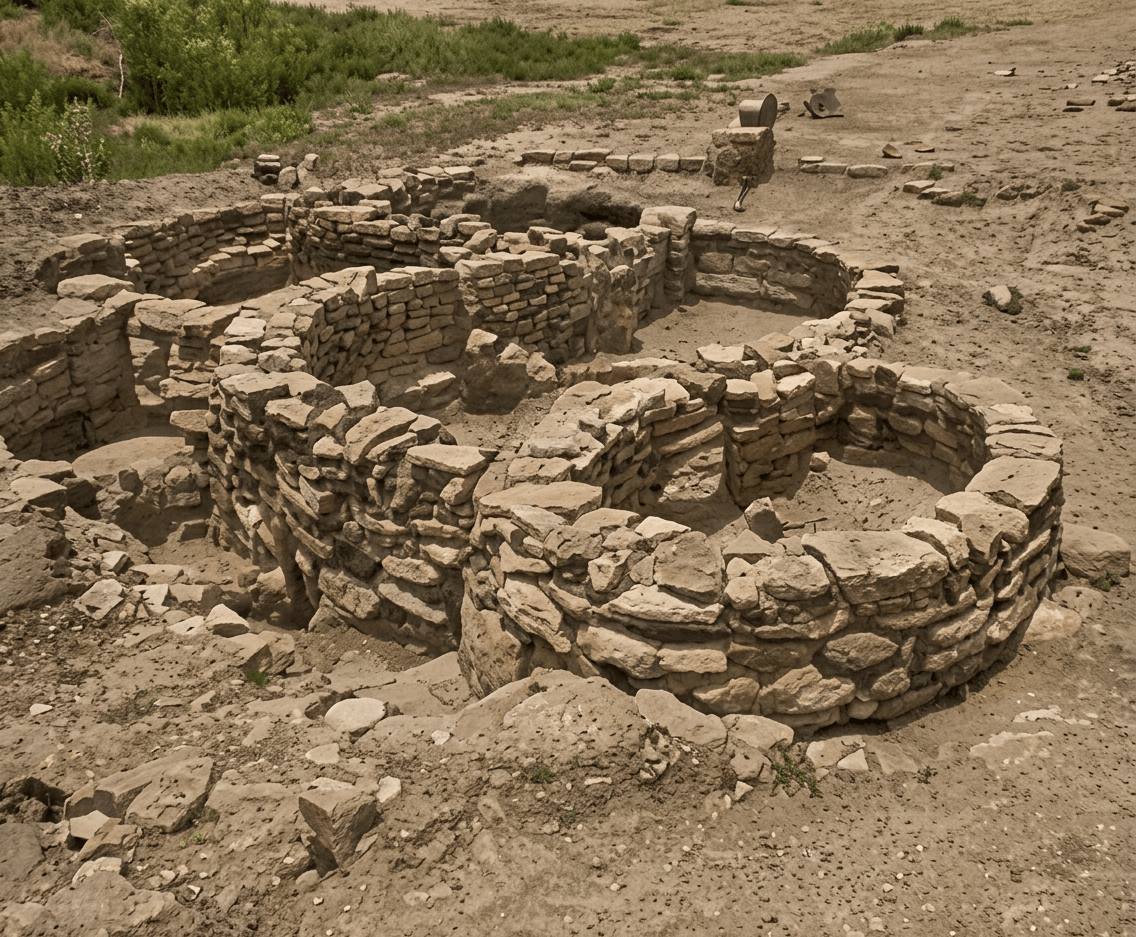
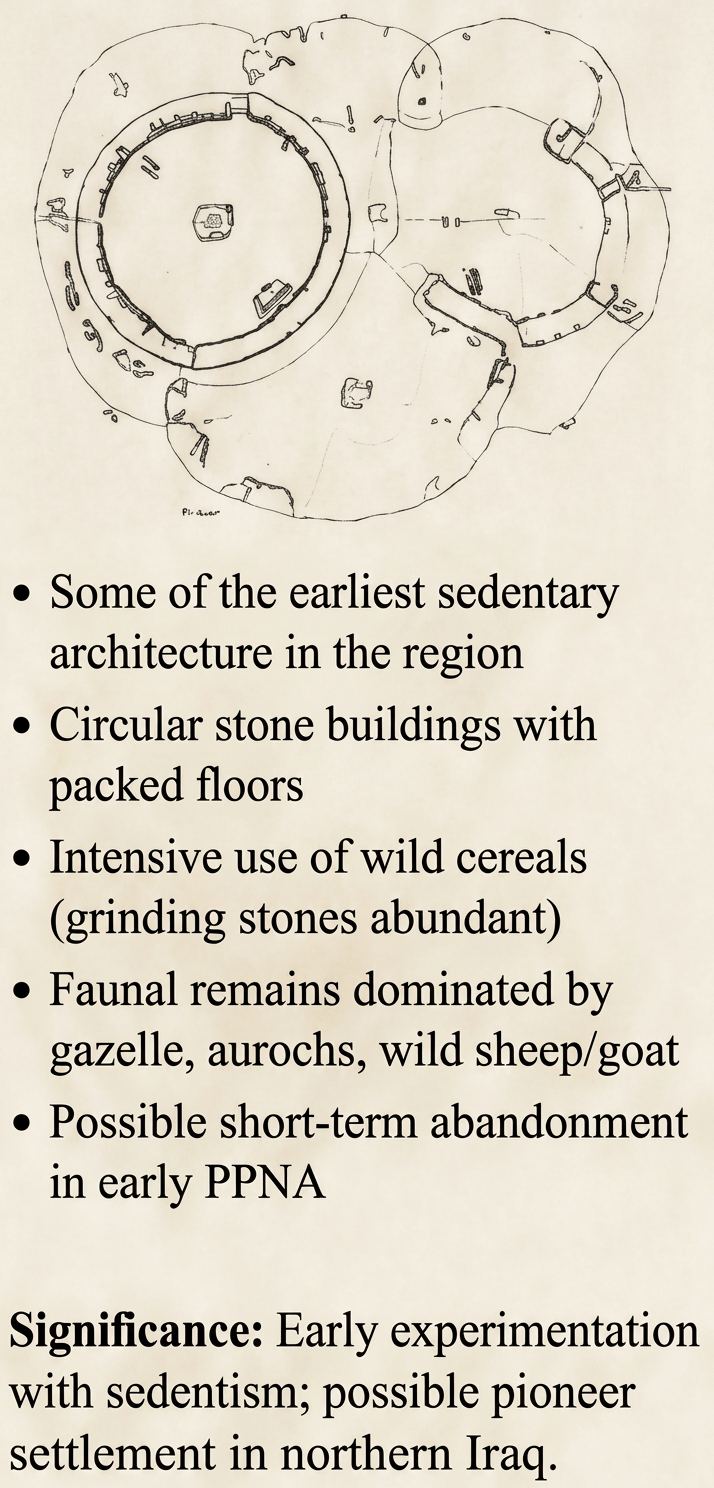
During its early phases of architecture round buildings dominated
There were circular / oval semi-subterranean houses, stone foundations, postholes and internal hearths. They were simple domestic units.
During the later PPNA, they developed a gradual shift towards more rectilinear and subdivided internal spaces, and transitional layouts (not fully rectangular like later PPNB villages)
Qermez Dere sits before full rectilinear village standardization.
Farming: fully domesticated einkorn, barley, or neither yet?
Early cultivation is present, but fully domesticated crops are uncertain in the earliest phase. Archaeobotanical work from PPNA northern Mesopotamia (including Qermez Dere context) shows wild cereals dominate early levels. Wild einkorn-type wheat (Triticum boeoticum group) likely exploited, and wild barley (Hordeum spontaneum) also present. The gradual appearance of morphologically domesticated traits appear later in the PPNA to early PPNB transition.
Clear “fully domesticated einkorn/barley” is not securely dominant in earliest layers. Instead there’s pre-domestication cultivation and intensive gathering. Farming could have begun 12 or 13 millenium ago.
Simplified Sequence (late epipaleolithic, PPNA, Early PPNB)
Late Epipalaeolithic: wild gathering + hunting;
PPNA:Cultivation begins (wild cereals managed) and sedentary villages appear; and
Early PPNB: Full domestication of wheat/barley consolidates and sheep/goat herding intensifies.
They probably had other plants
Legumes (wild vetches, peas in broader region); pistachio, almond (foothill resources); and other wild grasses and seeds.
Qermez Dere is part of the Zagros foothill “wild cereal management corridor”, not yet a fully domesticated agriculture core.
Unlike Göbekli Tepe, Qermez Dere does not show massive ritual enclosures
There are possible shared structures. Larger or centrally placed circular buildings. Repeated rebuilding of central spaces and evidence of structured domestic clustering. The site shows everday community organization.
There are multiple occupational phases (generally 2–3 main PPNA phases), repeated rebuilding of circular structures and stratified but not deeply massive tell formation (compared to later sites)
The site has been equvated and studied by the British Museum and using Iraqi–British collaborative prehistoric archaeology tradition
Susan Pollock and Roger Matthews, and the broader “Zagros Neolithic research school”. Teams also working on Nemrik 9, M’lefaat and others.
The site is a key for understanding how cultivation emerged BEFORE full domestication. As well, Zagros foothill adaptation
Neolithic expansion into upland valleys, begin with using the seasonal water systems and wild cereal ecotones. It was an architectural shift zone too. From circular to proto-rectangular domestic planning.
Flint/chert was locally available in the limestone of the Zagros foothills
Because there location was far outside Anatolian obsidian primary zones. It would have came via long-distance exchange chains (maybe 500 miles or so).
During the early Holocene (PPNA period) it was warmer and more stable than ice age, they had more moisture in Zargos foothills, it was a rich ‘ecotone landscape’ and there were instabilities
1) It was warmer and more stable than Ice Age. Post-glacial warming was underway and there was an expansion of vegetation zones upward into mountains;
2) They had more moisture in Zagros foothills. Stronger seasonal rainfall, and more reliable spring flows;
3) It was a rich “ecotone landscape”. It was in a zone with steppe grasses, oak-pistachio woodland patches and river valleys with dense edible wild plants; and,
4) Non uniform fluctuations existed. There were short cooling/drying events (eg. early Holocene instability phases) but overall more productive than today in many valleys.
Nearly 13 thousand years ago, in a small PPNA Zagros foothill village, people already begun living in permanent circular houses, harvesting wild einkorn and barley, beginning cultivation without full domestication. There participation in early regional exchange networks long before classical “Neolithic farming villages” fully formed, is an important element of neolithic architecture being studied today.
References: Matthews, R. (various works on Zagros Neolithic and PPNA–PPNB transition)
Pollock, S. (early village social organization in Mesopotamia/Zagros)
Köhler-Rollefson / regional archaeobotanical syntheses on early cereal management
General PPNA Zagros settlement studies (Nemrik 9, M’lefaat comparative frameworks)
Leave a Reply