< home # store # services # articles # game # app #contact >
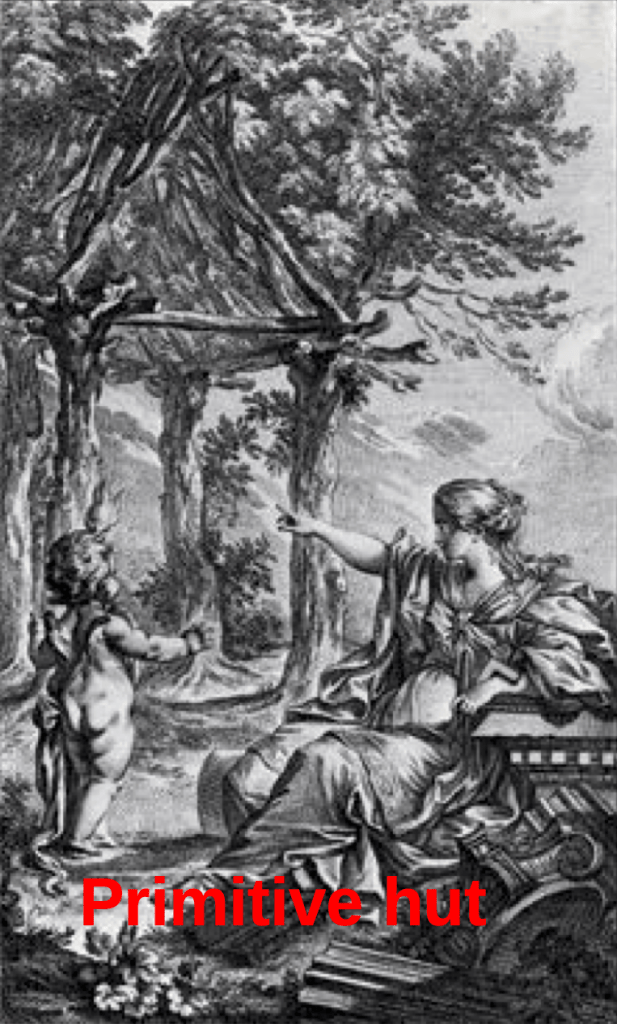
Often associated with the work of the French architect Marc-Antoine Laugier
The primitive hut serves as a theoretical and philosophical construct. It seeks to explain the origin and essence of architecture. From a perspective, greater than 300 years ago.
First published in 1753. According to Laugier’s “Essai sur l’Architecture” (Essay on Architecture). The primitive hut represents an idealized, fundamental structure that is simple, natural, and in harmony with its surroundings
Laugier proposed that the first architectural form emerged when early humans sought shelter in the branches of trees. It lead to the concept and creation of the primitive hut.
“Primitive hut” is conceived as a basic, uncomplicated structure
Reflecting the idea that true architecture originates from a simple, essential form.
Emphasized is the use of natural elements
It is suggested the primitive hut be constructed using materials readily available in nature. Such as tree branches.
The concept implies that architecture arises from functional needs
For shelter and protection. Evolving from instinctive responses to environmental conditions.
While the primitive hut is a theoretical construct, it has had a lasting influence on architectural discourse. It has inspired discussions about the essence of architecture. Its relationship between nature and design. And, the purity of this form. As time goes on, architects and theorists will always be engaged interpreting the ‘primitive hut’ concept in various ways.
Bibliography: Laugier, M. A. (1755). An Essay on Architecture. London: T. Osbourne and Shipton.
Germann, G. “Review: On Adams House in Paradise; The Idea of the Primitive Hut in Architectural History by Joseph Rykwert”. Journal of the Society of Architectural Historians. 33 (3, Oct., 1974).
“The Idea of the Primitive Hut” (http://www.hum.leiden.edu/lucas/legitimacy-of-architecture/project/the-primitive-hut.html). The Legitimacy of Architecture 1750-1850. Universiteit Leiden. 15 March 2013.
Leave a Reply