< home # store # services # articles # game # app #contact >
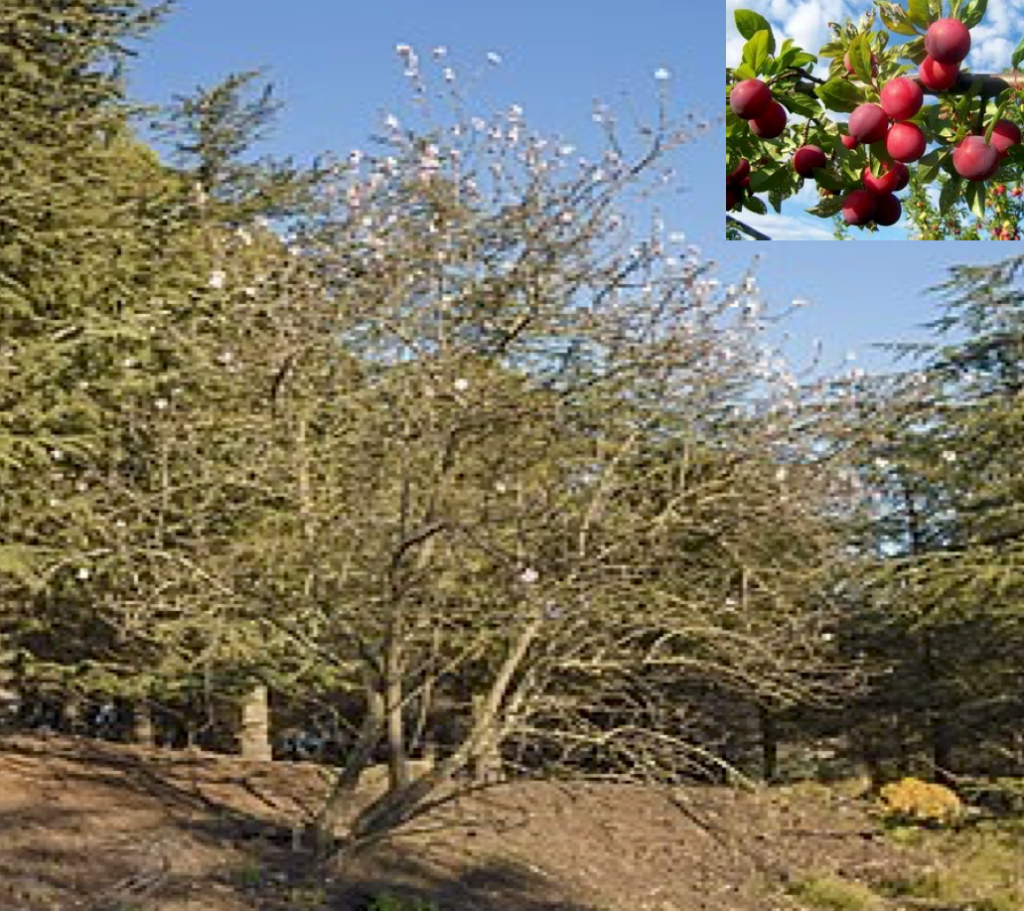
European plums are derived from cultivated stock
Hybridization from prunus cerasifera (cherry plum), and possibly P. spinosa (sloe), though the precise wild ancestor is debated.
Plum stones, or seeds have been found at neolithic sites in Europe, (Germany and Ukraine), dating to 4 to 6000 BCE
Bu they were often broad prunus species and not always clearly identifiable as P. domestica.
Farmers worked looking for larger and sweeter fruits compared to wild relatives
Early cultivars varied widely in size, color, and flavor.
They selected for: Fruit texture and juiciness; color differences ranging from dark purple to yellow and red in cultivated forms; and Varying ripening times and tastes.
Clonal propagation techniques like grafting onto rootstocks (p. cerasifera) were widely used in antiquity to preserve desirable fruit traits.
Plum seeds and cuttings were carried by humans along trade routes (Silk Road, Mediterranean caravan paths) and transported on pack animals such as horses, donkeys, or camels
People moved both seeds and grafted cuttings to establish orchards in new regions. There’s no biological barrier to these forms of transport.
The european plum, or prunus domestica has many cultivated forms. Check it out with some more neolithic architecture today.
Bibliography: Zhebentyayeva, T., Shankar, V., Scorza, R. et al. Genetic characterization of worldwide Prunus domestica (plum) germplasm using sequence-based genotyping. Hortic Res 6, 12 (2019). https://doi.org/10.1038/s41438-018-0090-6
Zohary, Daniel (1992-03-01). “Is the European plum, Prunus domestica L., a P. cerasifera EHRH.× P. spinosa L. allo-polyploid?” (https://link.springer.com/article/10.1007/BF00022260). Euphytica.60 (1): 75–77. Bibcode:1992Euphy..60…75Z (https://ui.adsabs.harvard.edu/abs/1992Euphy..60…7
5Z). doi:10.1007/BF00022260 (https://doi.org/10.1007%2FBF00022260). ISSN 0014-2336 (http
s://search.worldcat.org/issn/0014-2336). S2CID 10923512 (https://api.semanticscholar.org/CorpusID:10923512).
Tomo Milošević, Nebojša Milošević, Jelena Mladenović, Diversity of plums belonging to P. domestica L., P. insititia L. and Prunus × rossica Erem. Tree vigour, yielding and fruit quality attributes, Scientia Horticulturae, Volume 320, 2023, 112220, ISSN 0304-4238, https://doi.org/10.1016/j.scienta.2023.112220
Cullen, J. et al. (1995). The European Garden Flora. Volume IV (https://books.google.com/books?id=Ly7ESAAACAAJ). Cambridge University Press, Cambridge.
Crane, M.B.; Lawrence, W.J.C. (1947). The Genetics of Garden Plants (https://web.archive.org/web/20171215084723/http://krishikosh.egranth.ac.in/bitstream/1/2045588/1/16908.pdf) (PDF).
MacMillan & Co. LTD. p. 233. Archived from the original (http://krishikosh.egranth.ac.in/bitstream/1/2045588/1/16908.pdf) (PDF) on 2017-12-15
Leave a Reply