< home # store # services # articles # game # app #contact >

In NE Siberia, an attempt to re-create subarctic steppe grasses is taking place. To help reduce greenhouse gases, climate change, extreme weather & to create a better, more significant planet.

Pleistocene park is a nature reserve on the Kolyma River, south of Chersky in the Sakha Republic. They are testing a big hypothesis repopulating with large herbivores, (and predators), which they believe can restore rich grasslands ecosystems.
Another main aim, is to research the changes expected by the climatic effects of restoring the 10,000 year old plus grass ecosystem
The hypothesis is that change from tundra will result in a raised ratio of energy emission, to energy absorption of the area. This will lead to less thawing of the permafrost, and thereby less emission of greenhouse gases. It is also thought that the removal of snow, and stomping by large herbivores will reduce permafrost insulation. Thereby sucking in pollution, even in cold winter(s).

Melting permafrost is changing the planet because the greenhouse gasses it releases are warming the planet
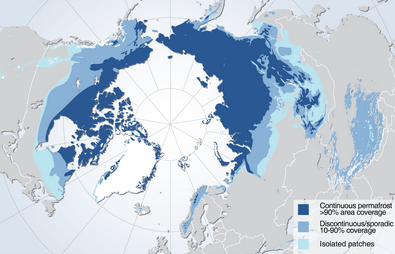
In some areas, like Siberia (Russia has 11 of the 18 million square km of permafrost), it is observed more than others. But believe it or not when there is a lot of snow, the ground and the permafrost do not get much colder. It’s why we call it permafrost.
When these soils thaw, old microorganisms wake up and attack. What they have not had time to consume
Releasing carbon dioxide when the soil is dry, and methane when it is saturated with water.
Due to recent climate change(s), the permafrost is increasingly thawing, releasing stored carbon and forming thermokarst lakes
More methane and more carbon dioxide emissions are released into the atmosphere. Included in the higher temperatures, rain and climate change you see in almost all places today.
It doesn’t help because this area, is also experiencing more rain
If it was only co2 released, rather than both co2 and methane. The emissions is equivalent to that of human beings.
For the greenhouse effect, (and thus melting of the permafrost), methane gas can be 4 times worse. Methane released from permafrost is more dangerous than carbon dioxide, and both are bad.
In the grassland ecosystem, everything that grew during the summer must be consumed in the winter
The only way to access the grass during the cold season is to dig through the cold snow. The parks animals dig in the snow all winter long. They need to eat. This contributes greatly to the cooling of the soil. And, absorption and release of the greenhouse gases.
While things were shut down during covid19. It was observed that many greenhouse gases decreased during the first year and a half
Regularly observed were appearances of new small springs where methane gases were bubbling up. In these areas there used to be permafrost. Instead of decreasing, the methane gases increased.
Many cannot see any other explanation for preventing this high concentration
The theory purposes that restoring the wildlife and ecosystem will absorb more greenhouse gases and help restore our natural environment.
Sergei Zimov (one of the managers) has been quoting telling the UN: “I created Pleistocene Park to observe how quickly animals could transform the moss tundra into productive grassland… why had the natural environment, which had known so many grasslands, horses, bison, mammoths, become so poor?” Permafrost has long been treated like an unwanted child in the scientific family. Reports are that by 2100 we will have lost another 10-20 percent. It is a big controversial topic.
What are the parks goals?
Researching the effects of large herbivores on the arctic tundra/grasslands ecosystem, and preserving the environment; and,
To research the climatic effects of the expected changes in the ecosystem.
Here the key concept is that some of the effects of the large herbivores, such as eradicating trees and shrubs or trampling snow, will result in a stronger cooling of the ground in the winter, leading to less thawing of permafrost during summer and thereby less emission of greenhouse gases
Sergei points out contradiction to this scenario:
Similar climatic shifts occurred in previous interglacial periods without causing such massive environmental changes as we are seeing today.
Those large herbivores of the former steppe that survived until today (e.g. musk oxen, bison, horses) thrive in humid environments just as well as in arid ones; and,
The climate (both temperatures and humidity) in today’s northern Siberia is in fact most similar to that of the mammoth steppe.

Did you know? Permafrost is a large global carbon reservoir that has remained frozen throughout much of the Holocene. It is ground that continuously remains below 0 °C (32 °F) for two or more years. It is not necessarily under the snow too. Sometimes it is found hundreds of meters deep.

Implementation & background: the regional pleistocene ecoregions will help regenerate the pleistocene terrain with its different ecological habitats. Such as taiga, tundra, steppe and alpine terrain
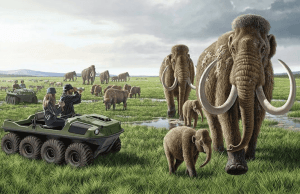
Mainly to recreate the extensive grasslands that covered the Beringia region. The mammoth steppe will also help with the large (if brought back), and medium herbivores. Species include: woolly mammoth, woolly rhino, steppe wisent, lena Horse, muskox, and reindeer.
On the edges, barrier shrub-like terrain, and dry conifer forests (similar to taiga) could exist
Woolly rhinoceros, moose, wapiti, yukon wild ass, and camels.
Beyond this, mountains, more mountain-going animals
Snow sheep; variety of carnivorous mammals, beringian cave lion, apex predators, shared grey wolf, cave hyena, homotherium (scimatar), wolverine; arctic fox; and, brown bear.
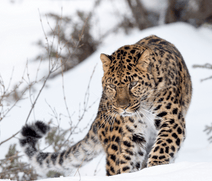
In shrubs and forests there were also brown bears, wolverines, cave bears, lynxes, tigers, leopards, and red foxes
Proposed procedure:
Few of the former species of megafauna are left; and/or their population density is extremely low, or too low to affect the environment. But the desired results density is actually raised artificially by fencing in and concentrating existing large herbivores.
A large variety of species are important. For example: effects on the flora, (mosses being replaced by grasses); effects on the atmosphere (changes in levels of methane, carbon dioxide, water vapor); and, thus the effects on the permafrost
Once a high density of herbivores over a vast area has been reached, predators larger than the wolves will have to be introduced to keep the megafauna in check
Where there were fires the rate of decomposition of organic matter in the soil depends mainly on temperature. It is known introducing grasses, and mammoth steepe slows the process down
Pleistocene park progress 1
-1988–1996: The first grazing experiments began in 1988 at the northeast science station in Chersky with yakutian horses;
-1996–2004: In 1996 a 50 ha (125 acre) enclosure was built
-yakutian horses were introduced, as most abundant ungulates;
Moose, already present in the region, were also re-introduced; and
Artificial effects of larger animals (mammoths and buffalo) were created by using a tank and 8×8 Argo. To crush pathways through the willowshrub.
Experiment working
The vegetation in the park started to change. In the areas where the horses grazed, the soil compacted. Mosses, weeds and willow shrub were replaced by grass. Flat grassland is now the dominating landscape inside the park. When air temperature sank to −40 °C (−40 °F) in winter, the temperature of the ground was found to be only –5 °C (+23 °F) under an intact cover of snow, but −30 °C (−22 °F) where the animals had trampled down the snow. The grazers thus help keep permafrost intact, thereby lessening the amount of methane released by the tundra.
Pleistocene progress 2
-2004–2011: A new fence was erected. After its completion, reindeer and more moose were brought into the park;
A 32 meter (105 foot) high tower was erected that constantly monitors the levels of methane, carbon dioxide and water vapor in the park’s atmosphere;
Muskox from Wrangel island were reintroduced in 2010; and
In 2011, Altai wapiti were introduced
2011–2016: Construction of new “wild field section”, and greater energy monitoring stations are put in.
-2017–present: yak, and sheep were brought to the park.
Pleistocene progress 3
More plans for future.
Reception, critical thinking & controversial aspects
Critics admonish that introducing alien species could damage the fragile ecosystem of the existing tundra. Scientist Sergey Zimov replies: “Tundra – that is not an ecosystem. Such systems had not existed on the planet (before the disappearance of the megafauna), and there is nothing to cherish in the tundra. Of course, it would be silly to create a desert instead of the tundra, but if the same site would evolve into a steppe, then it certainly would improve the environment. If deer, foxes, bovines were more abundant, nature would only benefit from this. And people too. However, the danger still exists, of course, you have to be very careful. If it is a revival of the steppes, then, for example, small animals are really dangerous to release without control. As for large herbivores – no danger, as they are very easy to remove again.”
Another concern point is a majority of species cant be introduced in harsh conditions. For example, according to some critics, the yakutian horses, would not survive without food supply and human intervention
Mostly in the fall when water freezes and before the snow hits. Because the horses eat the snow for water, but cant lick the ice as easily.

Thankfully the park is a select hub for a small number of journalists; and, international scientists, and students, who come from around the world to conduct their own ecological research and experiments; plus monitor and take care of things
Based on total costs and lifetime savings: Project drawdown claims the park as: “100 most substantive solutions to global warming”
In January 2020, a study from the University of Oxford assessed the viability of the park’s goals. It was estimated, if three large-scale experimental were set up, each containing 1000 animals. Over a ten year period, that 72,000 metric tons of carbon could be held and generate 360,000 US dollars in carbon revenues.
Park information
Size and administration:
Pleistocene Park is a 160 km square scientific nature reserve consisting of willow brush, grasslands, swamps, forests and a multitude of lakes.
The average temperature in January is about –33 °C;
and, in July +12 °C
Annual precipitation is 200–250 mm
The reserve is surrounded by a 600 km 2 buffer zone
Animals:
Herbivores: Reindeer (Rangifer tarandus);
Elk;
Moose (Alces alces);
Yakutian horses;
Muskox (Ovibos moschatus); and
European bison, Bison bonasus).

Muskoxen family: Domestic yak (Bos mutus grunniens);
Edilbaevskaya sheep (a domestic breed of sheep);
Kalmykian cattle (a domestic breed of cattle adapted for the Mongolian steppe);
Plains bison (Bison bison bison);
Orenburg fur goat (Capra aegagrus hircus); and,
Bactrian camel (Camelus bactrianus).

Carnivores: Eurasian lynx (Lynx lynx);
Tundra wolf (Canis lupus albus);
Arctic fox (Vulpes lagopus);
Eurasian brown bear (Ursus arctos arctos);
Wolverine (Gulo gulo);
Red fox (Vulpes vulpes);
Sable (Martes zibellina); and,
Stoat (Mustela erminea).


Herbivores considered for reintroduction:
Wood bison (Bison bison athabascae);
Bison priscus;
Altai wapiti or Altai maral (Cervus canadensis sibiricus);
Wild yak (Bos mutus);
Snow sheep (Ovis nivicola);
Wild Bactrian camel (Camelus ferus);
Siberian roe deer (Capreolus pygargus);
Saiga antelope (Saiga tatarica); and,
Altai maral.
Carnivores:
Siberian tiger (Panthera tigris tigris).

Did you know? Harvard university geneticist George Church, and others are working on a plan to genetically resurrect woolly mammoths.
Animals that could be placed in the park if revived from extinction:
Woolly mammoth (Mammuthus primigenius);
Cave lion (Panthera spelaea);
Steppe bison (Bison priscus);
Woolly rhinoceros (Coelodonta antiquitatis);
Irish elk (Megaloceros giganteus); and,
Cave bear (Ursus spelaeus).
Slip into your pleistocene freedom. Wander free and create your own natural time of life. Your kind will grow stronger, as the millennia go on.
One day, maybe all of our mistakes could be taken back. And, earth will overflow with prehistoric life again. If it does, and we re-incarnate the planet, maybe that will be the shit.
Bibliography: Kintisch, Eli (4 December 2015). “Born to rewild. A father and son’s quixotic quest to bring back a lost ecosystem – and save the world”. Science. Vol. 350, no. 6265. pp. 1148–1151.
Joel Makower (2014): “Inside Paul Hawken’s audacious plan to ‘drawdown’ climate change.” GreenBiz, 22 October 2014. Jan 2023
Александр Марков (Aleksandr Markov) (6 December 2006): “Хороший забор — главное условие восстановления мамонтовых степей.” In: Элементы. Article found in: http://www.pleistocenepark.ru/en/ – Media about us. Jan 2023
Leave a Reply