< home # store # services # articles # game # app #contact >
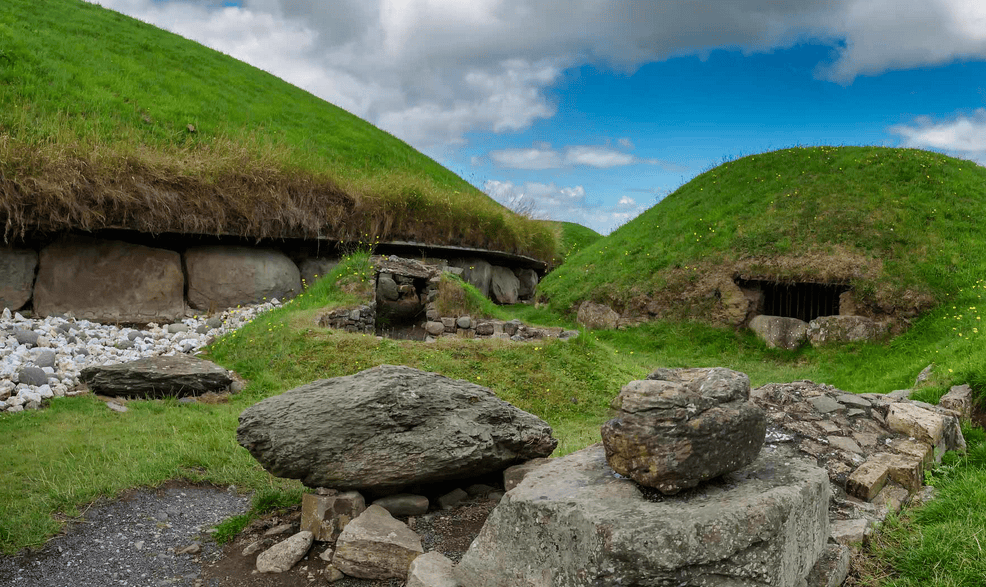
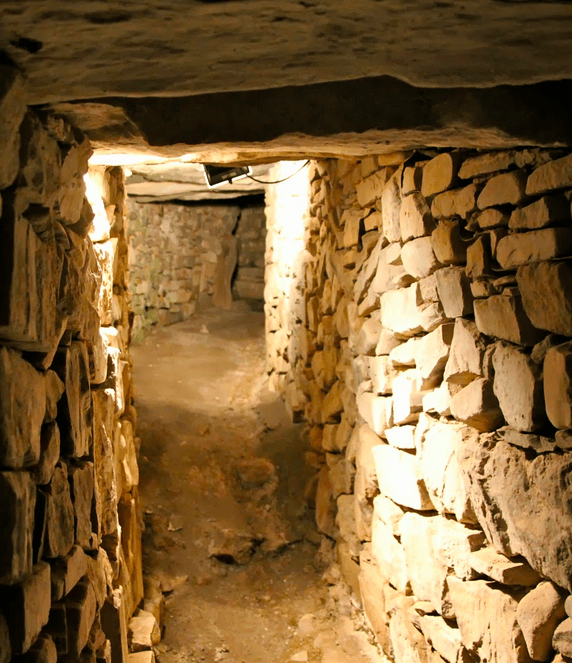
When covered in stone, dirt and earth. Passage grave, or tombs are types of burial mounds
Most of these designs are found in the western part Europe. And, date from the Neolithic period. Sometimes they are called a type of cairn. They have widespread distribution throughout Europe.
Key features include:
Often large stones or megalithic orthostats form walls of a long narrow, entry passage;
A center or rectangular chamber exists, often also constructed using large stones;
Usually the passage and center are covered. With more stones, earth, or both. Known as a cairn. It protects whats inside;
Scientists have discovered all kinds of artifacts. Pottery, tools; personal items: jewelry, lanterns, weapons; skeletal remains of both humans and animals; and, more. Providing belief and cultural evidence of the people that constructed and maintained them; and,
Orientations including astronomical alignments show the structures are connected to celestial events or beliefs.

Construction and design
Earlier designs seem to be smaller. Where as later, more advanced ones. Are aligned with features. Such as Newgrange, in Ireland. Sun shines through the passage into the chamber at different points of the year. Like sunrise, winter solstice, or at sunset on equinox. Later, many were also created at the top of hills or mountains. To be seen from great distances.
Megalithic art is carved at some sites
Maeshowe and others demonstrate not all passage graves or tombs were used for burials.
It is believed PGT’s were originated in Brittany (France) (1). And, that many of the terms, and variations. Maybe borrowed from Spanish: ‘tumbas de corredor’, or, the english term ‘corridor tombs’. (2)
Passage graves/tombs are distributed along the European Atlantic. In Ireland; Britain; Scandinavia; northern Germany; and, Netherlands. They are also found in Iberia, parts of the Mediterranean, and the northern coast of Africa.
Passage grave tombs are important archaeological sites. They provide insights into the social, religious, and technological aspects of society. Many of which. That were built during prehistoric times and the neolithic era.
Citation: 1) Citation: Sheridan, Alison. “Megaliths and Megalomania: An account and interpretation of the development of passage tombs in Ireland”. The Journal of Irish Archaeology. 3: 17–30.
2) Ó Nualláin, Seán & De Valera, Rúaidhrí (1961). Survey of the Megalithic Tombs of Ireland. Dublin: Ordnance Survey (Ireland).
Bibliography: Sheridan, Alison. “Megaliths and Megalomania: An account and interpretation of the development of passage tombs in Ireland”. The Journal of Irish Archaeology. 3:
Ó Nualláin, Seán & De Valera, Rúaidhrí (1961). Survey of the Megalithic Tombs of Ireland. Dublin: Ordnance Survey (Ireland)
Leave a Reply