< home # store # services # articles # game # app #contact >

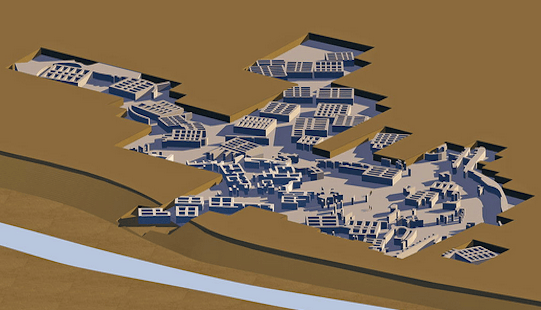
Mehrgarh is an archaeological site located in the Balochistan province of Pakistan, near the Bolan Pass. It is considered to be one of the oldest human settlements in the world, Dating back to the pre-ceramic neolithic era, around 7000 BC.
It was located in 1974, by the French archaeological mission (1)
People who settled originally were nomads preferring cattle herding over hunting. There’s evidence the neolithic people of Mehrgarh started out more advanced. Scientists found farming, pottery, metalwork, trade, and more.
Excavations at Mehrgarh have revealed a agricultural society with a system of irrigation, sophisticated tools, and pottery
Wheat and barley; and, animals such as sheep, goats and cattle were farmed.
The site could be the earliest known for farming, and herding (2)(3)
They cultivated 6 row barley, einkorn, emmer wheat, and dates. They hearded sheep, cattle, and goat.
Buildings included unbaked mud bricks
Many had four internal subdivisions.

Houses had stored grain in graineries
For storage, and transportation. Lined large basket containers with bitumen were found.
Numerous baskets; stone, bone tools; and beads, pendents were found
Sea shell, limestone, turquoise, lapis luzuli and other ordiments have been found.
Stone axes were found. Including in a burial. Some of the earliest context in S Asia
In 2001, 9 men were discovered with proof of proto dentistry (4)
7500-9000 year ago.

Female figurines were discovered, as well as more beads
As time went on, they both became more detailed, and were decorated and with ornaments. It may have had ‘cultic significance’. (5)(6)
Copper melting crucibles were found
And, tools fashioned from copper are also found
There were variations of kilns included updraft kilns, and pit kilns.
Did you know? Mehrgarh allows us to consider an even earlier use of cotton in the Old World, dating to the 6th millennium (7)
First button seals were produced with terra cotta, bone and geometric designs
There was evidence of long distance trade.
Though its influence by near east; (8) or, though independent origin is argued (9)
According to many, the culture migrated into the valley to become the Indus valley civilization of the bronze age. (10)
The use of the pottery wheel became widespread around 3000 BC
Intricate designs were included, including animal motifs. (11)
Lets hear it for Mehrgarh, and its rolling hills on the western edge of the Indus valley. They provide an important insight into the development of human civilization, and the transition from hunting and gathering, to settled farming communities. Check them out with some more neolithic architecture today!
Cite: 1) “French Archaeological Mission in the Indus Basin” (https://www.wikidata.org/wiki/Q105299055). http://www.wikidata.org
2) UNESCO World Heritage. 2004. ” (http://whc.unesco.org/en/tentativelists/1876/) Archived (https://web.archive.org/web/20181226013816/http://whc.unesco.org/en/tentativelists/1876/) 26
December 2018 at the Wayback Machine. Archaeological Site of Mehrgarh
3) Hirst, K. Kris. 2005. “Mehrgarh” (http://archaeology.about.com/od/mterms/g/mehrgarh.htm) Archived (https://web.archive.org/web/20170118071157/http://archaeology.about.com/od/mterms/g/mehrgarh.htm) 18 January 2017 at the Wayback Machine. Guide to Archaeology
The metallurgical analysis of a copper bead from a Neolithic burial (6th millennium bc) at Mehrgarh, Pakistan, allowed the recovery of several threads, preserved by mineralization.They were characterized according to new procedure, combining the use of a reflected-light microscope and a scanning electron microscope, and identified as cotton (Gossypium sp.)
4) Coppa, A. et al. 2006. “Early Neolithic tradition of dentistry: Flint tips were surprisingly effective for drilling tooth enamel in a prehistoric population.” (http://www.nature.com/nature/journal/v44
0/n7085/pdf/440755a.pdf) Archived (https://web.archive.org/web/20071127160643/http://www.nature.com/nature/journal/v440/n7085/pdf/440755a.pdf) 27 November 2007 at the Wayback
Machine Nature. Volume 440. 6 April 2006
5) Sarah M. Nelson (February 2007). Worlds of gender: the archaeology of women’s lives around the globe (https://books.google.com/books?id=ab1rF6tznkoC&pg=PA77). Rowman Altamira.
pp. 77–. ISBN 978-0-7591-1084-7. Archived (https://web.archive.org/web/20220709143420/https://books.google.com/books?id=ab1rF6tznkoC&pg=PA77) from the original on 9 July 2022
6) Sharif, M; Thapar, B. K. (January 1999). “Food-producing Communities in Pakistan and Northern India” (https://books.google.com/books?id=GXzycd3dT9kC&pg=PA254). History of
civilizations of Central Asia. pp. 254–256. ISBN 9788120814073. Archived (https://web.archive.org/web/20220709143234/https://books.google.com/books?id=GXzycd3dT9kC&pg=PA254)
from the original on 9 July 2022
7) Moulherat, Christophe & Tengberg, Margareta & Haquet, Jérôme-F & Mille, Benoît. (2002). First Evidence of Cotton at Neolithic Mehrgarh, Pakistan: Analysis of Mineralized Fibres from a Copper Bead. Journal of Archaeological Science. 29. 1393-1401. 10.1006/jasc.2001.0779.
8) Gangal, Kavita; Sarson, Graeme R.; Shukurov, Anvar (2014), “The Near-Eastern Roots of the Neolithic in South Asia”, PLOS ONE, 9 (5): e95714, Bibcode:2014PLoSO…995714G (https://ui.adsabs.harvard.edu/abs/2014PLoSO…995714G), doi:10.1371/journal.pone.0095714 (https://
doi.org/10.1371%2Fjournal.pone.0095714), PMC 4012948 (https://www.ncbi.nlm.nih.gov/pmc/articles/PMC4012948), PMID 24806472 (https://pubmed.ncbi.nlm.nih.gov/24806472)
9) Jean-Francois Jarrige Mehrgarh Neolithic (https://www.archaeology.up.nic.in/doc/mn_jfj.pdf)
Archived (https://web.archive.org/web/20160303221610/http://archaeology.up.nic.in/doc/mn_jfj.pdf) 3 March 2016 at the Wayback Machine, Paper presented in the International Seminar on
the “First Farmers in Global Perspective,” Lucknow, India, 18–20 January 2006
10) Parpola, Asko (15 July 2015). The Roots of Hinduism: The Early Aryans and the Indus Civilization. Oxford University Press. ISBN 978-0-19-022693-0 pg. 17
11) Sharif, M; Thapar, B. K. (1999). “Food-producing Communities in Pakistan and Northern India” (https://books.google.com/books?id=GXzycd3dT9kC&pg=PA128). In Vadim Mikhaĭlovich
Masson (ed.). History of civilizations of Central Asia. Motilal Banarsidass. pp. 128–137. ISBN 978-81-208-1407-3. Archived (https://web.archive.org/web/20220709132813/https://books.google.com/books?id=GXzycd3dT9kC&pg=PA128) from the original on 9 July 2022
Bibliography: Jarrige, J. F. (1979). “Excavations at Mehrgarh-Pakistan”. In Johanna Engelberta Lohuizen-De Leeuw (ed.). South Asian archaeology 1975: papers from the third International Conference of the Association of South Asian Archaeologists in Western Europe, held in Paris. Brill. pg. 76–. ISBN978-90-04-05996-2.
Jarrige J.F., Jarrige, C., Quivron, G., Wengler, L., Sarmiento-Castillo, D., Mehrgarh. The Neolithic Levels, Seasons 1997 – 2000
Leave a Reply