< home # store # services # articles # game # app #contact >

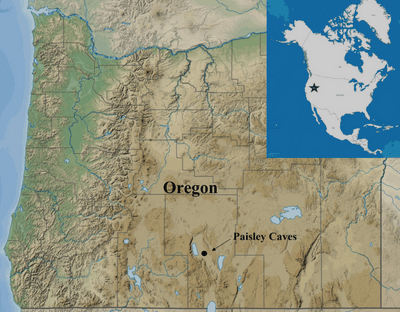
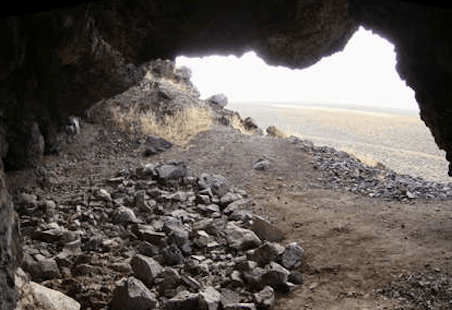
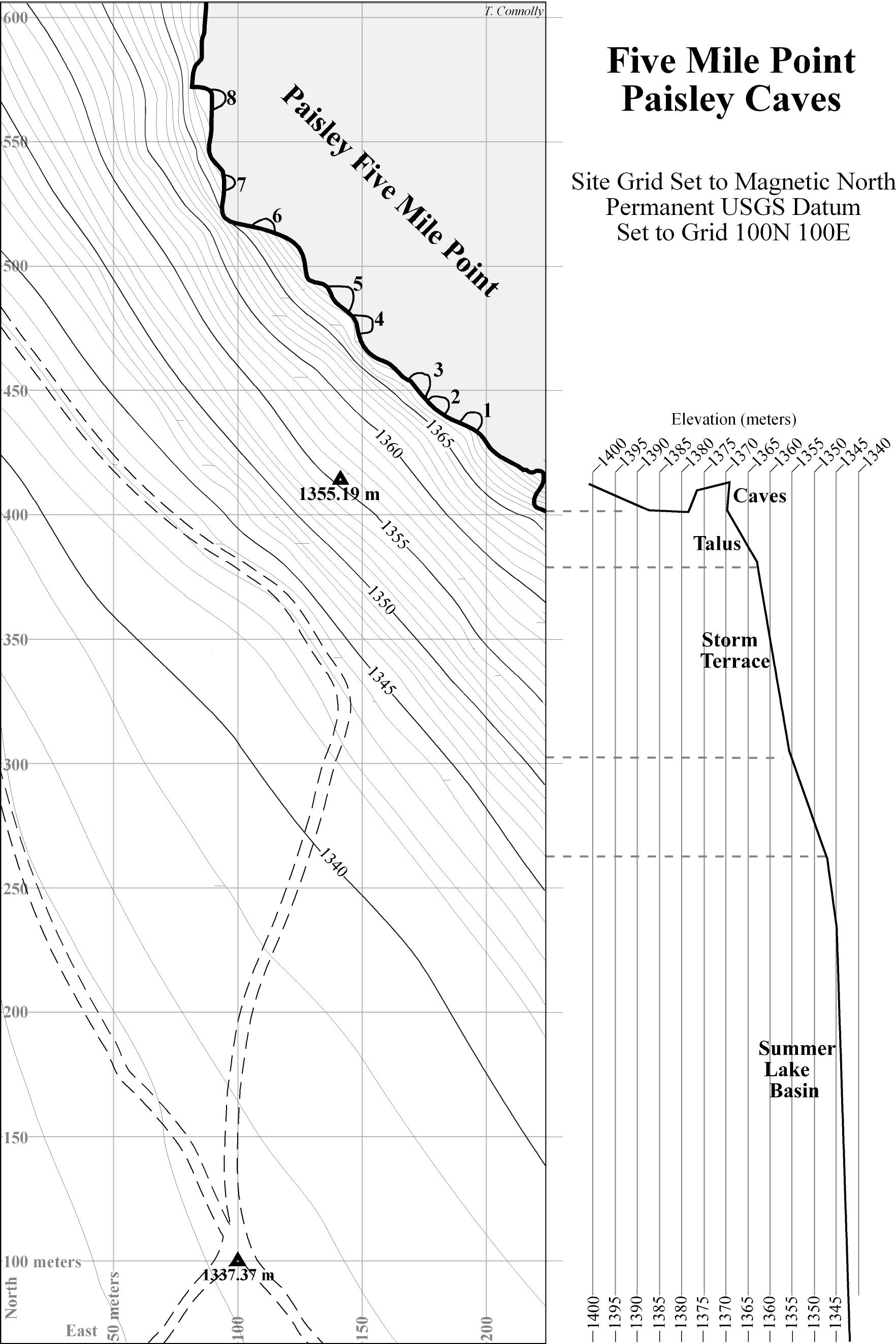
The caves are at 1380 meters or 4,520 feet. They face west and are located in an area known as the Summer Lake basin
Unlike Clovis sites, which are generally associated with specialized hunting tools like Clovis points, Paisley Caves contain artifacts dating back to around 14,300 years. That predates the traditional Clovis culture by more than 1,000 years. The site challenges the theory that the Clovis people were the first humans on the continent
Artifacts found in the caves bear little resemblance to traditional Clovis points. Instead are referred to as ‘Western Stemmed Tradition points’
‘Western stemmed tradition points’ are morphologically distinct from Clovis points. They have narrow bifaces, and shoulders. And, are thicker, with a more convex base. Instead of the longer prismatic blades of Clovis points. Its also believed they were flaked differently. Evidence of repeated sharpening suggests they may have also been used as knives for skinning and cutting. These different characteristics and techniques, help support the idea of a pre-Clovis human population.
Remains of extinct megafauna like bison, camels and horses were found
Early people at the caves likely interacted and probably hunted. Even though it is less obvious then with other clovis sites.
One of the most significant discoveries at the Paisley Caves, is the presence of ancient human fossilized feces, or coprolites
The coprolites were found in the same level as a small rock-lined hearth. 7 feet, or 2 m below the modern surface. They are radiocarbon dated to around 14,300 years ago. These are amongst the earliest direct evidence of human presence in north America. Also discovered at that level, was a large number of bones from waterfowl, fish, and the large mammals. Including extinct camels, horses, and bison. The human DNA analysis provided apparent genetic ties to Siberia or Asia.
Because of leaching, scientists have questioned the authenticity of the ancient DNA and stratigraphy evidence
Contamination by human DNA was found to have reached lower levels containing canid DNA. In addition to human DNA. Other inter-mixed coprolites contained no human DNA, and were megafaunas. While, some of the soil nearby feces contained human DNA.
Also, it is uncertain if damage to pre-Clovis animal bones was the result of human butchering, or animal trampling.
Did you know? a human-made bulrush shaft was found above a coprolite and dated to 12,270 years.
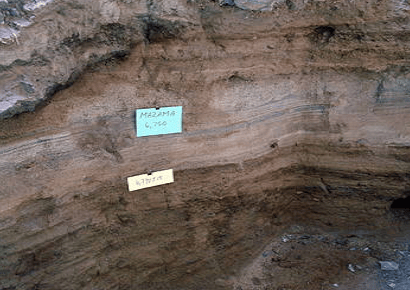
The Paisley Caves offers a unique glimpse into north America’s pre-Clovis cultures. Suggesting that people lived in the region before the traditional expansion. This site has reshaped our understanding of early human migration and settlements in the western hemisphere.
Bibliography: Davis, Loren G.; Nyers, Alex J.; Willis, Samuel C. (October 2014). “Context, Provenance and Technology of a Western Stemmed Tradition Artifact Cache from the Cooper’s Ferry Site, Idaho” (https://www.cambridge.org/core/product/identifier/S0002731600002262/type/journal_article). American Antiquity. 79 (4): 596–615. doi:10.7183/0002-7316.79.4.596 (https://doi.org/10.7183%2F0002-7316.79.4.596). ISSN 0002-7316 (https://search.worldcat.org/issn/0002-7316). S2CID 160027302 (https://api.semanticscholar.org/CorpusID:160027302).
Connolly, Thomas J. (n.d.). “Five Mile Point Paisley Caves” (https://cpb-us-e1.wpmucdn.com/blogs.uoregon.edu/dist/1/14870/files/2017/08/Paisley-sitemap-rev-2nrf396.jpg) (JPG). Museum of Natural and Cultural History.
Gilbert, M. Thomas P., Dennis L. Jenkins, et al. DNA from Pre-Clovis Human Coprolites in Oregon, North America (http://www.sciencemag.org/cgi/content/abstract/1154116), Science Express. 2008-04-03. Archived (https://web.archive.org/web/20080407052427/http://www.sciencemag.org/cgi/content/abstract/1154116) April 7, 2008, at the Wayback Machine
Shillito, Lisa-Marie; Whelton, Helen L.; Blong, John C.; Jenkins, Dennis L.; Connolly, Thomas J.; Bull, Ian D. (July 15, 2020). “Pre-Clovis occupation of the Americas identified by human fecal biomarkers in coprolites from Paisley Caves, Oregon” (https://www.ncbi.nlm.nih.gov/pmc/articles/PMC7363456). Science Advances. 6 (29): eaba6404. Bibcode:2020SciA….6.6404S (https://ui.ads
abs.harvard.edu/abs/2020SciA….6.6404S). doi:10.1126/sciadv.aba6404 (https://doi.org/10.1126%2Fsciadv.aba6404). PMC 7363456 (https://www.ncbi.nlm.nih.gov/pmc/articles/PMC7363456). PMID 32743069 (https://pubmed.ncbi.nlm.nih.gov/32743069)
Leave a Reply