Nympsfield long barrow is a neolithic chambered tomb located on the Cotswold escarpment in Gloucestershire
< home # store # services # articles # game # app #contact >
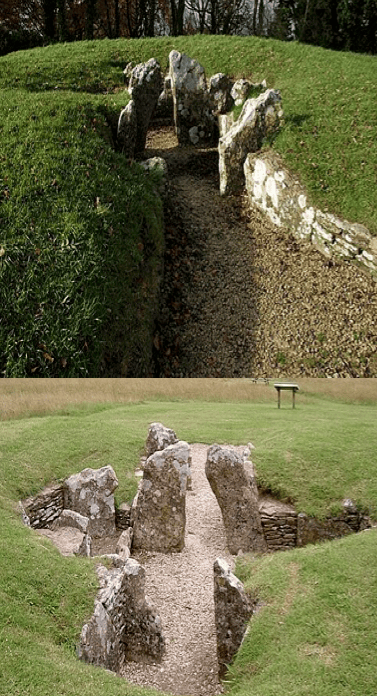
It is part of the Cotswold-Severn group of megalithic tombs, which were constructed by early farming communities around 4000–3000 BCE.
A trapezoidal mound, (now mostly eroded), originally about 27 meters long, and 18 meters wide
Three chambers feed off the entrance. Two on earch side of the middle, and one at the end. There are constricting stones to restrict acess. (1)(2)
The burial chambers, were made of large limestone slabs
Originally covered with a stone cairn and earthen mound, This is now mostly gone
The facade at the wider (eastern) end, served as the main ceremonial front
The long axis is oriented in a SE/NW direction. (3)
Excavated in the 19th century, when the remains of at least 13 individuals were discovered.
Other finds included human bones, animal remains, and some flint tools, but much was already disturbed by earlier robbing or erosion.
Like other long barrows, it suggests communal burial and may have had a ritual or ancestor-worship function.
Located within Coaley Peak, a public picnic site and viewpoint, near Uley Bury and Hetty Pegler’s Tump (another chambered tomb)
Managed by English Heritage; free to visit. NLB Offers dramatic views over the Severn Valley and is easily accessible to visitors.
Along with: Belas Knap, West Kennet Long Barrow, Uley Long Barrow (Hetty Pegler’s Tump) and others. Nympsfield long barrow is part of the rich neolithic landscape of the Cotswolds. Marking a shift to settled agricultural life, ancestor veneration, and a landscape marked by early farming and British societies. Check it out with some more neolithic architecture today!
Cite: 1) Darvill, T.; Stamper, P.; Timby, J. (2002). England: an Oxford archaeological guide to sites from earliest times to AD 1600 (https://archive.org/details/oxfordarchaeolog00timo). Oxford
archaeological guides. Oxford University Press(https://archive.org/details/oxfordarchae
olog00timo/page/296). ISBN 978-0-19-284101-8. Pg. 296
2) Castleden, R. (1992). Neolithic Britain: new stone age sites of England, Scotland, and Wales (https://books.google.com/books?id=-wYOAAAAQAAJ&pg=PA112). Routledge. ISBN 978-0-415-05845-2 Pg. 112
3) Lord Montagu of Beaulieu (1987). P. H. Reed (ed.). English Heritage. Hampstead Road,
London: English Heritage / Macdonald Queen Anne Press. ISBN 0-356-12773-7 Pg. 81
Bibliography: History and Research on Nympsfield barrow (https://www.english-heritage.org.uk/visit/places/nympsfield-long-barrow/)—English Heritage
Woodcock, R. (1998). A year of walks in the Cotswolds (https://books.google.com/books?id=nk
kH0rUbzRsC&pg=PA110). Sigma. p. 110. ISBN 978-1-85058-608-1.
Leave a Reply