< home # store # services # articles # game # app #contact >


Nevalı Çori is a neolithic site. Where houses had underfloor channels. In the Ataturk damn region. SE Turkey. It is no longer visible and underwater
Şanlıurfa Province, Southeastern Anatolia, Turkey. In the SE is one of the earliest, most significant neolithic archaeological sites. Strategically situated in a tributary of the Euphrates river. Around Kantara stream.
This settlement was located about 490 m above sea level. In the foothills of the Taurus Mountains
The site is known for having some of the world’s oldest known temples. And, the oldest domesticated einkorn wheat were found there. (1) It has helped revolutionize the scientific understanding of Eurasian neolithc period.
The site was examined from 1983 to 1991. Excavations were conducted by the the University of Heidelberg.
Together with other archaeological sites in the vicinity. Professor Harald Hauptmann (and, others) analyzed the stone, and other debris from the site. The research and discoveries have contributed to an emerging picture of the neolithic period.
The site was flooded by the damming of the Euphrates in 1993. (2)
In combination, with earlier sites like Göbekli Tepe. It included monumental architecture, and sculptures
Buildings here are found with underfloor channels.
There were five archaeological levels
Amazingly, found inside were remains of almost 10,000 year old rectangular long houses. Most of the dates correspond to pre-pottery neolithic B

Subdivided by wall projections. Each ‘long house’ contained two to three parallel flights of rooms, interpreted as mezzanines. These houses were big. Characterized by thick, multi-layered foundations. They are made, ground up. From large angular boulders and cobbles.
Gaps were filled with smaller stones. Allowing it to keep a relatively even surface. And, support for the structure
Found nearby were other rectangular structures too.
23 structures were excavated. With foundations interrupted every 1-1.5m, by underfloor channels
They could have served for drainage; or as, aeration, and to keep cool. There were channels which were covered in stone slabs but open to the sides. Serving as underwater channels.
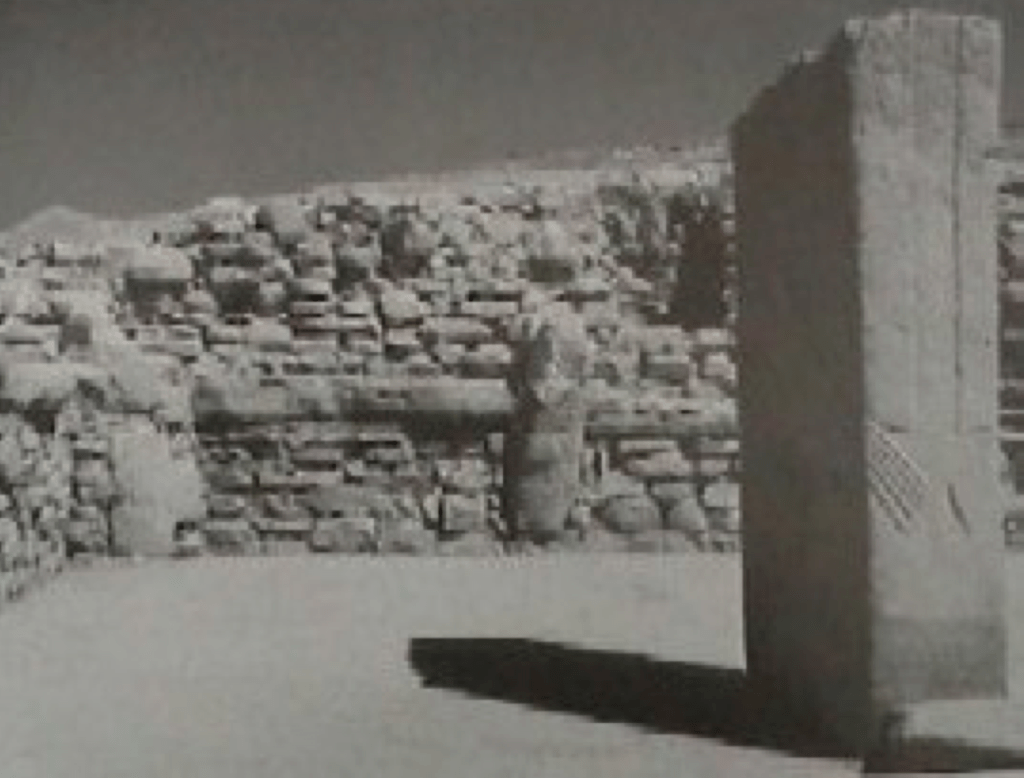
An area in the northwest part of the village appears to be of special importance. Here, a ‘cult complex’ had been cut into the hillside
Corners of the main ‘cult’ building are aligned leaving the temple facing almost exactly SW. The monoliths inside were orientated facing the Euphrates river. It had been suggesting this site. Was also orientated towards Giza, 1080 Km away.

The ‘cult’ complex has one of the oldest carved monoliths in the world
13 stone uprights are built into the walls. With an enormous monolith in the centre. Parallels are known from Cayönü and Göbekli Tepe . They all had terrazzo-style lime cement floors.

Numerous artifacts have been discovered at the site, including stone tools, pottery, and figurines. Some of these artifacts are decorated with intricate carvings and provide insights into the artistic and symbolic aspects of the neolithic culture.
Occurrence of narrow unretouched Byblos-type points places it on Oliver Aurenche’s Phase 3 i.e. early to middle Pre-Pottery Founded Neolithic B (PPNB)
Local limestone was carved into numerous statues and smaller sculptures. Including one of the pillars human hands. Various remains, including the monolith are now on display in the nearby ‘Urfa’ museum.

Several hundred, 5cm high, small clay figurines depicting humans were found
Fired at temperatures between 500-600 celsius. Before pottery proper, It suggests they had ceramic firing technology.
There is also a statue of a bird.

On a fragment of limestone bow, there is a picture of a couple humans, and a tortoise like creature dancing. (3) Perhaps enunciating the importance of feasts and rituals.
The sculpted head figure found here. Is claimed to have attachments to Indian Vedic priests

A bare human head with a snake, or sikha-like tuft was found. While researching the sculpture, author and scholar B. G. Sidhartha. Claimed it was the head of an Indian Vedic priest. Because such a hairstyle is dying, but still alive tradition in India today.
Farming and Agriculture
Analysis of the seeds discovered from the site shows that farming in the form of domesticated wheat was practiced at Nevali Cori. Early in the neolithic. The presence of domesticated plants, such as wheat and barley, and the raising of domesticated animals, including sheep and goats. All suggest that agriculture and animal husbandry were practiced for quite some time.
Burials
Of the buildings uncovered at Nevalı Çori. Inside many had shrines and the presence of decorated skulls. Adorned in head dresses of vulture feathers, suggest that the site was used for some sort of a ritual. Based on the sculpted figures, and carvings. Many which depict shamanic individuals. It may have been some sort of early neolithic religious temple.
Along with other nearby sites. Nevalı Çori will always shed light on the early history of human civilization . It continues to be of great interest to archaeologists and researchers studying the neolithic architecture and the neolithic period.
Cite: 1) Haldorsen, S.; et al. (2011). “The climate of the Younger Dryas as a boundary for Einkorn domestication”. Vegetation History and Archaeobotany. 20. 305.doi:10.1007/s00334-011-0291-5 (https://doi.org/10.1007%2Fs00334-011-0291-5). S2CID 128549516 (https://api.semanticscholar.org/CorpusID:128549516).
2) The Archaeological Settlements of Turkey – TAY Project (http://tayproject.org/TAYmaster.fm$Retrieve?YerlesmeNo=2064&html=masterengdetail.html&layout=web)
3) Oliver Dietrich; et al. (Aug 2012). “The role of cult and feasting in the emergence of Neolithic communities. New evidence from Göbekli Tepe, south-eastern Turkey” (https://www.cambridge.org/core/services/aop-cambridge-core/content/view/A1AA4FB20657599F8
59860D94CCD090E/S0003598X00047840a.pdf/role_of_cult_and_feasting_in_the_emergence_of_neolithic_communities_new_evidence_from_gobekli_tepe_southeastern_turkey.pdf)
(PDF). Antiquity. 86 (333): 674–695. doi:10.1017/S0003598X00047840 (https://doi.org/10.1017%2FS0003598X00047840). Figure 13.
Bibliography:
Hauptmann, H., Ein Kultgebäude in Nevalı Çori, in: M. Frangipane u.a. (Hrsg.), Between the Rivers and over the Mountains, Archaeologica Anatolica et Mesopotamica Alba Palmieri dedicata (Rome 1993)
E., Pelda (5 February 2021). “Mal û warê me, belaserê me!” (https://xwebun.org/mal-u-ware-me-bela-sere-me/). Xwebûn (in Kurdish)
Early Places Without Metals (http://www.tf.uni-kiel.de/matwis/amat/iss/kap_a/advanced/ta_1_2g.html)
B.G. Sidhartha. The Celestial Key to the Vedas. 1999. Inner Traditions Publ.
A. Collins. Gods of Eden. 1998. Headline book Publ.
Leave a Reply