<home # start here # guides # builds # services # shop # about # categories>

The site is situated in central Israels Judean Lowlands
About 30 km east off the Mediterranean coast, 20 km southeast of Tel Aviv. It is roughly 70 km northwest of Jerusalem. About 110 km west of Jericho and 85 km south of Hayonim Cave.
Unlike Upper Galilee sites, it occupies a narrow ecological corridor between the Mediterranean Coastal Plain and the Judean Hills
It is located within a natural karst sinkhole that trapped sediments and preserved archaeological remains remarkably well
The sites north-south section shows three stratigraphic units 6 meters or 20 feet deep.
It has been dated to Early Pre-Pottery Neolithic B (EPPNB)
8.5 to 8.3 thousand BC.
The Neolithic occupation appears to have lasted only a few centuries before the sinkhole filled naturally with sediments

One of the strengths of Nesher-Ramla is the excellent preservation of plant and animal remains
Studies indicate an environment of open grassland, patches of Mediterranean woodland, seasonal wetlands and nearby springs. Woodland probably included: Palestine oak, Pistachio (Pistacia palaestina), Terebinth, Wild almond, Wild fig, Hawthorn and Pear. The site’s paleoenvironment is considered broadly similar to today’s Mediterranean vegetation, although somewhat wetter during the early Holocene.
Botanical remains recovered from the site include cultivated cereals and wild plants. Evidence indicates use of emmer wheat, einkorn wheat and barley. Legumes probably included lentils, peas and bitter vetch. Wild foods likely included pistachios, almonds, figs and acorns. Unlike some older excavations, NRQN produced both botanical and wood remains, allowing direct environmental reconstruction.
Faunal remains indicate a mixed economy, sheep, and goats. While other animals included gazelle, deer, wild boar, hare and birds
Domestic livestock became increasingly important during this Early PPNB period.
Unlike large open villages like Jericho, the Neolithic occupation occurred around and within a natural sinkhole
Archaeological evidence includes domestic activity surfaces, hearths, stone-working areas, food preparation areas, combustion features and lime-plaster production.
Only limited structural remains survive, so complete house plans are not yet known. Researchers interpret the site as representing primarily domestic activities rather than a large permanent village.
An intriguing discovery is evidence for intense burning associated with possible lime-plaster production
Lime plaster was an important innovation of the Early PPNB and later became central to floors, walls, and mortuary practices throughout the Levant. Whether plaster production here had ritual as well as practical functions remains uncertain.
Unlike Sha’ar Hagolan, figurines are not a defining feature of this site.
Lithic assemblages include blades, projectile points, sickle blades, scrapers, burins and groundstone tools. Most flint is local.
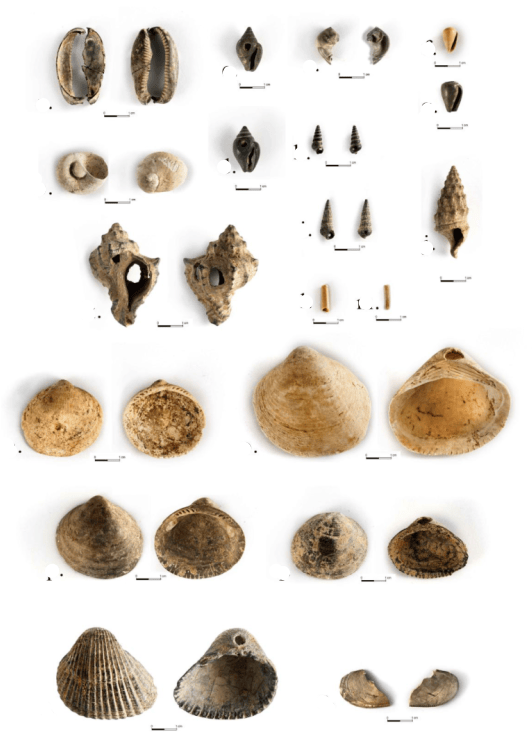
Marine shells and beads demonstrate exchange networks extending beyond the immediate area. Small quantities of obsidian have not been a major feature of the published assemblage.
Recovered tools include: projectile points, arrowheads, hunting blades and knives
These probably served both hunting and protection.
NRQN is a particularly important archaeological site. It preserves botanical, wood, faunal remains, shell beads; evidence for lime-plaster manufacture, and domestic refuse sealed within a sinkhole.
Together these finds provide an unusually detailed snapshot of daily life in the Judean lowlands during the Early PPNB.

References: Ullman, M., Brailovsky, L., Schechter, H. C., et al. (2022). The early Pre-Pottery Neolithic B site at Nesher-Ramla Quarry, Israel. Quaternary International, 624, 148–167.
Zaidner, Y., et al. (2014). “A series of Mousterian occupations in a new type of site: The Nesher Ramla karst depression, Israel.” Journal of Human Evolution, 66, 1–17. (Provides the geological and geomorphological context of the quarry.)
Tel Aviv University – Nesher-Ramla ProjectHebrew University research record for the NRQN publication
Bar-Yosef, O., & Belfer-Cohen, A. (1989). “The Origins of Sedentism and Farming Communities in the Levant.” Journal of World Prehistory, 3(4), 447–498.
Kuijt, I., & Goring-Morris, A. N. (2002). “Foraging, Farming, and Social Complexity in the Pre-Pottery Neolithic of the Southern Levant.” Journal of World Prehistory, 16(4), 361–440.
Leave a Reply