<home # start here # guides # builds # services # shop # about # categories>

Long before bronze chisels, iron saws, or steel hammers existed, early builders created homes, walls, temples, storage systems, roads, wells, towers, and monumental ceremonial architecture using stone, bone, wood, fiber, clay; and, human coordination alone.
The Neolithic period represents one of the greatest engineering transitions in human history. Communities moved from highly mobile hunter-gatherer lifestyles toward permanent settlements, agriculture, organized labor, and increasingly sophisticated construction techniques — all without metal tools.
Sites such as Göbekli Tepe, Çatalhöyük, Jericho, and the settlements of the Linear Pottery culture in Central Europe demonstrate that early builders possessed advanced practical knowledge of materials, geometry, leverage, timber construction, quarrying, plastering, and coordinated labor.
This article explores how Neolithic builders worked without metal and the technologies that made early architecture possible.

The Misconception of “Primitive” Technology
Modern people often assume metal defines technological advancement. But construction does not depend solely on metal tools. It depends on: Planning, Labor organization, Material knowledge, Mechanical understanding, Repetition and skill & Environmental adaptation. Neolithic societies compensated for the absence of metal through: Polished stone tools, Fire-assisted shaping, Abrasion techniques, Timber engineering, Rope systems, Collective labor & Incremental building methods. In many environments, these systems worked remarkably well for thousands of years.
The Main Materials Available to Early Builders
Before widespread metallurgy, builders relied on naturally available materials.
Stone. Used for: Axes, Adzes, Hammers, Chisels, Grinding tools, Structural walls & Foundations.
Wood. Used for: Roofs, Frames, Scaffolding, Levers, Rollers, Ladders, and Sledges.
Bone and Antler. Used for: Picks, Pressure flaking tools, Awls and Fine carving
Plant Fibers. Used for: Rope, Lashings & Basketry. And,
Binding materials included Clay and Earth. Which was used for: Mudbrick, Plaster, Mortar, Floors & Insulation.
Stone Tools Before Metal
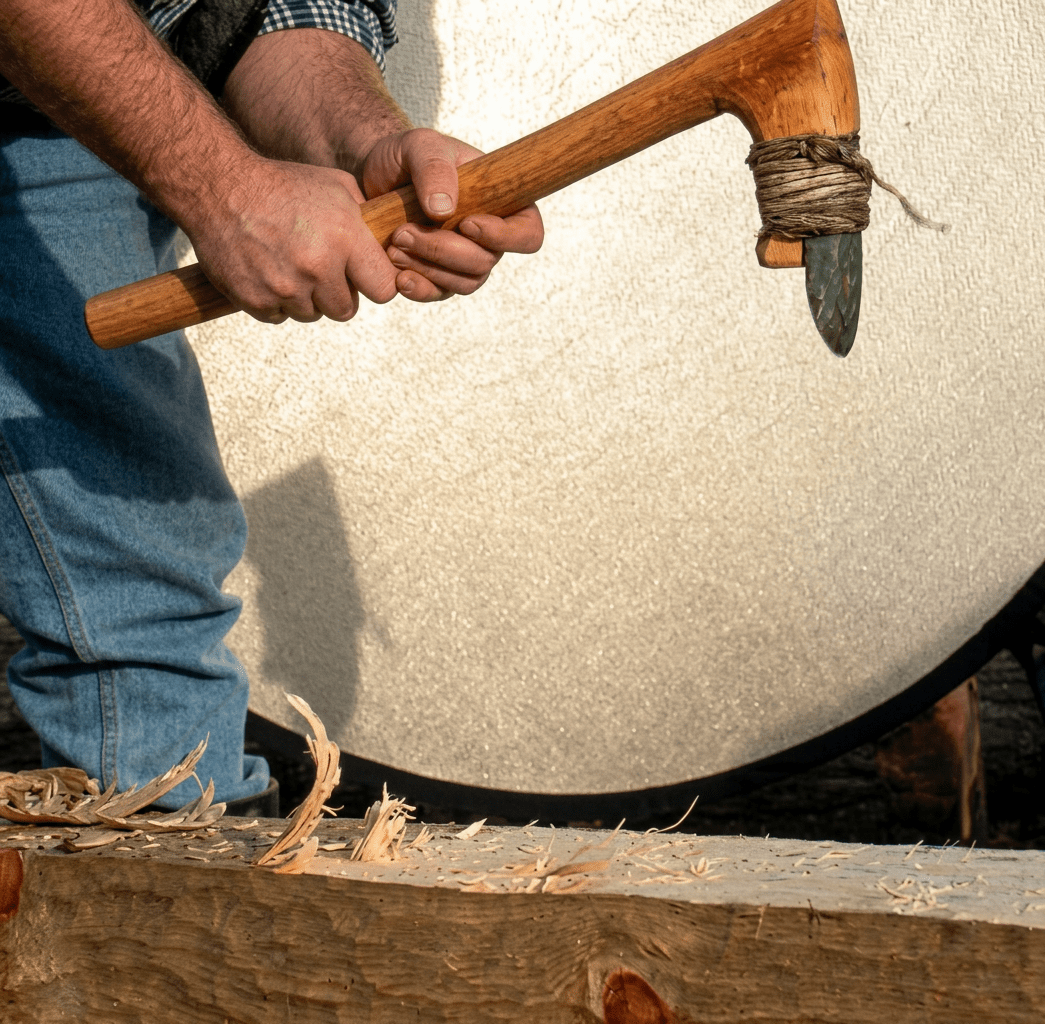
The most important technological breakthrough of the Neolithic was not metal — it was polished stone. Earlier Paleolithic tools were often flaked for cutting edges, but Neolithic communities developed grinding and polishing methods that created: Stronger cutting edges, Longer-lasting tools, Better woodworking capability, & More controlled shaping.
Important Stone Tools. Polished Axes. Used for: Felling trees, Splitting timber & Rough shaping;
Adzes: Adzes had blades mounted perpendicular to the handle and were essential for: Smoothing wood, Hollowing logs and Flattening beams;
Flint Blades. Used for: Fine cutting, Scraping, Trimming, & Harvesting;
Hammerstones. Used for: Quarrying, Breaking rock & Driving wedges. Experimental archaeology has shown that polished stone axes can successfully fell large trees, although far more slowly than steel tools.
How Trees Were Cut Without Metal
Chopping and Burning. One of the most effective prehistoric methods combined: Stone axe cutting, Controlled fire, Scraping charred wood away, and Repeated cycles. This reduced the amount of direct chopping required. Builders often targeted Softer interior wood, Existing cracks & Root transitions. Large trees could eventually be felled using patience and coordinated labor.
Timber Shaping Techniques
Once timber was harvested, builders shaped it using: Adzes, Scrapers, Abrasion stones, Fire hollowing & Wedges.
Common Techniques included: Splitting. Wood naturally splits along grain lines. Builders used: Wooden wedges, Antler wedges, Hammerstones & Scraping. They could also use sharp flint blades to smooth surfaces gradually.
Fire Hollowing. Controlled embers softened wood interiors for: Dugout canoes, Bowls, Storage vessels & Pegged Joinery. Wooden pegs and fiber lashings replaced nails. Even without metal, surprisingly accurate joints could be produced.
Quarrying Stone Without Metal Tools
Large stone construction existed thousands of years before iron tools. Quarrying Methods Included. Hammerstone Percussion. Repeated impacts weakened stone surfaces.
Wooden Wedges. Builders inserted dry wooden wedges into cracks, then soaked them with water. As the wood expanded, stone fractured naturally.
Fire and Water Fracturing. Heating stone followed by cooling created stress fractures.
Exploiting Natural Bedding Planes. Builders selected rock already weakened by geological layers.
Many early stone structures likely depended more on intelligent stone selection than brute-force carving.
Moving Heavy Stones Without Machines
One of the greatest mysteries for many modern observers is how Neolithic societies transported massive stones. Possible methods included: Wooden sledges, Rollers, Earthen ramps, Lubricated tracks, Rope pulling teams, Seasonal mud transport & Human coordination systems. Labor Was Technology. Hundreds of coordinated workers could accomplish extraordinary tasks using: Rhythm, Timing, Shared effort & Mechanical leverage. Simple machines such as: Levers, Inclined planes & Rollers. Greatly multiplied human strength. At Stonehenge and other megalithic sites, transportation likely combined several methods depending on terrain and stone size.

Rope, Fiber, and Binding Technologies
Rope was among the most important invisible technologies of prehistory. Early cordage may have been made from: Flax, Reed fibers, Tree bark, Animal sinew, Grass fibers & Hemp-like plants.
Rope enabled: Lifting, Dragging, Lashings, Roof construction, Scaffolding & Tool handles. Without strong cordage, large-scale architecture would have been far more difficult.
Building Walls Without Metal
Mudbrick Construction required: Clay-rich soil, Water, Straw or temper, Wooden molds & Sun drying. Builders stacked bricks using mud mortar. Advantages included: Thermal insulation.
Local availability & Low energy requirements. Large Neolithic settlements in the Near East heavily relied on earthen construction systems.
Wattle-and-Daub Systems
Flexible branches woven between posts created lightweight walls later coated with mud plaster. This method: Conserved timber, Reduced stone needs, Improved insulation & Allowed rapid construction. It remained common for thousands of years after the Neolithic.
Roofing Without Metal Fasteners
Roof systems likely used: Timber beams, Fiber lashings, Reed mats, Clay coverings & Thatch. Builders relied on: Compression, Interlocking geometry & Weight distribution. Rather than nails or screws. Flat roofs in dry climates often combined: Wooden beams, Brush layers & Packed mud surfaces
Plaster and Surface Technologies
Some Neolithic communities developed surprisingly advanced plaster systems. At sites like Çatalhöyük and Jericho, builders repeatedly replastered walls and floors using: Lime plaster Clay plaster & Ash mixtures. Producing lime plaster required controlled heating of limestone — a major technological achievement even before metal industries.
Measuring and Planning Without Modern Instruments
Early builders likely used: Body measurements, Rope lengths, Wooden measuring rods, Repeated proportions & Astronomical observation. Straight walls and aligned structures could be achieved through: Sight lines Peg-and-rope layouts & Repetition and experience. Many Neolithic settlements display sophisticated spatial organization despite lacking written mathematics.
Specialized Labor in the Neolithic
Construction increasingly required: Quarry workers, Timber cutters, Plaster makers, Tool makers, Rope makers, Transport teams & Skilled builders. It suggests growing social coordination and knowledge transfer. Some individuals may have functioned as early master builders or construction specialists.
Time Was a Major Construction Tool
Modern construction depends on speed. Neolithic construction depended on: Patience, Maintenance Seasonal cycles & Generational labor. Structures evolved gradually through: Repair, Expansion, Replastering & Rebuilding. Architecture was often a continuous community process rather than a single construction event.
Environmental Intelligence
Early builders understood: Local soils, Flood risks, Wind direction, Solar exposure, Timber species & Water access. This environmental awareness often produced buildings remarkably adapted to climate without modern engineering systems. Many traditional passive building principles used today have roots in prehistoric construction knowledge.

The Legacy of Pre-Metal Construction
The achievements of Neolithic builders challenge the assumption that advanced engineering requires industrial technology. Without iron, steel, engines, or powered machines, early communities developed Permanent settlements, Monumental architecture, Timber engineering, Quarrying systems, Long-distance transport methods, Plaster chemistry & Organized labor networks. Their technologies were slower, labor intensive, and deeply connected to local ecosystems — but they were highly effective within the environmental and social realities of their time. The story of early construction is not simply about survival. It is about experimentation, cooperation, adaptation, and the gradual development of human engineering long before the rise of metal civilization.
Recommended products
-

low tool high skills t-shirt
Price range: $60.00 through $70.00 -

na bold t-shirt
Price range: $60.00 through $70.00 -

sustainable building consulting
$2,000.00 -

log cabin shell
$20,000.00 -

experimental reconstruction products
-

jomon neolithic man women dig hole sticker
$4.00 -

course education service
$700.00 -

Pleistocene & megafauna coloring book
$2,500.00 -

f2j $450 long sleeve t-shirt
Price range: $80.00 through $90.00 -

button down shirt
Price range: $140.00 through $150.00 -

black peace button
$7.50 -

14 x 18″ canvas print
$30.00

Leave a Reply