<home # start here # guides # builds # services # shop # about # categories>
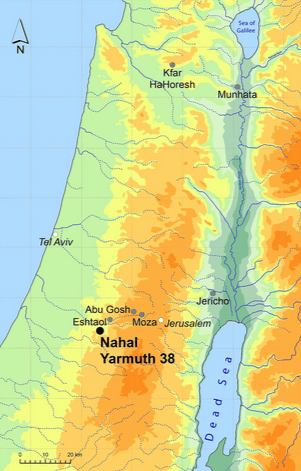
Nahal Yarmuth 38 is a small but exceptionally informative Middle Pre-Pottery Neolithic B (MPPNB) site in central Israel, near modern Beit Shemesh. Excavated in 2017–2018 by a joint Tel Aviv University–Israel Antiquities Authority team, the site covers only about 0.1–0.2 hectares, of which approximately 700 m² was excavated (Gopher et al. 2019). Its importance lies not in the size of the settlement but in its unusual combination of rectilinear lime-plastered buildings, intensive human burial activity, hunting, ground-stone technology, marine shells, ornaments and specialized flint production.
The site is now best understood as a designated PPNB burial place or mortuary complex, rather than a conventional residential village. At least 56 people were buried in association with the buildings, and many of the burials lay beneath carefully plastered floors (Eirikh-Rose et al. 2025). A 2026 bioarchaeological study further describes the population as a local, sedentary community with evidence for hunting and differentiated patterns of activity and labour (Makoviychuk et al. 2026).
That combination makes Nahal Yarmuth 38 particularly valuable for understanding an important Neolithic question: How did architecture begin to organize not only living, working and storing, but also memory, ancestry and the treatment of the dead?
Nahal Yarmuth 38 lies in central Israel, near Beit Shemesh, on the foothills of the Judean Mountains
34 km from the Mediterranean coast, near the modern town of Beit Shemesh and in the drainage system of Nahal Yarmuth. West of Jerusalem. The location places Nahal Yarmuth within the central Mediterranean zone of the southern Levant, rather than the hotter, more arid Jordan Rift Valley.
The site occupied a transitional landscape between Mediterranean woodland, open grassland, agricultural land, rocky hill country, and seasonal streams and valleys
The modern landscape has been heavily modified by agriculture, roads, towns and water management, so the Neolithic environment would have looked substantially different. During the early Holocene, the Levant was generally wetter than the present, although climate was highly variable from century to century.
For Nahal Yarmuth, the most important environmental characteristic was probably its position between the fertile Mediterranean lowlands and the Judean hill country. This gave inhabitants access to several ecological zones within relatively short distances: valley resources + woodland + grazing + wild game + cultivated/collectable plants + stone resources
Ecological diversity helps explain why hunting remained important even as Neolithic communities increasingly adopted agriculture and animal management.
The principal occupation is Middle Pre-Pottery Neolithic B (MPPNB)
The original 2019 report assigned it to the MPPNB on the basis of its architecture and lithic technology, while the more recent detailed publication confirms a PPNB layer lying directly on virgin soil or bedrock (Gopher et al. 2019; Eirikh-Rose et al. 2025).
The site also contains a later Pottery Neolithic occupation, attributed to the Lodian culture
Thus the archaeological sequence is: MPPNB → abandonment/hiatus to Pottery Neolithic Lodian occupation.
PPNB component dates to roughly the mid-10th millennium cal BP, while the later Pottery Neolithic occupation belongs to approximately the first third of the 8th millennium cal BP (Eirikh-Rose et al. 2025).
The 2026 skeletal study gives the PPNB occupation an approximate date of 9500 cal BP, while the later Pottery Neolithic layer is dated to approximately 7790–7690 cal BP (Makoviychuk et al. 2026).
In conventional BCE terms, the MPPNB occupation falls broadly in the 8th millennium BCE, although the exact calendar conversion depends on calibration

This is the site’s central archaeological mystery may have been that it was not a normal village
Nahal Yarmuth 38 is extraordinarily small, and its excavated area contains a very high concentration of burials. 2019 researchers therefore proposed that it may have been a designated burial site rather than a normal residential settlement (Gopher et al. 2019). It was several observations support that interpretation: at least 56 individuals were buried there; most were adults; burials were closely associated with the buildings; many were placed beneath plastered floors; fireplaces were scarce; refuse pits were absent or poorly represented; evidence for on-site flint production was limited; and the structures appear not to have supported substantial superstructures. (Gopher et al. 2019; Eirikh-Rose et al. 2025.)
This contrasts with large PPNB residential sites such as Jericho or Ain Ghazal, where archaeologists find much larger populations and extensive domestic refuse.

Architecture is remarkably regular.
Five PPNB structures were exposed, four sufficiently complete to reconstruct their plans. They were originally undivided square structures, approximately: 5 × 5 m to 6.5 × 6.5 m.
Their walls were: approximately 0.6–0.8 m thick; constructed of undressed stone; preserved in one to three courses; and, associated with carefully prepared lime-plastered floors. (Gopher et al. 2019.)
This is classic PPNB architectural technology: stone walls + prepared plaster floors + rectilinear geometry. The buildings were therefore substantially more engineered than simple shelters.
Plaster is one of the most technologically important materials of the PPNB
It requires, materials, heat, water, application and finishing (similar to modern concrete). The plaster floors at Nahal Yarmuth therefore represent considerably more than decoration. The dead were placed beneath those floors. That means the floor was simultaneously: a practical surface + architectural finish + memorial layer. The architecture literally incorporated ancestors into the building.
At least 56 individuals are associated with the PPNB structures (Eirikh-Rose et al. 2025)
Some graves contained multiple individuals.
One particularly striking burial contained two adults facing one another beneath the plaster floor of Structure III (Gopher et al. 2019). The arrangement suggests that the buildings may have been deliberately constructed around, above or in relation to the dead. This is fundamentally different from simply burying someone in a settlement’s rubbish area. The architecture appears to have created a permanent relationship between the living surface and the buried person.
Artifacts found include: sickle blades; grinding equipment; arrowheads; bone tools; pendants; ornaments; and , shells. But the quantity and distribution of domestic debris are limited. The absence of substantial fireplaces and refuse pits is particularly significant (Gopher et al. 2019). This suggests that people probably visited, worked and buried their dead at the site, but it may not have been a permanent village in the ordinary sense.
Wheat and barley
Nahal Yarmuth 38 has not yet produced the kind of large published archaeobotanical assemblage that would allow us to reconstruct its cereal economy confidently. The presence of a sickle does not by itself tell us whether its user harvested domesticated wheat, wild cereals, grasses or another plant.
A applies to Pistachio, almond, fig, fruit and nut trees. Presently insufficiently published to establish a detailed crop economy.
Animal evidence is much clearer
PPNB fauna includes: wild goat (Capra aegagrus), mountain gazelle (Gazella gazella), aurochs, wild boar, Persian fallow deer and red fox. (Gopher et al. 2019.) The dominance of wild goat and mountain gazelle is particularly significant. It suggests that hunting was an important component of the economy.
Hunting appears to have been extremely important
The assemblage contains: arrowheads; wild goat; mountain gazelle; aurochs; wild boar; and fallow deer. This is an important reminder that PPNB life was not simply “farmers replacing hunters.” The inhabitants were participating in the emerging agricultural economy while continuing to invest heavily in hunting technology.
The PPNB lithic assemblage suggests that Nahal Yarmuth 38 was participating in the wider southern Levantine PPNB technological sphere
The site is unusual because the excavated assemblage contains many tools but relatively few obvious matching cores, raising questions about where some of the blanks were produced and how they reached the site. (Ackerfeld et al.) It is potentially important evidence for specialized production, transport and use at a designated site. The site may not have been manufacturing everything it consumed.
Hundreds of shells were recovered. They represent several environments: terrestrial; freshwater; Mediterranean marine; and Red Sea sources
Mediterranean bivalves dominate the marine component, while gastropods and Red Sea shells are also present (Gopher et al. 2019). It is inland yet people had access to objects originating from coastal environments. Some shells were deliberately modified or incorporated into ornaments.
A small number of figurines were found
A particularly important discovery was a stone anthropomorphic figure (Gopher et al. 2019). It is one of the site’s most distinctive artefacts. The figure indicates that symbolic representation was part of the site’s material culture, even though Nahal Yarmuth 38 does not have anything approaching the large figurine assemblages from some other Neolithic settlements. Its presence alongside the unusual burial architecture is intriguing. It raises the possibility that the site was not simply a cemetery, but a place where people engaged in social and symbolic practices surrounding the dead.
Interestingly, the site produced a broken gaming board
This is one of the more unusual finds reported from the excavation. The discovery should nevertheless be treated cautiously because it is fragmentary and its precise use cannot be reconstructed with certainty. Nevertheless, it gives Nahal Yarmuth 38 a fascinating connection to the increasingly complex recreational and symbolic material culture of the Neolithic.
Bone tool assemblage also includes: bone points;, a spatula; bone beads; cylindrical bone beads; stone pendants; stone beads; and worked marine shells. (Gopher et al. 2019.) Some ornaments were associated with burials.
The buildings were: square + thick-walled + stone-built + lime-plastered. Typical dimensions were:
5 × 5 m to 6.5 × 6.5 m. The structures were originally undivided rather than containing the elaborate multi-room cellular plans seen at some later PPNB settlements.
It represents a very different architectural solution from: the large domestic compounds of Jericho; the cell-plan architecture of Çayönü; the special buildings of Göbekli Tepe; and, the multi-room structures of later PPNB villages. Its architecture was comparatively simple in plan, but highly invested in floor construction and burial practice.
The building could have functioned as a physical mechanism for: concealing the dead; preserving memory; maintaining ancestral connections; and separating the living surface from the burial below. Architecture was therefore not merely shelter. It became a technology for managing relationships between living people and their ancestors.
It was abandoned
A later Lodian culture occupation partially overlapped the earlier site. The later settlement was much smaller and structurally different. Recent research describes the Lodian phase as a small hamlet of approximately 500 m², centred on an oval stone-built structure with adjacent activity areas (Ackerfeld et al. 2025).
Nahal Yarmuth 38 is important because it challenges the assumption that Neolithic architecture was primarily about housing people. Here, architecture appears to have been used to organize: the dead + memory + identity + ritual + technology + landscape. The buildings were modest in size, but their floors were carefully constructed. The walls were substantial. The floors were plastered. People were buried beneath them. Marine shells arrived from distant environments. Hunters brought back wild goat and gazelle. Sickles indicate plant harvesting. Arrowheads indicate hunting. A stone anthropomorphic figure suggests symbolic representation. A broken gaming board points toward recreational or social activities. And a later Lodian hamlet demonstrates that the same location was subsequently used for a very different kind of settlement. The site therefore provides a remarkable archaeological lesson: Neolithic architecture was not simply the invention of the house. It was the invention of increasingly specialized places. At Nahal Yarmuth 38, one of those specialized places appears to have been a house-like building for maintaining relationships with the dead.

References: Gopher, A., Eirikh-Rose, A., Ashkenazi, H., Marco, E., May, H., Makoviychuk, Y., Sapir-Hen, L., Galmor, S., Schechter, H. C., Ackerfeld, D., Haklay, G., & Zutovski, K. (2019). Nahal Yarmuth 38: A new and unique Pre-Pottery Neolithic B site in central Israel. Antiquity, 93(371), e29. DOI: 10.15184/aqy.2019.162.
Eirikh-Rose, A., Zutovski, K., Ackerfeld, D., Asscher, Y., May, H., Makoviychuk, Y., Namdar, L., Gordover, Y., Sapir-Hen, L., Schechter, H. C., Ashkenazi, H., Lee, M. W., & Gopher, A. (2025). Nahal Yarmuth 38: A PPNB and PN Site in Central Israel. Palestine Exploration Quarterly. DOI: 10.1080/00310328.2025.2562700.
Makoviychuk, Y., Slon, V., Ackerfeld, D., Singh, P. P., Cohen, P., Gopher, A., & May, H. (2026). Reconstructing Lifeways and Social Differentiation in the Pre-Pottery Neolithic B Population of Nahal Yarmuth 38, Central Israel. American Journal of Biological Anthropology, 190(1), e70280.
Ackerfeld, D., Eirikh-Rose, A., Ashkenazi, H., Zutovski, K., & Gopher, A. Preliminary Analysis of the Lithic Assemblages of Nahal Yarmuth 38. In Tracking the Neolithic in the Near East: Lithic Perspectives on Its Origins, Development and Dispersals.
Ackerfeld, D., et al. (2025). A Flint Industry from the Pottery Neolithic Lodian Hamlet at Nahal Yarmuth 38, Central Israel. Lithic Technology, 50(3), 268–292.
Khalaily, H., & Marder, O. (2003). The Motza site and the PPNB of central Israel. Related regional PPNB evidence from Motza, Abu Gosh, Eshtaol and surrounding sites provides the broader archaeological context for Nahal Yarmuth 38.
Khalaily, H., et al. (2007). Studies of PPNB sites in central Israel, providing comparative evidence for the regional interaction sphere in which Nahal Yarmuth 38 participated.
Leave a Reply