< home # store # services # articles # game # app #contact >
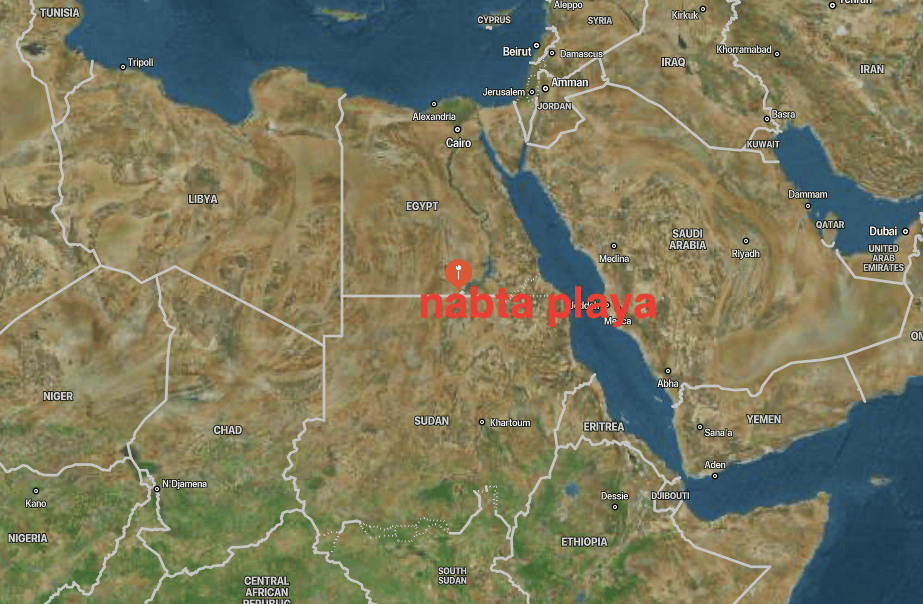
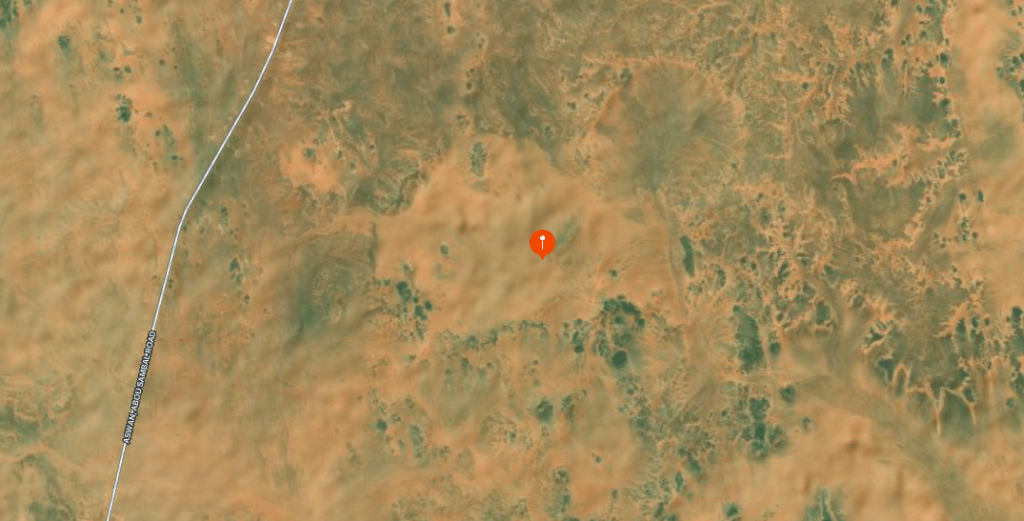
Nabta Playa is an ancient archaeological site located in the Nubian Desert of southern Egypt. It is known for its historical and cultural significance providing evidence of early human occupation. Including complex rituals, dating back to the neolithic time period.
It is located large endorheic basin, approximately 800 kilometers south of modern-day Cairo (1)
Although Nabta Playa currently lies within a dry and unforgiving desert, it was not always this way
Scientists have been able to determine that around 10,000 BC, a climatic change occurred. There was a northward shift of monsoons. It brought enough rainfall to fill a number of playas (or, dry lakes). (2) For at least several months of the year. And, that supported life for both plants; humans, and animals.
People who occupied this region at that time may have been early pastoralists, or like the Saami, semi-pastoralists. (2)
It could have been wild auroch that were gathered and hunted; or domesticated cattle introduced later, or something else. It remains a debate (3)
The Nabta Playa archaeological site, one of the earliest of the Egyptian Neolithic Period, is dated to circa 7500 BC (4)(5)
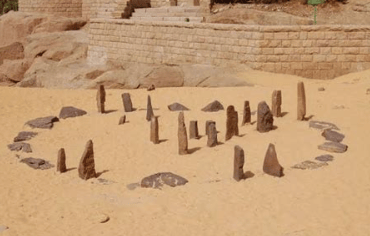
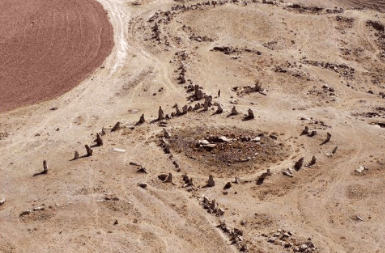
Currently, the area is more popular for its stone structures and megaliths. Which suggest that it was an important ceremonial and astronomical site
The most famous feature is a stone circle composed of large, upright stones, resembling a henge. This circle is often associated with astronomical observations, and celestial events. It is also suggested it was used for a calendar system. And, that it was possibly used by the ancient people to track seasons.
It suggests early and advanced study of astronomy and the natural world.
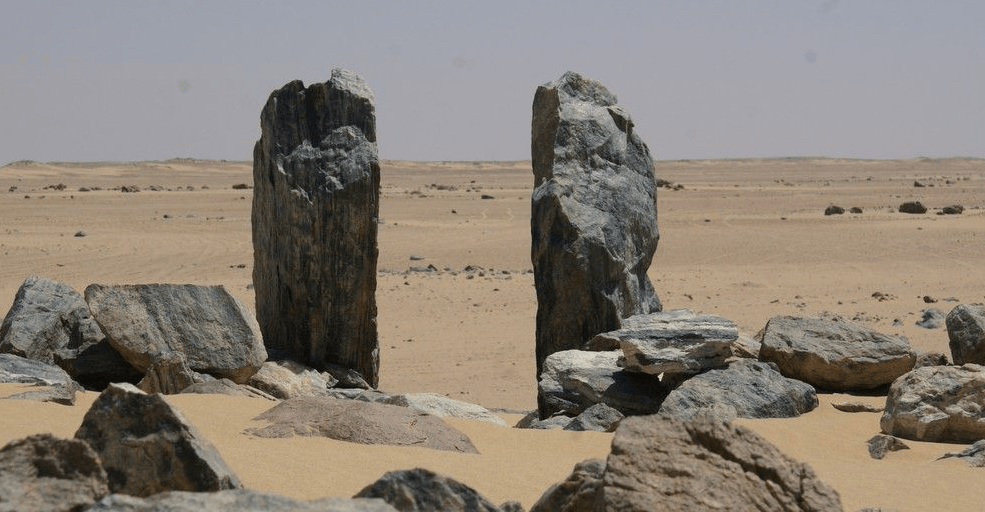
Around 9,000 years ago, the settlements became larger and more sophisticated
The people built huts with hearths, that were arranged in straight rows. (2) And, started to dig deep walk-in wells. (2) Enabling them to have a year-round water supply; stay warm, cook and be sanitized.
Sustenance included wild plants, such as legumes, millets, sorghum, tubers, and fruit. (2) Goats and sheep, apparently imported from Western Asia, begin to appear.[8] And correspondingly, many large hearths for cooking. (2)
They also had pottery
Originally having characteristics unlike pottery from surrounding regions. This type was followed by characteristics found only in the western desert. While later pottery, (from 5500 BC, or the Al Jerar phase), has similarities with pottery from the Sudanese region. (6)
Decorations included complex patterns, applied with a comb, in a rocking motion. (2)
Did you know? A mainly sub Saharan African affinity and origin has been detected here. Based on osteological and dental data. Their is also north African tendency, though less common. (7)(8)
The conditions provided the early necessitates for year round survival
From hunting, eating wild plants, and even domestication. The water supply, and diverse people.
Nabta Playa became a permanent settlement during this time. Not only was there evidence of domestication. There was also an establishment of an organized labor force
It was from this time on wards the region saw the arrival of a substantially more integrated, complex and advanced society.

It was also when most of the major megalithic structures were constructed. And, considered to be the height of human occupation.
Archaeological excavations included the structures, pottery; and, tools
They indicate the site was not only used for ceremonial purposes but was also inhabited by early agricultural communities.

Nabta Playa’s significance lies in its potential to provide insights into the development of early upper Egyptian societies. Not only in the region, but during the neolithic era. But within there corresponding cultures. And, with a astronomical and celestial observation role.
The site is still considered one of the oldest known, with megalithic structures. It has contributed greatly to our understanding of the prehistoric, and neolithic peoples, who lived in this part of Northern Africa, and beyond.
-
 neolithic packers 2 sticker$4.00
 -
 neolithic packers sticker$4.00
 -
 neolithic packers t-shirtPrice range: $60.00 through $70.00
Cite: 1) Slayman, Andrew L. (May 27, 1998). “Neolithic Skywatchers” (http://www.archaeology.org/online/news/nubia.html). Archaeological Institute of America.
2) Wendorf, Fred; Schild, Romuald (November 26, 2000). “Late Neolithic megalithic structures at Nabta Playa (Sahara), southwestern Egypt” (https://web.archive.org/web/20110806140123/http://www.comp-archaeology.org/WendorfSAA98.html). Comparative Archaeology Web. Archived from the original (http://www.comp-archaeology.org/WendorfSAA98.html)
3) Brass, Michael (2018). “Early North African Cattle Domestication and Its Ecological Setting: A Reassessment” (https://doi.org/10.1007%2Fs10963-017-9112-9). Journal of World Prehistory. 31: 81–115. doi:10.1007/s10963-017-9112-9 (https://doi.org/10.1007%2Fs10963-017 9112-9).
4) Margueron, Jean-Claude (2012). Le Proche-Orient et l’Égypte antiques (https://books.google.c
om/books?id=sju7HyZjbIoC&pg=PA380) (in French). Hachette Éducation. p. 380. ISBN 9782011400963.
5) Wendorf, Fred; Schild, Romuald (2013). Holocene Settlement of the Egyptian Sahara: Volume 1: The Archaeology of Nabta Playa (https://books.google.com/books?id=R0buBwAAQBAJ&pg=PA52). Springer Science & Business Media. pp. 51–53. ISBN 9781461506539.
6) Gatto, Maria (2002). “Early Neolithic Pottery of the Nabta-Kiseiba Area: Stylisitic Attributes and Regional Relationships”. Holocene settlement of the Egyptian Sahara, Volume 2: The pottery of Nabta Playa (https://www.academia.edu/401363). Plenum, New York. pp. 65–78.
7) Irish, Joel D. (2001). “Human Skeletal Remains from Three Nabta Playa Sites” (https://www.res earchgate.net/publication/232660407). Holocene Settlement of the Egyptian Sahara. pp. 521–
doi:10.1007/978-1-4615-0653-9_18 (https://doi.org/10.1007%2F978-1-4615-0653-9_18). ISBN 978-1-4613-5178-8 – via ResearchGate.
8) Holocene Settlement of the Egyptian Sahara: Volume 1: The Archaeology of Nabta Playa (http
s://books.google.com/booksid=R0buBwAAQBAJ&dq=Human+Skeletal+Remains+from+Three
+Nabta+Playa+Sites&pg=PA521), by By Fred Wendorf, Romuald Schild (chapter 18: Human Skeletal Remains from Three Nabta Playa Sites, by Joel D. Irish), p. 125-128, Kluwer Academic Publishers, 2003
Bibliography: Malville, J McKim; Schild, R.; Wendorf, F.; Brenmer, R (2007). “Astronomy of Nabta Playa”. African Skies/Cieux Africains. 11: 2. Bibcode:2007AfrSk..11….2M (https://ui.adsabs.harvard.edu/abs/2007AfrSk..11….2M).
Brophy, TG; Rosen PA (2005). “Satellite Imagery Measures of the Astronomically Aligned Megaliths at Nabta Playa” (https://web.archive.org/web/20080229170244/http://www.rhodes.aegean.gr/maa_journal/issues/past%20issues/volume%205%20no1%20june%202005/brophy.pdf) (PDF). Mediterranean Archaeology and Archaeometry. 5 (1): 15–24. Archived from theoriginal (http://www.rhodes.aegean.gr/maa_journal/issues/past%20issues/volume%205%20no1%20june%202005/brophy.pdf) (PDF)
Irish, Joel D. (2002). “The role of Neolithic peoples in northeast African prehistory: a biocultural perspective from Nabta Playa, Egypt” (https://www.researchgate.net/publication/298227748). American Journal of Physical Anthropology.
Leave a Reply