<home # start here # guides # builds # services # shop # about # categories>

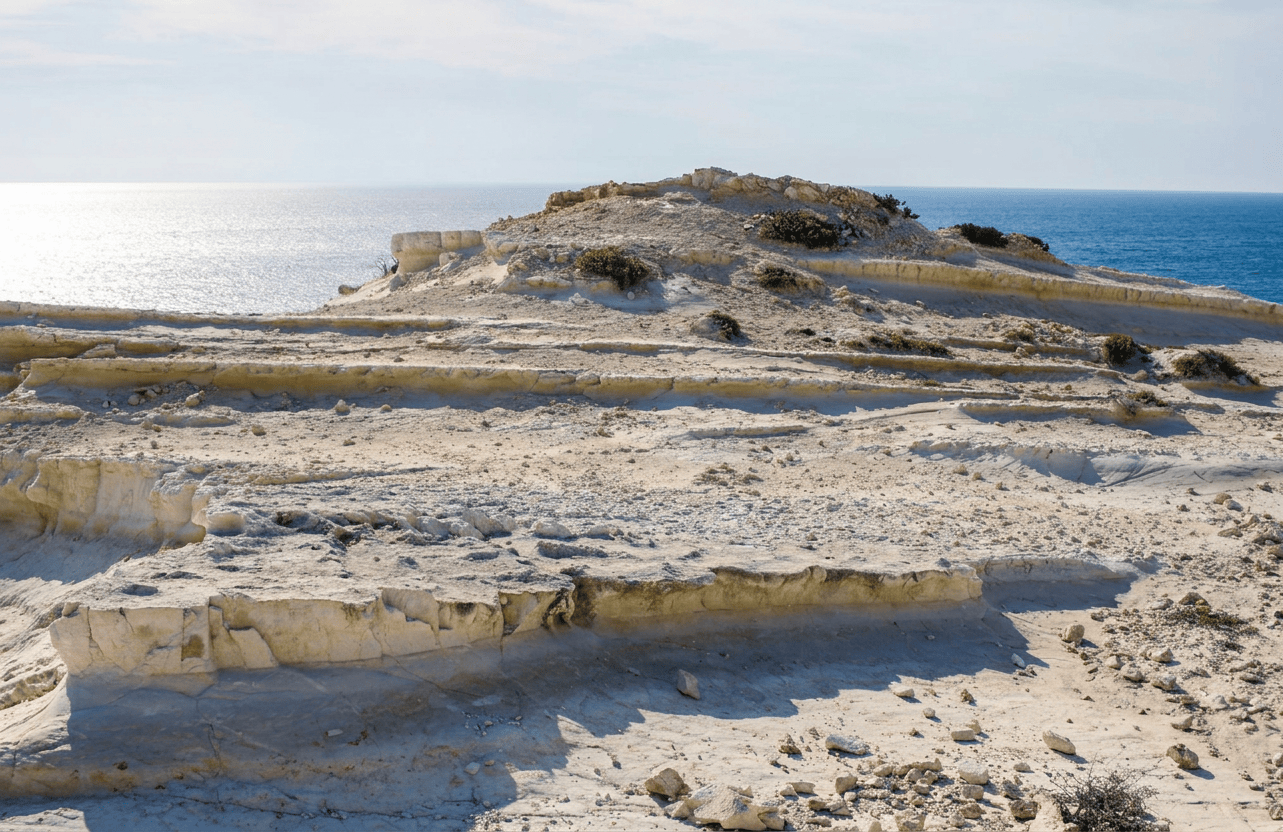
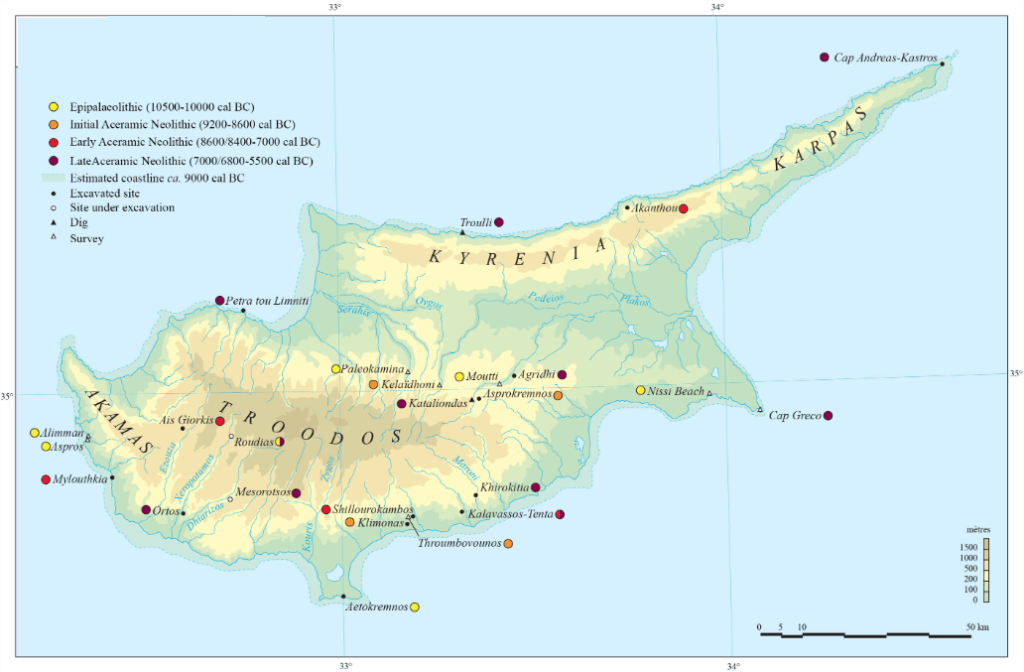
Long before the great stone villages of later Neolithic Cyprus, small groups of seafaring settlers crossed the eastern Mediterranean carrying seeds, animals, tools, and memories of mainland lifeways. On a limestone terrace near modern Paphos, they established Kissonerga–Mylouthkia, a settlement whose wells transformed our understanding of early island colonization.
Excavations revealed some of the oldest known water wells in the world, demonstrating that these pioneers possessed sophisticated environmental knowledge, and livlihood, and intended to live permanently on Cyprus. Rather than merely visit it seasonally (Peltenburg et al., 2000; Peltenburg, 2003; Knapp, 2013).
Features and significance (cypro ppnb, deep wells, imports, and maritime colonization)
Cypro-PPNB occupation
8300–7000 BCE; among the earliest farming communities on Cyprus.
Deep limestone wells
7–13 m deep; among the world’s earliest known wells.
Imported domesticates
Evidence for transported crops and herd animals from the mainland.
Maritime colonization
Strong proof of planned seafaring settlement, not accidental drift.
Architecture at the Water’s Edge
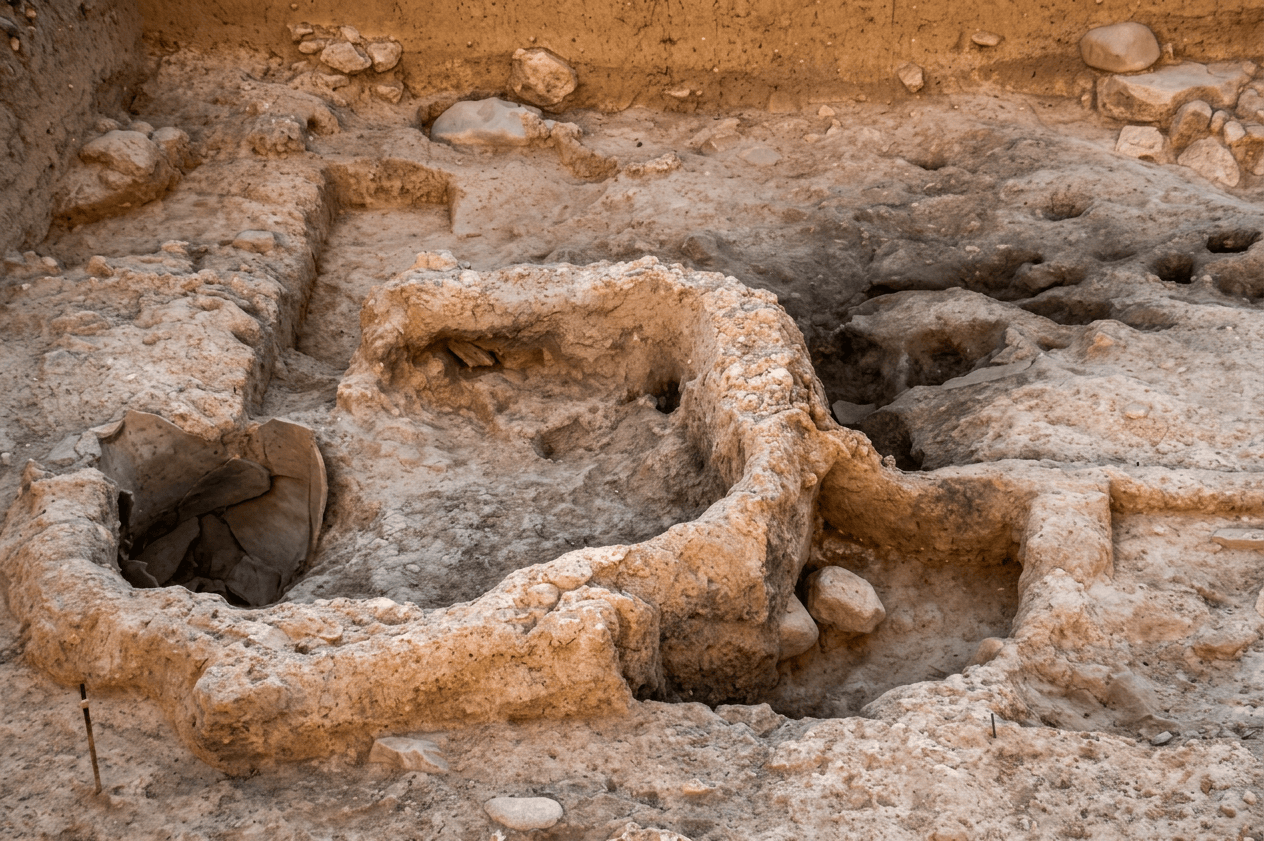
Unlike the dense agglomerations later seen at Khirokitia, the earliest occupation at Kissonerga–Mylouthkia consisted of light structures, pits, work areas, and ephemeral domestic spaces spread across the terrace. Archaeologists identified repeated rebuilding and continued use of the same locale over generations. Indicating growing permanence even before the emergence of more substantial, stone-founded houses elsewhere on the island. (Peltenburg, 2003; Knapp, 2013)
For architectural historians, the site is valuable precisely because it captures a transitional stage between mobile settlement and established village life. The community invested first in water infrastructure and landscape management, then gradually in longer-lasting domestic architecture.

The Wells: Engineering for Permanence
The discovery that made Kissonerga–Mylouthkia famous was a series of cylindrical wells cut directly into limestone and marl deposits. Some shafts were approximately one meter in diameter and reached depths of 7–8 meters, while later examples descended even farther to reliable groundwater. Their construction required planning, labor coordination, knowledge of local geology, and ongoing maintenance (Peltenburg et al., 2000; Peltenburg, 2003).
Architectural insight: before monumental walls or plazas
Settlers built a hidden infrastructure. The well was the settlement’s first enduring public work.
Farming Arrives by Sea
Cyprus lacked many of the domestic plants and animals that appear at early Neolithic sites. The most convincing explanation is that settlers transported crops, sheep, goats, cattle, and pigs across the sea from the mainland Near East. They brought with them a complete agro-pastoral economy. Kissonerga–Mylouthkia therefore represents not simply an isolated campsite, but part of a broader network of maritime colonization linking Cyprus with the Levant and Anatolia (Peltenburg et al., 2000; Knapp, 2013).
System Evidence at Kissonerga–Mylouthkia (water management, maritime mobility, food production and specialized continuity)
Water management
Deep, carefully excavated wells reaching groundwater.
Maritime mobility
Imported domesticates and mainland cultural parallels.
Food production
Early agro-pastoral economy adapted to island conditions.
Social continuity
Repeated occupation and rebuilding across centuries.
A Case Study for Neolithic Architecture
Kissonerga–Mylouthkia teaches a powerful lesson: infrastructure can precede monumentality. The earliest island farmers did not begin by constructing imposing villages. They first secured water, organized labor, maintained exchange networks, and adapted imported farming practices to a new environment. Architecture emerged from these interconnected systems of ecology, mobility, and cooperation.
Seen in this light, the site is more than a collection of wells. It is a record of people who deliberately crossed the sea, engineered a dependable water supply, and established one of the Mediterranean’s earliest enduring farming communities. Their achievements form a crucial chapter in the architectural history of settlement, demonstrating that the foundations of village life were often dug downward into the earth before they rose above it in stone and mudbrick. (Peltenburg, 2003; Knapp, 2013).
Check it out with some more neolithic architecture today!
References: Knapp, A. B. (2013). The Archaeology of Cyprus: From Earliest Prehistory through the Bronze Age. Cambridge University Press.
Peltenburg, E. (Ed.). (2003). The Colonisation and Settlement of Cyprus: Investigations at Kissonerga–Mylouthkia, 1976–1996. Paul Åströms Förlag.
Peltenburg, E., Colledge, S., Croft, P., & colleagues. (2000). Agro-pastoralist colonization of Cyprus in the 10th millennium BP. Antiquity, 74, 844–853.
Koutrafouri, V. (2017). Water management in prehistory: Research and heritage at Kissonerga–Mylouthkia. Public Archaeology, 16(4), 245–262.
Leave a Reply