< home # store # services # articles # game # app #contact >
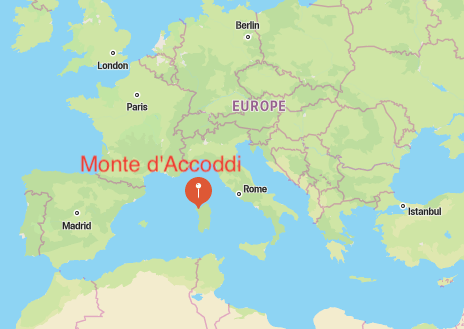
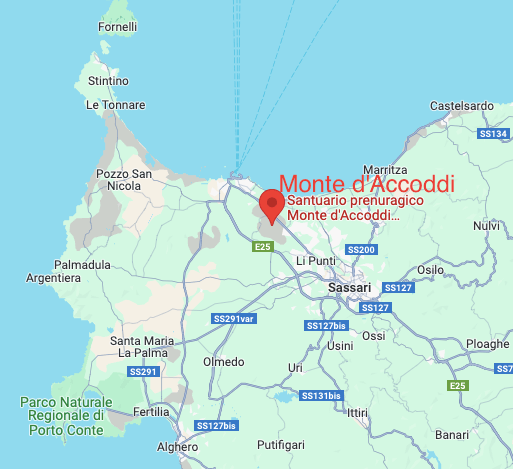
A mind expanding neolithic and chalcolithic archaeological site is located on the island of Sardinia. In Sassari, Italy
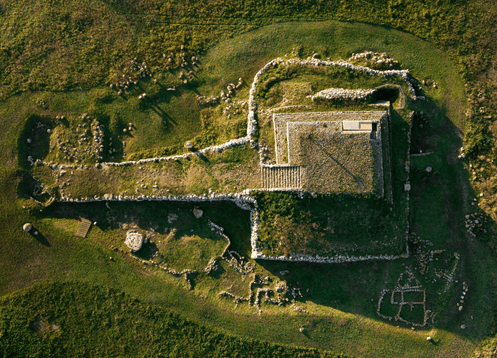
One of the most amazing monuments exist. It is distinctive for its combination of architectural features not commonly found together. The site consists of a massive raised stone platform, thought to have been an altar. A step pyramid consisting of ascending layers of earth and stone led up to it. The oldest parts dated to around 4,000–3,650 BC.
It is believed to be constructed by the Ozieri culture
It was surrounded by a complex of structures, including a circular hut and a rectangular building. These structures suggest that the site may have had multiple functions, possibly including residential or administrative purposes.

In a field, in 1954. The site was discovered by the Segni family
It had a base of 27 m by 27 meters. It probably reached a height of at least 10 or 15 feet. And, the first platform, was accessed via a ramp. That was about 12.5 m by 7.2 m.
There have been no chambers or entrances to the mound found
Believed to be an alter, temple or step pyramid. It could have also been for some sort of ritual or celebration. We can only assume. It may have also served observational function, as its square plan is co-ordinated with compass points.
Between 3500; and, 3000 BC. Earth and stone were used to cover the original structure
Large blocks of limestone were applied to establish a second platform. Making a larger 36×29 meter step pyramid. And, access ramp over the older one.
The second temple is similar to Mesopotamian ziggurats. And could have been attributed to a migration event, from the middle east, or similar neolithic expansion. As argued by G and M Webster. In 2017 and 2019. Based on the evidence of architecture, ritual deposits and diagnostic pottery. (1)
Chalcolithic archeological evidence. Indicate it was a site used for animal sacrifice
Known as one of the earliest and best preserved ritual and sacrificial sites. In equal amounts, remains of sheep, cattle, and swine were recovered. Providing insights to both neolithic and chalcolithic societies.
Bell beaker pottery also appears in large numbers after 2500 BC
Including hemispheric bowls, cups, tripods, and carenated bowls. Decorated with triangles, zigzags, and using the ‘pure maratime style’. The site appears to be abandoned around 700 years later. Perhaps due to illness, disease; lack of water, resource; or other.
There website is: I Beni Culturali della Sardegna Sassari, Tempio-altare di Monted’Accoddi
https://www.beniculturali.it/luogo/altare-prenuragico-di-monte-d-accoddi
In Italian.

In the south east corner. There is a dolmen. And across the ramp stands a menhir
There are also small foundations. Probably from houses. And, mysterious carving stones. Including the ‘carved egg boulder’. Cut through, with a suble curving three-dimensional line.
People probably lived, ate, worked, gathered, and there were functions here
Reconstruction during the 1980s
The public is welcome to visit the site. There is no public transportation though. And, opening times may change depending on the time of year.
The purpose and significance of Monte d’Accoddi remain subjects of debate among archaeologists. Some theories suggest that it may have been a religious or ritual center, while others propose that it had an economic or administrative function. Due to its unique design and the lack of clear parallels, it remains a fascinating and mysterious archaeological site that continues to be studied and explored by researchers seeking to unravel its secrets.


Citation: 1) G. Webster and M. Webster 2017. Punctuated Insularity. The Archaeology of 4th and 3rd millennium Sardinia, Oxford: BAR International Series 2871; Webster, G. 2019. “Identifying Monte D’Accoddi, Sardinia’s 4th-millennium ziggurat”, Sardinia, Corsica et Baleares Antiquae XVII, 39-59.
Bibliography:
“Monte D’Accoddi: where in Italy you’ll feel like you’re in Mesopotamia (https://www.203challenges.com/monte-daccoddi-where-in-italy-youll-feel-like-youre-in-mesopotamia)”
A. Sinclair & J. Bradbury; Megaliths and their Mysteries; 1979; pp. 109–112; ISBN 0-02-609730-3
Melis, Maria Grazia. “Monte d’Accoddi and the end of the Neolithic in Sardinia (Italy)” (https://www.researchgate.net/publicatMelis, Maria Grazia. “Monte d’Accoddi and the end of the Neolithic in Sardinia (Italy)” (https://www.researchgate.netpublication/272651018_Monte_d%27Accoddi_and_the_end_of_the_Neolithic_in_Sardinia_Italy). Documenta Praehistorica. 38 (207).
Leave a Reply