< home # store # services # articles # game # app #contact >

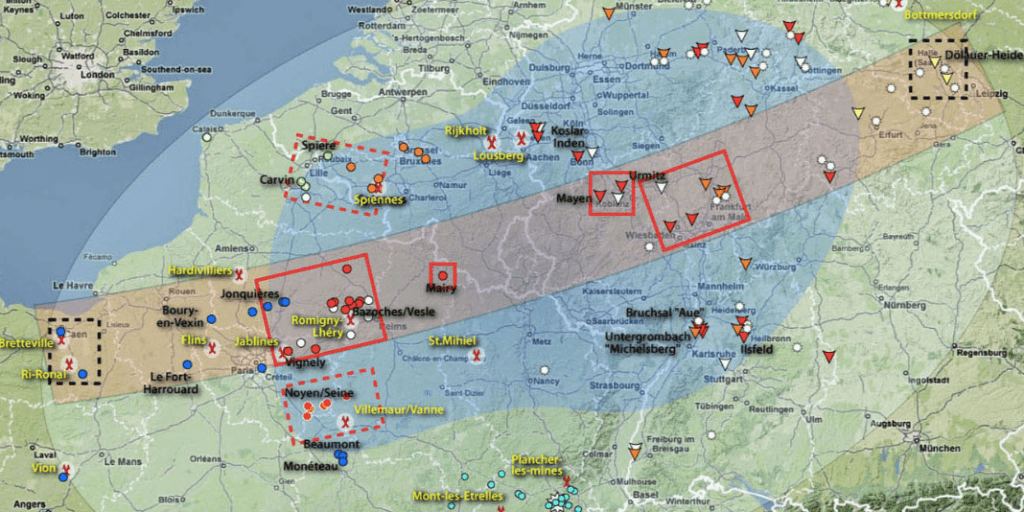
A hill near Untergrombach, Germany, belongs to entitling central Europe’s late neolithic period. Michelsberg culture (4400 to 3500bc) is characterized by undecorated pointy based tulip beakers
The entire area, covers much of west central Europe, along both sides of the Rhine. Scientists have identified Michelsberg culture, and its chronology based on pottery, and other neolithic elements.

Important sites include
Kapellenberg
Schierstein
Heilbronn-Klingenberg
Urmitz
Ilsfeld
Bruchsal-Aue
In north eastern France around 4400 BC (1)(2)(3), a new culture emerged
Based on human DNA, there tools, and craft. Evidence suggests that peoples here originated via a migration route from the Paris basin (1). Mediterranean farmers from the southwest, and linear pottery culture of central Europe (3)
Michelsberg culture expanded rapidly through central Germany, north eastern France, eastern Belgium and south western Netherlands.
The culture has strong affinities to the Chasseen culture of central France, and it has been suggested there expansion was not that pretty
Accompanied by violence, colonists from the Michelsberg culture strongly helped establish funnel beaker culture of northern Europe, and brought agriculture to southern Scandanavia (4)(5).
It could have also be said the Michelsberg culture displayed affinities to neolithic England too
Because the spread of agriculture has been identified as happening about the same time.
One of Michelsbergs largest fortified settlement of Kapellenberg has been analyzed. Being described as representing “the beginnings of urbanism” there in central Europe, already in 4000 BC (6)
German research agencies have identified numerous rectangular houses
There was jewelry, jade and stone tools; accompanies by a large tumulus (or, burial mound)
It was built right in the middle of the 26 hectare settlement. Because of all of this, ramparts were also built on the outside.
It’s suggested that the site had an influence from Brittany since Carnac and Saint-Michel were built around 4500 BC, and they both had megalithic tombs
And, judging by the numerous Jade axes and tools (from Italy); as well as, callaïs (variscite and turquoise) jewelry from Spain (7).
Elites, or the more sophisticated individuals begin trading in a network of goods
It included salt, and other commodities.
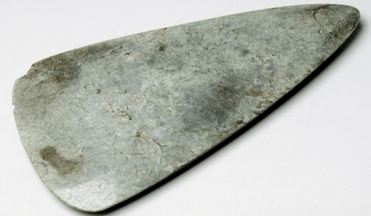
What is a Jade Axe? Jade is a very hard powerful stone. An axe would have been useful in the battle field; for status; construction; and, making and other tools.
Occasional finds, like at at the Heilbronn-Klingenberg site, do indicate the use of copper
The settlement at Schierstein may have housed up to several thousand inhabitants (8)
Rising steeply almost 600 feet above the plain. The Michelsberg hill is about 4km southeast of the modern town of Bruchsal
As defined by the 3 steep slopes on almost all sides. It is a protected natural defense mechanism.
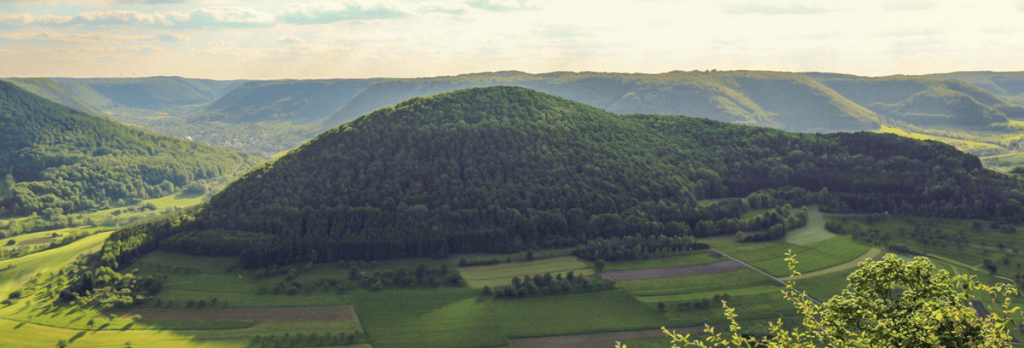
Formal archaeology on Michelsberg begin around 1884
Architecture consisted of daub covered wooden structures. All kinds of earthworks, pits, and a pathway was found on the east side of the site.
Suggesting an agricultural economy, barley and emmer were also discovered
Animal husbandry is indicated. There are bones of domesticated cattle, pig, sheep and goat.
Domestic dogs have also been identified
Even been bones of deer, fox and other animals were found. Suggesting hunting was an important element of Michelsberg culture.
Sparingly, there was no indication of a destructive end of the site; nor were there finds suggesting a violent end
Some of the earthworks and pits contained food reserves suggesting abandonment. It could have been due to environment, or something else. Drying up of the Rhines arms would have caused this. If there was less water available in the area. Like many other neolithic sites. Traveling, and/or dyking up would have become too burdensome. And, they would have went somewhere else.
Check out central Europe with some Michaelsberg culture, and more neolithic architecture today!

Cite: 1) Price, T. Douglas (2015). Ancient Scandinavia: An Archaeological History from the First Humans to the Vikings (https://books.google.com/books?id=dbC6BwAAQBAJ). Oxford University Press. ISBN 9780190231972 page 114.
2) Shennan, Stephen (2018). The First Farmers of Europe: An Evolutionary Perspective (https://books.google.com/books?id=4pheDwAAQBAJ). Cambridge World Archaeology.
Cambridge University Press. doi:10.1017/9781108386029 (https://doi.org/10.1017%
2F9781108386029). ISBN 9781108422925 pg. 142–146.
3) Shennan, Stephen (2018). The First Farmers of Europe: An Evolutionary Perspective (https://books.google.com/books?id=4pheDwAAQBAJ). Cambridge World Archaeology.
Cambridge University Press. doi:10.1017/9781108386029 (https://doi.org/10.1017%
2F9781108386029). ISBN 9781108422925 pg. 149.
4) Shennan, Stephen (2018). The First Farmers of Europe: An Evolutionary Perspective (https://books.google.com/books?id=4pheDwAAQBAJ). Cambridge World Archaeology.
Cambridge University Press. doi:10.1017/9781108386029 (https://doi.org/10.1017%
2F9781108386029). ISBN 9781108422925 pg. 142–146.
5) Shennan, Stephen (2018). The First Farmers of Europe: An Evolutionary Perspective (https://books.google.com/books?id=4pheDwAAQBAJ). Cambridge World Archaeology.
Cambridge University Press. doi:10.1017/9781108386029 (https://doi.org/10.1017%
2F9781108386029). ISBN 9781108422925 pg.183–184.
6) “Digital reconstruction of the Kappellenberg, c. 3700 BC” (https://web.rgzm.de/uploads/pics/Abb_1_RGZM_Kapellenberg_Visualisierung_Rekonstruktion.jpg).

7) Cassen, Serge (2019). “Real and ideal European maritime transfersalong the Atlantic coast
during the Neolithic” (https://www.academia.edu/54283882). Documenta Praehistorica. 46.
doi:10.4312/dp.46 (https://doi.org/10.4312%2Fdp.46)
8) “The onset of urbanisation in the Rhine-Main region 6000 years ago – the hilltop site of
Kapellenberg at Hofheim/Taunus” (https://web.rgzm.de/en/research/research-areas/a/article/anf
aenge-der-urbanisierung-im-rhein-main-gebiet-der-kapellenberg-bei-hofheim-am-taunus-vor-60
00-jah/). Romisch-Germanisches Zentralmuseum.
Bibliography: Shennan, Stephen (2018). The First Farmers of Europe: An Evolutionary Perspective. Cambridge World Archaeology. Cambridge University Press. doi:10.1017/9781108386029. ISBN9781108422925.
Jörg Biel, Helmut Schlichtherle, Michael Strobel u. Andrea Zeeb (ed.), Die Michelsberger Kultur und ihre Randgebiete – Probleme der Entstehung, Chronologie und des Siedlungswesens. Kolloquium Hemmenhofen 21.‒23. Februar 1997. Materialhefte zur Archäologie in Baden-Württemberg 43 (Stuttgart 1998).
Darvill, Timothy, ed. (2009). “Michelsberg Culture”. The Concise Oxford Dictionary of Archaeology (3 ed.). Oxford University Press. ISBN9780191727139.
Leave a Reply