<home # start here # guides # builds # services # shop # about # categories>
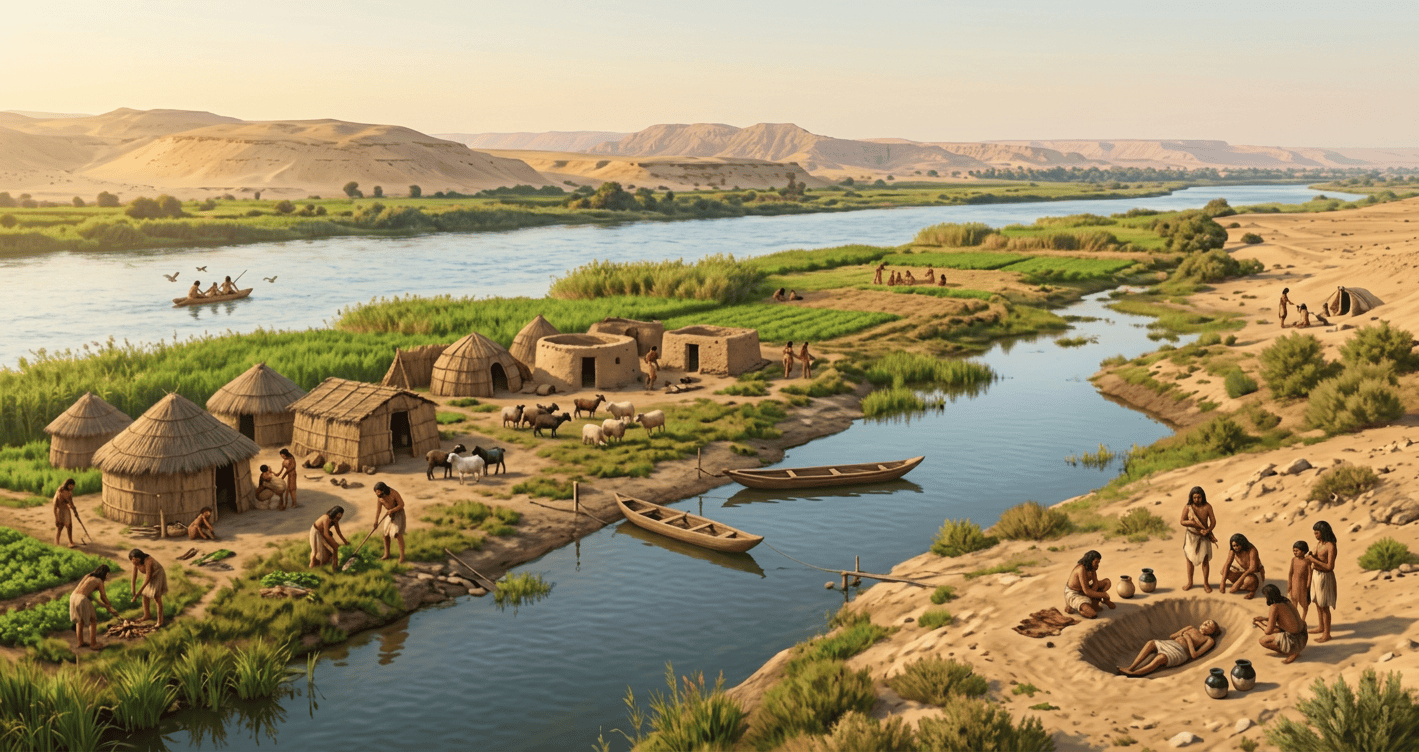
Merimde Beni Salama is one of the most important Neolithic sites in Egypt, and one of the places that makes the transition from mobile hunter-fisher communities to permanent farming villages unusually tangible.
It was not an Upper Egyptian site like Badari or Naqada. Merimde was in Lower Egypt, on the western edge of the Nile Delta, approximately 45–60 km northwest of modern Cairo. The settlement occupied a slightly elevated Pleistocene terrace beside the western Delta, about 2.5 km west of the Rosetta branch of the Nile. [1][2]
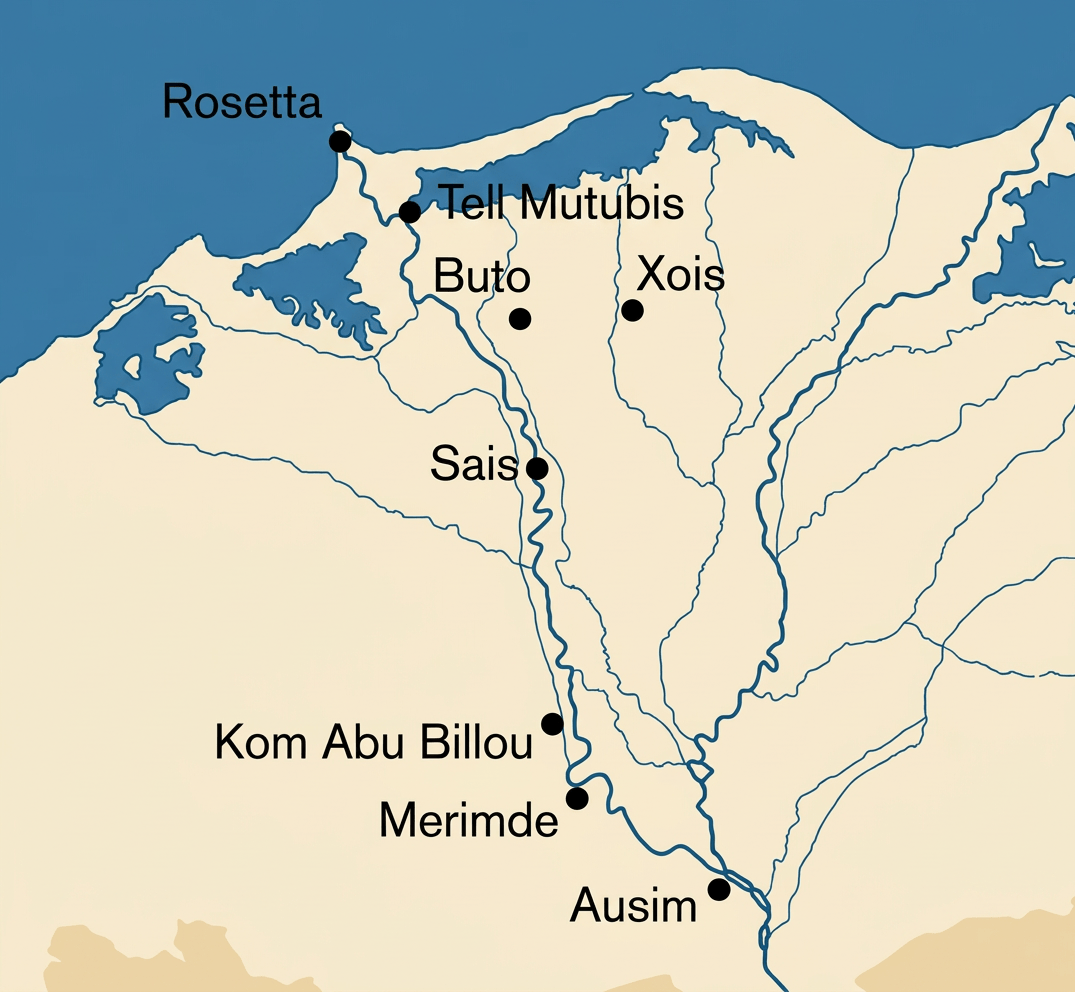
Its principal occupation dates roughly to 4900–4100 BC, with the earliest substantial phases around 4900–4700 BC. In other words, Merimde was flourishing about 6,900–6,100 years ago [3]
What makes it extraordinary is that archaeologists can watch a community become progressively more sedentary: light shelters to houses to storage to farming to livestock to organized village space to streets and household work areas.

The site lies on the western side of the Nile Delta, close to the boundary between the fertile Delta and the desert
It was associated with the Wadi el-Gamal terraces, an ancient landscape feature rather different from the sandy desert one might imagine when thinking of Egypt. The settlement itself was approximately 2.5 km from the Rosetta branch of the Nile. [1]
What Nile branch? The answer is important: the Rosetta branch
The modern Nile has two principal distributaries in the Delta. The Rosetta and Damietta branches. But the Delta has repeatedly rearranged itself. Channels migrated, filled, avulsed and were replaced. Its misleading to imagine that the river beside Merimde looked exactly like today’s Rosetta branch.
The archaeological site was positioned on higher ground overlooking a low-lying, water-rich Delta landscape
This was a sensible location: close to freshwater; high enough to reduce flood risk; near fertile soils; near wetlands and fishing; close to the desert edge; and, connected to the Nile transportation system. That combination may have been more important than simply being on the river.
Today Merimde is roughly 80–100 km from the Mediterranean coast, depending upon which point on the coast is used
But this should not be projected backward as an exact prehistoric distance. The northern Delta has experienced substantial: sea-level change; sediment accumulation; Nile-channel migration; lagoon formation; and coastal advance and retreat. The ancient landscape contained marshes, channels, flood basins and lagoons as well as the main Nile distributaries. The site was part of an enormous river–wetland–marsh ecosystem ultimately connected to the Mediterranean.
The western Delta’s geomorphology was complicated. Ancient channels could become abandoned while new channels developed elsewhere. Consequently, a settlement could remain only a few kilometres from a major Nile channel while smaller watercourses immediately around it changed considerably
An important reason archaeological coring and sediment studies are so important. The modern landscape hides the ancient waterways.
Simplified environmental timeline
Approx. date Environment
12,000 years ago Much of North Africa transitioning toward the African Humid Period;
10,000 years ago Much wetter Sahara; extensive grasslands, lakes and pastoral landscapes;
8,000 years ago Very humid conditions in much of North Africa;
7,000 years ago Humid period declining; Nile and Delta still highly productive
6,000–5,000 years ago Increasing aridity, but Delta remains a major wetland environment; and,
4,200 years ago Major widespread arid event; Merimde already disappearing
Pollen records from the Nile Delta show several episodes of declining Nile flow and increased aridity around 6000–5500, 5000 and 4200 calibrated years BP. These correspond to major regional climate disturbances. [4]
The famous 4.2-kiloyear arid event, however, happened after or near the end of Merimde’s occupation. It should not simply be blamed for the site’s abandonment.
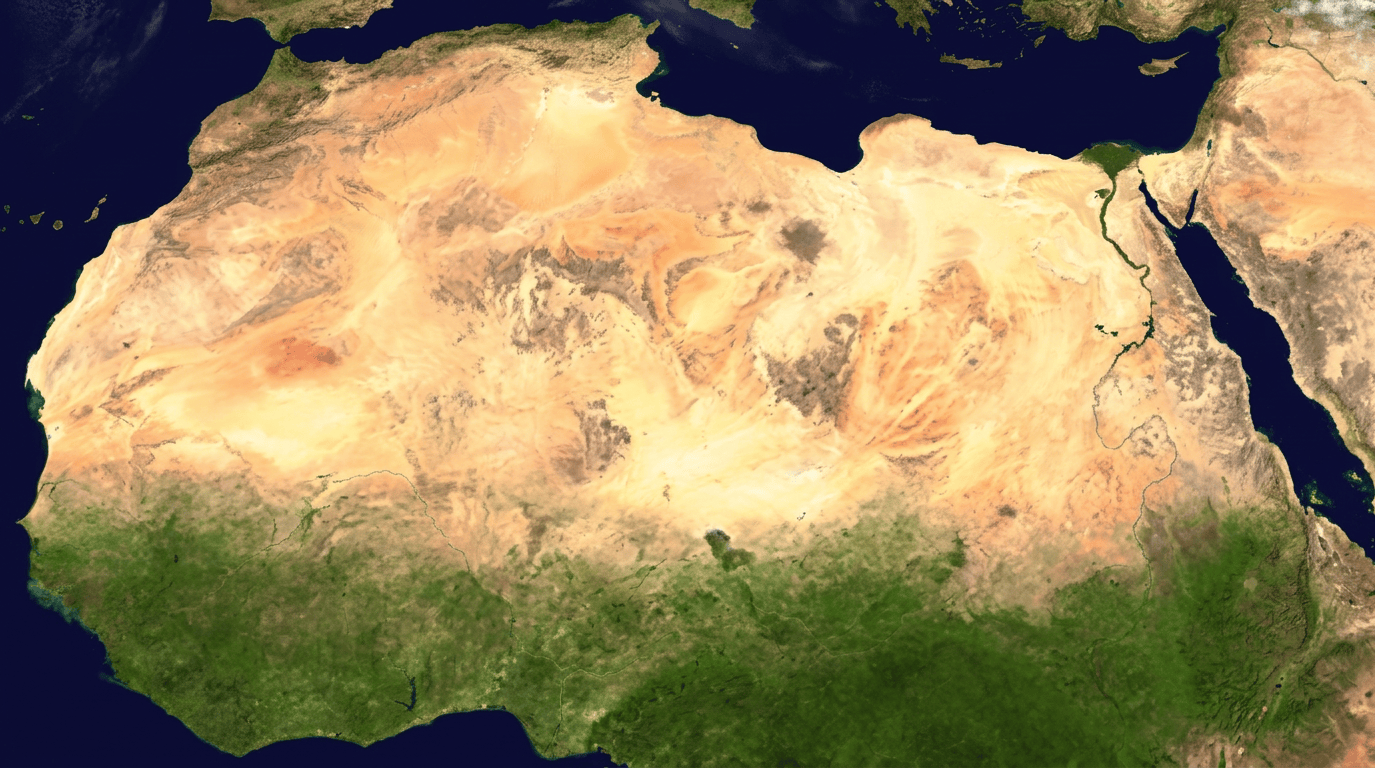
The environment probably looked like something much greener and wetter than modern Cairo’s surrounding landscape
Imagine: reed beds, grasses, shallow wetlands, floodplain, agricultural plots, patches of higher ground and desert beyond. The Delta was naturally much wetter than Upper Egypt. [5] There may have been trees and wooded patches, but we should not picture a dense tropical forest. The strongest evidence points toward a mixture of wetland vegetation, grasses, cultivated fields and scattered woody vegetation.
Was there anybody at Merimde 12,000 years ago?
The Merimde settlement belongs primarily to approximately 4900–4100 BC. However, the broader western Delta landscape was occupied much earlier. Archaeological surveys around the Wadi el-Gamal have identified Palaeolithic and Epipalaeolithic activity, meaning that the landscape had a human history long before the farming village appeared. [1]
How was Merimde discovered?
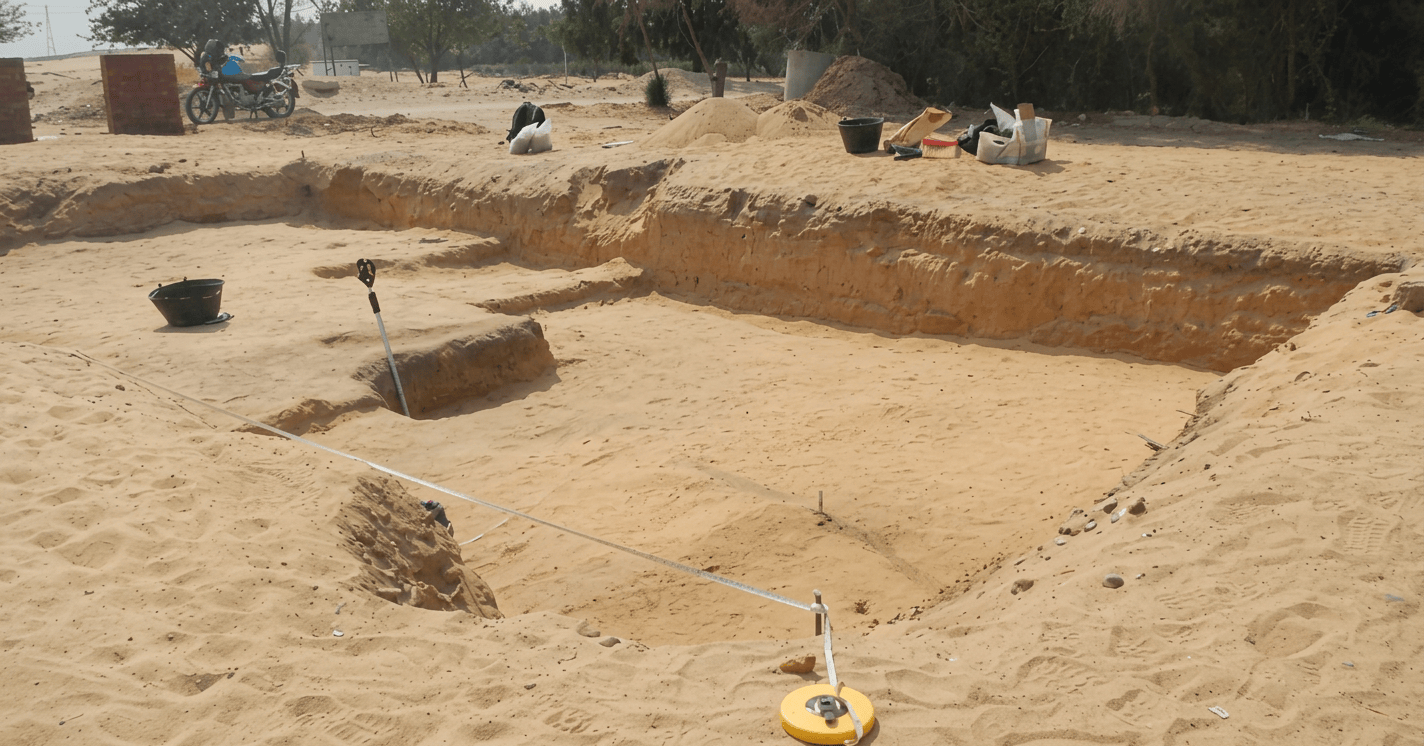
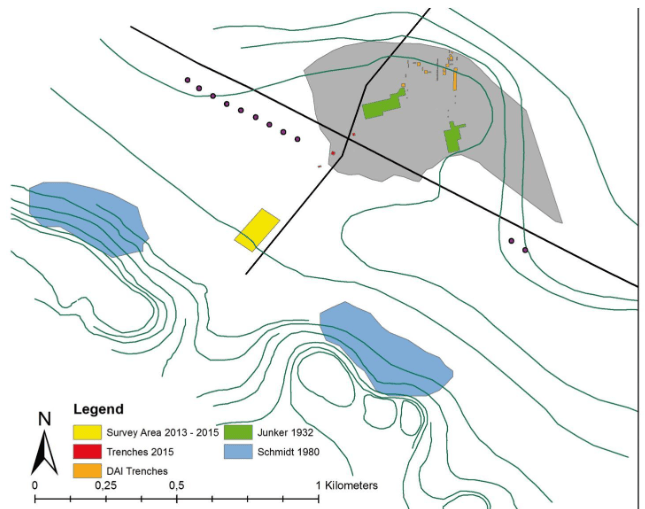
The site was identified during Hermann Junker’s West Delta Expedition in 1927–28. Junker subsequently excavated Merimde between approximately 1929 and 1939. Unfortunately, much of his original documentation was lost during the Second World War, which makes reconstructing the early excavations unusually difficult. [1][6] Later investigations included: Egyptian Antiquities Organisation work in 1976; excavations directed by Josef Eiwanger and the German Archaeological Institute, 1977–1982; and others.
The modern work is particularly interesting because archaeologists have discovered that the settlement was larger and spatially more complicated than earlier excavations suggested. [6][7]
One of Merimde’s greatest contributions to the history of architecture. Houses
There were several architectural phases, and the houses changed substantially through time. Phase I — light occupation. The earliest occupation appears relatively light. There were: postholes; shallow structures; hearths; and simple occupation surfaces. It may have resembled a seasonally or intermittently occupied settlement rather than the dense village that came later. [3]
Phase II — reed, wood and basket architecture. Architecture became more substantial. Archaeologists found evidence for: wooden elements; wicker/basketry; reed; oval structures; hearths; and storage installations. Some buildings were partly sunk into the ground. A genuine example of a hybrid architecture. Excavated earth, wooden framework, reed/wattle and mud/plaster. [8]
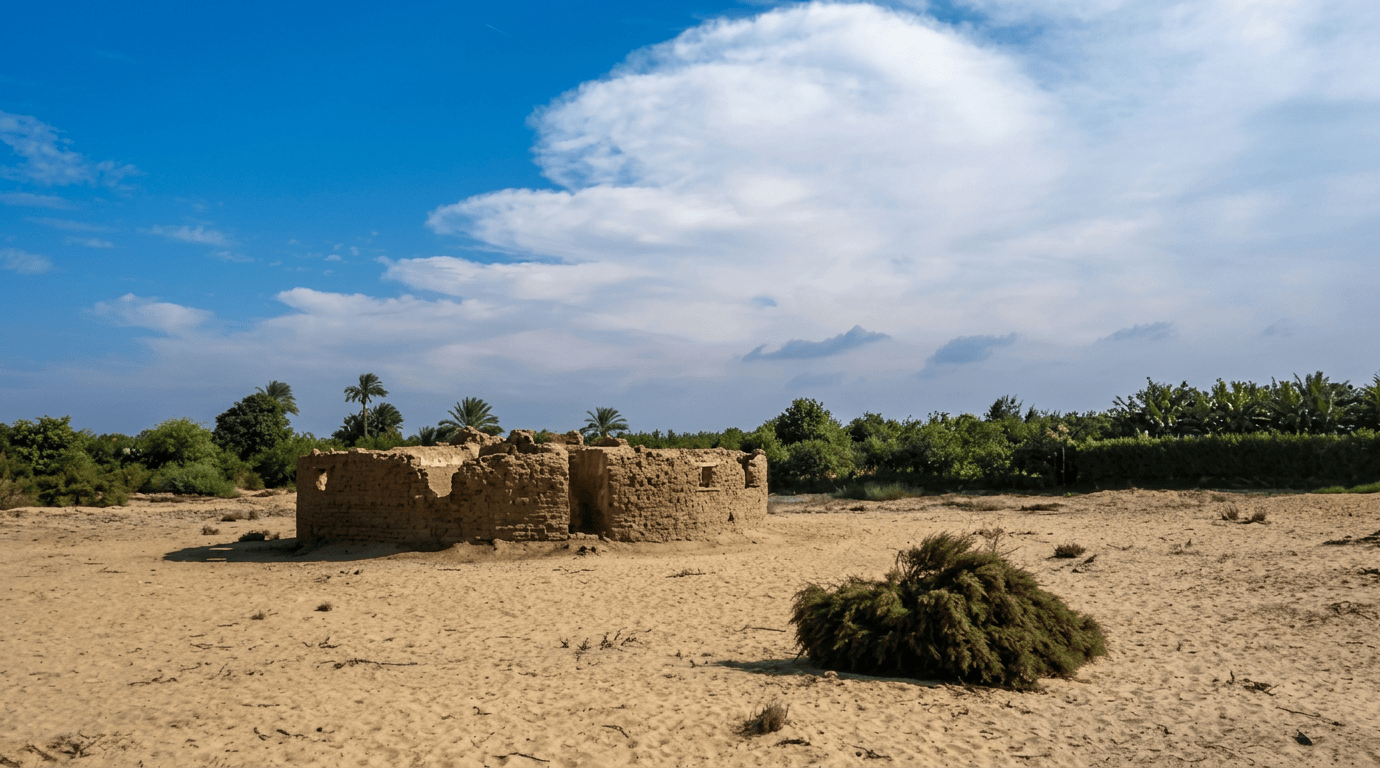
Phase III — the organized village. The later settlement became much more substantial. Buildings were generally: oval or elliptical; partly sunken; constructed using mud; reinforced with organic materials; roofed with branches/reeds; grouped closely together; and, associated with storage and working areas. Some reconstructions describe walls of mud/straw and reed structures, while other literature uses terms such as mud construction or mud-brick. The safest architectural interpretation is not a standardized rectangular mudbrick house like those of later Egypt, but small oval earth-and-organic buildings.
Subterranean architecture was important
The later Merimde houses could have floors sunk roughly 40 cm below the surrounding ground surface. A semi-subterranean or pit-house tradition. The excavated depression reduced the amount of wall that had to be constructed and may have provided advantages for: thermal stability; wind protection; structural stability; conserving building materials. The walls could then be constructed above the sunken floor using mud and organic material. This is remarkably close to architectural strategies found elsewhere in early village societies.
Yes to wattle and daub with important qualification
Organic construction is particularly significant at Merimde. Evidence includes: reeds; basketry; wooden elements; wickerwork; mud/plaster; and straw-tempered material. The classic small houses are therefore much closer to wattle-and-daub/reed-and-mud architecture than to the massive mudbrick architecture of later pharaonic Egypt. [2][8] An excellent example of building system requiring relatively few technologies. Wood, reed, mud, fibre, fire and stone tools.
Did they have stone buildings?
There is no major stone-built domestic architecture comparable with later Egyptian architecture. Stone was enormously important but primarily as a tool material, not as a wall-building material. A key distinction was that Merimde did not require stone architecture and was a perminant settlement.
There is no securely identified temple or monumental ceremonial building at Merimde
Instead, the settlement appears to have been organized around: households;
storage; food processing; craft activities; hearths; working areas; streets/pathways; and burial within the settlement. There may have been communal activities, but we cannot currently point to a Merimde equivalent of Göbekli Tepe’s monumental communal architecture. Merimde seems to show a different model: the village itself was the major social structure.
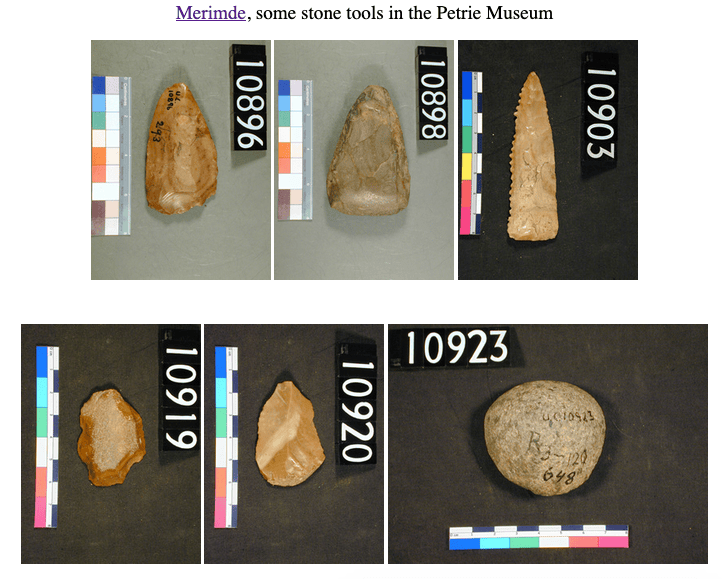
The later settlement provides evidence for specialized flint-working areas
The lithic industry changed through time, progressing from flake and blade technologies toward increasingly sophisticated bifacial technology. Tools included: sickle blades; axes; scrapers; borers/perforators; arrowheads; bifacial knives; grinding stones; and hand-mills. Specialized flint-processing areas are particularly significant because they suggest that certain activities were becoming spatially organized within the village. [9]

Hearths are well documented
They were important for: cooking; heating; processing materials; perhaps lighting; and social activity. Ovens and possible cooking installations, but don’t imagine later Egyptian bread ovens everywhere. The evidence does not justify reconstructing a village full of purpose-built enclosed ovens.
There is no convincing evidence for chimney technology comparable to other sites.
There is no convincing evidence for a standardized furniture industry. Like wooden chairs; beds; and tables
People could obviously have used: mats; baskets; hides; wooden objects; low platforms; and storage containers. But archaeologically, these are difficult to distinguish from ordinary household materials. A very useful principle for interpreting Neolithic houses is: The absence of preserved furniture does not mean the absence of furniture. Organic materials disappear extraordinarily easily in Nile Delta environments.
Storage was one of Merimde’s great architectural innovations
This may be even more important than the houses. Merimde contained: sunken storage pits; clay-lined installations; large baskets; storage jars; grain-storage facilities; and household-associated granaries. Some pits were lined with basketry or clay. This transforms the interpretation of the settlement. People were no longer simply arriving at the Nile, catching fish and leaving. They were building a system for: producing, processing, storing, protecting and consuming food. [6][8]
Merimde provides some of the earliest clear evidence for mixed farming in the Nile Delta
The crops securely associated with the settlement include. Cereals: emmer wheat, free-threshing wheat, hulled six-row barley; Pulses: lentils, peas; and, Fibre crops: flax. Vetches have also been reported in discussions of the plant assemblage. [3][10]
What about figs, pears and plums?
There is not good evidence that these were important cultivated crops at Merimde. Likewise, we should not automatically project later Egyptian fruit horticulture backward.
Olives?
No convincing evidence that olive cultivation was a major Merimde activity. The basic agricultural package was much simpler wheat, barley, legumes and flax. A remarkably effective Neolithic farming system.
Egypt’s later civilization is famous for irrigation
At Merimde, however, we should not imagine an elaborate canal-irrigation system. There is no convincing evidence that the inhabitants operated the massive engineered irrigation networks familiar from much later Egyptian history. Instead, agriculture probably benefited from: Nile flooding; naturally moist Delta soils; seasonal wetlands; rainfall; shallow groundwater; and nearby channels. The Nile itself was effectively the enormous water-management system. This is another important distinction: floodwater agriculture came before large-scale artificial irrigation engineering.
The animal economy was impressively mixed
Domestic animals included: cattle, sheep, goats, pigs and probably dogs. The proportions changed through the occupation.
Early Merimde had substantial sheep/goat representation, while cattle and pigs became increasingly important. In later levels, pigs could be particularly abundant. [11] Fascinating because Merimde was not a desert pastoralist camp. Pigs do well in wet environments with abundant plant food and water. Their presence alongside cattle and crops is another indication that Merimde belonged to a wet, productive Delta ecosystem.
Fishing was extremely important
Fish remains are abundant. Identified species include: Nile perch, tilapia, catfish and other Nile/floodplain fish. Fish made up a surprisingly large proportion of identified animal remains in some archaeological levels. [11] This gives us a much richer picture than: “early Egyptian farmers.” They were simultaneously farmers, herders, fishermen, hunters, gatherers and craftspeople.
Fauna evidence for wild animals includes: hippopotamus, aurochs, gazelle, hartebeest, birds, fish, freshwater molluscs and crocodile
Hippos are particularly interesting.Archaeologists have suggested that hunting them may not have been purely about meat. Hippos could damage agricultural fields, so hunting could have been partly a form of crop protection. [11] That is a wonderful example of how agriculture changes the meaning of hunting. A dangerous animal isn’t simply “wild food.” It can become: a pest, competitor and agricultural threat.
Freshwater molluscs occur, including freshwater snails and mussels. Land snails also occur, although some of the latter may be intrusive rather than food remains. [12]
Turtles
Aquatic reptiles certainly belonged to the broader Nile ecosystem, but turtle exploitation is not one of Merimde’s strongest defining archaeological signatures.
Crocodiles
Crocodile remains are documented in newer faunal work.
There is no strong evidence that mushrooms were an important Merimde food resource
That is another category where absence of evidence should not become an assertion of absence. Fungi generally preserve poorly unless exceptional conditions exist.
Was Merimde nomadic or agricultural?
By its mature phases, it was predominantly a sedentary agricultural village. But it was not purely agricultural. The best description is: sedentary mixed economy including: crop cultivation; livestock; fishing; hunting; gathering; and craft production. The earliest phase appears considerably more mobile/lightly occupied, while later phases show stronger investment in houses, storage and village organization. [3][6] That transition is one of the most important things Merimde tells us.
Burials are exceptionally interesting
Merimde did not initially have a separate monumental cemetery. People were buried inside the settlement. Bodies were commonly placed in a contracted/flexed position in oval pits, often without elaborate grave goods. [2] This is important because funerary architecture tells us how people conceptualized the relationship between: home, family ancestors and village. At Merimde, the dead apparently remained physically within the settlement rather than being separated into a monumental cemetery. That is very different from the elaborate funerary landscapes that would eventually dominate Egyptian civilization.
Ochre and other mineral pigments occur in Egyptian prehistoric contexts, but ochre-rich elaborate burial traditions are not the defining characteristic of Merimde. The Merimde burials are notable precisely because they are comparatively simple.
Textiles, fibre and baskets, Another area where Merimde is tremendously important
There is evidence for: basketry, reeds, woven/organic structures, fibre technology, flax, bone awls and objects associated with fastening or working fibre. Large basketry containers were used in storage installations. That means that basket-making was architectural technology, not merely household craft. A basket could become: bag, container, granary, wall component and/or structural element. This is one of the reasons Merimde belongs in any serious history of early sustainable architecture.
The Merimde toolkit demonstrates a transition in stone-working technology
Earlier technology: flakes; blades; scrapers; borers; axes; simple projectile points. And,
Later technology, increasingly sophisticated: bifacial tools; sickle inserts; polished-edge axes; arrowheads; specialized perforators; and flint-working areas. There were also: bone tools; ivory objects; shell objects; harpoons; grinding stones; and hand-mills.
Some tools were fitted into wood, bone or ivory handles. [9][13]
The stone tool was often only the cutting edge
The complete tool could be a composite technology. Flint, wood, fibre, bone/ivory; and, human skill.
Merimde was not technologically isolated
Objects include beads and ornaments made from materials such as: turquoise; agate; bloodstone/chalcedony-type materials; shell; ostrich eggshell; and ivory. There were also unusual stone objects, palettes and macehead fragments. [9] These materials suggest networks extending beyond the immediate village environment.
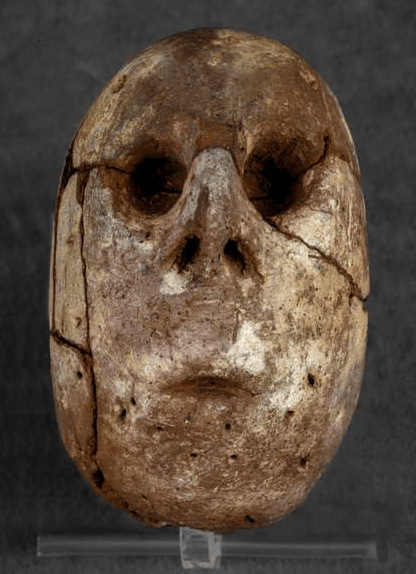
One of Merimde’s strangest discoveries: human images
Merimde produced some of the earliest known human representations from Egypt. Clay anthropomorphic figurines were found, including a particularly famous human head. The objects are extraordinarily valuable because they demonstrate that people in prehistoric Egypt were already experimenting with representing the human body thousands of years before the monumental sculpture of pharaonic Egypt. [9] The head has modeled facial features; eye sockets; nose; mouth; and traces suggesting additional surface treatment. It is one of those objects that makes Merimde immediately understandable to a general audience: Before the pyramids, Egyptians were already making human faces.
Clay boat models have been reported from Merimde
If correctly interpreted, they are fascinating because they suggest that boats were already part of the conceptual world of these communities. The Nile was therefore not merely water, fish and farmland. It was also transportation, communication and trade. Merimde is potentially one of the earliest pieces in the long Egyptian story of river transportation.
There is relatively little evidence for the enormous social differentiation characteristic of later Predynastic and Dynastic Egypt
The settlement appears comparatively household-based. Storage facilities associated with individual dwellings suggest that households could maintain their own economic resources. [1][6]
This does not mean everyone was equal. It means that we don’t yet see: palaces; elite tombs; monumental temples; royal residences; and/or enormous status monuments. Merimde is therefore an unusually good window into village-scale organization before the emergence of the Egyptian state.
Merimde is a Lower Egyptian Neolithic tradition
Unlike the Badarian tradition which belongs primarily to Upper Egypt, considerably farther south. Though partly contemporary, but they should not be treated as the same culture. Similarly, Merimde should not be casually called “Early Dynastic.” It belongs to the Neolithic / Predynastic world, centuries before the formation of the unified Egyptian state.
A potentially satisfying question on on can answer. Why did the people leave?
The occupation ends around the late 5th millennium/early 4th millennium BC. Possible factors include: changing Nile channels; changes in flood regime; environmental change; increasing aridity; changes in settlement organization; movement of populations; emergence of other regional centres; and changing economic networks. But there is no secure archaeological evidence saying “Merimde was abandoned because of drought X.” This is especially important because the major 4.2 ka drought event occurred considerably later than the principal Merimde occupation. The Delta itself was changing dynamically. Nile channels migrated and sediment accumulated, meaning that a settlement could lose its optimal relationship with water without the entire region becoming desert.
How do we reconstruct this site and climate?
We do not simply look at the houses and say “it was wet.” A better approach is tocombine multiple independent proxies: 1. Sediment cores. Scientists drill into the Delta and reconstruct: ancient channels; floodplain deposits; wetlands; river migration; and sea-level changes.
2. Pollen. Pollen tells us about vegetation. The Burullus Lagoon record, for example, preserves approximately 7,000 years of vegetation history. Changes in sedge-family pollen can be used as an indicator of Nile-flow changes. [4]
3. Charcoal. Microscopic charcoal can indicate changing fire regimes and environmental stress.
4. Animal bones. The animals themselves are environmental indicators. A landscape supporting: hippo, crocodile, fish, cattle and pig. Was very different from an arid desert landscape.
5. Seeds. Seeds reveal what people cultivated and what wild plants grew around them.
6. Archaeological architecture. Storage tells us that people expected to remain. House construction tells us how much labour they were willing to invest.
7. Radiocarbon dating. Radiocarbon establishes the sequence of occupation.
Together these techniques produce a much stronger reconstruction than any one source.
What happened at 10,000, 8,000 and 6,000 years ago?
For the wider Egyptian landscape 10,000 years ago (or 8000 BC). North Africa was entering/within the African Humid Period. The Sahara was dramatically greener than today, with: grasslands; lakes; wetlands; pastoral landscapes; and much greater surface water. Merimde itself was not yet the Neolithic village.
8,000 years ago (or, 6000 BC)
The humid period was still substantial, although its eventual decline was underway. The Nile system and Delta were experiencing major environmental changes.
6,000 years ago (or, 4000 BC)
Now we are approaching the world of Merimde’s final phases. North Africa was becoming substantially drier. Yet the Nile Delta remained an extraordinarily productive refuge.
The great lesson: the Sahara could dry while the Nile Delta remained green. The Nile concentrated water, nutrients, animals and people into a relatively narrow corridor.
A useful reconstruction of Merimde would look something like this
Picture a slightly elevated settlement; oval semi-sunken mud/reed houses; hearths and grinding stones; baskets and clay-lined grain stores; wheat and barley fields; sheep, goats, cattle and pigs; fish-filled Nile channels; reed beds and wetlands; hippos and crocodiles; the Nile and its distributaries and, Mediterranean wetlands farther north That is a much more accurate image of prehistoric Lower Egypt than the popular image of an empty desert surrounding pyramids.
The research history is unusually long
Junker first identified and excavated the site during the West Delta Expedition. [6] Later important researchers included many others.
The Imbaba Prehistoric Survey and related projects have been particularly valuable because they have moved the research from simply excavating the old mound toward reconstructing the entire prehistoric landscape around Merimde. [6][7]
And, this is important for a question about whether new sites like Oued Beht can still be found
The western Delta research has already demonstrated that the archaeological landscape is much larger and more complicated than the classic excavations suggested. Yes, modern satellite imagery, geophysics, GIS, coring and systematic surface survey could find prehistoric activity that older archaeologists simply could not see. [1][6]
5 points everyone should know
- It is one of Egypt’s earliest true villages. Merimde demonstrates a transition toward permanent settlement and mixed farming almost 7,000 years ago. [1][3]
- Its architecture was brilliantly simple. Earth, reed, wood, fibre and fire. No stone monuments were required.
- It was not purely agricultural. Merimde people were simultaneously: farmers, herders, fishermen, hunters and craftspeople.
- The dead lived among the living. Burials were placed within the settlement rather than in a separate monumental cemetery.
- It shows Egypt before Egypt. There were: houses; streets; food stores; farming; livestock; boats; fishing; workshops; figurative art; and exchange networks; but no pharaohs, pyramids or writing yet.
That makes Merimde one of the best places in Egypt for understanding how a civilization begins before it looks like a civilization.
Merimde is almost a textbook example of “architecture for survival”
It did not begin with monumental stone. It began with a small depression in the earth, a few posts, reeds, mud, fibre, fire, a grinding stone, a basket for grain and a nearby source of water. Then people added storage. Then livestock. Then fields. Then streets. Then workshops. Then figurative art. Then increasingly permanent houses. That sequence: environment → materials → tools → food → storage → house → village and society—is one of the clearest archaeological demonstrations of how architecture can grow directly out of human survival needs.
References: [1] Rowland, J. M., & Bertini, L. C. (2016). The Neolithic within the context of northern Egypt: New results and perspectives from Merimde Beni Salama. Quaternary International 410, 160–172.
[2] UCL Digital Egypt. Merimde Beni-Salame (the Merimde culture). Useful summary of architecture, burials and excavation history.
[3] Salazar-García et al. (2014). New Archaeozoological Data from the Fayum “Neolithic” with a Critical Assessment of the Evidence for Early Stock Keeping in Egypt. PLOS ONE. Includes comparative evidence for Merimde chronology, crops and animals.
[4] Bernhardt, C. E., Horton, B. P., & Stanley, J.-D. (2012). Nile Delta vegetation response to Holocene climate variability. Geology. Particularly useful for reconstructing changing Nile flow and vegetation.
[5] Rowland, J. M., et al. Research on the prehistoric western Delta and Imbaba region.
[6] Rowland, J., Tassie, G., & Falk, S. (2017). The Neolithic in the Nile Delta. Topoi research/data project, including GIS and re-analysis of the Merimde material.
[7] Rowland & Tassie. Prehistoric Sites along the Edge of the Western Nile Delta: Report on the Results of the Imbaba Prehistoric Survey 2013–14. Journal of Egyptian Archaeology 100, 49–65.
[8] Junker/Eiwanger architectural evidence as summarized in archaeological studies of prehistoric Egyptian habitation.
[9] Eiwanger, J. Merimde-Benisalame 3: Die Funde der jüngeren Merimdekultur; summary of lithics, ornaments, figurines and human representations.
[10] Zohary & Hopf / subsequent archaeobotanical syntheses concerning wheat, barley, legumes and flax at Merimde.
[11] von den Driesch & Boessneck / later synthesis of Merimde archaeofauna: livestock, fish, hippo, aurochs, gazelle and hartebeest.
[12] Rowland & Bertini, new faunal work at Merimde, including freshwater molluscs, fish, crocodile, livestock and pig.
Leave a Reply