< home # store # services # articles # game # app #contact >

The Irish elk (megaloceros giganteus), is also known as great horn antler, or giant deer. It is an extinct species of deer from the genus megaloceros. It is one of the largest deer that ever lived. Its range extended across Eurasia. From Ireland, to Lake Baikal in Siberia and during the pleistocene. The most recent remains of the species have been carbon dated to 7000 years ago, in western Russia.

It became known from abundant skeletal remains which were found in bogs in Ireland
Skeletons, skulls, and antlers are prized ornaments, and used in aristocratic homes. Upon there discovery, the remains of Irish elk were of high value. “In 1865, full skeletons might fetch £30, while particularly good heads with antlers could cost £15″.
Did you know? Leeds Philosophical and Literary Society bought a full skeleton in 1847, from Glennon’s in Dublin, for £38. This specimen, discovered at Lough Gur near Limerick, is still on display at Leeds city museum. Nearby in Ballybetagh Bog, near Dublin over 100 individuals have been found.
Descriptions of the largest antlers were 88lbs (1) or about 3.65 m (12.0 ft) from tip to tip
The Irish elk stood about 2.1 m (6 ft 11 in) tall at the shoulders. Bucks may have ranged from 450–700 kg (990–1,540 lb), with an average of 575 kg (1,268 lb). Irish elk was the heaviest known cervine (“old world deer”). Females weighed less.(2)
Life restoration
80% of buck size, or 460 kg (1,010 lb). Is, on average comparable to modern moose. Minus the giant horns distinguishing characteristics. Concave frontals, proportionally long braincase, proportionally short front section of the skull (orbitofrontal region), and in proportion to supporting its horns.
There teeth had an absence of upper canines, and the molarisation of the lower fourth premolar. Its large antlers, could create a skull and mandible with substantial thickening (pachyostosis), and with early and complete obliteration of cranial suture.
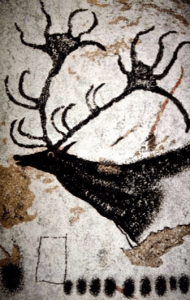
A famous cave painting dipicts a colouration of great horn antler. A dark stripe running along the back, a stripe on either side from shoulder to haunch, a dark collar on the throat and a chinstrap, and a dark hump on the withers (between the shoulder blades)
It is found at Grotte de Cougnac, in France. And, has an estimated date between 25,000 and 19,000 years old. (3)

It is not closely related to either of the living species currently called elk: Alces alces (the European elk, known in North America as the moose); or, Cervus canadensis (the North American elk or wapiti)
It was a giant deer. Phylogenetic speaking analyses support that their closest living relatives are fallow deer (Dama).
It has been historically thought that, because both have palmated antlers, the Irish elk and fallow deer are closely related
This is supported by several other morphological similarities,including the lack of upper canines, proportionally long braincase and nasal bones, and proportionally short front portion of the skull.
Species identification:
In the early part of the species discovery, most had been identifying the remains as elk (known as the moose in north America). Thomas Molyneux, an irish physician, was the first to describe the irish elk or “great horn antler” in 1695. By 1812, french scientist Georges Cuvier documented that the Irish elk did not belong to any species of mammal currently living, declaring it “le plus célèbre de tous les ruminans fossiles”. And, in 1827 Joshua Brookes, in a listing of his zoological collection, named the new genus Megaloceros. (4)

Orthogenesis versus natural selection
Before the 20th century, the Irish elk was believed to evolved from smaller ancestors, with smaller antlers. It was taken as a prime example of orthogenesis, or directed evolution. An evolutionary mechanism in which antlers became larger, and larger. Opposed to Darwinian evolution, or natural selection. Where, in undeviating direction, the successive species within the lineage, become in favor of survival, and reproduction. For a short time, the theory was claimed orthogenesis, or direct evolutionary, because scientists thought antlers kept growing. The species went extinct because the antlers grew to sizes which prevented eating. The animal become trapped in tree branches(5). In the past, many believed Irish elk evolution proceeding in a straight line direction, void of natural selection.
In the 1930s, orthogenesis was disputed by Darwinians, led by Julian Huxley, who noted that antler size was not grossly large, and was proportional to body size Theories changed. The current and favoured view is that sexual selection was the driving force behind the large antlers rather than orthogenesis or natural selection.
Evolution giant deer polyphylectic
Antler construction suggest a close relationship between M. stavropolensis, and Asian Sinomegaceros. The oldest generally accepted records of the genus are from the late early Pleistocene. Other species often considered to belong to Megaloceros include reindeer sized M. savini, which is known from (~700,000–450,000 years ago), and from localities in England, France, Spain and Germany.
The exact origin of M. giganteus remains unclear, and appears to lie outside Western Europe. (~1.2 Ma), partial skeleton remain in Libakos, Greece could be closely related to M. giganteus. It is being studied.

Habitat
It was not exclusive to Ireland or the United kingdom. It was named because best preserved fossil specimens were been found in lake sediments and peat bogs there. The Irish elk had a far reaching range, extending Atlantic Ocean to Lake Baikal in Siberia. They have not been identified northbound onto open mammoth steppes (like mammoth and reindeer), rather more known in the boreal steppe-woodland environments. Mostly consisting of scattered spruce and pine, as well as low-lying herbs and shrubs including grasses. Like sedges, ephedra, artemisia and other brush.
‘Great horned antler’ antlers vary widely in form, depending upon the habitat. Such as a compact, upright shape in closed forest environments. They likely shed their antlers and re-grew a new pair during mating season
Antlers generally require high amounts of calcium and phosphate. Especially those for stags which have larger structures. The large antlers are usually explained for from male-male battles and, to attract females during mating season.
Dieting and feeding
Diet based on dental wear patterns and bone specimen analysis. Show a pattern towards mixed feeding and grazing, but included leaf browsing and a wide range. Based on the dietary requirements of similar deer, a 675 kg (1,488 lb) lean Irish elk stag would have needed to consume 39.7 kg (88 lb) of fresh forage daily.
Assuming antler growth occurred over a span of 120 days, a stag would have required 3lb of protein daily, as well as access to nutrient and mineral dense forage starting about a month before antlers began sprouting and continuing until they had fully grown. Larger stags perhaps sought after aquatic plants in lakes, or areas of more protein and nutrients. After antlers were grown, stags could probably satisfy their nutritional requirements in productive sedge lands bordered by willow and birch forests.
Predators
The Irish elk may have been preyed upon by the large carnivores of the time, including the cave lion, and the cave hyena.
Extinction
As discussed by previous scientists. Antler size changed through the late pleistocene, and into the holocene, and was probably not a primary cause of extinction.
It had been said: “environmental factors, cumulatively over thousands of years, reduced giant deer populations to a highly vulnerable state. In this situation, even relatively low-level hunting by small human populations could have contributed to its extinction.” (6)
Who knows, maybe one day you will see one at a friends, museum, or it might be brought back. You could always keep learning about giant deer, or Megaloceros giganteus today.

Cite: 1) Lister, Adrian M.; Edwards, Ceiridwen J.; Nock, D. A. W.; Bunce, Michael; van Pijlen, Iris A.; Bradley, Daniel G.; Thomas, Mark G.; Barnes, Ian (2005). “The phylogenetic position of the giant deer Megaloceros giganteus”. Nature. 438 (7069): 850–853. Bibcode:2005Natur.438..850L (https://ui.adsabs.harvard.edu/abs/2005Natur.438..850L). doi:10.1038/nature04134 (https://doi.org/10.1038%2Fnature04134). PMID 16148942 (https://pubmed.ncbi.nlm.nih.gov/16148942.S2CID) 4396326 (https://api.semanticscholar.org/CorpusID:4396326).
2) R. D. E. Mc Phee, Extinctions in Near Time: Causes, Contexts, and Consequences p. 262
3) Jaubert, Jacques. L’” art ” pariétal gravettien en France : éléments pour un bilan chronologique (https://www.researchgate.net/publication/43222160). p. 446. OCLC 803593335 (https://search.worldcat.org/oclc/803593335).
4) Joshua Brookes (1827) “Brookesian Museum. The Museum of Joshua Brookes, Esq. Anatomical and Zoological Preparations” (https://books.google.com/books?id=4DwAAAAAQAAJ&pg=PA20) London Gold and Walton
5) Hughes, Sandrine; Hayden, Thomas J.; Douady, Christophe J.; Tougard, Christelle; Germonpré, Mietje; Stuart, Anthony; Lbova, Lyudmila; Carden, Ruth F.; Hänni, Catherine; Say, Ludovic (2006). “Molecular phylogeny of the extinct giant deer, Megaloceros giganteus”. Molecular Phylogenetics and Evolution. 40 (1): 285–291. Bibcode:2006MolPE..40..285H (https://ui.adsabs.harvard.edu/abs/2006MolPE..40..285H). doi:10.1016/j.ympev.2006.02.004 (https://doi.org/10.1016%2Fj.ympev.2006.02.004). PMID 16556506 (https://pubmed.ncbi.nlm.nih.gov/16556506).
6) Lister, Adrian M.; Stuart, Anthony J. (January 2019). “The extinction of the giant deer Megalocerosgiganteus (Blumenbach): New radiocarbon evidence” (https://doi.org/10.1016%2Fj.quaint.2019.03.025). Quaternary International. 500: 185–203. Bibcode:2019QuInt.500..185L (https://ui.adsabs.harvard.edu/abs/2019QuInt.500..185L). doi:10.1016/j.quaint.2019.03.025 (https://doi.org/10.1016%2Fj.quaint.2019.03.025).
Bibliography: Geist, Valerius (1998). “Megaloceros: The Ice Age Giant and Its Living Relatives”. Deer of the World: Their Evolution, Behaviour, and Ecology. Stackpole Books. ISBN978-0-8117-0496-0.
Vislobokova, I. A. (2010), “Giant Deer: Origin, Evolution, Role in the Biosphere”, Paleontological Journal. vol. 46 no. 7 pg. 643–775
O’Driscoll Worman, Cedric; Kimbrell, Tristan (2008). “Getting to the hart of the matter: Did antlers truly cause the extinction of the Irish elk?”. Oikos. 117 (9): 1397–1405. doi:10.1111/j.0030-1299.2008.16608.x. S2CID85392250
Leave a Reply