<home # start here # guides # builds # services # shop # about # categories>

Throughout human history, builders have faced a fundamental question: how much technology is necessary to create safe, durable, and comfortable shelter?
From the stone, timber, earth, and fiber structures of the Neolithic period to today’s computer-designed skyscrapers and automated construction equipment, architecture has continually evolved. Yet modern builders, homesteaders, sustainability advocates, and disaster-relief organizations increasingly recognize that low-tech building methods still offer valuable lessons.
Rather than viewing low-tech and high-tech construction as opposing systems, it may be more useful to see them as different tools for different circumstances. Each approach offers advantages and disadvantages in terms of cost, labor, sustainability, resilience, and accessibility.
This article examines the trade-offs between low-tech and high-tech construction, and explores what modern builders can learn from Neolithic architectural traditions.

What Is Low-Tech Construction?
Low-tech construction relies primarily on locally available materials, simple tools, human labor, and practical knowledge passed through experience. Common examples include Earth construction, Timber framing, Dry stone walls, Cob houses, Wattle and daub structures, Straw bale construction, Traditional log cabins and Lime plaster finishing. Many of these techniques have roots stretching back thousands of years to the Neolithic era.

Characteristics of Low-Tech Building:
Minimal machinery;
Locally sourced materials;
Repairable components;
Lower financial investment;
Higher labor requirements; and,
Emphasis on practical skills
Neolithic communities built homes, storage structures, ceremonial monuments, and defensive works using these principles long before metal tools or industrial manufacturing existed.
What Is High-Tech Construction?
High-tech construction depends on advanced engineering, specialized materials, mechanization, and digital technologies.
Examples include: reinforced concrete buildings, steel-frame construction, computer-aided design (CAD), building information modeling (BIM), automated manufacturing, prefabricated components, smart building systems and heavy earthmoving equipment. Modern cities would be impossible without these technologies.
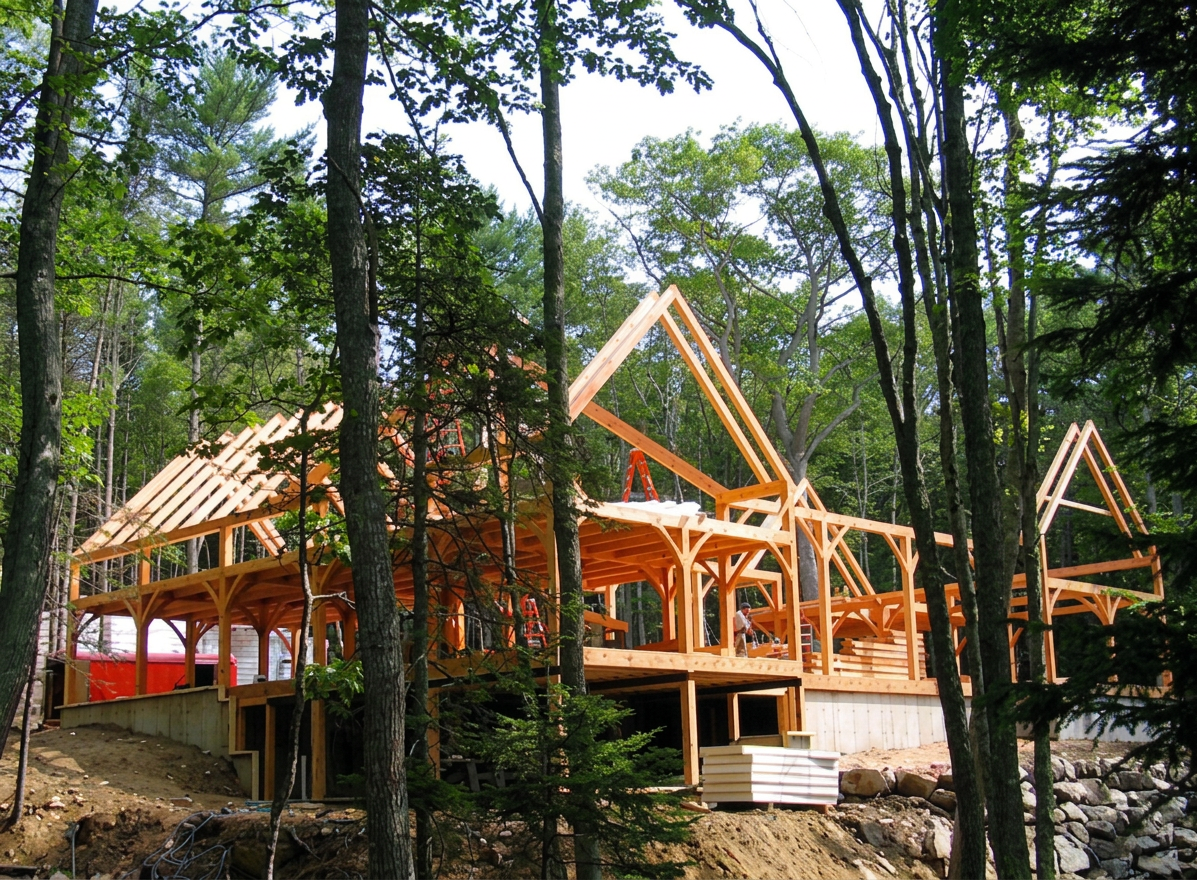
Characteristics of High-Tech Building:
Extensive machinery use;
Industrially manufactured materials;
Specialized labor;
Faster large-scale construction;
Higher capital investment; and,
Complex supply chains.
High-tech methods excel when projects require large spans, significant heights, advanced infrastructure, or rapid mass production.
The Neolithic Perspective
Neolithic builders worked in environments where every material and tool had to be obtained locally. Stone came from nearby quarries. Timber came from surrounding forests. Clay was dug from local soil. Plant fibers became rope, baskets, and reinforcement materials. Because transportation was difficult and expensive, construction naturally favored local resources.
This principle remains one of the strongest lessons Neolithic architecture offers modern builders.

Cost Comparison: Low tech versus high tech
Low-Tech Advantages. Low-tech methods often reduce material costs, transportation expenses, equipment rental and fuel consumption. Many traditional building materials can be harvested, gathered, or processed directly from the surrounding landscape. For owner-builders and homesteaders, this can dramatically lower financial barriers.
Low-Tech Challenges. Costs may increase through: Greater labor requirements, longer project timelines, skill development, and manual material processing.
High-Tech Advantages. Modern construction can build quickly, scale efficiently, reduce labor hours and improve scheduling. Large commercial projects often become economically feasible only through mechanization.
High-Tech Challenges. High-tech projects frequently involve expensive equipment, specialized contractors, supply chain dependencies, rising material costs and labor
Skill Requirements
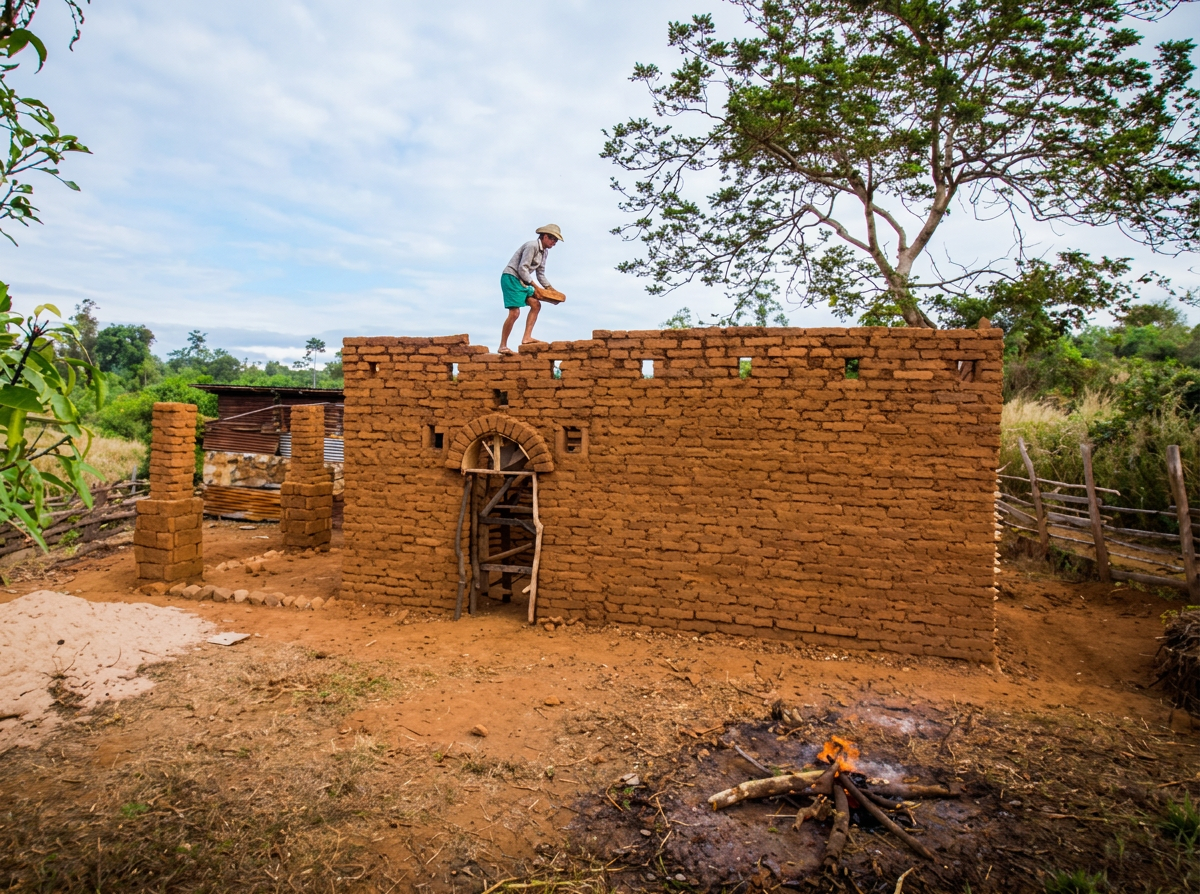
One common misconception is that low-tech construction requires less expertise. In reality, traditional building often demands deep practical knowledge. Builders must understand soil behavior, timber selection, joinery techniques, weather patterns and structural load paths. Neolithic communities accumulated this knowledge over generations.
High-Tech Skill Requirements
Modern construction also requires expertise, but often in different areas engineering, equipment operation, computer modeling, building codes and industrial manufacturing. Both systems depend on skilled workers; the nature of the skill simply differs.
Environmental Impact
Low-Tech Construction. Low-tech building frequently has a smaller environmental footprint because it relies on local materials, renewable resources, minimal manufacturing and reduced transportation. Natural materials often require significantly less energy to produce. Examples include timber, earth, stone, straw and lime.
High-Tech Construction. Modern materials can require substantial energy inputs. Examples include portland cement, structural steel, synthetic insulation, plastics and engineered composites. However, modern technologies can also improve energy efficiency during a building’s operational life. The environmental picture is therefore more complex than simply “old good, new bad.”

Resilience and Self-Sufficiency
One of the greatest strengths of low-tech construction is resilience. If supply chains fail, local builders can often continue working with stone, wood, clay and natural fibers. Repairs can frequently be made without specialized equipment. This characteristic made Neolithic communities remarkably adaptable.
Modern Vulnerabilities
Many contemporary buildings depend upon replacement parts, industrial materials, electrical systems and specialized contractors. When these systems become unavailable, maintenance can become difficult or expensive.
Comfort and Performance
High-Tech Advantages. Modern technologies provide climate control, advanced insulation, mechanical ventilation, moisture management and fire suppression systems. These innovations greatly improve indoor comfort.
Low-Tech Advantages. Traditional construction often achieves comfort through thermal mass, natural ventilation, thick walls, strategic orientation and passive solar design. Many ancient building principles remain effective today. In fact, some modern sustainable architecture combines passive Neolithic-inspired strategies with advanced engineering.
Speed of Construction
High-Tech Construction Wins. For speed alone, high-tech methods are difficult to match. A modern crew using: Excavators, Cranes, Power tools and Prefabricated components. Can complete projects in weeks that might have taken months or years versus using traditional methods.
Low-Tech Construction Wins Elsewhere. Speed is not always the primary goal. Low-tech projects often emphasize durability, local participation, community involvement. skill development and long-term sustainability.

Disaster Recovery and Humanitarian Applications
Following disasters, low-tech building methods can offer important advantages. Local materials may remain available even when industrial supply chains are disrupted. Communities can often participate directly in reconstruction efforts. Many humanitarian organizations have successfully employed earth construction, timber systems, bamboo structures and local masonry techniques. These approaches reflect principles that Neolithic builders understood intuitively: build with what is available.
Hybrid Construction: The Best of Both Worlds
Increasingly, architects combine low-tech and high-tech methods. Examples include:
Traditional timber frames engineered with modern calculations;
Earth walls paired with modern foundations;
Lime plasters used alongside contemporary moisture barriers; and,
Passive solar design enhanced by energy-efficient windows.
These hybrid approaches seek to capture the strengths of both systems while minimizing weaknesses.
Lessons from Neolithic Architecture
Neolithic builders teach several enduring principles. Use local materials whenever possible; Design for climate rather than against it; Build structures that can be repaired; Value practical skills and craftsmanship; Consider long-term durability; and, Create buildings that communities can maintain themselves.
These lessons remain relevant whether constructing a small homestead cabin or designing sustainable modern housing.

The debate between low-tech and high-tech construction is not about choosing one system and rejecting the other. It is about understanding trade-offs. High-tech construction offers speed, precision, scale, and modern comfort. Low-tech construction offers resilience, sustainability, repairability, and local self-reliance.
Neolithic architecture demonstrates that sophisticated buildings can emerge from simple materials, practical knowledge, and cooperative effort. Modern builders increasingly recognize that some of humanity’s oldest construction techniques still provide valuable solutions to contemporary challenges.
The future of sustainable building may not lie entirely in new technologies or ancient traditions, but in thoughtfully combining both to create structures that are efficient, durable, environmentally responsible, and accessible to the communities they serve.
Recommended products
-

low tool high skills t-shirt
Price range: $60.00 through $70.00 -

na bold t-shirt
Price range: $60.00 through $70.00 -

sustainable building consulting
$450.00 -

log cabin shell
$12,000.00 -

experimental reconstruction products
-

jomon neolithic man women dig hole sticker
$4.00 -

course education service
$450.00 -

Pleistocene & megafauna coloring book
Price range: $2,000.00 through $2,500.00 -

f2j $450 long sleeve t-shirt
Price range: $80.00 through $90.00 -

button down shirt
Price range: $140.00 through $150.00 -

black peace button
$7.50

Leave a Reply