<home # start here # guides # builds # services # shop # about # categories>

One of the greatest mysteries surrounding Neolithic architecture is not how ancient people built their structures, but how they organized themselves to accomplish such ambitious projects. Archaeologists have long recognized that many Neolithic buildings, from simple homes to monumental ceremonial complexes,required far more labor than a single family could provide.
Long before written contracts, professional construction companies, or formal engineering schools, Neolithic communities developed systems for coordinating workers, managing resources, sharing knowledge, and completing complex building projects. Whether constructing a small village house, a communal granary, a defensive enclosure, or a massive stone monument, early builders had to solve many of the same organizational challenges faced by modern construction crews.
Understanding labor and crew organization provides valuable insight into the social structures, economies, and cultural values of Neolithic societies. It also reveals how cooperation itself became one of humanity’s most important building technologies.

Why Labor Organization Mattered
Building projects require more than materials and tools. They require people working together efficiently. Even relatively modest Neolithic structures demanded material gathering, transportation, site preparation, tool production, construction work and maintenance. Larger projects could involve hundreds of individuals over extended periods. Without effective organization, even the simplest construction efforts would have struggled to succeed. The emergence of increasingly sophisticated architecture during the Neolithic period suggests that communities developed equally sophisticated methods of cooperation.
The Family as the Basic Building Unit
In many early agricultural societies, the household likely served as the foundation of construction activity. Family members contributed according to age, experience, and physical ability. Typical responsibilities may have included: (adult men, adult women, older children, and elders)
Adult Men: tree felling, heavy lifting, stone quarrying, structural construction and earth moving;
Adult Women: clay preparation, plaster production, fiber processing, roofing material preparation and interior finishing;
Older Children: gathering materials, carrying water, assisting skilled workers and transporting tools; and
Elders: supervising work, teaching techniques, planning construction and preserving traditional knowledge.
Although labor divisions varied among cultures, architecture was often a household effort rather than an individual task.

Community Building Projects
Many structures exceeded the capabilities of a single family. Examples include defensive walls, ceremonial buildings, community storage facilities, large timber halls and megalithic monuments. These projects required cooperation among multiple households. Archaeological evidence suggests that communal labor became increasingly important as settlements grew larger and more socially complex. Community construction likely strengthened social bonds while creating shared infrastructure that benefited everyone.

Specialized Roles in Neolithic Construction
While most people probably possessed basic building skills, some individuals may have developed specialized expertise. These specialists could have included Stone Workers. Experts in quarrying, shaping stone, selecting suitable materials, and constructing masonry features
Timber Specialists. Experienced builders responsible for structural frameworks, roof systems, joinery techniques and earth Builders. Individuals skilled in mudbrick production, clay preparation, plaster application, earthen wall construction and ritual Leaders. For ceremonial projects, religious or cultural leaders may have guided site selection, orientation, and symbolic design elements. Such specialization represents an important step toward the professional trades found in later civilizations.
Organizing Large Construction Crews
Monumental Neolithic sites demonstrate remarkable organizational capabilities. Projects involving large stones, extensive earthworks, or substantial timber structures required coordinated labor. Crew organization may have involved work teams, assigned specific tasks, seasonal labor schedules, designated supervisors, shared food provisioning and coordinated transportation efforts. Rather than functioning as random gatherings of workers, many projects likely operated through carefully planned systems of cooperation.
Seasonal Construction Cycles (spring, summer, autumn & winter)
Agriculture influenced nearly every aspect of Neolithic life, including construction. Building activities were often scheduled around farming responsibilities.
Spring. Common activities included material gathering, timber harvesting and site preparation
Summer. Suitable for earth construction, roofing work and stone transport Autumn. It often involved completing structures before winter, storage facility construction and maintenance work
Winter. May have focused on tool production, planning, craft activities and indoor repairs
These seasonal rhythms helped communities balance construction with food production.

Food and Labor
One of the most important aspects of crew organization was feeding workers.
Large construction projects required substantial food resources. Communities may have organized shared meals, seasonal feasts, agricultural surpluses and food storage systems. Some archaeologists believe communal feasting played an important role in motivating and rewarding labor participation. Food could serve both practical and social purposes, helping maintain cooperation during large projects.

Knowledge Transfer and Training
Without written manuals or architectural drawings, construction knowledge had to be transmitted directly between individuals. Skills were likely learned through observation, apprenticeship, participation, oral instruction and repeated practice. Young people gained experience by assisting more skilled builders. This system allowed construction techniques to persist across generations. Many traditional building cultures around the world continued to rely on similar methods well into recent history.
Leadership in Construction Projects
Large-scale building efforts required decision-making and coordination. Leadership may have taken several forms: (household, village, builders and religious)
Household Leadership. Family heads directing domestic construction.
Village Leadership. Community leaders organizing shared projects.
Skilled Builders. Experienced craftspeople supervising technical work.
Religious Authorities. Individuals overseeing ceremonial structures and ritual spaces.
The nature of leadership varied between societies, but some form of coordination was almost certainly necessary for complex projects.
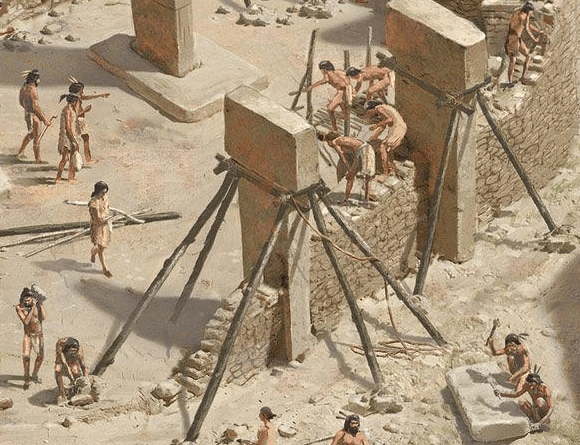
Monument Building and Social Cooperation
Some of the most impressive evidence for labor organization comes from monumental architecture. Sites such as: Stonehenge, Göbekli Tepe and Newgrange required extraordinary coordination. These projects demonstrate that Neolithic societies could mobilize substantial labor forces long before the emergence of states, bureaucracies, or written administration. Monuments may have served not only religious purposes but also social ones, bringing communities together through collective effort.
Gender and Construction Labor
Archaeologists continue to debate how labor was divided between men and women in Neolithic societies. Earlier interpretations often assumed construction was primarily male work. Modern research suggests a more complex picture. Many tasks associated with building—including plastering, material preparation, weaving, roofing, and finishing—may have involved significant contributions from women. Evidence from ethnographic studies of traditional societies shows that construction frequently depends upon the labor of entire communities rather than a single demographic group.

Challenges Facing Early Construction Crews
Neolithic builders faced numerous difficulties, including: (transportation, weather, resource availability, labor coordination & tool limitations)
Transportation: Moving heavy stone and timber without wheeled vehicles in many regions.
Weather: Rain, heat, cold, and seasonal changes affecting construction schedules.
Resource Availability: Obtaining suitable materials without exhausting local supplies.
Labor Coordination: Balancing construction with farming, hunting, and household responsibilities.
Tool Limitations: Completing large projects using stone, bone, antler, and wooden tools.
Overcoming these challenges required effective planning and cooperation.

Lessons for Modern Construction
Although separated by thousands of years, Neolithic and modern builders share many concerns. Both must manage labor resources, scheduling, material supply, worker safety, project coordination and skill development. Modern construction relies on advanced technologies, but successful projects still depend fundamentally on human cooperation. Neolithic communities remind us that organization, communication, and shared purpose can be as important as tools and machinery.
What Archaeology Reveals About Human Cooperation
The study of labor organization in Neolithic architecture highlights an important truth: buildings are social achievements as much as technical ones. Every house, wall, monument, and ceremonial enclosure reflects countless acts of cooperation. Architecture provides evidence not only of construction methods but also of community relationships, leadership structures, economic systems, cultural values and shared identities. The ability to organize labor on a large scale helped lay the foundations for increasingly complex societies throughout human history.

The story of Neolithic architecture is ultimately a story of people working together. From family homes built through household effort to monumental structures requiring coordinated labor from entire communities, early construction depended upon organization, planning, and cooperation. Without modern machinery, written plans, or professional contractors, Neolithic builders developed effective systems for managing crews, transferring knowledge, allocating resources, and completing ambitious projects. Their success demonstrates that one of humanity’s most powerful technologies has never been a tool or machine. It has been the ability to collaborate toward a common goal. By studying labor and crew organization in early builds, we gain a deeper understanding of how architecture helped shape the social, cultural, and economic foundations of the Neolithic world, and how cooperation itself became a cornerstone of civilization.
Leave a Reply