< home # store # services # articles # game # app #contact >

The genus name is derived from the ancient greek: hēmi-, “half” and auchēn, “neck”
Discovered in south America in 1880; and,
Described in north America, in 1883, by Edward Drinker Cope.
Found in Canada to central Mexico. Including SE Alberta. And, in Floridia, South Carolina, Mississippi, Texas, Kansas, Nebraska, Arizona, California, Oklahoma, New Mexico, Oregon, Colorado, and Washington.
South American fossils were found in the Luján and Agua Blanca Formations of Buenos Aires Province and Córdoba Province, Argentina. The Tarija Formation of Bolivia. Pilauco of Osorno, Los Lagos, Chile. And, Paraíba, Ceará, and the Touro Passo Formation of Rio Grande do Sul, Brazil.
They were around 5.5 feet height at shoulder. And, 880lbs full grown
Habitat included woodlands wetlands and grasslands. They lived in small herds. And, were well known in the Mojave desert.

Species are also specified using latinised names from other languages:
H. vera (true hemiauchenia):
Relatively low-crowned teeth (part of visible teeth ends close to gums);
Large caniniform (canine-like) upper first premolar; and
Retention of lower third premolar.
H. blancoensis (blancan hemiauchenia):
Named for blancan age stratum where typically found;
Shorter mandibular diastema (teeth-spacing between incisors and molars); than H. macrocephala and
H. vera;
Caniniform upper first premolar;
Absent second premolar;
Upper third premolar present or absent; and,
Lower crowned molars.
H. macrocephala (great-headed hemiauchenia):
Possesses a larger skull relative to other species;
Long, robust limbs;
Large skeletal size;
Presence of a deciduous upper second premolar;
Fully molariform deciduous second premolar (its infant bicuspids were like molars);
High-crowned molars;
Thick layer of cementum on the teeth; and,
Broad mandibular symphysis (line where the bones of the jaw join together) with incisors in a vertical fashion.
H. minima (least hemiauchenia):
Despite being the earliest recognized species, general distinguishing characteristics for H. minima are little known.
Other species:
Also, a few lesser known species. These may or may not be considered legitimate taxa.
Like horses and deer, the genus has a number of species.
Classification history:
In 1974, scientist David Webb, proposed that holomeniscus, lama, and tanupolama fossil specimens were part of a single hemiauchenia genus.

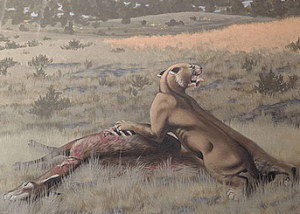
These friendly looking critters had many predators. Including: direwolfs, smilodon, american lion, coyotes and humans. Despite there looks, the ‘half necks’ probably had to keep distance from carnivores and man. And, if caught, were potentially a tasty snack.
Bibliography: Hemiauchenia macrocephala”. University of Florida, Florida Museum of Natural History.
Nowak, R. M. 1999. Walker’s Book of Mammals, vol. 1. Johns Hopkins University Press, Baltimore, pp. 837 – 1936.
Scherer, Carolina Saldanha (March 2013). “The Camelidae (Mammalia, Artiodactyla) from the Quaternary of South America: Cladistic and Biogeographic Hypotheses” (http://link.springer.com/10.1
007/s10914-012-9203-4). Journal of Mammalian Evolution. 20 (1): 45–56. doi:10.1007/s10914-012-9203-4). ISSN 1064-7554 (https://search.worldcat.org/issn/1064-7554).
Leave a Reply