<home # start here # guides # builds # services # shop # about # categories>
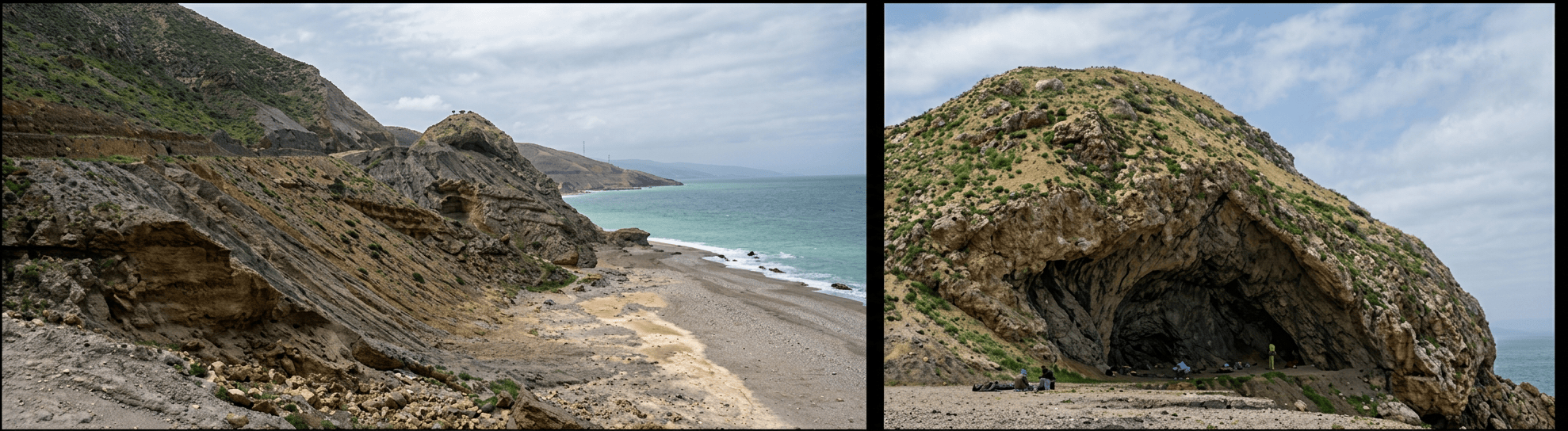
Ifri Oudadane is one of the most important sites for understanding how North Africa became Neolithic. It is particularly interesting for Neolithic Architecture because it does not begin as a farming village with rows of houses. Instead, it is a coastal rock shelter where people continued an older hunter-gatherer way of life while gradually adopting pottery, domestic animals, cereals and legumes. The result is a fascinating picture of Neolithic transition rather than sudden replacement.
The occupation lasted roughly 11,000–5,700 calibrated years before present (cal BP), with the major transition to the Early Neolithic around 7,600 cal BP [1][2]. Archaeologists have recovered marine shellfish, terrestrial animals, wild plants, domesticated sheep/goats, cereals, pulses, pottery, stone tools, bone tools and evidence for animal penning.
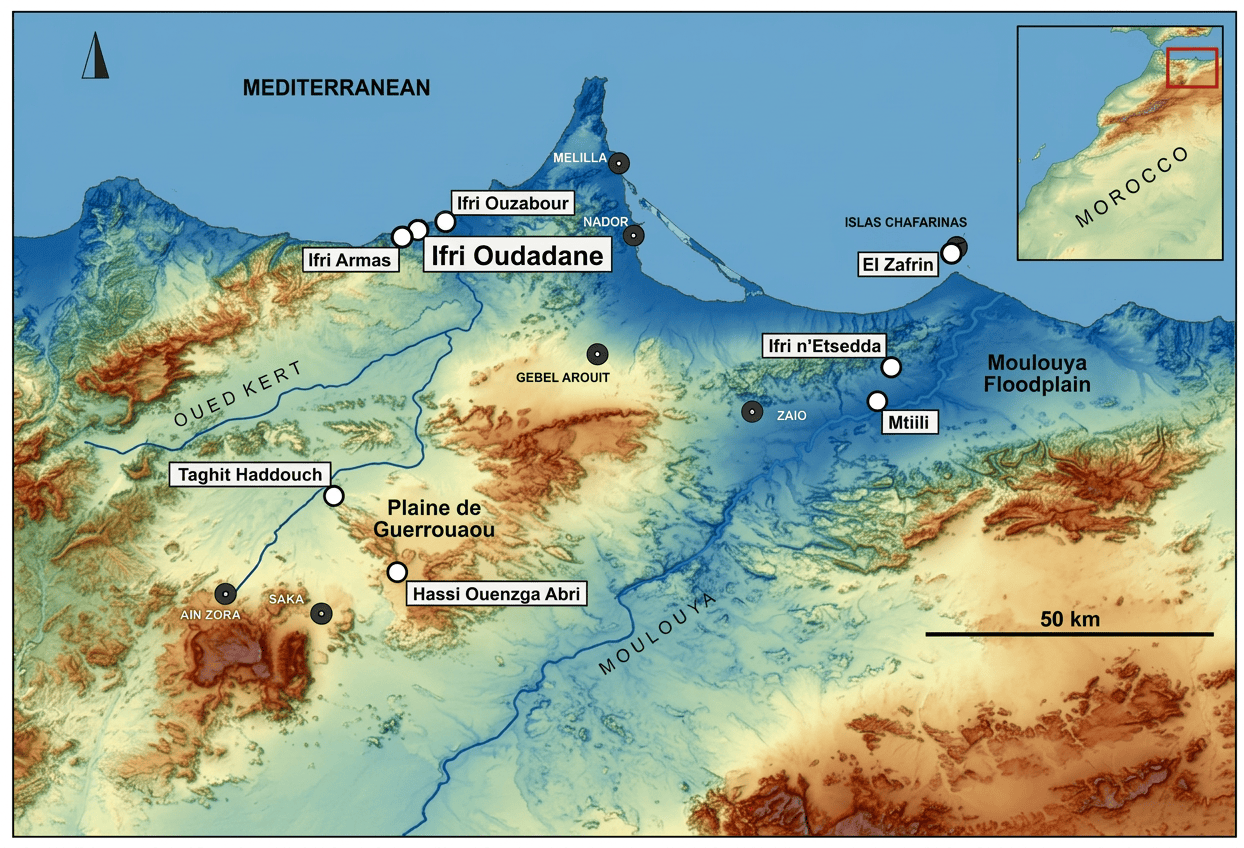
Ifri Oudadane is in northeastern Morocco, in the Eastern Rif, on the Mediterranean coast west of the Melilla Peninsula. It is approximately: 5 km east of the mouth of the Oued Kert, about 50 m above the present shoreline. Roughly 20 km west of the Melilla Peninsula, in a coastal marble cliff and facing the Mediterranean Sea [1][3].
The shelter itself is approximately 5 m high and 15 m wide.
This is an unusually dramatic location: the shelter looks out toward the sea while the land immediately behind it rises toward the Eastern Rif hills and plateaus.
Was it near a river? Yes
The important river was the Oued Kert, whose mouth is about 5 km away. Archaeologists have suggested that the lower Oued Kert could have been part of the larger settlement landscape, providing freshwater and access to fluvial gravels containing stone suitable for tool manufacture. It eventually drains into the Mediterranean Sea.
A larger river, the Moulouya, lies farther east/southeast and was another major source of water, alluvial stone and ecological resources in the wider region
The landscape can be visualized as mountains and uplands, streams/Oued Kert, coastal plain and Mediterranean Sea. Rather than an isolated cave in an otherwise dry landscape.
Was it near mountains? Very much so.
Ifri Oudadane belongs to the Rif mountain system of northern Morocco. The immediate coastal terrain rises rapidly behind the shelter, while the broader Eastern Rif contains several mountain and upland zones.
The Kebdana Mountains, for example, occur farther east around the Lower Moulouya region. Another nearby Eastern Rif shelter, Ifri n’Etsedda, lies directly on the southern flank of the Kebdana Mountains. It is useful as a regional comparison, although it should not be confused with Ifri Oudadane.
The site was positioned in an excellent ecological transition zone. Mediterranean Sea, rocky coast, river valleys, hills/mountains, woodland and semi-arid interior. That helps explain the extraordinary variety of resources found at the site.
The site could be a challenging, semi-arid environment
Today the region has a Mediterranean climate: relatively mild winters, hot summers, rainfall concentrated in autumn and winter and semi-arid conditions locally [2]. But the early Holocene landscape was considerably greener. Pollen from the Epipalaeolithic levels indicates a landscape with substantial woodland, including: evergreen oak, alder, willow, ash, poplar, wild olive, mastic, myrtle and other Mediterranean shrubs [2]. During the earliest occupation, roughly 11,000–7,600 cal BP, arboreal pollen could represent about 60–72% of the pollen assemblage. So imagine something considerably more wooded than the modern landscape.

What happened to that climate?
This is one of the most important parts of the Ifri Oudadane story. Around 10,000 years ago. The surrounding environment was becoming warmer and more favourable after the beginning of the Holocene. People were exploiting woodland, rivers, wild plants, terrestrial animals and marine resources. The site was still fundamentally a hunter-gatherer settlement.
Around 7,600 years ago Something important happened
The archaeological record begins showing pottery, domesticated cereals, legumes, domesticated ovicaprids, increased evidence of herding and new lithic technologies [1][2]. This is the Neolithic transition.
After about 6,600 years ago
The environmental record begins changing dramatically. Arboreal vegetation declined. Riparian trees such as: alder, ash, poplar and willow declined or disappeared. At the same time, shrubs and grasses increased, including Tamarix and Artemisia. The landscape was becoming increasingly open and dry. By approximately 6,300–6,000 cal BP, occupation intensity at Ifri Oudadane was falling sharply.
How we know the climate changed? Several independent scientific methods converge
Researchers use: Pollen, Pollen trapped in archaeological sediments reveals what plants were growing around the shelter. More oak and riparian trees are wetter/woodier landscape. More grasses and drought-tolerant shrubs are more open/arid landscape.
Charcoal. Burned wood reveals which trees people were cutting for fuel. At Ifri Oudadane, charcoal analysis identified substantial use of: wild olive, Pistacia, willow, juniper and alder. Changes in charcoal assemblages help reconstruct both vegetation and human fuel selection. [2]
Black carbon. Researchers went beyond ordinary charcoal identification. They chemically analyzed black carbon compounds in the sediment. This showed a change from predominantly wood-burning fires in the Epipalaeolithic toward greater use of grass-based fuels during the Neolithic. [7] That is remarkable. It means the sediment preserves something resembling a fuel history.
Marine shells
The oxygen isotopes in marine molluscs can also provide information about past sea-surface temperature. Neolithic shells from Ifri Oudadane suggest sea-surface temperatures around 20–22°C, approximately 2–4°C warmer than today, although shell chronology is complicated by time averaging.
Radiocarbon dating
More than 18—and in later syntheses 23—radiocarbon measurements have helped establish the sequence. Together these methods produce a much stronger climate reconstruction than any single measurement.
When we begin to study architecture, Ifri Oudadane is particularly interesting
It was NOT a conventional Neolithic village. The main archaeological structure is a natural rock shelter. There is no securely documented large village of rectangular houses, no monumental temple and no obvious communal building comparable to places such as Çatalhöyük, Çayönü or Göbekli Tepe. The shelter itself was the architecture. It is about: 5 m high × 15 m wide, and formed naturally by marine erosion in the marble cliff. That means the people inherited an enormous piece of architecture for free. Think of it as a prehistoric house-sized natural building. The cliff provided: roof, rear wall, wind protection, shade, thermal buffering, elevated position above the beach and proximity to marine resources. People then modified the interior through their activities rather than constructing an elaborate building.
There’s no evidence for subterranean huts, nor is there secure evidence for: timber-frame houses, wattle-and-daub walls, mudbrick houses, stone-built houses and substantial wooden roof structures. Those technologies existed elsewhere in the Neolithic world, but they cannot simply be transferred to Ifri Oudadane.
Did they use timber? They certainly burned wood
Archaeological charcoal is abundant enough to reconstruct fuel selection. However, surviving structural timber is not reported as an important part of the Ifri Oudadane assemblage. This is exactly the sort of situation where archaeology can accidentally make ancient people appear to have used less wood than they really did. Wood disappears. Charcoal survives much more readily.
In an ordinary oxygen-rich archaeological soil, unburned wood can disappear in decades to centuries. Under exceptionally favourable conditions. Especially permanently waterlogged, oxygen-poor, very dry, frozen, mineralized and/or sealed inside a structure. Wood can survive for thousands of years. At Ifri Oudadane, the preservation environment was good enough to preserve charred wood, seeds and other microscopic evidence, but that does not mean that intact 7,000-year-old construction timber should be expected.
Hearths and fire technology
The archaeological deposits contain charcoal, ash and burned material, and a hearth has been associated with the final occupation around 5.7 ka cal BP. But I would be cautious about calling the site technologically equivalent to places with specialized heating systems. There is no evidence for underfloor heating, flues, hypocaust-like systems, sophisticated clay heating channels and/or masonry ovens comparable to later Near Eastern systems. Instead, the evidence points toward ordinary but highly important open-fire technology. Fire served several purposes: cooking, heating, processing food, burning wood, probably drying, processing plant foods and maintaining the shelter.
The interesting technological development is not a fancy fireplace. It is the change in fuel economy
During the older Epipalaeolithic occupation, the fire record indicates greater use of wood. During the Neolithic, there is stronger evidence for grass-derived fuel. Why? One possibility is environmental change. Another is that people were altering the woodland themselves through cultivation, grazing, fuel collection and clearing. The researchers therefore interpret the fire record together with pollen, charcoal, animal dung indicators and archaeology. This creates a picture of people increasingly engineering their landscape rather than simply living within it.
There was no elaborate built-in platforms sometimes found at other Neolithic settlements
The natural floor of the shelter was repeatedly accumulated with: shell, charcoal, ash, bones, plant remains, sediment and animal dung/coprolytes. The main Neolithic deposit became something archaeologists describe as “fumier-like”, resembling the dung-rich deposits created when animals are repeatedly kept inside caves and shelters. So rather than a neat house with:
A shelter could have not been simply: “a place where people slept.” It could function as: home, animal pen, kitchen, food-processing area and storage/working space
That is architecture as a system of survival.
There is evidence for stored food and food-processing activity, especially through the carbonized plant assemblage and pottery
Archaeologists haave not identified large purpose-built storage rooms or silos like some other sites. Instead, storage probably relied substantially on: pottery vessels, baskets or organic containers that have not survived, food kept in the shelter and possibly temporary storage arrangements. This is another important archaeological warning: A container may survive archaeologically even when the storage system surrounding it does not.
What did they grow?
Ifri Oudadane has some of the earliest securely dated evidence for cultivated plants in North Africa. The Early Neolithic assemblage includes: Cereals. barley — Hordeum vulgare, einkorn/emmer-type wheat — Triticum monococcum/dicoccum, durum-type wheat — Triticum durum and bread/durum-type wheat — Triticum aestivum/durum
Legumes. Lentil — Lens culinaris and pea — Pisum sativum
The famous discovery is a domesticated lentil, directly dated to approximately 7,600 cal BP.
The archaeobotanical evidence is much stronger for: wheat, barley, lentils, peas and wild plants. Than domesticated fruit trees (figs, apples, pears, apricots, pomegranates etc)
We resist filling the site with familiar Mediterranean fruit trees simply because they exist in Morocco today. There was also a rich wild plant environment. The Epipalaeolithic population exploited a landscape containing: oak, wild olive, Pistacia, myrtle, juniper, riparian plants, grasses and other Mediterranean vegetation.
Were they farmers or hunter-gatherers? They did both. “Mixed economy” is the best description
This is one of the most important things to understand about Ifri Oudadane. The Early Neolithic inhabitants did not simply abandon hunting and gathering and become full-time farmers. Instead they combined: Marine gathering with Hunting with Wild plant gathering with Sheep/goat herding with Cereal cultivation with Legume cultivation.
Researchers have emphasized that domesticated animals represented only a minority of the faunal assemblage in the early work, while marine resources remained extremely important. So agriculture looks more like a risk-reduction strategy than a complete economic replacement.
What did they eat?
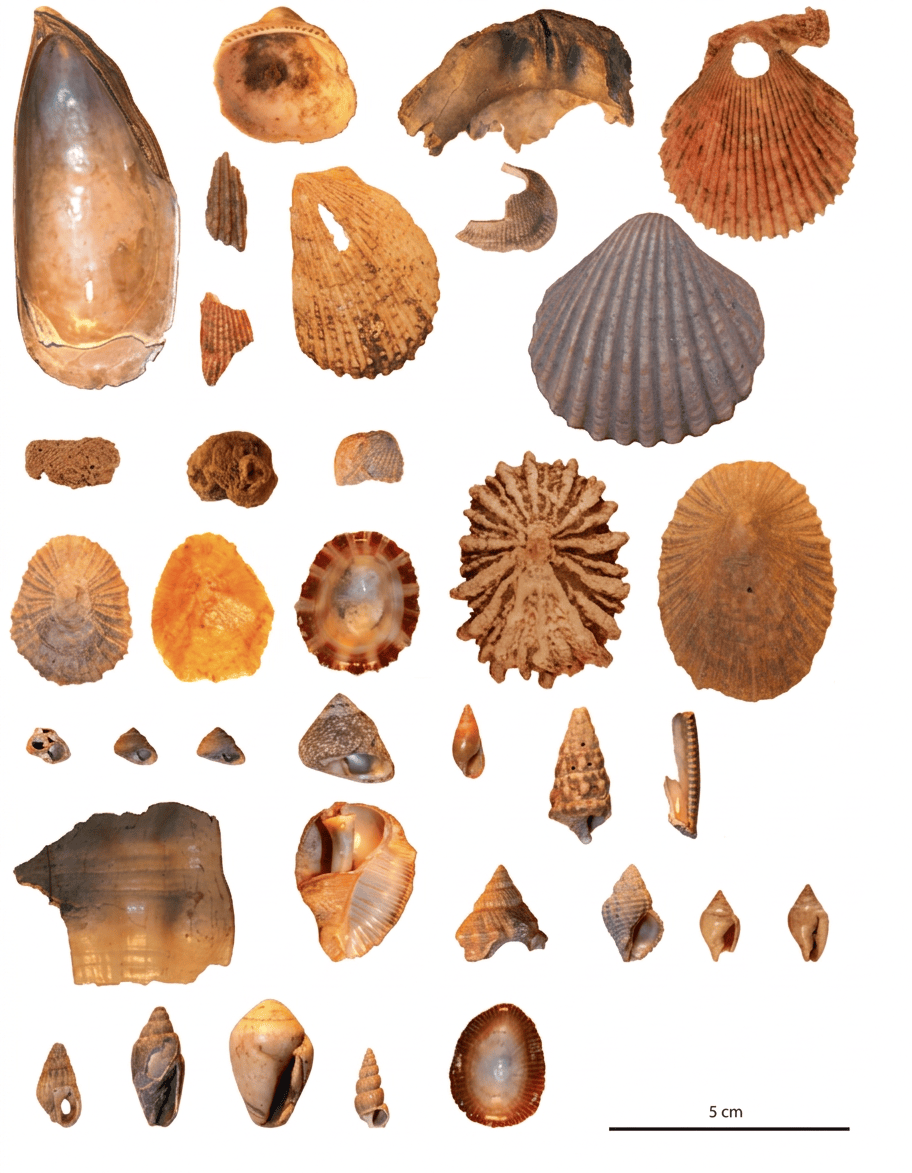
The answer is wonderfully broad. Seafood. Thousands of shellfish remains were recovered. One study of 4,415 litres of sediment identified: 8,749 individuals representing at least 40 species of shellfish. Major food species included: limpets, topshells, mussels and rockshells. Together these represented about 98% of the molluscan fauna in the studied assemblage. Interestingly, the dominant shellfish changed: Epipalaeolithic limpets, to Neolithic topshells. There was even evidence for systematic processing of topshells.

One of everyones favourite things about Ifri Oudadane shells were not just food
People had a surprisingly sophisticated shell technology. Some shells were eaten. Other species were deliberately collected for:beads, pendants, tools, polishers and possible pigment palettes.
Perforated shells such as Columbella rustica could have been sewn onto clothing. Other shells were modified by drilling, grinding, sawing or striking.
So the Mediterranean was simultaneously: pantry, workshop, jewelry store and transportation corridor.
The strongest evidence for animals is for ovicaprids (sheep and goats)
Importantly, molecular analysis has helped distinguish domestic goat from Morocco’s native wild Barbary sheep. There is also evidence for wild animals and a broad terrestrial fauna.
Wild boar/pig remains occur in the broader faunal record, but this should not be turned into a claim that Ifri Oudadane was a pig-farming settlement.
Ifri Oudadane has a substantial lithic industry
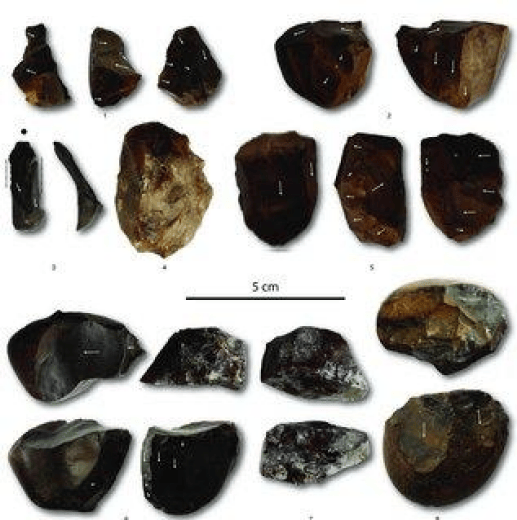
Tools include: blades, backed bladelets, microliths, scrapers, notched pieces, denticulates, arrowheads, retouched flakes, cores and cutting tools. The Neolithic assemblage includes large notched blades and transverse arrowheads. This is important because the stone technology demonstrates continuity with earlier local traditions alongside the arrival of new Neolithic practices.
What stone did they use?
Several raw materials have been identified. Particularly important are: Black silex. A high-quality black flint/silex is abundant. Its exact geological source was still under investigation, although its small rounded pebbles suggest an alluvial source and it was probably not far away.
Moulouya Brown and Moulouya White. These materials occur as rounded river gravels associated with the Moulouya River.
Other materials. The assemblage includes various exotic or less common materials, with geological investigations continuing. This is a good example of how rivers functioned as prehistoric rock quarries.
Very likely there was some long-distance contact. But the evidence is more interesting than simply saying “trade”
Marine shells and ornaments occur in similar forms across the western Mediterranean. The same general tradition of perforated shells, beads, pendants, pottery, Neolithic crops and domesticated animals. Connects North Africa with the wider Mediterranean world.
Recent ancient-DNA research also supports substantial interaction between Iberia and North Africa during the spread of Neolithic lifeways
One major hypothesis is therefore that some of the agricultural package reached Morocco through Mediterranean coastal connections, potentially including maritime movement. That is an exciting possibility: The sea was not necessarily a barrier. It may have been the highway.

Pottery is one of the great archaeological markers of the transition
The Early Neolithic pottery includes Cardium-style impressed decoration, followed by other impressed and comb-related decorative techniques.
The earliest Early Neolithic phase, ENA, is dated around 7.6–7.3 ka cal BP.
The major ENB occupation lasted approximately 7.1–6.7 ka cal BP.
This is important architecturally because pottery changes the possibilities of a settlement: boiling, storage, transport, processing and serving. Can all become easier.
Did they have textiles?
There is no substantial preserved fabric assemblage from Ifri Oudadane. However, the perforated shell beads are significant. If shells were sewn onto clothing, then some form of clothing, cordage, stitching and textile/leather technology must have existed. Bone needles also occur in the Early Neolithic assemblage. So we do not have preserved shirts. But we do have archaeological evidence that people were making and decorating things worn on the body.
Figurines, weapons, gold and precious stones?
There is no famous monumental figurine tradition or gold hoard from Ifri Oudadane. Nor is there evidence for a spectacular precious-metal economy comparable to much later prehistoric societies. What there is more subtle: shell jewelry, bone ornaments/tools, modified shells, ochre-associated shell objects, stone arrowheads, bone points, needles, spatulas and rings. One modified shell appears to have functioned as a possible ochre palette/container. That could be more interesting than gold because it shows everyday technology and personal identity.
Burials and ritual
Ifri Oudadane is not primarily a cemetery or ceremonial site. There is no securely identified monumental ritual complex comparable to Göbekli Tepe, Niuheliang or later Moroccan megalithic sites. The excavated record is dominated by: domestic activity, food processing, shellfish consumption, fire, animal keeping, pottery, stone tools and plants. I would therefore not describe Ifri Oudadane as having a temple or communal ritual building. There are symbolic objects, especially ornaments and ochre-related shell objects, but they should not automatically be interpreted as evidence for a formal religious structure.
It was probably not a village in the conventional sense
This is another key point. The site represents an episodically occupied rock shelter. Archaeologists have identified several occupation phases rather than a continuously occupied town. The archaeological deposits accumulated over more than 5,000 years, but individual occupation events are difficult to isolate. The shelter may have been part of a much larger settlement landscape associated with the Oued Kert. Unfortunately, erosion and later landscape disturbance mean that much of that surrounding settlement may have disappeared.
What might the settlement have looked like?
A reasonable reconstruction would be something like this: Sea to rocky beach / shellfish gathering to coastal rock shelter. There were hearths, cooking, shell processing, stone-tool production, pottery, sleeping/living areas and animal penning. There were small paths toward: Oued Kert, freshwater + river gravel + plants, uplands and woodland; and, hunting, herding, gathering and cultivation. This is not a city. It is a resource network concentrated around a natural architectural shelter.
Ifri Oudadane shows that the Neolithic did not arrive as a finished package. People could keep hunting, gathering shellfish and using an old rock shelter while gradually adding pottery, sheep, goats, wheat, barley, lentils and peas to their survival system. That is the important story.
The Neolithic here was recombination. Old: rock shelter, marine gathering, hunting, wild plants, local, stone technology and fire. New: pottery, domestic animals, cereals, legumes, animal penning and new tool forms.
The final early Neolithic occupation becomes very weak around 6.3 ka cal BP, followed by a more poorly preserved later occupation around 5.7 ka cal BP
The abandonment appears to coincide with a broader environmental deterioration across arid and semi-arid northern Morocco. Evidence suggests: warming/drying, vegetation decline, greater landscape stress, changing subsistence and reduced occupation.
Climate change probably interacted with: grazing, woodland clearance, cultivation, resource depletion, changing settlement mobility and wider social networks. The pollen record specifically indicates both climatic and human impacts on the landscape.
The 8,200-year climate event
There is another interesting climatic connection. The beginning of the Neolithic at Ifri Oudadane occurred after the famous 8.2 ka climatic event, a major abrupt cooling/drying event recorded in many parts of the Northern Hemisphere. Regional western Mediterranean evidence indicates subsequent warming followed by a longer-term trend toward cooling and drying. Some researchers have proposed that the favourable conditions following the 8.2 ka event helped create the environmental circumstances in which food production could become attractive in northeastern Morocco.
So the sequence is approximately: ~8,200 BP: abrupt climatic disturbance, ~7,600 BP: Neolithic package appears at Ifri Oudadane, ~7,100–6,700 BP: major occupation / mixed economy, ~6,600 BP: increasing aridity and vegetation change, ~6,300 BP: Early Neolithic occupation collapses and ~5,700 BP: final later occupation evidence.
The really unusual thing: the “Neolithic” was not agricultural enough
This may be the most important lesson. Ifri Oudadane is sometimes described as an early farming site. That is true but incomplete. The people were still heavily dependent upon the sea. The shellfish evidence demonstrates intensive marine exploitation even after domesticated plants and animals arrived. This means agriculture was probably a buffer. If the crops failed: fish, shellfish, wild plants and hunting were still available. If the sea became less productive crops, sheep/goats and wild resources provided alternatives. This is what we would call today a diversified risk-management system.
Ifri Oudadane as “survival architecture”
The architecture wasn’t primarily about building bigger buildings. It was about choosing the right place. The shelter offered roof; natural marble cliff, thermal protection, massive rock surrounding the occupants; Water, Oued Kert nearby; food, Mediterranean shore; fuel, woodland and later grasses; animals, hunting and domestic caprines; Agriculture, Wheat, barley, lentils and peas; workshop, stone, bone and shell tools; clothing, shell beads and bone needles; storage/cooking, pottery; and, landscape, Sea, river, mountain and woodland. That is a remarkably complete survival system without requiring a large permanent house.
Ifri Oudadane is one of the best places in North Africa to see the Neolithic happening as a process rather than a revolution. The people did not wake up one morning and become farmers. They continued to use an ancient coastal shelter, gather shellfish, hunt and collect wild plants. Then, over time, they incorporated pottery, sheep/goats, wheat, barley, lentils and peas. The result was not “hunter-gatherer versus farmer.” It was a new combination of old and new technologies. And, then climate and landscape change began pushing the system in another direction.
That makes Ifri Oudadane a particularly strong because its architecture is not merely a building. The architecture is the entire landscape.
References: [1] Linstädter, J., & Kehl, M. (2012). The Holocene archaeological sequence and sedimentological processes at Ifri Oudadane, NE Morocco. Journal of Archaeological Science, 39, 3306–3323.
[2] Zapata, L., López-Sáez, J. A., Ruiz-Alonso, M., Linstädter, J., Pérez-Jordà, G., Morales, J., Kehl, M., & Peña-Chocarro, L. (2013). Holocene environmental change and human impact in NE Morocco: Palaeobotanical evidence from Ifri Oudadane. The Holocene, 23, 1286–1296.
[3] Morales, J., Pérez-Jordà, G., Peña-Chocarro, L., Zapata, L., Ruíz-Alonso, M., López-Sáez, J. A., & Linstädter, J. (2013). The origins of agriculture in North-West Africa: macro-botanical remains from Epipalaeolithic and Early Neolithic levels of Ifri Oudadane, Morocco. Journal of Archaeological Science, 40, 2659–2669.
[4] Linstädter, J., & Wagner, G. (2013). The Early Neolithic Pottery of Ifri Oudadane, NE Morocco – Qualitative and Quantitative Evidence. Journal of African Archaeology, 11, 155–178.
[5] Linstädter, J., et al. (2015). Neolithic transition and lithic technology: The Epipalaeolithic and Early Neolithic assemblages of Ifri Oudadane, NE-Morocco.
[6] Hutterer, R., Schröder, O., & Linstädter, J. (2021). Food and Ornament: Use of Shellfish at Ifri Oudadane, a Holocene Settlement in NE Morocco. African Archaeological Review, 38, 73–94.
[7] Lehndorff, E., Linstädter, J., Kehl, M., & Weniger, G.-C. (2015). Fire history reconstruction from Black Carbon analysis in Holocene cave sediments at Ifri Oudadane, Northeastern Morocco. The Holocene, 25, 398–402.
[8] Yanes, Y., Hutterer, R., & Linstädter, J. Research on oxygen-isotope evidence from Phorcus turbinatus at Ifri Oudadane, including Neolithic sea-surface temperature reconstruction.
[9] Morales, J., et al. (2016). The introduction of South-Western Asian domesticated plants in North-Western Africa: An archaeobotanical contribution from Neolithic Morocco. Quaternary International, 412, 96–109.
[10] Nature (2023). Northwest African Neolithic initiated by migrants from Iberia and Levant. This provides broader genetic and archaeological context for Mediterranean connections during the Neolithic transition.
Leave a Reply