< home # store # services # articles # game # app #contact >


Named after Hongshanhou (simplified Chinese: 红山后; traditional Chinese: 紅山後). A site in Hongshan District
In the early 1900s. Hongshan culture, (simplified: 红山文化; traditional: 紅山文化), was discovered and became studied.
It was believe to be from around 4700 to 2900 BC
It is now apart of NE China, including southeastern Inner Mongolia
Sites have been found in an area stretching from Inner Mongolia, and Liaoning and Hebei provinces China. Including around the West Liao river basin.


The culture is well known for complex burials, painted pottery, and jade artifacts, and may have been linked to other neolithic cultures in China, and along the coast
Climate change & emigration: A development in Chinese civilization
The region was once thought to have been desert for the past 1 million years. However, in 2015, a study found the region had water, deep lakes and forests. Existing from 12,000 years ago to 4,000 years ago.
Around 4200 years ago, the climate changed (1)
It is believed the culture may have emigrated south to the Yellow River valley.

Historical context
The Yangshao and Hongshan cultures probably interacted with each other.
Hongshan was contemporary, or split into a few other cultures including the Xinle, and a couple others.
Likely due to the climate change. There was a shift from farming to pastoral nomadism. In this historical context. It is believed this west Liao basin was also populated by nomads.

Agriculture & farming
Similarly to the Yangshao culture, Hongshan cultivated millet. Isotope analyses reveled millet may have contributed more than 70% of diets. They were early agriculturalists. They raised/domesticated pigs and cultivated millet. Supplementing their diet. They also engaged in hunting, fishing, and gathering activities. The development of agriculture and millet during this period, played a critical role in community standards. And, the emergence and development of complex social structures.


Artifacts & art
The Hongshan culture is primarily characterized by its sophisticated stone and jade artifacts (2). Intricately carved, they made masks, hair objects, and ritual pieces. These artifacts often feature animal motifs, including dragons, birds, and pigs. It is believed to have had religious or ceremonial significance.
Burial artifacts include some of the earliest known examples of jade working
Jade pig dragons, and embryonic dragons were well known. They had clay figurines, including figurines of pregnant women, also throughout sites. Small copper rings have also been excavated.
Dating back to 6,000 – 5,000 years ago, Niuheliang, Hongshanhou, & Weijiawopu were some of the important site(s)


The Niuheliang 牛河梁 archaeological site
It was believed to be a burial and sacrificial center during the late period. The site boasts the greatest scale, the best preservation, and the richest varieties of remains. It also has the largest number of unearthed cultural relics.

It is located on the border of Lingyuan City, Jianping County, and Harqin Left Wing. Mongol Autonomous County. Under the jurisdiction of Chaoyang City, Liaoning Province
The area is naturally composed of a number of mountain valleys. In the NE/SW direction. Its altitudes are around 600 meters. And it is known as an area with foothills located between the Mongolian Plateau, and the offshore zone of the north China plain. The archaeological spots are mainly distributed on the hilltop of the mountain ridges. Sites are divided into the following six categories: Goddess Temple, platform, stone mound, sacrificial altar, building foundation, the cellar. Within an area of 50 square kilometers. No residential settlements have been discovered. It shows Niuheliang as an example of “holy, or sacrificial land”. And, it boasts the largest scale, and the most prominent expression of beliefs in north eastern Asia. The temple complex. Which includes an altar—and cairns. Was constructed of stone platforms. And, even had painted walls. Archaeologists have given it the name “Goddess Temple” (Chinese: 女神庙; pinyin: nüshenmiao). Due to the discovery of a clay female head with jade inlaid eyes (3). It was in an underground structure, 1m deep.

Included on its walls were mural paintings
Housed inside the Goddess Temple are clay figurines as large as three times the size of real-life humans. The exceedingly large figurines are possibly deities, but for a religion not reflective in any other Chinese culture.
The Goddess Temple and its northern platform, are surrounded by several sacrificial pits. Temple ruins are semi-subterranean earth-wood structures, composed of a set of interconnected chambers and a single chamber in the south. It measures 25 meters long from north to south, 2 to 9 meters wide from east to west, and covers an area of 75 square meters. (?)
Parts of six individual clay figures were unearthed during preliminary excavations, including one life-size statue of human head
All the statues, were exquisitely made with female features, being regarded as statues of female ancestors who were worshiped
In addition, animal-shaped sculptures, and sacrificial potteries were unearthed at the Goddess Temple.
There are also 14 stone mounds discovered on the hilltops within Niuheliang
Each hill may have a single grave, double graves, or multiple graves. All different sizes, shapes; as well as materials; and, things found inside.
Did you know? In the larger graves, carved jade dragons, phoenix’s, a even a tortoise shell, was found
In these ways and discovery, Niuheliang shows a hierarchy, order; and system
Resembling sacrificial altars in later times that are used to worship heaven and earth. Architectural forms at Niuheliang exemplify some of the first of their kind. And, in NE Asia.

The Hongshanhou Archaeological Site
Dating back to 6000 or 5500 years ago. Hongshanhou was an earlier residential settlement. On the Hongshan mountain. The settlement lies on the SE slope of the secondary peak. It covers an area of about 20,000 meters square.
It was 1935 when first excavated. House ruins, and ash pits were discovered. A large number of cultural relics, including potteries, and stone/bone artifacts were recovered.
It, for the first time revealed the state of prehistoric human production, and, lifestyle in the West Liao River Basin. It probably laid the foundation for later civilizations and discoveries


Weijiawopu Archaeological Site
Located south of Hongshan District, Chifeng City, Inner Mongolia Autonomous Region. It is 20 kilometers away from Chifeng City.

Relatively flat, the site is also residential. It covers an area of 93,000 square meters. When dug up. Settlement clusters provided remains of 103 semi-subterranean homes. 201 cellars, and sacrificial pits. As well as many well preserved trenches. Weijiawopu provides some of Hongshans richest varieties, including the largest number of culture relics.
It appears the site was well organized too. Pottery and crafts were highly developed here. Because of the large number of food production tools found. It is believed they enjoyed farming. Probably hunting and fishing too. And, worked together.
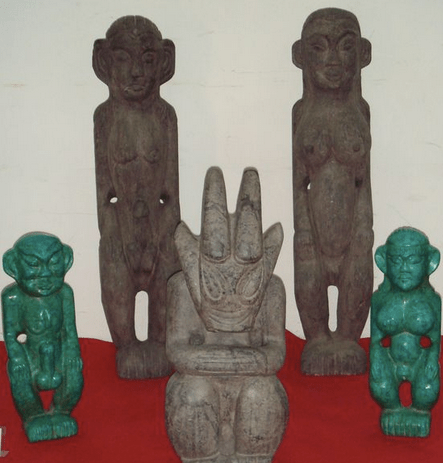
Religion & social structure
The architecture existence such as monuments, pyramids and the Goddess temple, point to the existence of “chiefdom”. (4) Over 60 tombs, constructed of stone and covered by stone mounds had been found. Frequently including jade carved artifacts.
Similar to Yangshao cultural sites, Hongshan provide the earliest evidence for Feng Shui (chinese: wind water) (5)
It includes governing spatial arrangements, orientations, and who was favourable at the time. Things like sitting and designing buildings probably involved Feng Shui, and the flow of energy.
Both the presence of round and square shapes. Also, suggests an early sign of the Gaitan cosmography (“round heaven, square earth”).
Did you know? Hongshan probably contributed to ancient Korea. However, some scholars consider it a pseudohistory (sham). Because they would not have been the only ones in the north eastern section of Asia. During such a long cultural time period. There were nomads, outcast and, others.
The Hongshan neolithic culture is significant because it represents an early phase of civilization in northeastern China. The elaborate art and burial practices suggest the presence of complex religious and social systems. The culture is also notable for its influence on subsequent nurtures in the region. As evidenced by the presence of Hongshan-style artifacts, in later archaeological sites. And, thru a timeline demonstrating what became more challenging climatic conditions.
Overall, the Hongshan neolithic culture provides valuable insights into the social, economic, and artistic development of ancient China, and, southeastern Inner Mongolia, during the neolithic period.
Cite: 1) Yang, Xiaoping; Scuderi, Louis A.; Wang, Xulong; Scuderi, Louis J.; Zhang, Deguo; Li, Hongwei; Forman, Steven; Xu, Qinghai; Wang, Ruichang (2015-01-20). “Groundwater sapping as the cause of irreversible desertification of Hunshandake Sandy Lands, Inner Mongolia, northern China” (https://www.ncbi.nlm.nih.gov/pmc/articles/PMC4311 860). Proceedings of the National Academy of Sciences. 112 (3): 702–706. Bibcode:2015PNAS..112..702Y (https://ui .adsabs.harvard.edu/abs/2015PNAS..112..702Y). doi:10.1073/pnas.1418090112 (https://doi.org/10.1073%2F pnas.1418090112). ISSN 0027-8424 (https://search.worldc at.org/issn/0027-8424). PMC 4311860 (https://www.ncbi.nl m.nih.gov/pmc/articles/PMC4311860). PMID 25561539 (htt ps://pubmed.ncbi.nlm.nih.gov/25561539).
2) Logie, Andrew (2020). “Claiming the Lineage of Northeast Asian Civilization: The Discovery of Hongshan and the “Hongshan Turn” in Popular Korean Pseudohistory” (https:// muse.jhu.edu/article/779703). Seoul Journal of Korean Studies. 33 (2): 279–322. doi:10.1353/seo.2020.0012 (https ://doi.org/10.1353%2Fseo.2020.0012). ISSN 2331-4826 (htt ps://search.worldcat.org/issn/2331-4826).
S2CID 231624654 (https://api.semanticscholar.org/CorpusI D:231624654)
3) Centre, UNESCO World Heritage. “Sites of Hongshan Culture: The Niuheliang Archaeological Site, the Hongshanhou Archaeological Site, and Weijiawopu Archaeological Site” (https://whc.unesco.org/en/tentativelist s/5804/). UNESCO World Heritage Centre.
4) (https://web.archive.org/web/20060923142811/https://po rtfolio.du.edu/portfolio/getportfoliofile?uid=38863) Sarah M. Nelson, Rachel A. Matson, Rachel M. Roberts, Chris Rock and Robert E. Stencel: Archaeoastronomical Evidence for Wuism at the Hongshan Site of Niuheliang, 2006.
5) (http://www.pitt.edu/~chifeng/text.html) University of Pittsburgh, Pennsylvania: Regional Lifeways and Cultural Remains in the Northern Corridor: Chifeng International Collaborative Archaeological Research Project. Cited references: Drennan 1995; and Earle 1987, 1997.
Bibliography: “Exhibition Brochure Timeline of cultures, dynasties, and archaeological sites represented in the exhibition” (https://web.archive.org/web/20140408032920/http://www.nga.gov/exhibitions/chbro_chron.shtm). http://www.nga.gov. Timeline posted by National Gallery of Art,
Washington, DC.
(https://books.google.com/books?id=1Gui8CdUfVoC&pg=PA29) Keith Pratt(2006), Everlasting Flower, p.30.
Cui, Yinqiu (2013). “Y Chromosome analysis of prehistoric human populations in the West Liao River Valley, Northeast China” (https://www.ncbi.nlm.nih.gov/pmc/articles/PMC3850526). BMC Evolutionary Biology. 13: 216. doi:10.1186/1471-2148-13-216 (http
s://doi.org/10.1186%2F1471-2148-13-216). PMC 3850526 (https://www.ncbi.nlm.nih.gov/pmc/articles/PMC3850526). PMID 24079706 (https://pubmed.ncbi.nlm.nih.gov/24079706).
Nelson, Sarah. “Tracing population movements in ancient East Asia through the linguistics and archaeology of textile production”
(https://www.cambridge.org/core/services/aop-cambridge-core/content/view/440213710888C5D9488901B27E047D03/S2513843
X20000043a.pdf/tracing_population_movements_in_ancient_east_asia_through_the_linguistics_and_archaeology_of_textile_pro
duction.pdf) (PDF). Cambridge University.
Wang, Chuan-Chao (2021). “Genomic insights into the formation of human populations in East Asia” (https://www.researchgate.n
et/publication/349510968). Nature. 591 (7850): 413–419. Bibcode:2021Natur.591..413W (https://ui.adsabs.harvard.edu/abs/2021
Natur.591..413W). doi:10.1038/s41586-021-03336-2 (https://doi.org/10.1038%2Fs41586-021-03336-2). PMC 7993749 (https://w
ww.ncbi.nlm.nih.gov/pmc/articles/PMC7993749). PMID 33618348 (https://pubmed.ncbi.nlm.nih.gov/33618348).
New Thoughts on the Impact of Climate Change in Neolithic China (http://www.archaeology.org/news/2883-150109-mongolia-ho
ngshan-jade) Archaeology誌解説記事
Scuderi, Louis A.; Yang, Xiaoping; Ascoli, Samantha E.; Li, Hongwei (2019-02-21). “The 4.2 ka BP Event in northeastern China: a geospatial perspective” (https://cp.copernicus.org/articles/15/367/2019/). Climate of the Past. 15 (1): 367–375.
Bibcode:2019CliPa..15..367S (https://ui.adsabs.harvard.edu/abs/2019CliPa..15..367S). doi:10.5194/cp-15-367-2019 (https://doi.
org/10.5194%2Fcp-15-367-2019). ISSN 18
.
Leave a Reply