<home # start here # guides # builds # services # shop # about # categories>
Hierakonpolis—ancient Nekhen, the “City of the Falcon” is one of the most important prehistoric archaeological landscapes in Egypt.
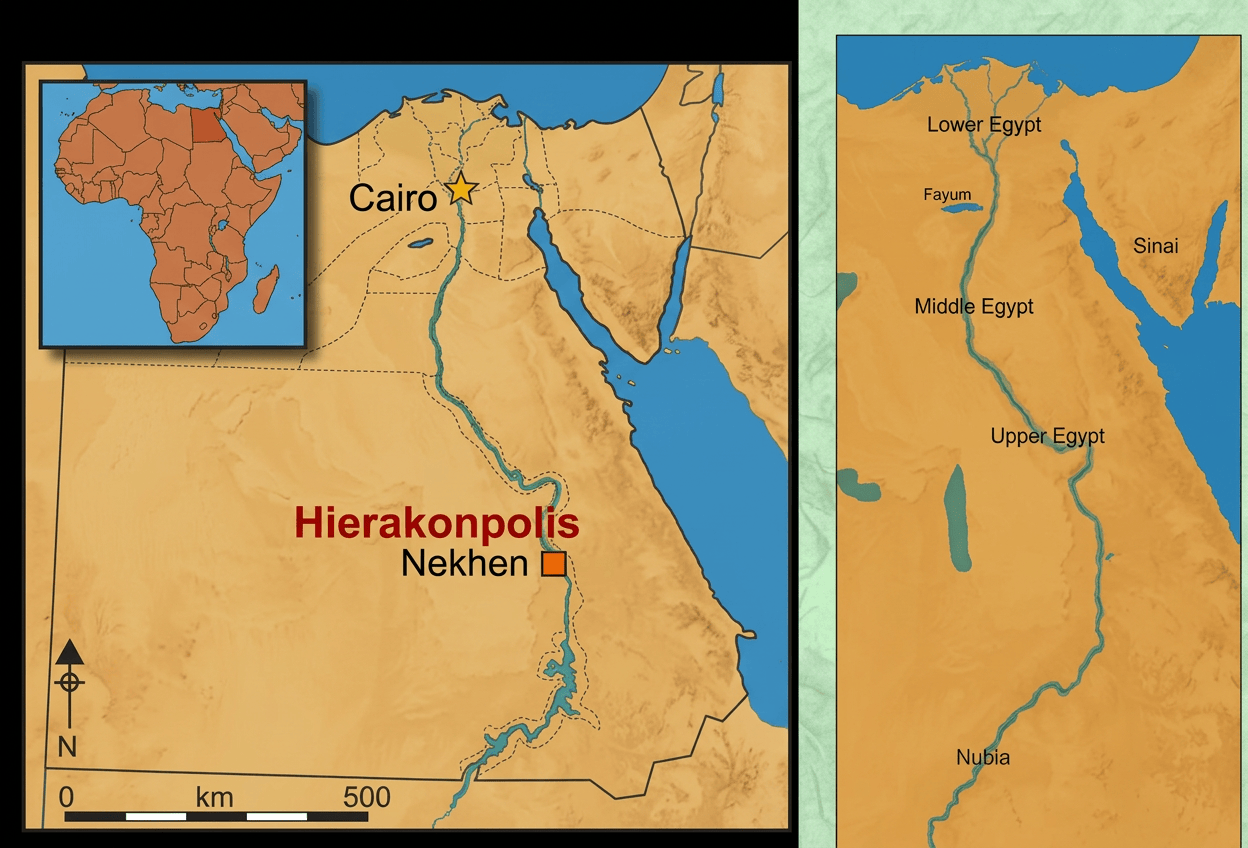
It is not simply a cemetery, temple or ruined city. It is an unusually complete landscape of houses, workshops, breweries, cemeteries, ceremonial buildings, storage areas, animal facilities, rock art and agricultural zones. At its height, around 3700–3500 BC, the settlement extended for roughly 2.5–3 km along the desert edge and almost 3 km into Wadi Abu Suffian. Deep coring shows occupation from approximately 4400 BC, or the Badarian period.
That makes Hierakonpolis especially valuable for a project about Neolithic architecture: we can see not only see and interpret what people built, but how water, agriculture, animals, craft production, ritual, burial and climate interacted to create an early city
Though an important qualification. In the narrow chronological sense, the best-preserved monumental and urban evidence is Chalcolithic/Predynastic, particularly Naqada I–III, rather than Neolithic.
Hierakonpolis is in Upper Egypt, on the west bank of the Nile, about 17 km north of modern Edfu and approximately 113 km north of Aswan
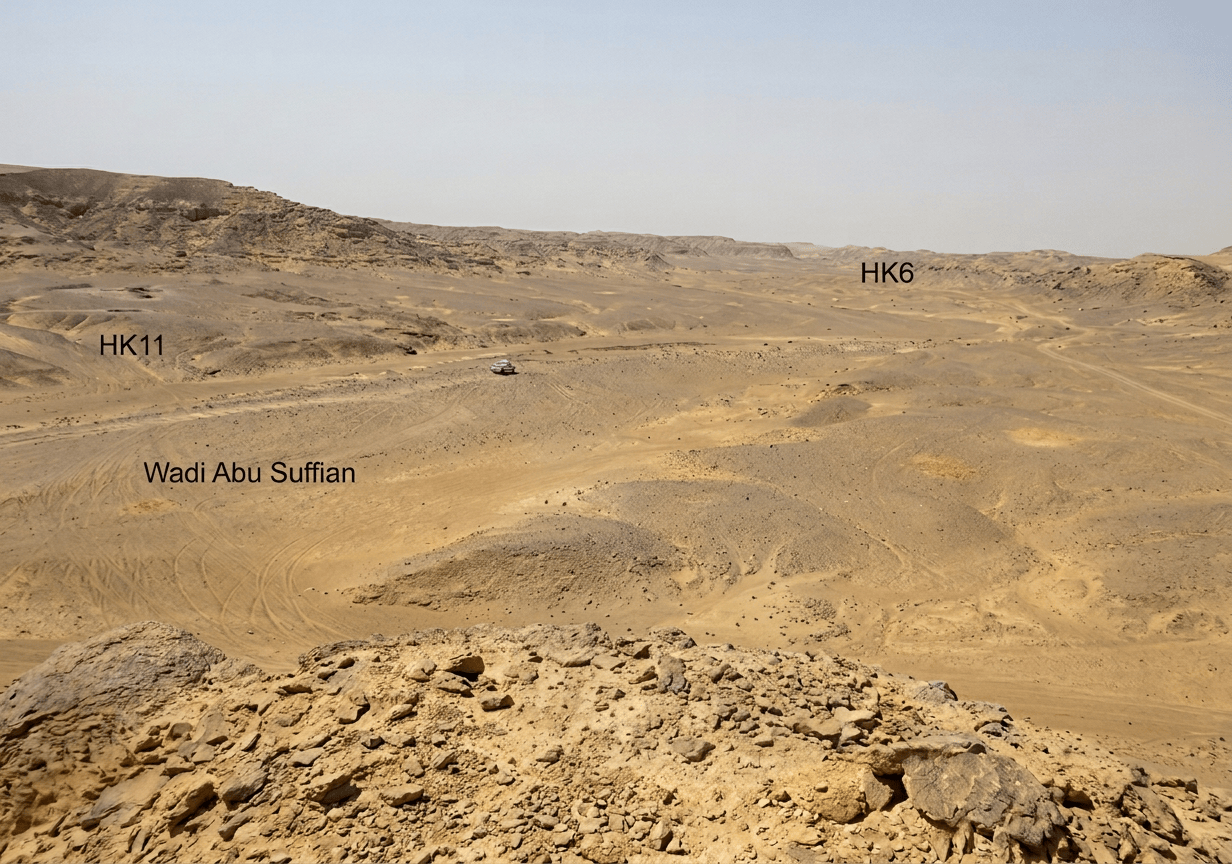
The archaeological landscape occupied the crucial boundary between: Nile floodplain, low desert, wadi and higher desert. The Great Wadi, Wadi Abu Suffian, runs westward from the Nile through the site.
This was an extraordinary location because people could exploit several ecological zones within a short distance. Including: fertile Nile floodplain, river and fish, marsh/wetland environments, desert-edge vegetation, wadi pasture, wild animals, stone, clay, timber and routes toward the Eastern Desert and Red Sea. It was roughly: 150–200 km from the Red Sea coast, and roughly 550–650 km from the Mediterranean coast in straight-line terms.
How close was it to the Nile? Very close
The settlement reached the floodplain, while some of its desert neighborhoods were several kilometres inland. One particularly interesting household at HK11 was about 1.5 km from the edge of the modern cultivation, and its excavators found a copper fishhook even though the locality is now about 4 km from the present Nile. This demonstrates how dramatically the river channel and landscape have changed.
Geological research indicates that a former Nile channel ran along the boundary between the desert and floodplain during the Predynastic period. By about 3100 BC that channel was shifting/drying, helping to change the settlement pattern.
Hierakonpolis was fundamentally a Nile-and-wadi environment
But that does not mean it was dry everywhere. The archaeological and botanical evidence indicates Nile channels, seasonally wet areas, wetlands, swamp vegetation, flood basins, wadi runoff and groundwater-dependent vegetation. Plant remains include Phragmites reeds, Cyperus, Juncus and other wetland plants, alongside acacia, tamarisk, sycamore and desert vegetation. So imagine a green ribbon of river and floodplain surrounded by increasingly dry desert, with a wadi extending westward into the desert. Much closer to the ancient environment than imagining the middle of today’s completely barren Sahara.
One of the interesting things about the site is that people used the wadi landscape for much more than simply travelling through it
The wadi contained: settlement, workshops, breweries, pottery production, rock art, cemeteries and animal activity.
Was the environment “extreme”?
By modern standards, yes—but with an enormous qualification. Today the area is extremely arid. The prehistoric inhabitants, however, lived beside one of the world’s greatest perennial rivers. So it was an arid-environment civilization with a reliable aquatic core. That’s important. It wasn’t Nabta Playa, where human occupation depended heavily on rainfall and shrinking vanished lakes.
Was there anyone here 12,000 years ago?
At Hierakonpolis itself: not according to current evidence. The documented settlement sequence begins around the Badarian period, approximately 4400 BC. But there is an extraordinary qualification. The larger Hierakonpolis archaeological concession contains much older archaeological evidence. A locality known as Sayyida I produced a remarkably preserved deposit approximately 12,000 years old, and the wider concession contains evidence of human activity extending tens of thousands of years into the Palaeolithic. So humans were using the wider landscape long before Nekhen became a Neolithic/Predynastic settlement. But we should not call those people “Neolithic inhabitants.”
The architecture was surprisingly light
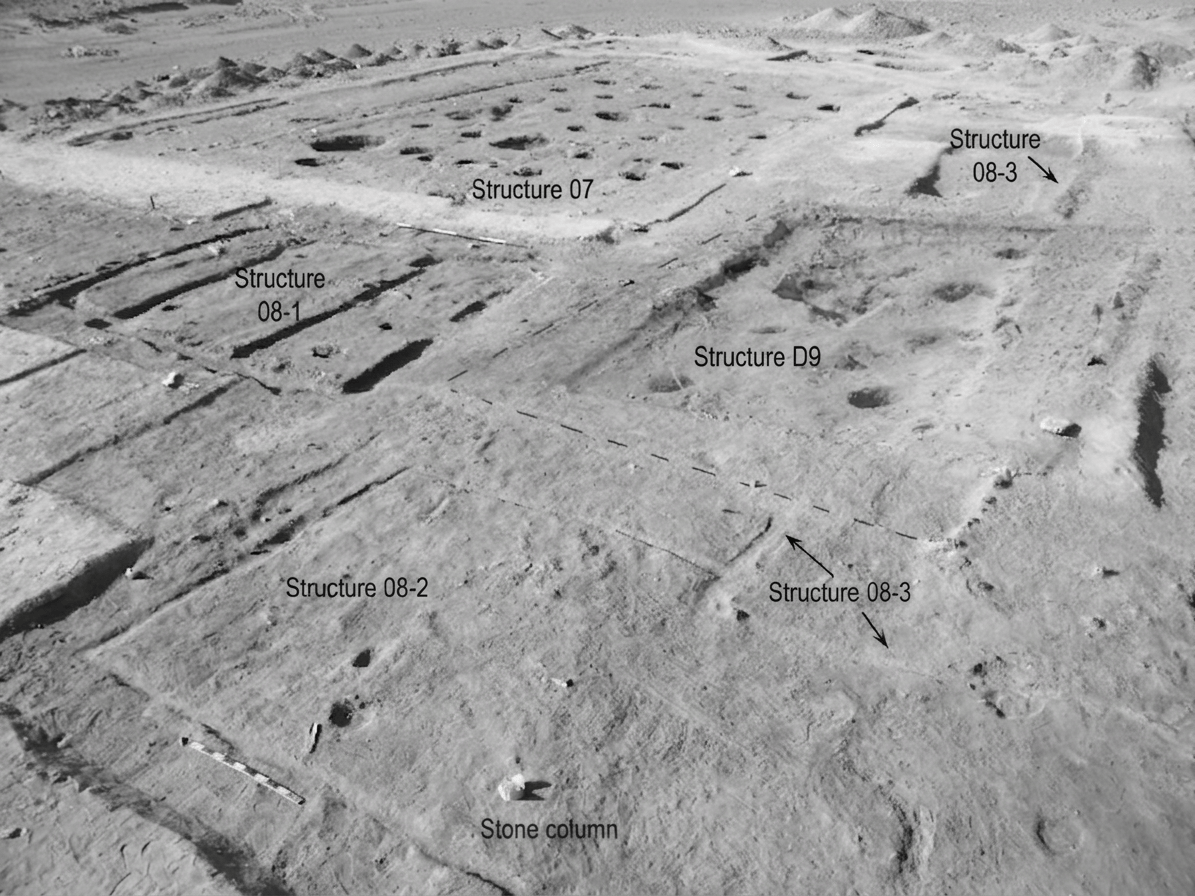
If you visited the site 5,500 years ago, you would not have seen a city of stone. Much of the architecture was constructed from wood, reeds, mud, mud plaster, mudbrick, stone, woven mats, twine and compacted earth. And, much of it has disappeared. Archaeologists therefore frequently find the negative evidence. Including: postholes, foundation trenches, sunken floors, pits, hearths, patches of burned mud, charcoal, impressions of reeds and collapsed mud. The 2026 GPR study emphasizes that much of Hierakonpolis’s prehistoric architecture survives as precisely these negative features.
HK29: The famous Burnt House
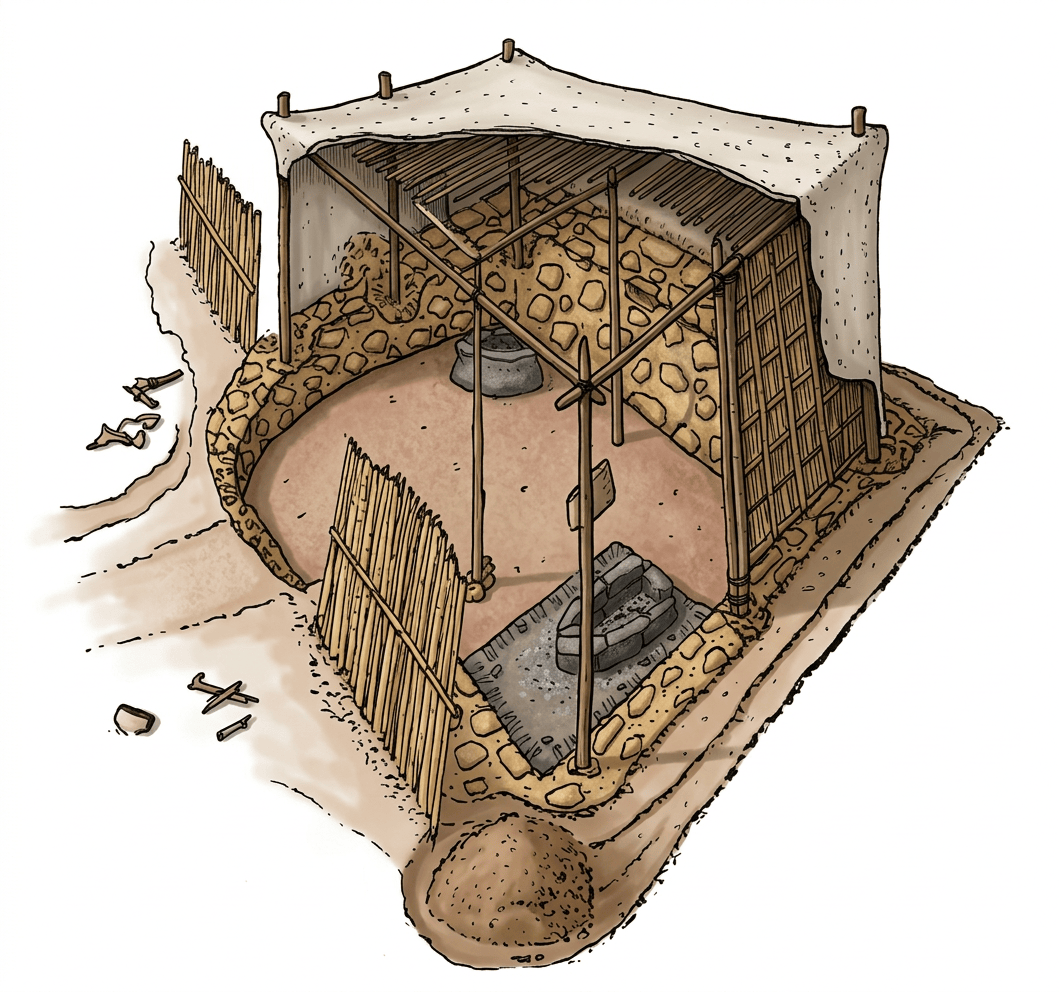
Perhaps the single best Neolithic-architecture-style building at Hierakonpolis. HK29 was a small rectangular house belonging to a potter, where something went spectacularly wrong. About 5 meters from the house, his pottery kiln apparently caught the building on fire. The disaster became an archaeological gift. The fire hardened mud, baked the lower walls, carbonized posts; and preserved reeds, roofing material and the position of structural elements.
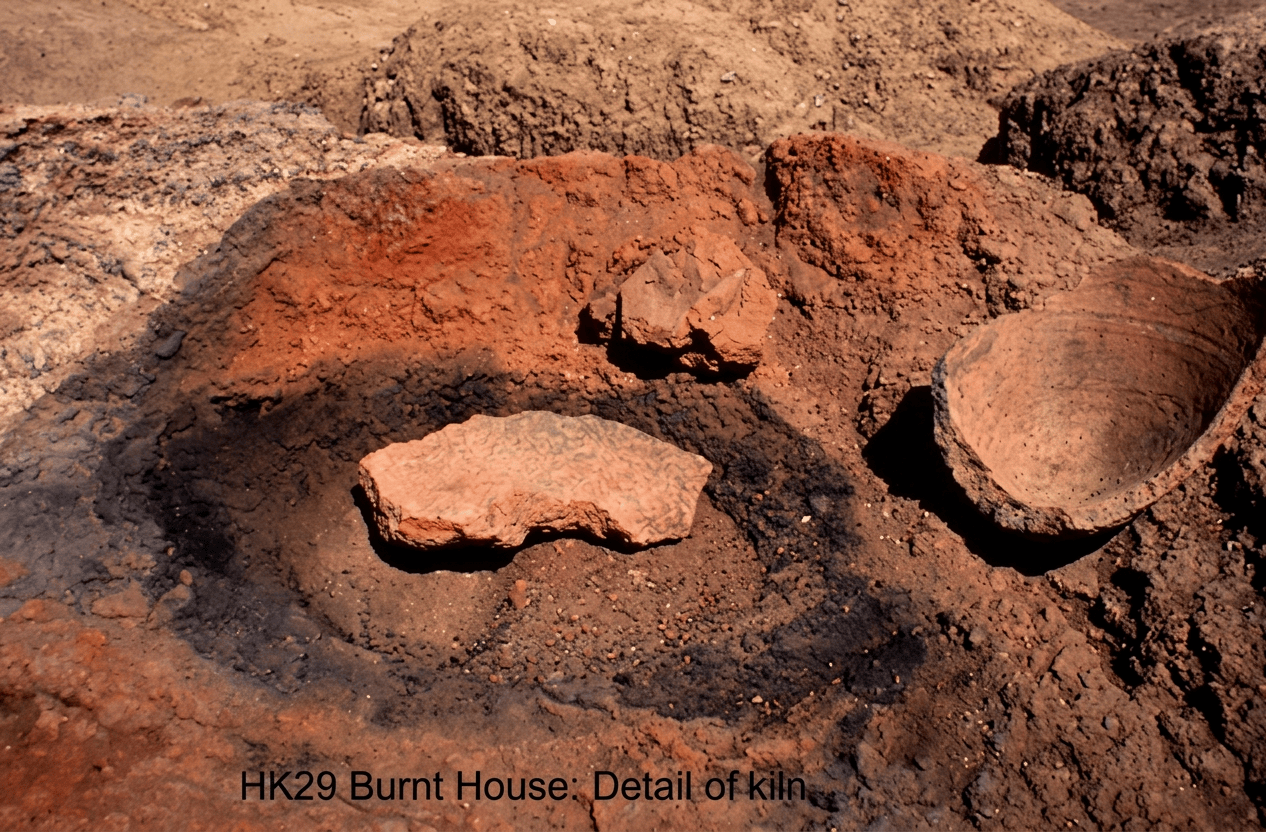
The house measured approximately 4 × 3.5 m and was dug roughly 50 cm into the ground. Eight wooden posts supported the walls/roof. Mud mortar and mudbrick formed the lower construction, while the walls incorporated plastered reeds. Genuine hybrid architecture. Earth, timber, reed, mud plaster and stone/earth hearth technology.
Yes, there was sunken architecture
HK29 is explicitly semi-subterranean. The floor was dug approximately half a metre into the ground. Other houses appear to have had sunken floors, postholes, shallow foundations, mud walls, reed walls and wooden structural frames. It makes sense because sunken floors reduces wind exposure, uses the ground, has thermal mass, reduces wall height, provides a stable foundation and can make a lightweight structure more secure. An especially interesting connection with interests in passive environmental architecture.
Wattle-and-daub?
Very likely, and in some cases directly supported. At HK29 later structures included possible mud, mudbrick, reused potsherds and wattle-and-daub constructions. At HK11 the fence is even more spectacular. More than 40 acacia posts supported lengths of reed matting, which were attached using twine and then coated on one side with mud. Its essentially a timber/reed/mud composite wall. Exactly the sort of building technology that can disappear almost completely if it isn’t burned.
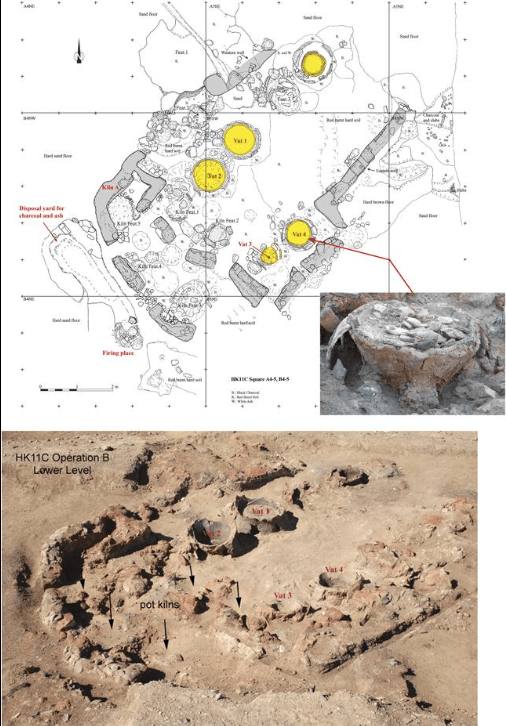
HK11: one of the best domestic architecture discoveries
A home provides an unusually good sequence of domestic construction. One early phase contained sub-rectangular floor, wall trench, postholes, small post settings, pot emplacements, large stone-lined hearth, reed matting, grinding stone and mud-lined storage pit. Later, a 20-metre-long fence was constructed from acacia posts and reed matting. The fence was mud-coated. There was an entrance/courtyard arrangement, hearth, food preparation area, storage and evidence for keeping animals. Much more than a “hut.” It was more like a household compound.
Did they have stone buildings?
Stone was important—but not usually as the primary domestic wall material in the early settlement. Stone was instead used for hearths, grinding stones, tools, vessels, foundations/features, monumental architectural elements and specialized objects. Monumental Predynastic architecture was still heavily dependent on wood. The HK29A gateway, for example, used enormous acacia timber pillars.

HK29A: ceremonial architecture
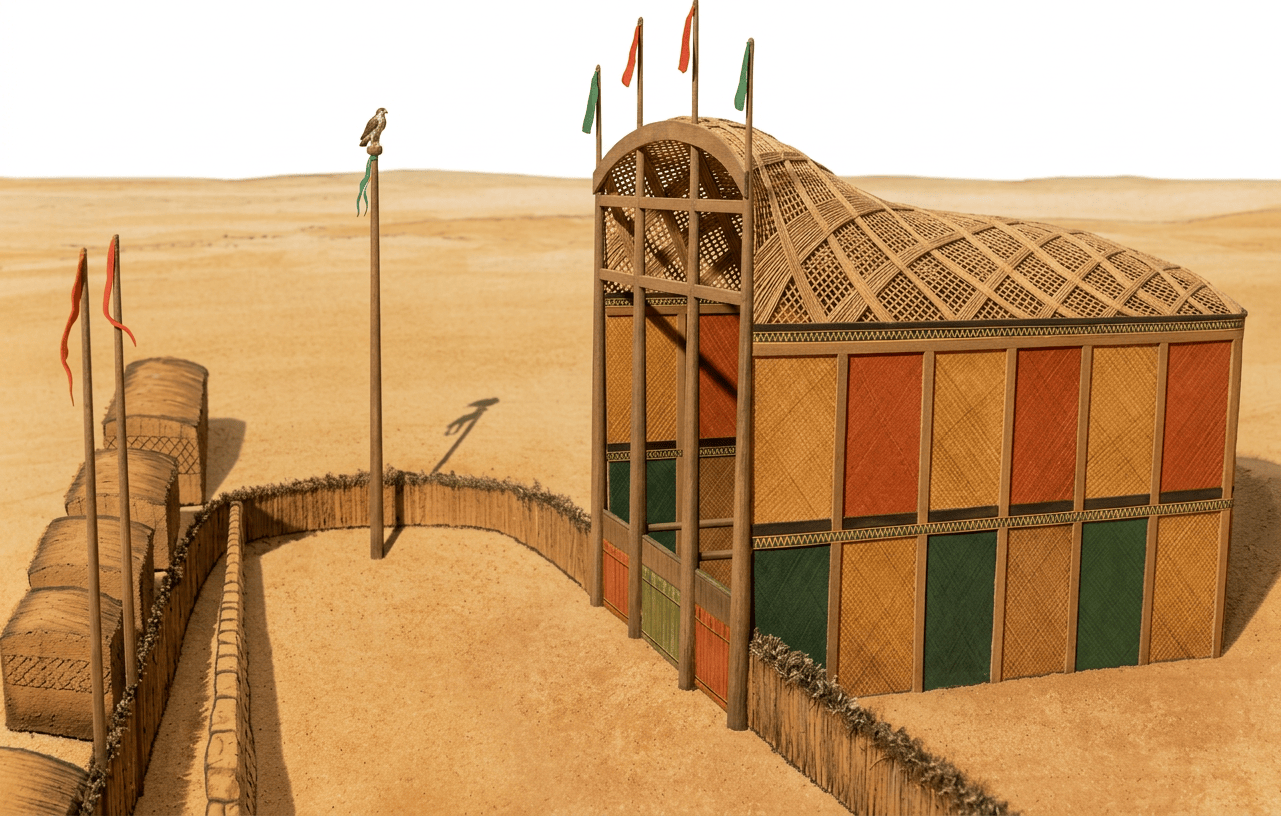
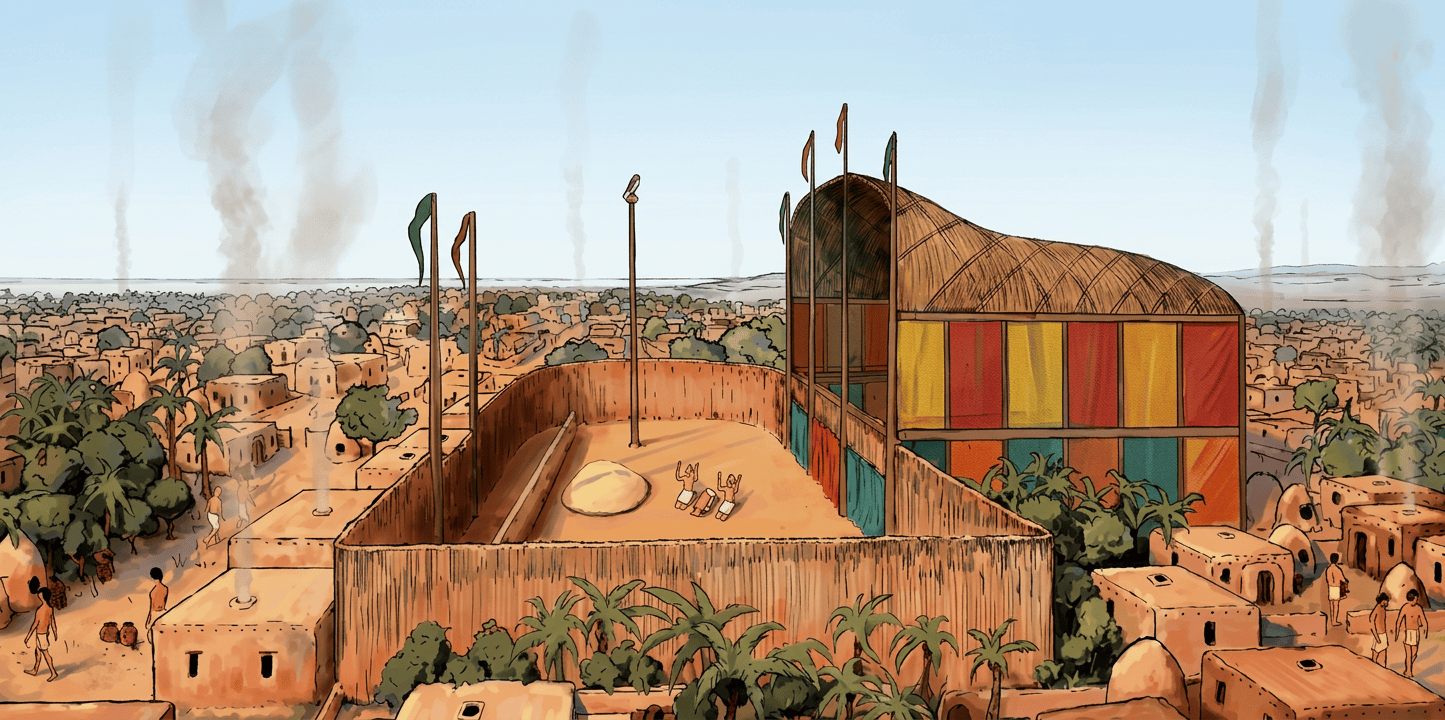
This is where Hierakonpolis becomes extraordinary. HK29A appears to have been a ritual/ceremonial center, although interpretations of its exact function continue to evolve. It contained a large oval courtyard more than 40 m long, associated with a monumental entrance. The entrance contained four enormous acacia pillars; plus, smaller wooden posts. Nearby was the HK29B palisade. More than 50 metres of the wooden wall has been excavated, and the newly published 2026 GPR survey traced another 18 m of its buried continuation. The complex may have enclosed more than a hectare, although its full extent remains uncertain. That uncertainty is important. We should not simply call it “the first temple.” The latest research describes it more cautiously as a ceremonial/administrative complex, with manufacturing and other activities potentially enclosed within the larger compound.
What happened inside? A great question
This is one of the most remarkable archaeological assemblages from Predynastic Egypt. Thousands of animal bones were deposited there. They include domestic cattle, sheep/goat, pigs and fish. Wild crocodile, hippopotamus, soft-shelled turtle, gazelle, Barbary sheep, fennec, striped hyena, aurochs and other carnivores. There’s evidence large Nile perch, sometimes more than a metre long were even consumed. The unusually high percentage and diversity of wild animals distinguishes the assemblage from ordinary household refuse. The evidence suggests feasting and ritual animal sacrifice, but researchers have also proposed that the wild animals had symbolic significance connected with the control of dangerous/chaotic forces. The exact interpretation of the rituals remains debated.

Is it an early form of Egyptian temple architecture?
The earlier interpretation of HK29A as a conventional “shrine” has been revised. The present evidence points toward a place where large groups gathered, animals were processed, feasting occurred, unusual animals were deposited, monumental wooden architecture was used and administrative activity may have occurred. It is an early example of architecture organizing people, food, animals and ritual. And, not merely an early stone temple.

Hierakonpolis had specialized industrial neighborhoods and workshops
There were shops for: pottery, beer, stone vessels, beads, flint, food preparation, and perhaps copper/metalworking.
The HK29A/B complex included workshops for fine flint tools, semiprecious beads and drilled stone vessels. It tells us something important about the settlement: people weren’t simply farmers making everything at home. Instead, specialized production was already emerging.
Pottery technology was sophisticated
The potters used carefully prepared clay, often tempered with straw. Fine red vessels were shaped by hand, dried carefully, coated with red ochre/iron oxide, polished and fired. Some vessels were extremely thin and technically demanding.
Experimental archaeology indicates that utilitarian pottery may have been fired in pit kilns, with vessels covered by mud and potsherds to retain heat
Some pottery-production installations were deliberately placed in small gullies where prevailing winds could help increase firing temperatures. A wonderful example of architecture responding to natural airflow.
Brewery surprises
Large-scale beer production occurred at HK24 and HK11C. At HK24, magnetometry revealed at least eight brewing installations, generally rectangular and containing large vats arranged in rows. HK11C contained: huge vats, cooking installations, fire installations, pottery-production facilities, storage, mudbrick structures and working spaces. Some of the vats could hold roughly 75 litres. So beer was not necessarily somebody’s little household hobby. It was part of an organized food-and-drink economy.
Hearths, ovens and “heaters”
HK11 and HK29 contain substantial hearth evidence. HK11 has a large stone-lined hearth with reddened soil and ash.
Ovens/kilns. Pottery firing installations are abundant.
Food-processing heating. HK11C contained large vats and fire installations.
Chimneys. No convincing evidence. Its believed there is no good reason to reconstruct conventional chimneyed houses at Predynastic Hierakonpolis. The buildings were low and relatively open, with lightweight walls and roofs. Smoke could escape through openings or around the roof rather than through a purpose-built chimney.
An area where the archaeological evidence is much weaker. Beds, benches and chairs
Scientists have securely documented: reed and woven mats; storage pots; baskets; grinding equipment; working surfaces; hearths and, containers. At HK43, bodies were laid on mats, sometimes with many layers of matting. A Predynastic tomb at HK6 even contained wood beneath layers of matting that may have formed some kind of bed/platform, although that belongs to funerary architecture rather than an ordinary house.
Do not illustrate an HK11 house with modern-looking furniture
Chairs, conventional beds, tables and cupboards were not securely demonstrated for ordinary homes. A better reconstruction would have been mats, baskets, pots, storage pits, grinding stones and low working surfaces.
Agriculture
The agricultural economy was strongly based on: Emmer wheat. The principal human cereal. And, barley but it appears to have been particularly important as animal feed.
Flax. Was used for linen production, with seeds also potentially used as food/fodder.
Melons. Cultivated melons are documented.
Wild plants include: Balanites (desert date), Ziziphus (sidr/christs thorn), Citrullus (watermelon type plant), field weeds, desert plants and wetland vegetation.
Did you know? At HK43, archaeologists even recovered garlic that still retained its aroma after roughly 5,500 years.
Animals: an unusually rich picture
Domestic: cattle, sheep/goat, pigs and dogs.
Wild: gazelle, hippopotamus, crocodile, fox, aurochs, barbary sheep, birds, turtles and fish. Especially: nile perch and synodontis catfish. Reminding us the Nile remained central to subsistence even while the settlement expanded into the desert.
They were farmers, herders, fishers and hunters
The economy was genuinely mixed. At HK11, domestic animals dominate the faunal assemblage, while hunted animals occur in smaller numbers. At HK29A, however, wild animals become disproportionately important because that was a special ceremonial context. So we should not calculate the entire society’s economy from HK29A. The overall picture is combined farming, livestock, fishing, hunting, gathering, and craft production.
Did they use irrigation?
There was probably some form of floodwater management. The evidence needs careful wording. The strongest evidence is for agriculture on the Nile floodplain, where natural inundation could provide moisture. The floodplain contained natural levees and basins that could trap floodwater. Such basin-style flood agriculture does not require the elaborate permanent canal networks associated with much later irrigation systems.
There have been proposals that Predynastic Hierakonpolis used basin irrigation, and some archaeological interpretations place early artificial water management in this period. But there is not a securely excavated Predynastic canal network at Hierakonpolis that lets us reconstruct a sophisticated irrigation system in detail
Agriculture depended heavily on Nile inundation and floodplain water management; limited basin irrigation may have existed, but a large engineered canal-irrigation system has not been demonstrated at Predynastic Hierakonpolis.
Tool assemblage is impressive
They made flint knives, blades, scrapers, arrowheads, sickle elements, bifacial tools, stone grinders, palettes, maceheads, stone vessels, beads, bone tools and copper tools.

At HK11, the household lithic assemblage was surprisingly expedient rather than being a specialized factory. People maintained a flexible collection of tools for different jobs
From a neolithic technology perspective interesting. The ordinary household toolkit could be quite simple: stone, wood, bone, fibre, clay and fire. But specialized workshops were simultaneously producing remarkably sophisticated objects.
Copper
Yes. Copper occurs in the Predynastic settlement. HK11 produced copper needles and a finely made copper fishhook. The fishhook is especially fascinating because it was found in a household compound far from the modern Nile.
Later research at HK11C has been investigating evidence for copper-related industries, using portable XRF and other analytical techniques.
Gold certainly occurs in the broader Hierakonpolis archaeological record, although some of the most spectacular gold objects belong to later Dynastic contexts
Predynastic Hierakonpolis was connected to long-distance networks. Objects included: copper, malachite, carnelian, exotic stones, shells, obsidian, lapis lazuli, cedar and other imported materials. The appearance of such materials shows that Hierakonpolis was connected to networks extending far beyond the immediate Nile valley.
Predynastic Hierakonpolis produced fragments of Lebanese cedar
That tree could not have grown locally. So somebody had to obtain it through long-distance exchange. This is particularly interesting because cedar, resin and other forest products connect the Egyptian desert to the Levantine forests and Mediterranean world.
There are exceptionally well preserved textiles
At HK43 there are linen shrouds, linen padding, woven textiles, mats, string and basketry. Some bodies were covered by multiple mats. The textile evidence is sophisticated enough to study spinning direction, yarn manufacture, weaving, thread technology, fibre quality and social differences in textiles. There is even evidence for an early red-coloured textile, apparently coloured with iron oxide/mineral pigment.
Definitely baskets
HK43 is extraordinarily important for basketry. Archaeologists recovered: coiled baskets, pedestal-based baskets, fibre containers, baskets containing food and baskets containing grave goods. One basket contained: stone pendants, an amulet, red ochre, galena and other materials. This is important because baskets are essentially architecture at a tiny scale: fibre, frame, container, storage and transport. The same principles used in reed fencing and mat walls were used to make portable containers.
Burials and ochre
Hierakonpolis has both elite and non-elite cemeteries. The HK43 workers’ cemetery contained at least 452 graves / more than 500 people. They were usually buried flexed on their side, often on mats and beneath linen. Grave goods included: pottery, bread, beer, fruits, beads, palettes, copper, ochre and tools. One woman had a complete garlic bulb wrapped in fabric.
Hierakonpolis provides an extraordinary early stage in the history of Egyptian body preservation
At HK43, some bodies were: wrapped, padded, covered with linen, protected by mats and treated with resin. One individual appears to have had an internal organ removed and wrapped before being returned to the body, although researchers appropriately stress that more evidence is needed before drawing firm conclusions. This is not yet the fully developed Egyptian mummification of later dynasties. But it demonstrates experimentation with wrapping, padding, resin, body manipulation and preservation.
Human archaeology: Hair Dye
One HK43 burial provides some of the earliest evidence for henna-dyed hair in Egypt and early hair extensions. A woman’s gray hair had been dyed and additional hair had been incorporated into the hairstyle. Its not just “subsistence.” Someone cared about how another person looked.
There is no reason to imagine a professional medical system comparable to later Egypt. But..
Archaeology shows: dental health, trauma, nutritional conditions, disease, injuries, body treatment, preservation techniques and plant use. HK43 dental remains generally show surprisingly good dental health, although individual cases include severe tooth wear and tooth loss. So it is safer to talk about health knowledge, nutrition and bodily treatment than “medicine” in the later Egyptian sense.
An extraordinary discovery, the elephant burials
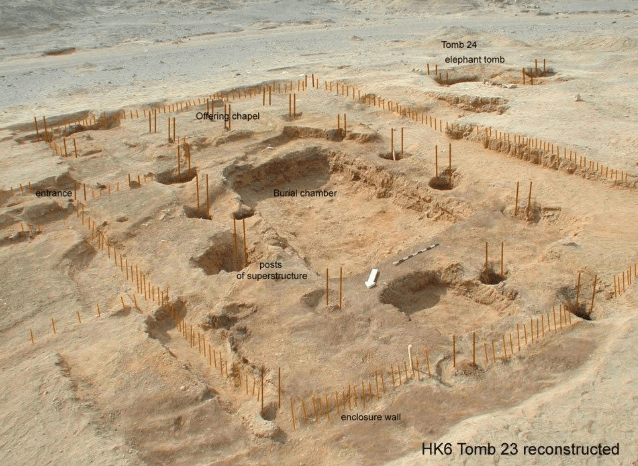
One of Hierakonpolis’s strangest discoveries was an elephant burial in the elite cemetery HK6. It was an extraordinary animal associated with elite funerary activity. Other unusual animals occur at HK6 and HK29A, including hippopotamus and other dangerous or symbolically important species. It suggests that animals were not merely food. They could represent: wealth, power, danger, prestige, ritual and control over nature.
The elite cemetery HK6
HK6 is essential because it reveals a second kind of architecture monumental funerary architecture. There were: large tombs, subsidiary burials, animal burials, funerary chapels and complex spatial arrangements. The cemetery belonged to an elite sector of society and contrasts beautifully with the workers’ cemetery HK43. So at Hierakonpolis you can compare ordinary houses, workers’ graves, elite tombs and ceremonial center. An unusually complete social landscape.
Perhaps the most important point. The settlement was already becoming a city
Hierakonpolis wasn’t simply a big village. At its maximum extent it contained: Residential areas. HK11, HK29 and other localities;
Industrial zones. Pottery and breweries;
Administrative/ceremonial areas. HK29A/B;
Elite cemetery. HK6;
Non-elite cemeteries. HK43 and others;
Agricultural land. Nile floodplain;
Transport corridor. Wadi Abu Suffian; and,
Ritual/artistic landscape. Rock art and ceremonial deposits.
The site’s own archaeological project describes it as containing essentially all the components of a city: houses, trash mounds, cemeteries, industrial areas and cult/ceremonial centers.
Climate: what was happening 10,000 years ago?
Here we need to separate regional climate history from the specific occupation at Hierakonpolis. Around 10,000 years ago, North Africa was substantially wetter than today. The African Humid Period transformed parts of the Sahara into: grassland, savanna, wetlands, lakes and seasonal rivers. But Hierakonpolis lies farther south in the Nile Valley, where the Nile itself remained the crucial source of water. So the landscape was probably not a forest. It was more like riverine woodland, wetlands, grassland patches, desert scrub and wadi vegetation.
8,000 years ago
The African Humid Period was still underway. Climate wasn’t uniformly wet everywhere, however. There were significant fluctuations in rainfall and hydrology. The famous 8.2 ka climate event, around 8200 years ago, represents an abrupt global/regional climatic disturbance associated with major changes in North Atlantic circulation.
It wasn’t one switch from “wet” to “dry.” It involved pulses, regional differences, changing Nile floods, rainfall variability and gradual ecological reorganization
More relevant to the emergence of Predynastic Egypt was 6,000 years ago
Across northeastern Africa, the African Humid Period was beginning to weaken. The Sahara gradually became more arid. Pastoral populations increasingly faced a choice: follow shrinking water sources or concentrate around permanent rivers/oases. The Nile consequently became increasingly important. This is one reason it is dangerous to explain Egyptian civilization simply as “People happened to live beside the Nile.” The Nile became especially valuable as surrounding landscapes became less reliable.
The critical period for Hierakonpolis was around 5,000–4,000 years ago
By the Predynastic period, the environment was becoming increasingly dry. At HK11, archaeobotanical sequences show decreasing representation of desert trees/shrubs and increasingly sparse vegetation in later deposits. The Hierakonpolis research team associates the decline in precipitation after about 3500 BC with abandonment of the low-desert settlement zones. It doesn’t mean “Climate change destroyed Hierakonpolis.” The story is more complicated.
It wasn’t simply abandoned
The low-desert Predynastic settlement areas contracted or were abandoned, but Nekhen itself continued. Geological research indicates that the Nile channel near the desert edge shifted eastward and gradually dried toward the end of the Predynastic period. People subsequently concentrated more heavily on a raised area in the floodplain—later associated with Kom el-Gemuwia. The sequence can be better described: low desert settlement, environmental/hydrological change, contraction, relocation toward reliable floodplain land and continued occupation of Nekhen. It was adaptation, not simply collapse.
Climate change was only one factor
Other possible factors include: Nile-channel migration, declining floodwater, increasing aridity, pressure on fuel resources, intensive wood cutting, expansion of agriculture, changing political organization and changing settlement priorities. The Hierakonpolis team specifically notes that extensive tree cutting for brewing and pottery fuel may have contributed to local ecological change, while broader drying ultimately made low-desert habitation less viable. We shouldn’t pretend that one cause explains everything.
Eight things make Hierakonpolis unique
- It preserves a whole early city Not merely a tomb or temple.
- It preserves ordinary houses. Especially HK29 and HK11.
- It preserves industry. Pottery, beer, stoneworking, beads and other crafts.
- It preserves ritual. HK29A is an extraordinary early ceremonial complex.
- It preserves social differences. HK43 versus HK6.
- It preserves organic material. Wood, reeds, baskets, textiles, food and even hair survive.
- It preserves environmental information. Plants, animals, Nile sediments, wadis and ancient channels.
- It connects directly to the emergence of kingship. The site’s later history includes the Narmer Palette and other objects associated with the formation of the Egyptian state.
The Narmer Palette
The famous Narmer Palette, discovered at Hierakonpolis in 1897, is slightly later than the core Neolithic period. But it is difficult to tell the story of Hierakonpolis without mentioning it.
It shows how the settlement had become embedded in an emerging ideology of kingship, ritual, warfare, territory and political authority.
The Scorpion Macehead and other objects similarly connect Hierakonpolis to the early development of Egyptian royal symbolism. The state did not suddenly appear. Its political institutions grew out of a much older settlement containing houses, farms, workshops, breweries, cemeteries and ceremonial spaces.
Hierakonpolis is one of the rare prehistoric sites where you can watch a community turn a river, desert, wadi, farms, workshops, cemeteries and ceremonial spaces into an early city
The first Egyptian cities were not built out of stone. They were built from systems of wood, reeds, mud, fibre, fire, food, water and human organization. The famous monumental objects came later but the underlying architecture was already there.
References: Friedman, R. F. 2009. “Hierakonpolis Locality HK29A: The Predynastic Ceremonial Center Revisited.” Journal of the American Research Center in Egypt 45: 79–103.
Hoffman, M. A. 1980. “An Amratian House from Hierakonpolis and Its Significance for Predynastic Research.” Journal of Near Eastern Studies 39:119–137.
Friedman, R. F. et al. — continuing Hierakonpolis Expedition / Nekhen News publications.
Linseele, V., Van Neer, W. & Friedman, R. 2009. “Special Animals from a Special Place? The Fauna from HK29A.”
Fahmy, A. G. & Fadl, M. 2009. Plant macroremains from HK29A.
Watrall et al. / Friedman et al. — HK11 domestic settlement and archaeobotanical research.
Baba, M. — Predynastic pottery production and firing technology.
Jones, J. — Predynastic textiles from HK43.
Aziz, A. M., Friedman, R. & Attia, T. 2026. “Unveiling hidden prehistoric structure via high-resolution GPR survey at Hierakonpolis, Aswan, Egypt.” Scientific Reports 16, 22413. This is the important new 2026 research on HK29B and the ancient Nile channel.
Leave a Reply