<home # start here # guides # builds # services # shop # about # categories>
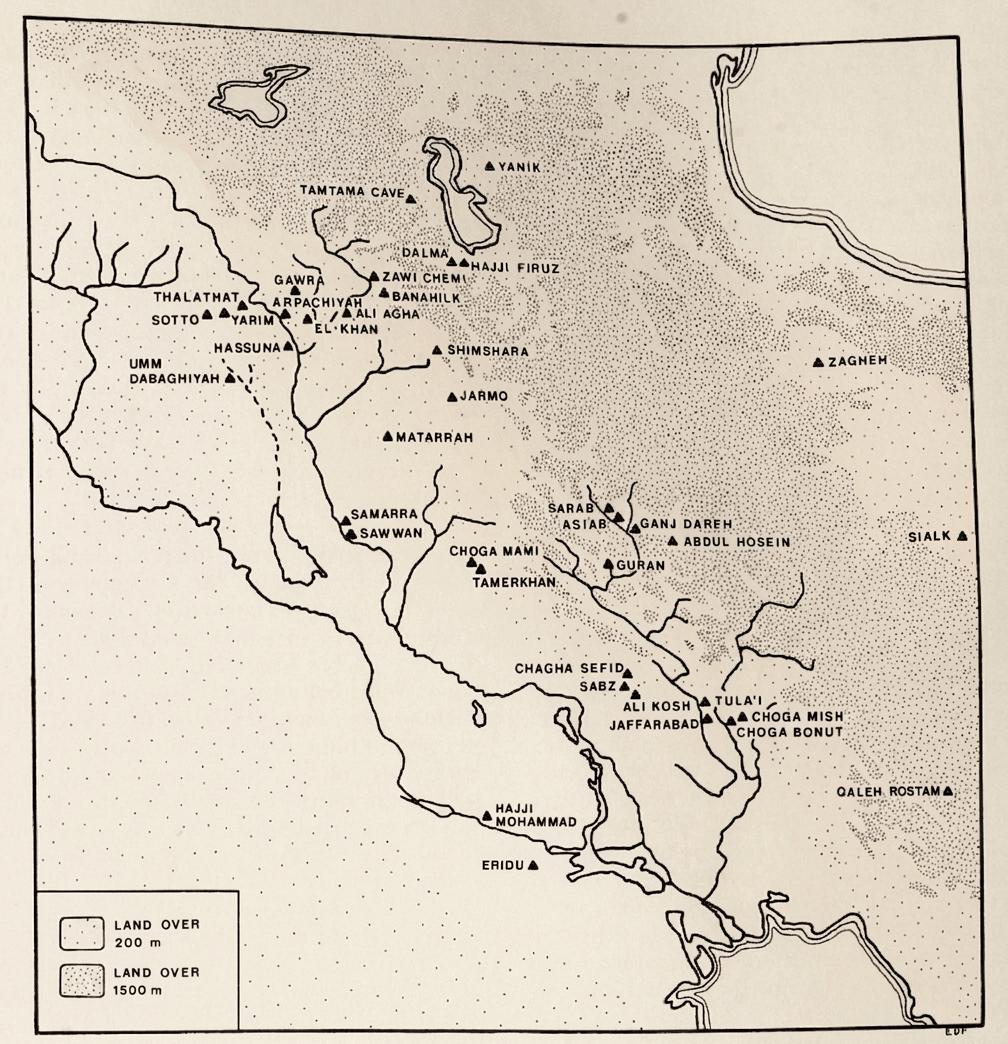
Hajji Firuz Tepe is one of the most important Neolithic sites in Iran for understanding the spread of farming into the Lake Urmia basin and northwestern Zagros. It is particularly valuable because it combines a remarkably well-preserved sequence of small mudbrick houses, storage installations, ovens, household burials, clay figurines and tokens, cereal agriculture, sheep/goat and pig husbandry, obsidian exchange, and sophisticated pottery production.
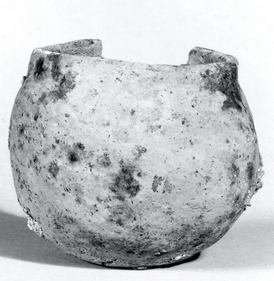
It is also famous for something rather different: chemical residues in pottery vessels have been interpreted as evidence for grape wine, dating to roughly the mid-sixth millennium BC. That makes Hajji Firuz one of the classic sites in the history of fermented beverages.
But the wine is only one part of the story. Architecturally, Hajji Firuz is an excellent example of a small household-based farming village, rather than a monumental or centrally planned settlement.
Where was Hajji Firuz Tepe?
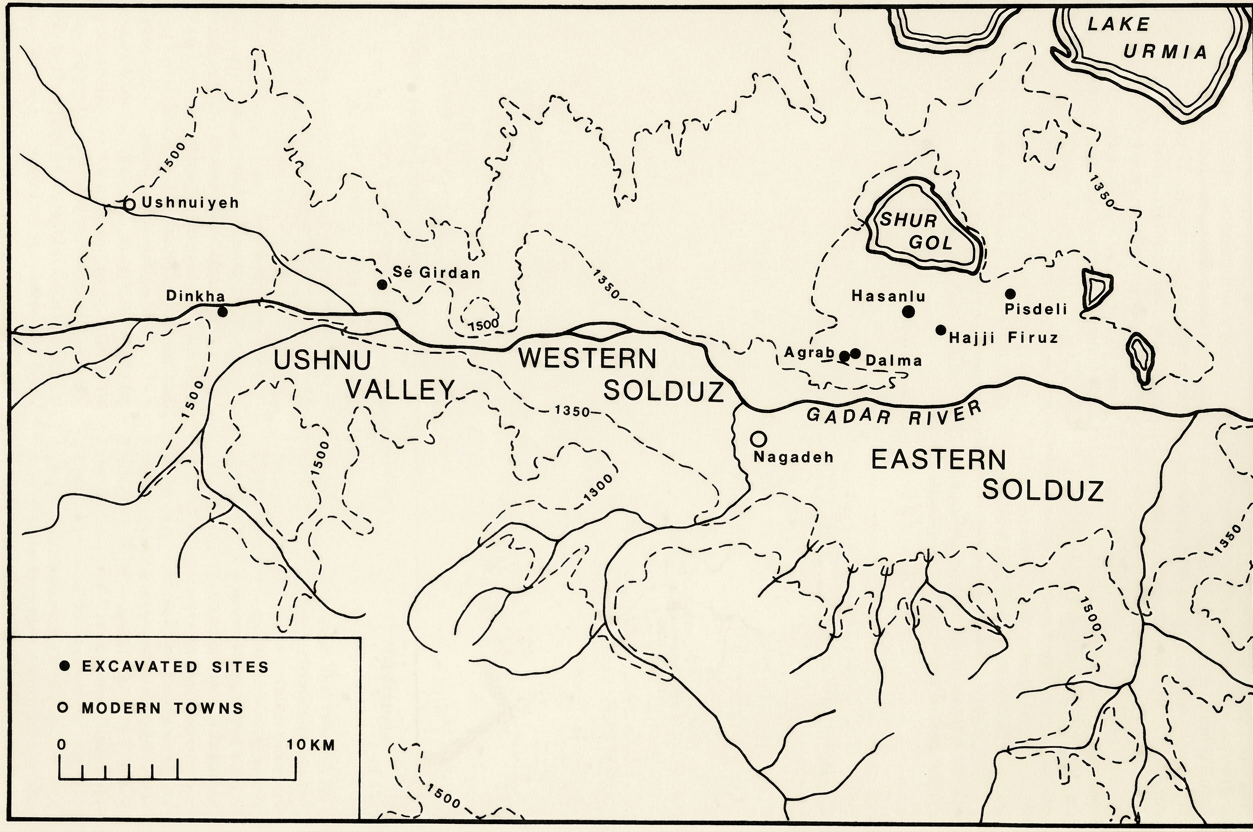
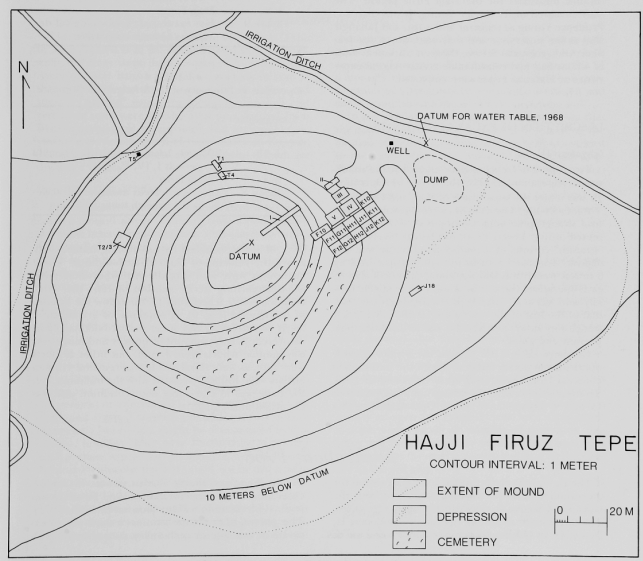
Hajji Firuz is in West Azerbaijan Province, northwestern Iran, in the Ushnu-Solduz (Ošnū-Solduz) valley, immediately south of Lake Urmia.
The site is at approximately 1,300–1,350 m above sea level. It lies in the valley of the Gadar River, which flows eastward toward the marshes at the southern end of Lake Urmia. Its geographical position is Lake Urmia basin, Gadar River valley, northwestern Zagros and Iran. The site is approximately 2 km southeast of Hasanlu Tepe, the much larger archaeological mound that later became famous for its Iron Age destruction.
Modern Naqadeh (Naghadeh) is only a few kilometres from Hasanlu; Hasanlu itself is about 3.5 km north of Naqadeh. So, in modern geographic terms, Hajji Firuz is roughly: Naqadeh → Hasanlu → Hajji Firuz in the southern Lake Urmia basin.
It was at the northwestern edge of the Zagros system
It is not a high mountain settlement like Ganj Dareh or Tepe Abdul Hosein. It lies on the relatively open Solduz valley floor, around 1,300 m elevation, surrounded by the mountains of northwestern Iran.
The valley was an important natural corridor. Routes from the region could lead: north toward the Lake Urmia basin; west through the Zagros toward northern Iraq; northwest toward eastern Anatolia; and, south toward other Iranian Zagros valleys. The site’s position therefore helps explain why it received obsidian and other non-local materials.
What river was beside the site?
The Gadar River. This is one of the clearest differences between Hajji Firuz and the Central Zagros sites we have just been discussing. The Gadar River still exists today. It rises in the Zagros near the Iran–Turkey–Iraq border region and runs through the Ushnu-Solduz valley before reaching marshes associated with Lake Urmia. The ancient inhabitants had access not only to the river itself but to a much more interesting hydrological landscape: permanent water; seasonally flooded ground; shallow groundwater; marshes; small lakes or wet depressions;
reed beds; and green summer vegetation. Voigt argued that these seasonally wet environments were probably one reason Neolithic settlers found the valley attractive. Its important point for understanding the agriculture. They did not necessarily need sophisticated irrigation canals. Instead, they could exploit: winter/spring precipitation + floodwater + high groundwater + seasonally wet soils.
What is the modern climate like?
The Solduz valley today has a continental climate: cold winters; substantial snowfall; warm, dry summers; and pronounced seasonal precipitation. But the Neolithic environment was not simply identical to today’s. Pollen records from Lake Urmia indicate major vegetation changes through the Holocene. Around 9,000–8,000 BP, forest-steppe expanded, and by roughly 7,000 BP vegetation was becoming more similar to the modern regional pattern.
Other palaeoenvironmental work suggests that the Early–Middle Holocene transition involved substantial changes in woodland, particularly the expansion of oak woodland, while earlier landscapes contained substantial Pistacia and other open woodland/steppe elements.
Climate at the time of Hajji Firuz
The most useful reconstruction is not “Hajji Firuz was much wetter than today.” It is more complicated. The wider northwestern Iranian landscape during the Neolithic appears to have been a mixture of: grassland, open woodland, wetland, seasonally flooded valley floor and mountain woodland. The archaeological environment was therefore capable of supporting both farming and herding. The Gadar valley was especially attractive because its wetlands could remain productive during the dry summer. That is an important architectural connection: The settlement’s location reduced the risk of relying exclusively on rainfall agriculture.
When was Hajji Firuz occupied?
This is one area where older publications and newer chronological schemes need to be distinguished.
The Hajji Firuz Neolithic sequence is generally placed in the late seventh/early sixth millennium BC, with the main excavated settlement belonging broadly to the first half of the sixth millennium BC.
A commonly used regional chronology places the Hajji Firuz period at approximately: 6100–5400 cal BC. While older summaries sometimes give approximately 7900–7500 BP.
The famous wine-bearing vessels are generally dated somewhat later within the sequence, around: 5400–5000 BC.
Older radiocarbon calibrations vary.
Hajji Firuz was not Pre-Pottery Neolithic?
This is an important distinction from Tepe Abdul Hosein, Ganj Dareh and other earlier Zagros sites. Hajji Firuz represents a Pottery Neolithic settlement. There is currently no securely demonstrated Pre-Pottery Neolithic settlement underneath it. In fact, one of the striking features of the region is that the archaeological evidence for permanent farming communities appears relatively late compared with the Central Zagros. Voigt argued that the Hajji Firuz settlers may have arrived in the region as already established farmers and herders.
What kind of pottery did they make?
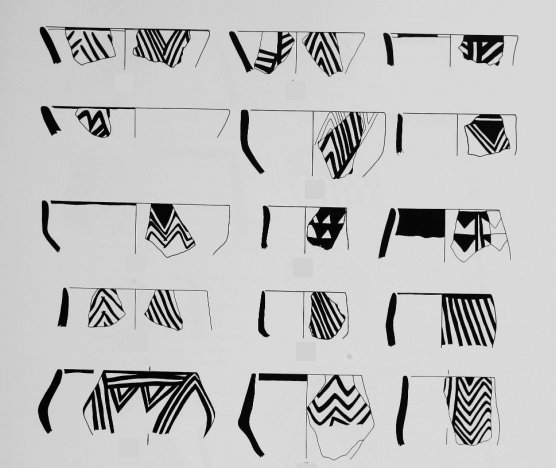
A great deal. Hajji Firuz pottery is: handmade; chaff/vegetable tempered; relatively low fired; generally buff, pink, orange or reddish; sometimes burnished; sometimes painted; and sometimes incised. The clay contains chopped grass/chaff and natural grit. Pottery was made using a sequential-slab technique, while some vessels show impressions suggesting basket moulds and reed mats were involved in manufacture. A fascinating from a construction perspective. The same community was using: clay, organic temper, plaster, mudbrick, baskets, reeds and timber across several different technologies.
What about wheat?
Yes—wheat was cultivated. The archaeobotanical assemblage includes: emmer wheat, bread wheat / hexaploid wheat, barley and lentil. The presence of bread wheat is especially interesting because it indicates that the agricultural system was not simply a primitive continuation of the earliest cereal domestication phase.

Barley?
Yes. Barley was an important cereal. Together, wheat and barley formed the principal cereal component of the agricultural economy. Large storage jars set into house floors were probably used for storing cereals and pulses.
Lentils and other legumes
Lentils and two types of wild pulses were recovered and may have been gathered rather than cultivated.
The agricultural package includes: emmer, bread wheat, barley, lentils and wild plant gathering.
Rye and other plants
The botanical assemblage also contained rye and knotgrass, interpreted as weeds associated with cereal cultivation.
Other wild plant remains included wetland and wild-pulse resources. This is particularly interesting because it provides evidence not only for what people deliberately cultivated but for the ecology of their fields.
There were pistachios, with an important qualification
The region naturally supported Pistacia, and chemical analysis of the famous wine vessels found evidence for a Pistacia/terebinth resin associated with the fermented beverage. This does not demonstrate that the inhabitants planted pistachio orchards. The safer interpretation is: wild Pistacia/terebinth was a locally available tree resource.
Grapes
Grapes are one of Hajji Firuz’s defining discoveries. The Gadar valley lies within the natural distribution zone of wild Eurasian grapevine (Vitis vinifera subsp. sylvestris). Six large jars were found embedded in the floor along a wall in what was interpreted as a kitchen area. Chemical analysis detected: tartaric acid/tartrate; associated organic acids; and resin. The interpretation is that the vessels contained grape wine treated with tree resin. The jars held roughly 9 litres each, giving the household a potential storage capacity of about 55 litres if all six were full.
Is this really the world’s oldest wine?
It has traditionally been described as the earliest convincing archaeological evidence for wine production, around 5400–5000 BC. There is now a caveat. The discovery of even earlier chemical evidence from Neolithic Georgia means the claim of “oldest wine” has become more complicated. Penn Museum research on Shulaveri/Shomutepe-related sites has produced evidence dating around 6000–5800 BC.
Hajji Firuz contains one of the earliest securely dated archaeological contexts interpreted as grape-wine production.
Sheep and goats
The economy included domesticated: sheep; and goats. The faunal evidence indicates that goat numbers were at least substantial, although the original sample was relatively small. This was not purely agricultural settlement. It was an agro-pastoral economy.
Pigs
Domestic pigs were present. Meadow’s analysis suggested that some pigs were being killed relatively young, consistent with a managed/domestic population. This is one of the interesting contrasts with some more mobile Zagros pastoral economies: pig husbandry strongly favors a relatively settled community.
Dogs
Domesticated dogs were present.
Hunting
Hunting continued alongside farming and herding. Wild animals included: red deer; aurochs; wild boar; hare; badger; and fox.
Birds and wetland animals were also exploited
Some evidence suggests hunting of large mammals remained important, even though the main food economy was increasingly based on domesticated plants and animals.
How were the houses designed?
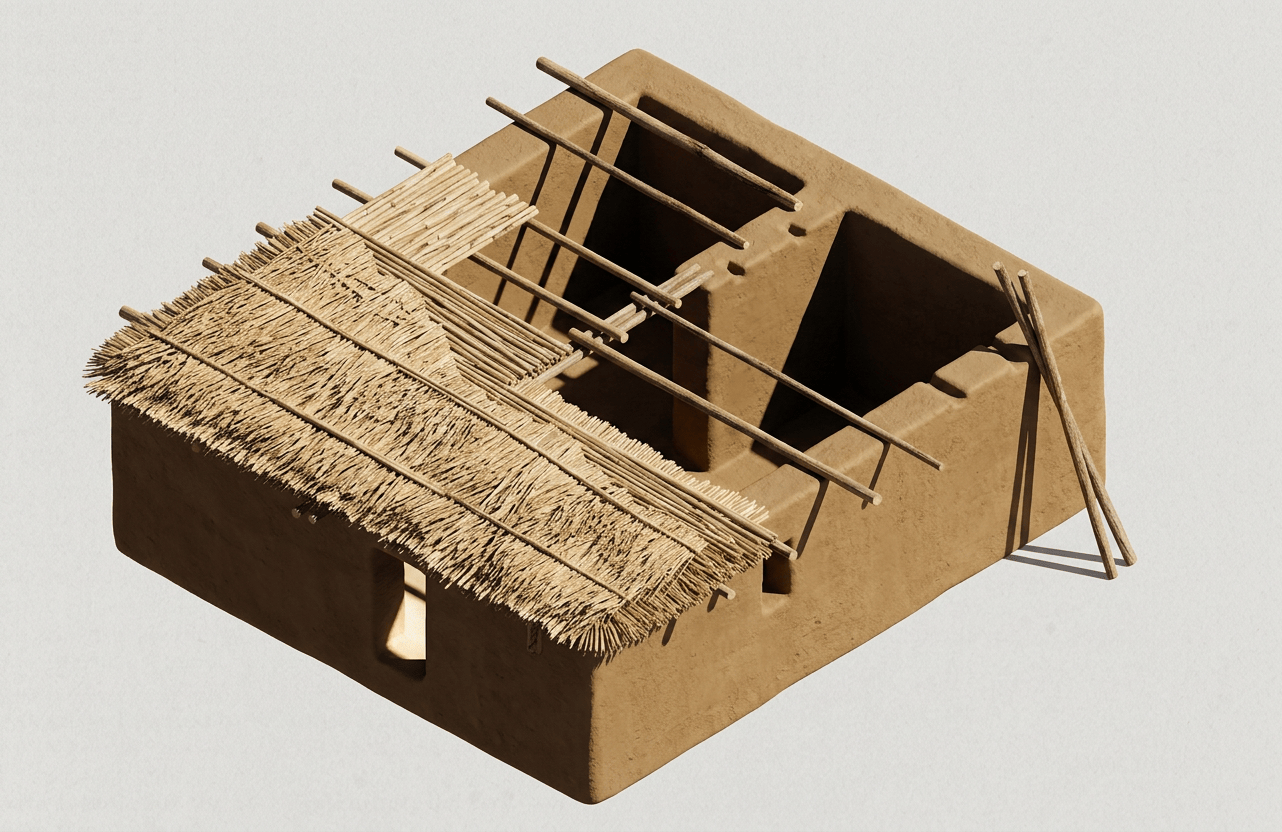
This is where Hajji Firuz becomes particularly valuable. The excavated settlement consisted primarily of small, freestanding rectangular mudbrick/pisé houses. Typical buildings were approximately: 6–7 m across and, were often: nearly square or rectangular with: one or two rooms; internal divisions; storage bins; ovens/hearths; plastered floors; and external open working areas. The buildings were not packed together like Çatalhöyük. There were open spaces between them.
A typical house
A useful simplified reconstruction is:
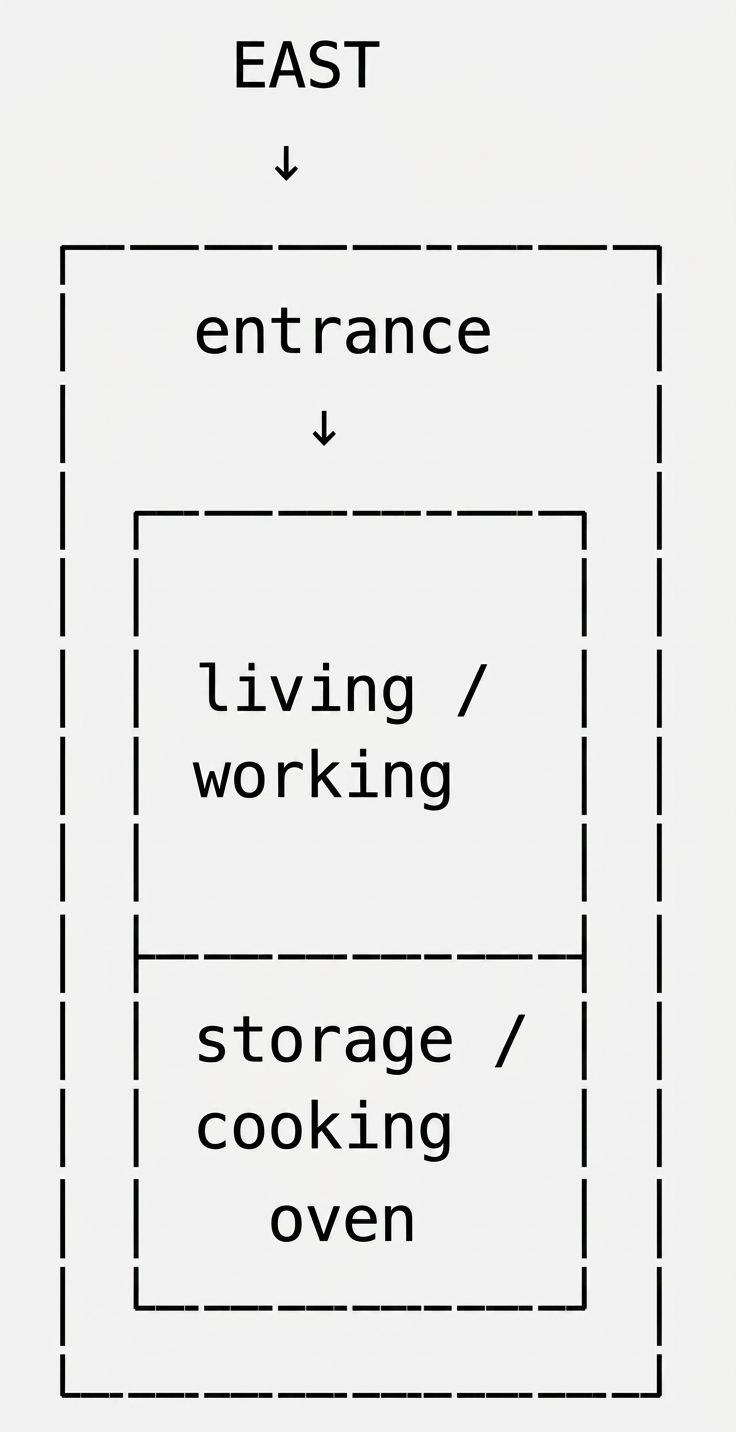
This is schematic rather than a reproduction of one individual house. (include pictures) The important point is that the household was the basic economic unit. Families controlled their own: food preparation; storage; and domestic production.
Doors
Yes—there is architectural evidence for entrances/doorways. The standard house arrangement generally placed entrances toward the eastern side in the reconstructed plans. Some buildings also had exterior wall extensions that may have acted as windbreaks or sheltered entrances. This is particularly interesting environmentally. An entrance protected by an exterior wall could reduce: winter wind; snow penetration; dust; and direct summer solar exposure. It is an example of passive environmental design without mechanical technology.
Roofs and woodwork
The buildings were constructed with earthen walls and timber roofs. The roofs probably used: wooden beams/poles; reeds or similar vegetal material; and, mud/straw covering. The archaeological evidence does not preserve complete wooden roofs, but the architecture requires some form of timber roof support.
Lime plaster and painted architecture
This is one of the more attractive aspects of Hajji Firuz. The buildings had carefully finished surfaces, including lime plaster, with traces of red and black paint. This means the houses were not simply piles of mudbrick. They were deliberately finished architectural spaces.
A likely sequence was: mudbrick wall, fine plaster, smoothing and pigment/paint. This is excellent evidence for the social importance of interior architecture.
Storage bins
Storage was integrated directly into the architecture. There were: plastered bins; large jars/pithoi; storage installations; and floor-set containers. Large jars embedded in floors were particularly useful for cereals and other stored food. This is a major architectural change from purely mobile food storage. The building itself became a food-storage technology.
Ovens and kitchens
Hajji Firuz had ovens and hearths within houses. The famous wine jars were found along a wall of a room interpreted as a kitchen. This is important because it suggests that food and drink processing was largely: household based. There was no evidence that the village was organized around a huge centralized food-processing facility.
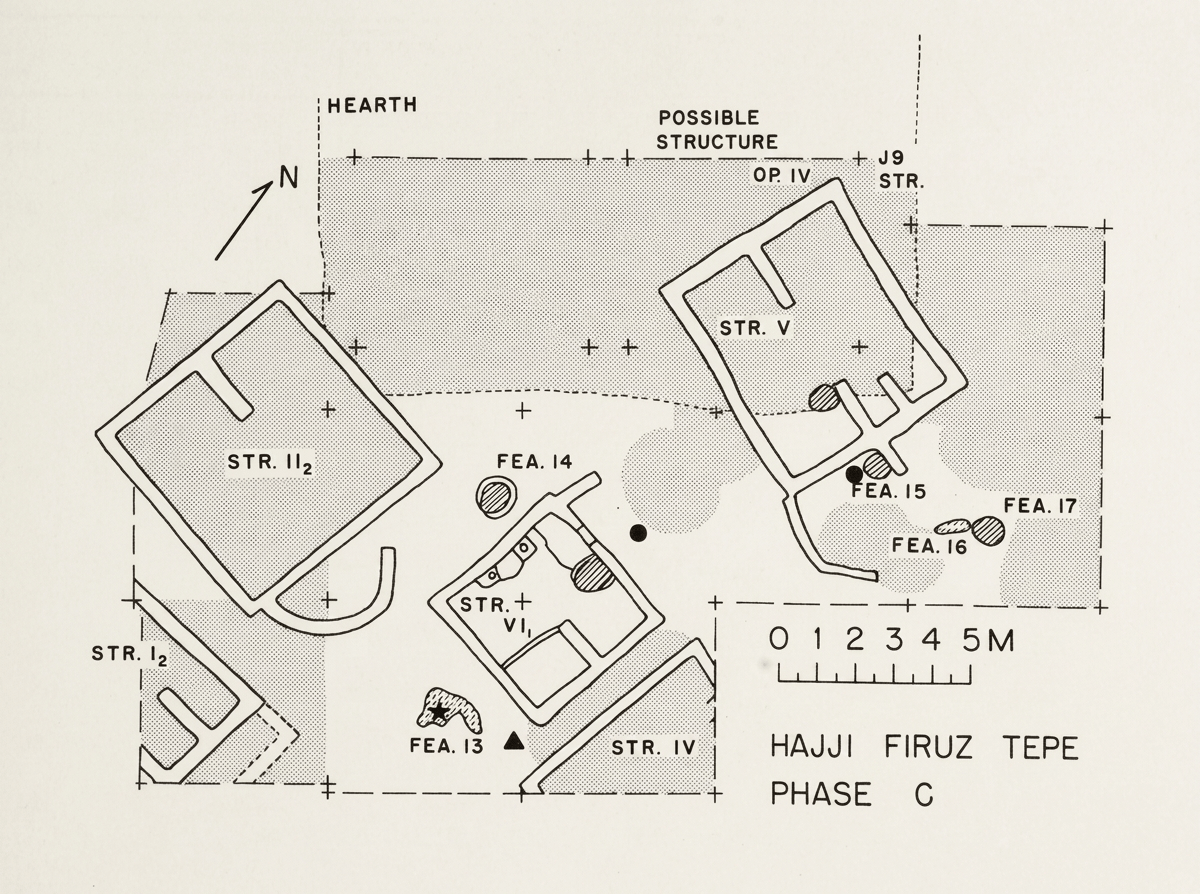
Was there a communal building?
No large communal/ritual building has been securely identified. This is actually one of the site’s most important characteristics. Hajji Firuz contrasts strongly with: Göbekli Tepe; Çayönü; and Nevali Çori. Ssome of the large communal buildings of the Levant.
The excavated settlement is dominated by small household units. A regional study specifically notes that Hajji Firuz lacked large-scale communal construction and appears to have maintained a household-centered organization. There were, however, shared activities in open areas and some communal production facilities.
Ritual activity
The ritual evidence is actually quite fascinating. Hajji Firuz produced: human burials beneath floors; secondary/ossuary burials; red ochre; clay figurines; clay tokens; unusual clay objects; and deliberately broken figurines. Voigt interpreted many of the figurines as having a ritual or magical role. So this was not a “purely utilitarian” farming village.
Burials inside houses
Yes. People were buried inside the settlement, frequently beneath floors. Some burials were: single individuals; children; multiple individuals; secondary burials; and, ossuaries. One ossuary contained the remains of at least four people. Some included animal bones and grave goods. This means the house was not merely a shelter. It could simultaneously function as: home + food store + workshop + burial place + ancestral space. That is a very important architectural concept.
The ossuary burials
Some of the most unusual burials involved secondary deposition of human bones. Red pigment/ochre was associated with some of them. This resembles a wider Neolithic phenomenon in which human remains were periodically: buried;
recovered; rearranged; and redeposited. The settlement therefore had a strong relationship between architecture and ancestry.
Figurines
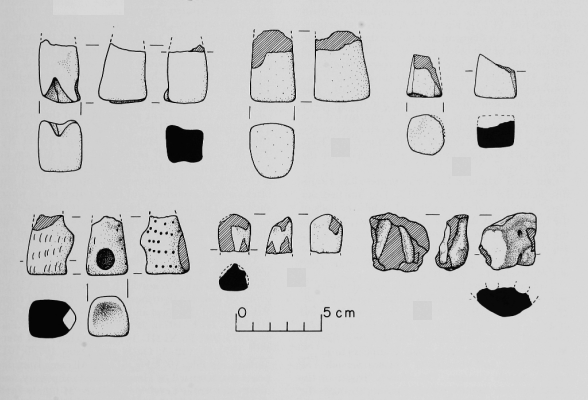
Hajji Firuz produced several categories of clay figurines/objects: human; animal; conical forms; and other geometric clay figures. Mary Voigt studied the figurines in detail. Their spatial distribution and deliberate breakage led her to argue that many had a ritual/magical function rather than simply being children’s toys.
Game pieces? One should be cautious
Clay tokens: definitely yes but game pieces: possible, not proven. Recent research emphasizes that the Hajji Firuz tokens could have had multiple functions: counting; symbolic use; ritual/talismanic use; and possibly games. Several were deliberately placed with burials or between floors.
Clay sealings
Another remarkable discovery is 14 clay sealings, although they do not carry recognizable seal impressions. Some appear to have been pressed against: reeds; flat surfaces; pots; and cylindrical/angular objects. This is extremely interesting in the history of information technology. It is not writing. But it represents experimentation with: clay + marking + closure + identification centuries before writing systems.
Obsidian
Yes—and quite a lot. Hajji Firuz is an important obsidian site.
One study reports approximately 100 obsidian pieces, with obsidian slightly outnumbering flint by count and representing about 34% of the lithic assemblage by weight in Voigt’s analysis.
Another recent synthesis reports 234 obsidian pieces among 438 stone tools in the analysed assemblage.
The discrepancy reflects differences in what is counted and which collections are included. The important conclusion is: Obsidian was a major component of the Hajji Firuz stone-tool economy.
Where did the obsidian come from?
The older analyses assigned Hajji Firuz obsidian to sources around the Lake Van/eastern Anatolian–Armenian region. Three pieces originally classified as “Group 3c” have subsequently been associated with Sevkar/Syunik in southeastern Armenia. Other research continues to refine the sourcing.
Obsidian came through long-distance exchange networks involving eastern Anatolia and the Armenian highlands.
Flint/chert
Local stone was also used. The community made chipped-stone tools from locally available raw materials, while imported obsidian supplied a significant portion of the cutting-tool assemblage.
Some of the stone materials give us a very useful Neolithic economic model: local raw materials → everyday tools; and, long-distance obsidian → selected high-performance cutting tools. It is a similar to the pattern seen at many Neolithic sites across the Fertile Crescent.
Weapons
There is no evidence for a specialized military industry. But hunting weapons and cutting tools were certainly present. Chipped-stone assemblage included: blades; flakes; points; and sickle elements. Obsidian blades could also have been used as exceptionally sharp cutting/sickle inserts.
Other unique objects
Hajji Firuz produced an unusually broad collection of small objects: spindle whorls; grinding stones; pounders; stone tools; bone tools; shell objects; clay tokens; clay figurines; sealings; obsidian blades; beads and, pottery. Some cowrie-shell beads are particularly interesting because their source may lie far outside the immediate region.
Textile production
The presence of spindle whorls indicates spinning. This suggests that the household economy included textile production, probably using: wool; animal hair; and plant fibres. The combination of sheep/goat husbandry and spindle whorls is especially suggestive of household textile production.
Again, was there a ritual building?
No. But there is an important distinction. No monumental communal building, does not mean no ritual activity. Instead, ritual appears to have been embedded in ordinary houses. Evidence includes: burials beneath floors; ossuaries; ochre; tokens; figurines; deliberate breakage; and unusual clay deposits. This suggests that ritual was household-based rather than monument-based.
Yes the settlement was abandoned but the sequence is complicated
The Neolithic Hajji Firuz occupation eventually ended. There appears to have been a gap after the Hajji Firuz phase, followed by later settlement associated with the Dalma period. The site subsequently saw additional occupations, including: later Chalcolithic; Bronze Age/Iron Age; and Islamic-period activity. The Neolithic village was abandoned, the site later returned to use, and the mound accumulated occupations over thousands of years.
How many times was it occupied?
The Neolithic settlement itself is divided into a long sequence of architectural phases. Thirteen architectural phases have been distinguished in the Neolithic sequence, while the major excavated deposits are conventionally divided into phases L through A, with some subdivided further. 13 phases” does not mean 13 separate villages. It means repeated rebuilding/occupation episodes within the Neolithic settlement. The village was repeatedly: built, used, modified, rebuilt and resurfaced over many generations.
Was there a major fire?
There are burnt installations and ash-filled pits, but Hajji Firuz should not be treated like a site such as Hasanlu, where catastrophic destruction preserved an entire city. The evidence instead suggests ordinary household maintenance, rebuilding and localized burning.
Architecture as a system
Hajji Firuz is particularly valuable because it represents an integrated low-energy building system: Local earth. mudbrick/pisé walls; Local clay. plaster; Reeds/grass. temper + roofing/basketry; Local timber. roof structure; Wetland. Water, reeds, grazing and fertile soils; Cereal agriculture. Food and straw/chaff; Sheep/goats. Meat, milk, wool/hair. Pottery. Storage, cooking and fermentation; and, Obsidian. Exceptionally sharp cutting tools.
That is almost a complete Neolithic “building ecosystem.”
Thermal architecture
Although there are no modern thermal simulations of Hajji Firuz that allow us to give a defensible U-value, the architecture has obvious passive-performance characteristics: earthen walls: thermal mass; small rooms: easier heating; limited openings: reduced heat loss; partly protected entrances: wind control; lime/mud plaster: air-tightness and surface protection; earthen floors: thermal inertia; and seasonally wet valley: access to water without complex infrastructure. So Hajji Firuz could make an excellent case study for “10,000 Years of Passive Thermal Design: What Neolithic Buildings Can Teach Modern Construction.”
Hajji Firuz in the wider Fertile Crescent
Hajji Firuz sits at a fascinating intersection: Upper Mesopotamia, Lake Urmia / Caucasus, Northern Zagros and Central Zagros. Its pottery has similarities with Hassuna-related traditions in northern Mesopotamia, while the obsidian and other materials demonstrate connections northward toward eastern Anatolia and Armenia. It is therefore not an isolated Iranian village. It was part of a large interregional exchange network.
The big story
Hajji Firuz represents a somewhat different solution to the Neolithic problem than the earlier Central Zagros sites. The community had already inherited a substantial agricultural package: wheat, barley, lentils, sheep, goats, pigs, dogs and then built a settlement around it. They used: mudbrick, plaster, timber, reed, pottery, storage and wetland resources. They traded for: obsidian and participated in wider networks extending toward: Anatolia + Armenia + Mesopotamia + the Zagros. And within the houses they: cooked, stored grain, spun fibre, made tools, made figurines, buried their dead and apparently fermented grape wine. That makes Hajji Firuz an unusually complete example of a small, household-centered Neolithic village.
References: Voigt, M. M. (1983). Hajji Firuz Tepe, Iran: The Neolithic Settlement. Hasanlu Excavation Reports I, University Museum Monograph 50. Philadelphia: University Museum, University of Pennsylvania.
Penn Museum — Hajji Firuz Tepe, Iran: The Neolithic Settlement
Meadow, R. H. (1983). “The Vertebrate Faunal Remains from Hasanlu Period X at Hajji Firuz.” In Voigt, Hajji Firuz Tepe.
Vandiver, P. B. Research on sequential-slab pottery construction and the technological history of Near Eastern ceramics, including Hajji Firuz.
McGovern, P. E., et al. (1996). Chemical analysis of residues from Hajji Firuz vessels, providing the classic evidence for Neolithic grape wine. The interpretation has subsequently been discussed in the broader literature on early wine.
Barge, O., et al. (2018). “Diffusion of Anatolian and Caucasian obsidian in the Zagros Mountains and the highlands of Iran.” Quaternary International, 467, 297–322.
Orange, M., et al. (2021). “Extending the scale of obsidian studies: Towards a high-resolution investigation of obsidian prehistoric circulation patterns in the southern Caucasus and north-western Iran.” Archaeometry, 63, 923–940.
Voigt, M. M. “Ceramics II: The Neolithic Period in Northwestern Persia.” Encyclopaedia Iranica.
Hole, F. Regional chronology and environmental interpretation of the Iranian Neolithic. The older calibrated chronology places Hajji Firuz broadly in the sixth millennium BC.
Bottema, S. (1986). “A late Quaternary pollen diagram from Lake Urmia (Northwestern Iran).” Review of Palaeobotany and Palynology, 47, 241–261.
Djamali, M. et al. (2008). Long-term pollen evidence from Lake Urmia documenting the transition from steppe/forest-steppe toward Holocene woodland environments.
Matthews, R., et al. Recent research on information systems, tokens and sealings in prehistoric Iran is particularly useful for interpreting Hajji Firuz’s clay tokens and sealings.
The Metropolitan Museum — Neolithic Hajji Firuz pottery
Leave a Reply