< home # store # services # articles # game # app #contact >


The Gravettians were skilled hunters and gatherers who relied on a variety of food sources, including large game animals like mammoths, reindeer, and bison. They also exploited other resources, such as fish, birds, and plant materials. Evidence suggests that they lived in small groups or mobile bands and likely had a nomadic lifestyle, following the seasonal movements of game animals.


During this period. The megafauna were still around and the climate was different. Gravettians thrived on their ability to hunt animals
Through lithic reduction they utilized a variety of tools such as blades and bladelets. Made from stone, and other materials such as bone, antler and ivory. They utilized special hunting strategies. Compared to Neanderthals and earlier humans. Gravettian hunters appear to be more complex and mobile. They lived in caves, semi-subterranean areas, or both. Typically arranged in small “villages”. Gravettian rounded dwellings were even found.
Gravettians were adaptable, it is thought that they may have innovated tools and technology Such as blunted-back knives, tanged arrowheads and boomerangs. (1) Other developments included the use of woven nets and oil lamps made of stone. (2) The small pointed blade with stright blunt back is known today as the Gravette point. (2)


Gravettian Range
Gravettian culture extended across a large geographic region. Scientists usually divide two areas of Gravettians. West Europe; and, central, eastern Europe and Russia. During this time, the west of Europe was extremely cold. The west Gravettians became mostly known from cave sites in France, Spain and Britain. While the eastern Gravettian in Russia, were more known as specialized mammoth hunters. (1) There remains were not necessarily found in caves, but open air sites.


Surviving Gravettian art includes numerous cave paintings and small, portable Venus figurines made from clay or ivory, as well as jewellery objects
They created figurines and engraved objects, often depicting animals such as mammoths, horses, and lions. These artworks were typically made from bone, ivory; or limestone and showcase a high level of artistic skill.

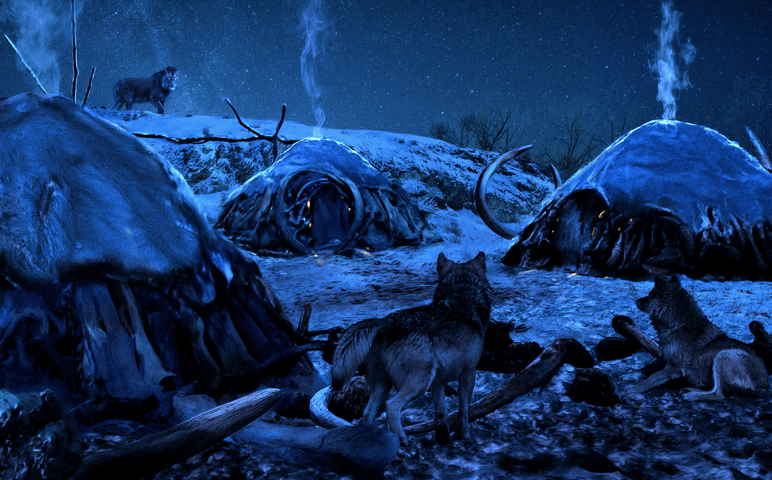
Present day Moravia is suggested as a closely related Gravettian era landscape
For example, animals remains demonstrate both decorative and utilitarian purposes. Bones and hides were used for shelters here. Fox teeth were used for decoration, and horse ribs and others for pelt preparation and other tools. Like pointers, knives, arrow points and fish hooks.
Diet
During this period. Animals were a primary food source. (4) Because of the cooler temperatures. Humans preferred food sources high in energy, and fat content. Picture prehistoric beef jerky. The more north you went, studies on dietary remains reveal greater emphasis on meat. Versus neanderthals, who went extinct around 28,000 years ago. Gravettians developed the technology and societal organization that enabled them to migrate more successfully with food. (5)
Hunting
Gravettians were smart hunters, evidence suggests they following the seasonal movements of game animals. They tended to settle near valleys where prey mingled and migrated. Like Klithi in Greece. It allowed them to travel less distances. Specifically, another site, La Gala, in southern Italy. While the temperature from nearby hills and mountains was cooling, deer were forced in. (6) Thereby allowing the crews and groups their big catch.
Discoveries also include a prehistoric trapping net. In the Czech Republic. A 4 mm (0.16 in) thick rope was preserved on clay imprints. (7) Weaving of the nets must have been a community task. Relying on the work of both women, men and families.
Move with the herds; and, characteristics of hides
Diets incorporated a huge variety of animal prey. The main factors were animal’s age and size. For example, for common animals such as deer. One year olds were more suitable for clothing, while older ones contained more meat. (8) Dietary analysis also showed larger animals such as hyenas, wolves, reindeer, and mammoth were ate.
It has even been show, foxes, hares and smaller mammals were caught with nets. (7) The time period must have emphasized large meat consumption. Agriculture had not been fully documents or introduced. And, especially in the winter and cooler season, when areas and climate was not yet favourable. (4)


Sea food
Coastal Gravettians were able to avail of marine protein. From remains found in Italy and Wales, carbon dating revealed that 20-30% of Gravettian diets consisted of sea animals. (9) Populations of lower latitudes relied more on shellfish and fish while higher latitudes’ diets consisted of seals. (10)


Physical type
Physical remains of people of the Gravettian have revealed that males were tall, relatively slender people with high cheekbones. The male height of the Gravettian culture burial at Sungir, Russia, was around 6 feet and 150lbs. Females were shorter, around 5 foot 2 and 119 lb.
During the post glacial period (about 22,000 years ago), evidence of the culture begins to disappear. Except for areas around the Mediterranean. Where some elements lasted until c. 17,000 BP. (11) In Spain and France, Gravettian was succeeded by Solutrean. In Italy, the Balkans, Ukraine; (12) and Russia (13). The culture developed into the Epigravettian.
Suggesting a belief in the afterlife. The culture is also associated with the development of some early forms of ritual and burial practices. (9) Burial sites have been found. The deceased were often laid to rest with grave goods, such as tools, ornaments, and animal remains.
Overall, the Gravettian culture represents an important phase in human prehistory. Characterized by significant advancements in tool technology, artistic expression, and social complexity. It provides valuable insights into the lives and behaviors of early modern humans in Europe and Russia during the proto-neolithic and upper Paleolithic period(s).
Cite:
1) Kipfer, Barbara Ann. “Encyclopedic Dictionary of Archaeology”. Kluwer Academic/Plenum Publishers, 2000. Pg. 216. ISBN 978-0-3064-6158-3
2) Bains, Gurnek. “Cultural DNA: The Psychology of Globalization”. John Wiley & Sons, 2015. Pg. ISBN 978-1-1189-2891-2
3) Ehrich, Robert W.; Pleslová-Štiková, Emilie. “Aurignacian Lithic Economy: Ecological
Perspectives from Southwestern France”. Academia, 1968. pp. 37-41
4) Schulting, R.J., Trinkaus, E., Higham, T., Hedges, R., Richards, M. & Cardy, B. (1997). “A mid-upper Palaeolithic human humerus from eel point, south Wales, UK”. Journal of HumanEvolution. 48 (5): 493–505. doi:10.1016/j.jhevol.2005.02.001 (https://doi.org/10.1016%2Fj.jhevol.2005.02.001). PMID 15857652 (https://pubmed.ncbi.nlm.nih.gov/15857652).
5) Holden, C. (2004). “Neandertals and Climate”. Science. 303 (5659): 759.
doi:10.1126/science.303.5659.759a (https://doi.org/10.1126%2Fscience.303.5659.759a).
S2CID 220102720 (https://api.semanticscholar.org/CorpusID:220102720)
6) Mussi, M. (2001). Earliest Italy: An Overview of the Italian Paleolithic and Mesolithic (https://archive.org/details/earliestitalyove00muss). Kluwer Academic/Plenum Publishers. pp. 250 (https://archive.org/details/earliestitalyove00muss/page/n268)–252
7) Pringle, H (1997). “Ice Age Communities May Be Earliest Known Net Hunters”. Science. 277 (5330): 1203–1204. doi:10.1126/science.277.5330.1203 (https://doi.org/10.1126%2Fscience.27 7.5330.1203). S2CID 128873468 (https://api.semanticscholar.org/CorpusID:128873468)
8) Bogucki, P. (1999). The Origins of Human Society. Oxford: Blackwell Publications inc. p. 95
9) Pettitt, P.B.; et al. (2003). “The Gravettian burial known as the Prince (“Il Principe”): new evidence for his age and diet” (https://www.cambridge.org/core/services/aop-cambridge-core/content/view/F762F2C33F994E69A4780AD7AF2DEFE7/S0003598X00061305a.pdf/gravettian_burial_known_as_the_prince_il_principe_new_evidence_for_his_age_and_diet.pdf) (PDF). Antiquity. 77 (295): 15. doi:10.1017/S0003598X00061305 (https://doi.org/10.1017%2FS000359
8X00061305). S2CID 38461013 (https://api.semanticscholar.org/CorpusID:38461013)
10) Jacobi, R., Richards, M., Cook, J., Pettitt, P.B. & Stringer, C.B. (2005). “Isotope evidence for the intensive use of marine foods by Late Upper Palaeolithic humans”. Journal of Human Evolution. Max Planck Institute for Evolutionary Anthropology. 49 (3): 390–394.
doi:10.1016/j.jhevol.2005.05.002 (https://doi.org/10.1016%2Fj.jhevol.2005.05.002).
PMID 15975629 (https://pubmed.ncbi.nlm.nih.gov/15975629)
11) Pesesse, Damien (2013). “Le Gravettien existe-t-il? Le prisme du système technique lithique” [Does the Gravettian exist? The prism of the lithic technical system]. In Marcel Otte (ed.). Les Gravettiens. Civilisations et cultures (in French). Paris: Éditions errance. pp. 66–104. ISBN 978-2877725095. “D’ailleurs selon les auteurs et les thèmes abordés, la définition et donc les contours du Gravettien variant, parfois considérablement. Tantôt certains ensembles de la plaine russe seront intégrés sur la base des témoignages funéraires, tantôt les statuettes
féminines serviront d’argument pour annexer les rives du lac Baïkal à cette supra-entité. De même, le Gravettien débuterait vers 31,000 BP ou 27,000 BP selon les régions pour finir parfois à 22,000 BP, parfois à 17,000 BP. Ce ne sont pas là de menues différences. [Besides, depending on the authors and the subjects at hand, the definition and therefore the borders of the Gravettian vary, sometimes considerably. Sometimes, certain assemblages of the Russian plains are integrated on the basis of funerary customs, other times feminine statuettes are used to annex the shores of Lake Baikal to this supra-entity. Likewise, the Gravettian would start around 31,000 or 27,000 BP depending on the region and finish sometimes at 22,000 BP, sometimes at 17,000 BP. These are not small differences.]”
12) Marquer, L.; Lebreton, V.; Otto, T.; Valladas, H.; Haesaerts, P.; Messager, E.; Nuzhnyi, D.; Péan,
S. (2012). “Charcoal scarcity in Epigravettian settlements with mammoth bone dwellings: The taphonomic evidence from Mezhyrich (Ukraine)”. Journal of Archaeological Science. 39 (1):109–20. doi:10.1016/j.jas.2011.09.008 (https://doi.org/10.1016%2Fj.jas.2011.09.008)
13) Germonpré, Mietje; Sablin, Mikhail; Khlopachev, Gennady Adolfovich; Grigorieva, Galina Vasilievna (2008). “Possible evidence of mammoth hunting during the Epigravettian at
Yudinovo, Russian Plain”. Journal of Anthropological Archaeology. 27 (4): 475–92.
doi:10.1016/j.jaa.2008.07.003 (https://doi.org/10.1016%2Fj.jaa.2008.07.003)
Bibliography:
Marquer, L.; Lebreton, V.; Otto, T.; Valladas, H.; Haesaerts, P.; Messager, E.; Nuzhnyi, D.; Péan, S. (2012). “Charcoal scarcity in Epigravettian settlements with mammoth bone dwellings: The taphonomic evidence from Mezhyrich (Ukraine)”. Journal of Archaeological Science. 39 (1):109–20. doi:10.1016/j.jas.2011.09.008 (https://doi.org/10.1016%2Fj.jas.2011.09.008).
Germonpré, Mietje; Sablin, Mikhail; Khlopachev, Gennady Adolfovich; Grigorieva, Galina Vasilievna (2008). “Possible evidence of mammoth hunting during the Epigravettian at Yudinovo, Russian Plain”. Journal of Anthropological Archaeology. 27 (4): 475–92.doi:10.1016/j.jaa.2008.07.003 (https://doi.org/10.1016%2Fj.jaa.2008.07.003).
Renfrew, Colin. “Death Rituals, Social Order and the Archaeology of Immortality in the Ancient
World: ‘Death Shall Have No Dominion’”. Cambridge University Press, 2018. p. 58.
ISBN 978-1-1070-8273-1
Marks, Anthony E., Bicho, Nuno, Zilhao, Joao, Ferring, C. R. (1994). “Upper Pleistocene Prehistory in Portuguese Estremadura: Results of Preliminary Research”. Journal of Field Archaeology. 21 (1): 53–68. doi:10.2307/530244 (https://doi.org/10.2307%2F530244.JSTOR) 530244 (https://www.jstor.org/stable/530244).
De Laet, S.J. “History of Humanity: Prehistory and the beginnings of civilization”. United Nations Educational Scientific and Cultura, 1994. p. 212. ISBN 978-9-2310-2810-6
Renfrew, Colin. “Death Rituals, Social Order and the Archaeology of Immortality in the Ancient World: ‘Death Shall Have No Dominion’”. Cambridge University Press, 2018. p. 58. ISBN 978-1-1070-8273-1
Holden, C. (2004). “Neandertals and Climate”. Science. 303 (5659): 759. doi:10.1126/science.303.5659.759a (https://doi.org/10.1126%2Fscience.303.5659.759a).
S2CID 220102720 (https://api.semanticscholar.org/CorpusID:220102720).
Jacobi, R., Richards, M., Cook, J., Pettitt, P.B. & Stringer, C.B. (2005). “Isotope evidence for the intensive use of marine foods by Late Upper Palaeolithic humans”. Journal of Human Evolution. Max Planck Institute for Evolutionary Anthropology. 49 (3): 390–394. doi:10.1016/j.jhevol.2005.05.002 (https://doi.org/10.1016%2Fj.jhevol.2005.05.002). PMID 15975629 (https://pubmed.ncbi.nlm.nih.gov/15975629).
Holt, Brigitte M.; Formicola, Vincenzo (2008). “Hunters of the Ice Age: The biology of Upper Paleolithic people” (https://doi.org/10.1002%2Fajpa.20950). American Journal of Physical Anthropology. Suppl 47: 70–99. doi:10.1002/ajpa.20950 (https://doi.org/10.1002%2Fajpa.20950). ISSN 1096-8644 (https://www.worldcat.org/issn/1096-8644). PMID 19003886 (https://pubmed.ncbi.nlm.nih.gov/19003886).
Hermanussen, Michael (July 2003). “Stature of early Europeans” (https://doi.org/10.14310%2Fhorm.2002.1199). Hormones. 2 (3): 175–178. doi:10.14310/horm.2002.1199 (https://doi.org/10.14310%2Fhorm.2002.1199). ISSN 1109-3099 (https://www.worldcat.org/issn/1109-3099.PMID) 17003019 (https://pubmed.ncbi.nlm.nih.gov/17003019).
Holt, Brigitte M.; Formicola, Vincenzo (2008). “Hunters of the Ice Age: The biology of Upper Paleolithic people” (https://doi.org/10.1002%2Fajpa.20950). American Journal of Physical Anthropology. 137 (S47): 70–99. doi:10.1002/ajpa.20950 (https://doi.org/10.1002%2Fajpa.20950). ISSN 1096-8644 (https://www.worldcat.org/issn/1096-8644). PMID 19003886 (https://pubmed.ncbi.nlm.nih.gov/19003886).
Straus, L.G. (1993). “Upper Paleolithic Hunting Tactics and Weapons in Western Europe”. Archeological Papers of the American Anthropological Association. University of New Mexico. 4(1): 83–93. doi:10.1525/ap3a.1993.4.1.83 (https://doi.org/10.1525%2Fap3a.1993.4.1.83).
Earliest Italy: An Overview of the Italian Paleolithic and Mesolithic (https://archive.org/details/earliestitalyove00muss). Kluwer Academic/Plenum Publishers. pp. 250 (https://archive.org/details/earliestitalyove00muss/page/n268)–252.
Nývltová-Fisáková, M. (2005). “Animal bones selected for tools and decorations”. In J. Svoboda(ed.). Pavlov I southeast: A window into the gravettian lifestyles. Brno, Czech Republic: Academy of the Sciences of the Czech Republic, Institute of Archaeology. pp. 247–251.
Cave sites in France (https://web.archive.org/web/20061116070957/http://www.culture.gouv.fr/culture
Leave a Reply