< home # store # services # articles # game # app #contact >


Goseck Circle is an archaeological site located in Goseck, Germany. It is a neolithic structure that consists of a circular enclosure made up of concentric ditches and banks, with a diameter of about 75 meters (246 feet).
The site dates back to approximately 4,900 BCE, making it one of the oldest known solar observatories in the world
The Goseck Circle was discovered in 1991. Along with others in central Europe during an aerial survey. It was subsequently excavated. The structure’s purpose is believed to have been related to astronomical observations and the tracking of celestial events. Particularly the winter and summer solstices.
The entrance to the enclosure aligns with the sunrise during the winter solstice, while two wooden palisades inside the circle align with the sunrise and sunset during the equinoxes


A circular v-shaped moat of up to 1.8 m depth surrounds the site. Its soil was used to create a rampart on the outside
Gating the way, a perimeter was created to keep others out.
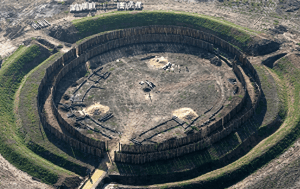

Inside, double wooden palisades stand
Entry is in symmetry to the north, southwest, and southeast.
No traces of internal buildings were ever found
One thing is for sure. Its large circular oak walls and ditches stood strong and tall.
In addition, there were small gaps in the palisades allowing viewing or access.
The moat followed the three main entries outward (see diagram). The entrances in the inner palisade were narrower than those in the outer, which in turn, were narrower than the gap in the moat.
The circle is considered a significant archaeological find because it provides evidence of advanced astronomical knowledge, and complex architectural planning during the neolithic period.
It suggests that the people who built the site had a sophisticated understanding of celestial movements
And, that they likely placed great importance on celestial events, in their cultural and religious practices.
The site has no signs of fire or other destruction. Why it was abandoned, is unknown.
Today, Goseck Circle is open to visitors in Goseck, Germany. A sense of journey to its original neolithic form. The site has become a popular tourist attraction and serves as an educational site for learning about ancient astronomy and the cultural practices of the Neolithic people. Check it out with some more neolithic architecture today.
Bibliography: Literski-Henkel, Norma (February 2017). “Das “Sonnenobservatorium” von Goseck” (https://www.aid-magazin.de/nc/zeitschrift/einzelhefte-archiv/jahrgang-2017/heft-12017/denkmal/denkmal-himmelswege-ins-neolithikum.html) [The “solar observatory” of Goseck]
Archäologie in Deutschland (in German). Stuttgart, Germany: Konrad Theiss (WissenschaftlicheBuchgesellschaft). pp. 70–71. ISSN 0176-8522 (https://www.worldcat.org/issn/0176-8522)
Leave a Reply